Bringing ASPICE to Semiconductor Development: Challenges and Practical Strategies
As semiconductor companies expand into automotive, adopting Automotive SPICE is no longer optional — it’s a prerequisite to engage with…
Bringing ASPICE to Semiconductor Development: Challenges and Practical Strategies

As semiconductor companies expand into automotive, adopting Automotive SPICE is no longer optional — it’s a prerequisite to engage with OEMs and Tier-1 suppliers.
But here’s the reality:
ASPICE was not originally designed with semiconductor development in mind.
And this is where the real challenge begins.
Why ASPICE Is Hard for Chip Companies
1. Hardware/Software Co-Development
In automotive ECUs, software is often the dominant element. In semiconductors, especially RF or mixed-signal devices, hardware defines system behavior.
Yet ASPICE processes are heavily structured around software lifecycle models.
This creates tension:
- Hardware evolves through iterations and characterization
- Software expects stable, versioned interfaces
👉 Result: misalignment between silicon maturity and software expectations
2. Long and Non-Linear Validation Cycles
Unlike software, silicon cannot be patched easily.
Validation involves:
- Prototyping (A-samples, B-samples…)
- Lab characterization across temperature, voltage, process corners
- Long-term reliability testing
This doesn’t map cleanly to a classical V-cycle.
👉 Evidence for ASPICE compliance becomes fragmented and difficult to structure.
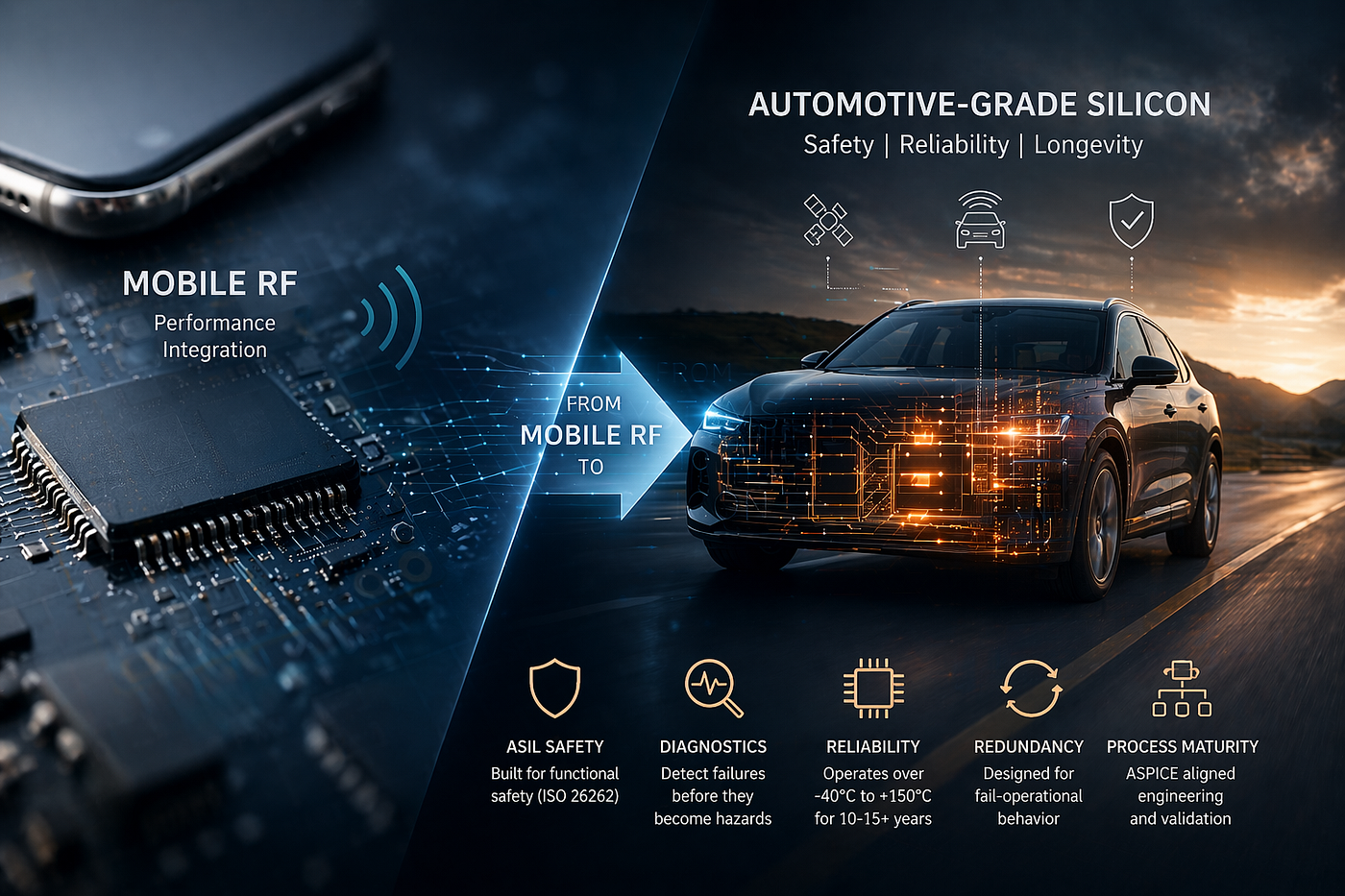
The Gap: Transitioning from Mobile to Automotive
For companies coming from consumer markets, the biggest challenges are not technical — they are systemic.
Documentation Culture
In mobile:
- Fast iterations
- Minimal formal documentation
- Knowledge often implicit
In automotive:
- Every requirement must be documented
- Every test must be traceable
- Every decision must be justified
Traceability
ASPICE requires:
Bidirectional traceability from system requirements down to implementation and validation.
For semiconductors, this raises difficult questions:
- How do you trace a system-level safety requirement to an analog circuit behavior?
- How do you link RF performance metrics to vehicle-level use cases?
👉 This is where many organizations struggle at ASPICE Level 1.
From Compliance to Value: Practical Strategies
Achieving ASPICE maturity is not about adding process overhead. It’s about making engineering decisions explicit, traceable, and verifiable.
1. Requirements Engineering for Mixed-Signal Systems
A key step is to rethink how requirements are defined.
Instead of:
- Pure electrical specs (gain, noise figure, efficiency)
Move toward:
- System-oriented requirements, such as:
- Signal integrity under defined environmental conditions
- Detectability of degraded modes
- Diagnostic coverage expectations
👉 This creates a bridge between system safety and silicon design.
2. Linking Silicon Validation to System Requirements
Validation should not stop at “specification compliance.”
It should answer:
Does this silicon behave correctly in real automotive scenarios?
Concrete improvements:
- Map lab tests to system-level use cases
- Include degradation and corner cases in validation plans
- Structure validation results for traceability
Example: Instead of validating LNA gain only at nominal conditions:
- Validate across aging scenarios
- Link results to communication reliability requirements
3. Structuring Evidence for ASPICE
One common pain point is not the work itself — but how it is captured and presented.
Key practices:
- Define clear work products aligned with ASPICE expectations
- Use consistent requirement IDs across teams
- Automate traceability where possible
👉 The goal is to transform implicit engineering knowledge into auditable artifacts.
The Critical Role of Embedded Software Teams
Embedded software engineers are in a unique position.
They sit at the intersection of:
- Silicon capabilities
- System requirements
- OEM expectations
Their role goes beyond integration.
They can:
- Define meaningful diagnostics based on hardware behavior
- Expose observability (registers, error flags, telemetry)
- Translate system requirements into implementable features
👉 In many cases, software teams become the bridge that enables ASPICE maturity.
A System-Level Mindset Is the Key
Bringing ASPICE into semiconductor development is not about forcing a software process onto hardware teams.
It’s about aligning all domains around a common goal:
Delivering silicon that is not only high-performance — but also traceable, verifiable, and safe within a system context.
Final Thought
Reaching higher ASPICE levels is often seen as a compliance milestone.
But for semiconductor companies entering automotive, it’s something deeper:
A transformation from product-driven engineering to system-driven engineering.
And those who master this transition will not only meet OEM expectations — they will shape the next generation of automotive platforms.
Curious to hear how others are tackling ASPICE in mixed-signal or RF environments. What are your biggest challenges today?
메타데이터
- post_id
- 2bd04323381a
- slug
- bringing-aspice-to-semiconductor-development-challenges-and-practical-strategies-2bd04323381a
- url
- https://medium.com/@asnoussi92/bringing-aspice-to-semiconductor-development-challenges-and-practical-strategies-2bd04323381a
- canonical_url
- https://medium.com/@asnoussi92/bringing-aspice-to-semiconductor-development-challenges-and-practical-strategies-2bd04323381a
- author_url
- https://medium.com/@asnoussi92
- status
- ok
- fetched_at
- 2026-07-11 01:37:02