Book Reviews: The Women Who Do The Work
Nothing Special by Nicole Flattery, I Thought I Heard You Speak by Audrey Golden, and Exit Interview by Kristi Coulter
Book Reviews: The Women Who Do The Work
Nothing Special by Nicole Flattery, I Thought I Heard You Speak by Audrey Golden, and Exit Interview by Kristi Coulter
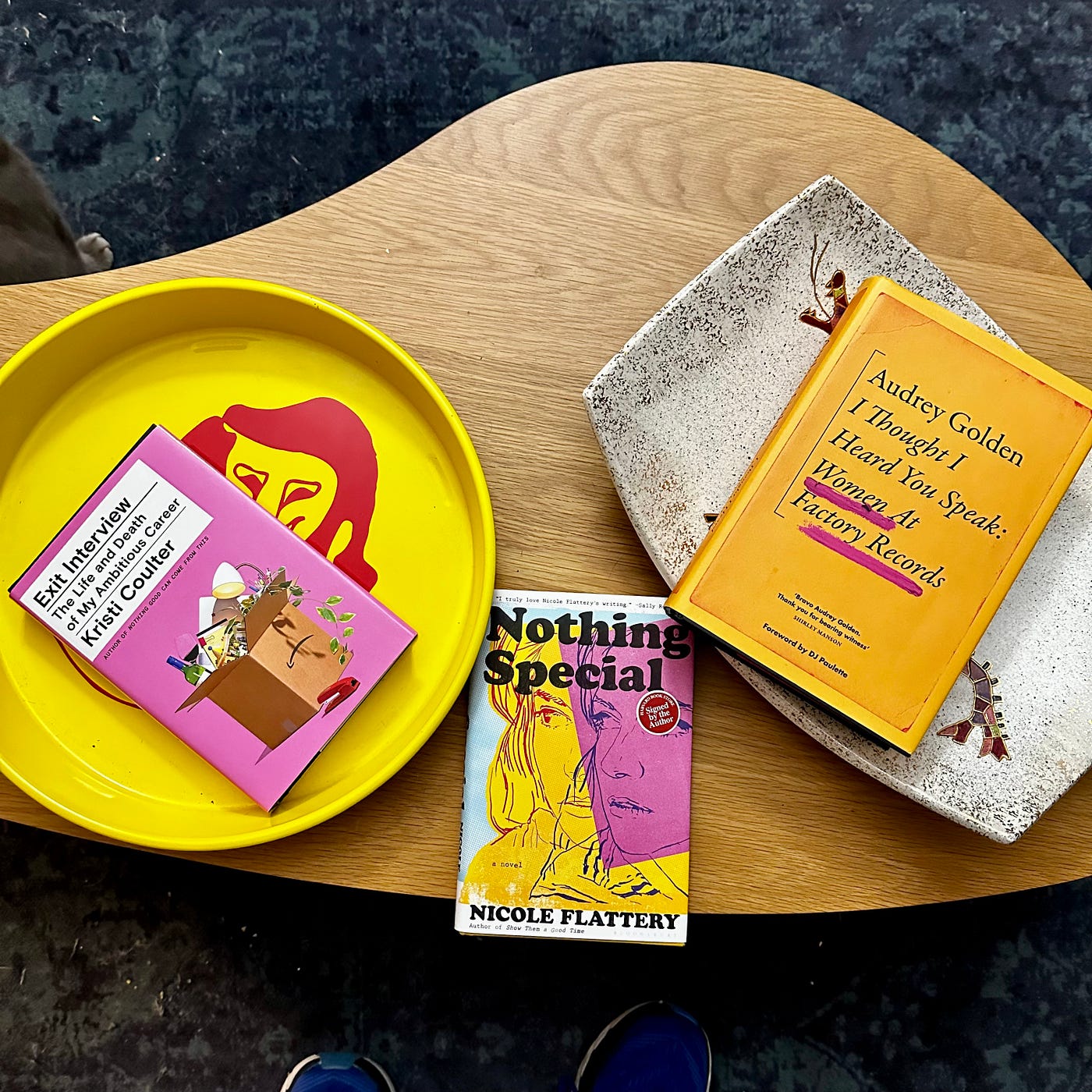
Three books: a novel, an oral history, and a memoir. Three decades: the 1960s, 1980s, and 2010s. Three cities, each the place to be at the time: New York, Manchester, and Seattle. And one topic: women who throw themselves deeply into their work, with all of the daily triumphs and tragedies that involves, while more powerful men get called geniuses for the labor of others.
Nothing Special (Bloomsbury, $26.99), the debut novel by Irish author Nicole Flattery, opens with a woman in late middle age caring, awkwardly and with a great deal of second-guessing herself, for her mother near the end of her life. Then it’s 1966, and unexceptional 17-year-old Mae is just starting her senior year when a slip-up during a school talent show suddenly brands her as the class weirdo, severing her one close friendship in the process.
Life at home kinda sucks too, between her alcoholic drama-queen mother and mom’s unemployed hipster boyfriend, a devotee of foreign films and poetry in translation whom Mae can never quite peg as either an ally or a threat. So she just sort of detaches herself from…well, everything…spending her days repeatedly riding the clackety wooden escalators in downtown department stores until she allows herself to get picked up by an older man. Which through a series of brilliantly strange encounters ends up with Mae working for Andy Warhol at his studio-salon-hangout The Factory.
Now, this is where things really get interesting. Flattery clearly knows her way around Warhol’s history — even the book’s title is an in-joke. (Warhol spoke often of getting his own network TV showcase, which he would call Nothing Special.) But in an artistic choice I find both admirable and perfectly in keeping with Mae’s disaffected mood, Flattery has chosen not to show her work to the rest of the class. As far as I can tell, Mae never once says the name “Andy Warhol” in this entire 230-page novel, mostly referring to him as “the artist.” Similarly, the Factory is just “the studio” or “the loft,” and outside of a couple of casual references to the fact that the walls are covered in silver foil and that the radio or a record player is always playing rock ’n’ roll, Flattery doesn’t attempt to immerse the reader in you-are-there realism.
Contrast that to some other recentish historical novels partially set in the downtown New York art world, like Garth Risk Hallberg’s City On Fire, which was just okay, or Rachel Kushner’s The Flamethrowers, which I loved. In those books, it’s hard to get away from just how much detailed historical research the authors did, to the point that it seems to drive entire scenes. Here, Flattery sketches Mae as an emotionally wounded, deeply withdrawn teenage girl who lives mostly in her own head. That’s not a character who would info-dump a lot of concrete scene-setting details — we don’t even know what neighborhood Mae lives in — and that’s a big part of why she feels emotionally real. As a result, Nothing Special takes place in a kind of dream-state mid-sixties Manhattan, in which the occasional glancing mention of an actual place, a certain pop song, or a real-world celebrity feels disconcertingly strange.
So anyway, Mae shows up at the Factory, where abrasive office manger Anita asks, “Do you have any skills or are you just one of those girls that hangs around?” Those girls — and occasional boys — are who we know as Warhol’s Superstars, another term Flattery ignores. To Mae, they’re strangely beautiful people who drift in and out of the loft, having loud conversations and pilfering anything that can be easily sold. They only become part of Mae’s life when she and her mysterious deskmate Shelley get drafted into a special new project: transcribing a box of 24 hour-long audiocassettes, recordings of conversations between various members of Warhol’s inner circle, for an oncoming book project.
Again, that’s fully historically accurate: the never-named book — which really was typed up by a random pair of teenage girls at the Factory — was published as a: A Novel in 1968. 19 years after that, as a Velvet Underground-loving high school senior, I found a paperback copy at a used bookstore in Lubbock, Texas. Over the next decade, I tried three or four times to read it but always gave up less than a hundred pages in. That copy is still in a box in my basement here in Boston, if it hasn’t been eaten by mice in the 20+ years since I packed it away during my last move.
Mae does have skills. She’s a skilled typist who has enough of a work ethic that over the next several months, sitting at her desk under a pair of headphones, rewinding and re-listening to these taped conversations becomes the entire focus of her life. In particular, Mae becomes obsessed with Ondine, a motormouth amphetamine addict who emerges as the tapes’ main character simply through his inability to stop talking. Outside of the tapes, Mae becomes equally fascinated by the taciturn Shelley, a runaway who refuses to talk about her previous life, why she came to New York, or even what she wants to do now that she’s here. As the pair bond over their slow, painstaking work transcribing the box of tapes, they’re drawn deeper into the artist’s world — underground films, art galleries, parties in decrepit lofts and posh apartments, occasional and mechanical sex, impulsive theft, and always always always long, discursive conversations that start to echo the everything-and-nothing feel of the tapes.
By the end of the tapes, Mae — now realizing that no one will ever know of her role in creating this book — has begun inserting herself into her transcriptions, introducing deliberate mistakes, adding pauses, and inventing dialogue. Shelley, who turns out to have had an entirely different idea of how her time in the Factory would go, merely breaks down. They drift apart, and away from the loft, as haphazardly as they’d arrived.
The reason this blend of blankness and voyeurism works is that Mae is a genuinely likable, endearing character. Even at her most disaffected, Mae seems to care about other people, even her psychologically abusive mother and dopey Mikey. In the book’s most emotional scene, Mae spends an afternoon shopping and eating lunch with the artist’s elderly immigrant mother, whose care has been passed off to her because nobody else — including the artist — can be bothered to spend time with her.) Mae understands the surface appeal of the girls that hang around, but it’s just not her bag. She’s the sort of person who needs a job — even one as questionably satisfying as transcribing cassettes of aimless, speed-driven conversations between self-important hipsters. It’s Nothing Special’s final unspoken irony: the real-world Andy Warhol, himself a dedicated workaholic, probably would have loved Mae.
Contrary to popular belief, Factory Records wasn’t named after Warhol’s Factory: on the day they chose a name, co-founder Alan Erasmus had just seen a real estate sign advertising a factory for sale. In 1977, most of Manchester was a depressed industrial area, which is a big part of why it was the second city where British punk flourished: there wasn’t anything else to do. You already know this if you’re a Factory Records fan, either from reading one of the many, many other histories of the label, or at least from seeing Michael Winterbottom’s enormously fun 2002 film 24 Hour Party People, where British comedian Steve Coogan plays the legendarily self-promoting Factory figurehead Tony Wilson as a self-important blowhard almost exactly like Coogan’s most famous character, vacuously clueless TV personality Alan Partridge.
All of those books, and that movie, make it sound like Wilson was solely responsible for Factory’s success — maybe with an assist from graphic designer Peter Saville, whose iconic sleeves made it possible to spot a Factory release from 20 yards away in any ’80s record store. British music journalist Audrey Golden tells a very different story in I Thought I Heard You Speak: Women at Factory Records (White Rabbit [UK], £25; US edition coming February 13, 2024, $32.99). This 500-page oral history centers the voices of the women who worked at or with Factory Records from its founding past its 1992 collapse. From the executive suite to the women who cleaned the loos at the Haçienda, the Factory-owned nightclub, Golden has either interviewed or found quotes from nearly a hundred women. And although many of them have horror stories — original Haçienda manager Penny Henry was tied up and beaten during an attempted robbery, then fired by managing partner Rob Gretton, who implied that she was somehow in on the crime — one theme becomes clear: Factory did a better job than most of its contemporaries in living up to the post-punk ideal of an egalitarian workplace where women’s work and ideas were genuinely valued.
This was very true of the record label — especially its more experimental subsidiary Factory Benelux, run by Belgian journalist and promoter Annik Honoré, who only gets mentioned in most Factory texts misidentified as the marriage-wrecking girlfriend of Joy Division leader Ian Curtis. (Honoré maintains their relationship was strictly platonic, and she would know.) Both labels featured acts with women in both vocal and instrumental roles, from label stars like New Order and Section 25 to cult favorites like Stockholm Monsters and Life. (Life only lasted for two singles, but 1984’s “Tell Me” is quite often my absolute favorite song Factory ever released.) Women signed bands — I had no idea before reading this that Wilson’s wife Lindsay Reade was an active A&R scout — and also managed and promoted bands. But it was even more true of The Haçienda. Although Wilson and the other managing partners conceived of the massive multi-story club on a whim, thinking of it as much as a personal clubhouse as a venue, the people who made this utterly impractical venture work were the experienced, in-the-know women who actually put it together and ran it.
The Haçienda eventually — as in like five years after it opened, during the Madchester summer of 1989 — became a huge success. Based on the descriptions here, I would have preferred its early days, when it “felt like a student union,” as one employee puts it, with patrons reading books and playing board games in quiet corners. In the basement was The Gay Traitor, Manchester’s first gay bar, with a weekly fetish night and reputedly the best DJs in the north. There was also a hairdressers called Swing, which became not only THE place to get your barnet done, but a hangout for every band in town, from The Smiths to The Fall. There were fashion shows, art exhibitions, and a t-shirt shop. All of that sounds absolutely glorious. And more to the point, despite Factory’s cold visual image and tortured, it’s-grim-up-north reputation, Golden and her subjects make it all sound incredibly fun and rewarding. (Plus I love that Joy Division/New Order bassist Peter Hook, who has written a couple of incredibly self-serving books about his Factory years, repeatedly comes off as an asshole; even his bass tech on multiple tours refers to him cheerfully as “Ol’ shit-for-brains Pete.”)
More to the point, the Haçienda did serve as a meeting point, just not entirely in the way Wilson and Gretton envisioned. Artist and curator Clare Cumberlidge, who designed The Gay Traitor bar, points out that she and her creative partners “weren’t going to The Haçienda only because we wanted to dance. Rather, we used it almost the way that gentlemen’s clubs operated, but not for gentlemen….It was a place where you met different creative people and had the kinds of conversations that were generative for cultural production, supporting emerging practices.” Access to those third places, neither work nor home, has always been a key part of how business is done in the UK; I recently read that one reason British tailors still congregate on London’s Savile Row is that for centuries, tailoring secrets have been passed from one generation to another through shop talk over pints at specific pubs. Having that kind of space is hugely important.
According to Kristi Coulter, one of Amazon’s main problems is that none of its Seattle campuses — at least during the decade-plus that she worked there — provided something as useful as a casual hangout spot, except maybe a lobby Starbucks if you were super lucky. Although Coulter’s sprightly, witty memoir Exit Interview: The Life and Death of My Ambitious Career (FSG, $29) also makes it sound like if anybody did take a half hour to talk shop over an espresso, they might find somebody else sitting at their desk when they got back. Which probably wasn’t so much a desk as it was a door on a couple sawhorses. Mind the splinters.
Okay, it maybe wasn’t as cutthroat as all that, although she’s not kidding either about the door-desk or the general lack of employee perks. (When the company finally started leaving Amazon-branded umbrellas in their lobbies in notoriously rainy Seattle, she assumed they were only meant for guests.) In her telling, one of the biggest and most profitable companies in the world was still being run like a skin-of-its-teeth start-up that’s not quite sure what it’s doing yet. There’s a famous story/urban legend about Amazon’s earliest days that when founder Jeff Bezos learned that employees were complaining about having to crawl on the floor around stacks of books to fulfill orders, his first suggestion was to buy everyone kneepads before one of his underlings told him that sorting tables were a thing that exists, so that tracks.
Sometimes that sense of barely contained chaos is hilarious. I would pay actual money to see Coulter act out all the characters in the scene early in her tenure where basically the entire company comes to a complete skidding stop one Monday morning because over the weekend, Bezos’ personal email account had gotten one of those “Hey, if you bought this, you should try this!” emails that suggested he should buy lube. (“Like, lube lube?” one of her officemates asks.)
But it’s clearly hard to maintain a pace like that, especially at a corporation that casually requires literal “nearly superhuman” abilities in its written performance reviews. By the halfway point of Exit Interview, the simple grind of Coulter’s job feels impossible to maintain, and that’s before you even get to the clueless fuckery of tech dudes prior to and at the height of the #MeToo era. As both a writer/editor and a passionate home cook, I was particularly irritated by her coworker who insisted that any mention of the bitter cruciferous vegetable that normal people know as either rapini or broccoli rabe be written as “broccoli rape” — a point he keeps insisting on so hard that it starts to seem like this dude’s personal fetish.
So yeah, parts of Exit Interview are an absolutely infuriating read. (And you definitely get both why Coulter develops an alcohol problem and why she quits drinking.) But at the same time, it’s also clear why she stayed as long as she did: the project she was working on with Broccoli Git was what became the supermarket Amazon Go, and her “okay, this is fucking cool” enthusiasm for it feels contagious. (To be fair, I grew up in retail and find supermarkets endlessly fascinating, so I’m kind of a target reader for that section of the book.) What keeps Coulter going throughout her career at Amazon, in various roles in different departments, is that despite the growing wave of anti-Amazon sentiment in the outside world — a lot of it totally justifiable — she genuinely believes in the work that she’s doing. One point she repeatedly returns to is that for a year when she was 14, her family lived in Las Cruces, New Mexico, a small town an hour away from the nearest book store, and she would have found Amazon a lifeline then. My 14th and 15th years were spent in Russell, Kansas, and Levelland, Texas, similarly remote small towns, and I can’t agree more. Amazon is a hugely, hugely flawed company…and for some people, they’re an absolute fucking godsend.
Exit Interview is a work memoir that’s funny, smart, endearing, and occasionally makes me want to hunt specific people down and slap some damn sense into them. (“Broccoli rape”…for fuck’s sake, dude, do you also insist on calling canola oil “rapeseed oil”?) Plus, there’s so much going on here that I recognize — on, thankfully, a more human-sized scale — from my own job as a managing editor that it’s relatable as hell. You should read all three of these books if they sound at all appealing, but start here.
메타데이터
- post_id
- 2bd1006cd894
- slug
- book-reviews-the-women-who-do-the-work-2bd1006cd894
- url
- https://medium.com/@stewartallensworthmason/book-reviews-the-women-who-do-the-work-2bd1006cd894
- canonical_url
- https://medium.com/@stewartallensworthmason/book-reviews-the-women-who-do-the-work-2bd1006cd894
- author_url
- https://medium.com/@stewartallensworthmason
- status
- ok
- fetched_at
- 2026-08-07 10:53:20