The Myth of Fixed Cultural Context: Why High and Low Context Is a Moving Target
I have spent nearly two decades training professionals from Fortune 500 companies and watching advanced English learners plateau not…
The Myth of Fixed Cultural Context: Why High and Low Context Is a Moving Target
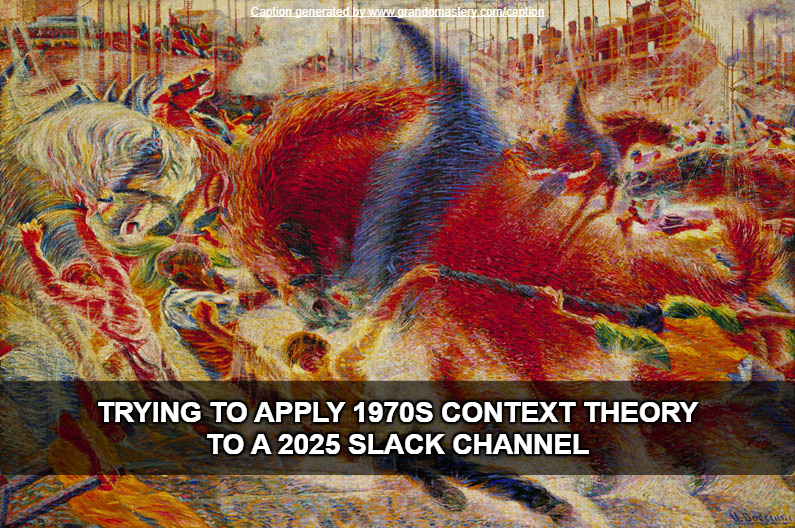
The City Rises / Umberto Boccioni / 1910 The swirling chaos and dynamic movement capture the acceleration of cultural change and the impossibility of holding cultures static in a globalized, digitally connected world.
I have spent nearly two decades training professionals from Fortune 500 companies and watching advanced English learners plateau not because of grammar gaps but because they treat cultural frameworks as static maps rather than living systems. The high-context versus low-context dichotomy, popularized by Edward T. Hall in the 1970s, remains one of the most cited models in intercultural communication. Yet it carries a dangerous assumption: that cultures occupy fixed positions on this spectrum and that individuals can be neatly sorted into boxes labeled “direct” or “indirect.”
This assumption crumbles under scrutiny. Cultural norms are not geological formations. They are fluid, contested, and perpetually under revision. A Japanese startup founder negotiating with Silicon Valley investors in 2025 operates in a different communicative reality than their grandparents did in 1975. A German corporation adopting agile methodologies imports not just workflows but communication styles that would have been unthinkable in hierarchical Mittelstand traditions. The context is not just high or low. It is oscillating, hybrid, and increasingly unmappable by binary frameworks.
The consequences of treating culture as static show up everywhere. English learners memorize that “Americans are direct” and “Asians are indirect,” then find themselves bewildered in actual interactions. A Singaporean tech worker codes in blunt Slack messages. A Texan executive masters the art of saving face. A Polish remote team adopts emoji-heavy banter that would baffle their parents. These are not exceptions. They are the norm in a world where migration, digital communication, remote work, generational shifts, and cross-pollination of professional practices have accelerated cultural evolution to unprecedented speeds.
What Hall described in the 1970s reflected industrialized, relatively isolated national cultures with stable communication patterns across generations. That world no longer exists. Today, a single individual might toggle between high-context family WhatsApp groups, low-context Jira tickets, and code-switched LinkedIn posts within an hour. The mistake is not in Hall’s original taxonomy but in treating it as a permanent map rather than a historical snapshot.
When I work with learners through Grandomastery, the issue surfaces immediately. Exercises like Random Country (https://grandomastery.com/country) or Random Statement (https://grandomastery.com/statement) force participants to inhabit multiple perspectives simultaneously. The cognitive dissonance is productive. A Korean learner explaining why a Brazilian approach might solve a Norwegian problem cannot rely on stereotypes. They must think through shifting contexts, generational divides, urban versus rural splits, and the hybrid identities that globalization produces. The task is not to master a fixed cultural script but to develop what I call transcontextual thinking: the ability to recognize that context itself is a variable, not a constant.
Consider what happens when we assume cultural context is stable. Miscommunication gets blamed on national identity rather than situational factors. A terse email from a Dutch colleague is read as “typical Dutch directness” rather than deadline pressure. A vague request from a Japanese manager is interpreted as “Asian indirectness” rather than hierarchical caution in a specific corporate structure. These attributions are lazy. Worse, they prevent us from asking better questions: What is this person optimizing for in this moment? What constraints are shaping their communication? How does their context differ from mine right now, not in some generalized cultural sense?
The shift toward remote work has accelerated this problem. Digital communication strips away many high-context cues: body language, tone, shared physical space, real-time feedback. Even cultures historically reliant on context are moving toward explicitness by necessity. But this does not mean everyone is converging toward low-context American norms. Instead, new hybrid forms emerge. Emoji and GIF usage creates visual context where verbal context is absent. Threaded conversations allow for layered meaning. Video calls restore some face-to-face nuance but introduce new ambiguities around lag, framing, and whose turn it is to speak.
Generational change compounds this. Younger professionals globally have grown up in digitally mediated environments where context must be constructed rather than assumed. A 25-year-old in Tokyo may communicate more like a 25-year-old in Berlin than like their own parents, not because national culture has disappeared but because the communicative ecosystem they inhabit prioritizes speed, clarity, and global interoperability. This is not Westernization. It is the emergence of transnational professional subcultures with their own evolving norms.
The implications for language learning and creativity training are profound. Rote memorization of cultural dos and don’ts becomes not just inadequate but actively misleading. What learners need is the ability to read and adapt to shifting contexts in real time. This requires metacognitive awareness: recognizing when you are importing assumptions, when your interlocutor is operating from a different baseline, and when the context itself is ambiguous or contested.
Activities like Random Abstractions (https://grandomastery.com/abstractions) or Random ISM (https://grandomastery.com/ism) build this capacity by forcing learners to bridge concepts that have no obvious connection. The cognitive labor mirrors what happens in real intercultural communication: you must construct shared meaning across a gap, without a stable reference point. The exercise is not “learn Japanese communication style” but “learn to build bridges in the absence of a shared foundation.” That skill transfers across every context, high, low, or hybrid.
Anthropologists and sociolinguists have long understood that cultures are not monoliths. Within any society, context varies by region, class, profession, age, and subculture. A lawyer in Mumbai and a software engineer in Mumbai operate in different contextual worlds despite sharing nationality. But business communication training still defaults to national stereotypes because they are easier to package and sell. The result is a generation of professionals who can recite Hofstede’s dimensions but cannot navigate a Zoom call with a multicultural team.
The fluidity of cultural context also means that individuals are not passive carriers of their culture’s norms. They are active negotiators. A Chinese manager working for a German firm does not simply “be Chinese” or “be German.” They code-switch, prioritize, and improvise based on audience, stakes, and desired outcomes. To treat them as a representative of Chinese high-context communication is to deny their agency and adaptability. It also blinds us to the fact that they are simultaneously shaping what “Chinese communication” means in their specific professional ecosystem.
What replaces the high-context versus low-context binary? Not the abandonment of the concept but its radical contextualization. Instead of asking “Is this culture high or low context?” we should ask: In this specific interaction, with these specific people, under these specific constraints, how much shared knowledge can be assumed? How much must be made explicit? And how is that balance shifting over time?
This is where Grandomastery’s emphasis on improvisation and bisociation becomes critical. Exercises like Random Predicament (https://grandomastery.com/predicament) or Random Job Interview (https://grandomastery.com/interview) simulate the kind of high-stakes, low-information scenarios where cultural scripts break down. You cannot rely on memorized rules. You must read the room, test assumptions, and adapt on the fly. This is not cultural sensitivity training in the traditional sense. It is cognitive flexibility training that happens to apply to cross-cultural contexts because those contexts demand the same mental agility as any complex, ambiguous problem.
The danger of static cultural models is not just theoretical. It has real consequences. Teams fail to collaborate because members assume the other side is “just being indirect” or “just being blunt” rather than investigating the specific reasons behind a communication breakdown. Negotiations stall because one party interprets silence as agreement and the other interprets it as discomfort. Talent gets overlooked because someone’s communication style does not match the stereotype of their national origin, leading evaluators to see them as inauthentic or inscrutable.
If cultural context is fluid, how do we prepare learners? By building the skills that matter in any shifting landscape: the ability to tolerate ambiguity, the capacity to ask clarifying questions without defensiveness, the habit of testing interpretations rather than assuming them, and the metacognitive practice of noticing when your own cultural baseline is shaping your perceptions. These are not innate traits. They are trainable. But they require exposure to genuinely unpredictable, multi-perspectival scenarios rather than sanitized case studies where the “correct” cultural response is telegraphed in advance.
This is why I designed Grandomastery around structured spontaneity rather than scripted lessons. When you are asked to connect two random abstract concepts or improvise a pitch deck for an absurd startup idea, you cannot fall back on cultural stereotypes because there is no stereotype for “justify why a company selling edible motivational posters should merge with a blockchain-based astrology service.” The cognitive work is the same whether you are a Korean speaker or a Spanish speaker: you must generate novelty under constraint, without a template. That is the skill that transfers to intercultural communication in a world where the templates no longer hold.
The myth of fixed cultural context also intersects with the problem of linguistic fossilization. Learners who believe “I am from a high-context culture, so I should be indirect” lock themselves into patterns that may no longer serve them. They avoid directness even when the situation demands it, then blame cultural identity for the resulting confusion. This is not cultural authenticity. It is cognitive rigidity disguised as tradition. Real cultural fluency includes the ability to move along the context spectrum as the situation requires, not to perform an unchanging script.
What we are witnessing is not the death of cultural difference but its acceleration and complexification. Cultures are evolving faster than our models can track. The high-context and low-context distinction still has descriptive value as a starting point, but it must be paired with an understanding that cultures are contested, generationally stratified, digitally mediated, and constantly in flux. The individual you are communicating with is not a cultural average. They are a person navigating multiple, overlapping contexts, some inherited, some chosen, some imposed by circumstance.
This means that the goal of intercultural training cannot be to memorize static rules. It must be to develop the improvisational capacity to read, test, and adapt to contexts that are themselves unstable. Grandomastery’s emphasis on bisociation, defamiliarization, and integrative thinking is not a detour from language learning. It is the direct path to the kind of cognitive flexibility that modern cross-cultural work demands. When you can hold two contradictory ideas in your head and construct a coherent narrative, you can also navigate a Zoom call where half the team expects explicitness and half expects you to read between the lines.
The future of intercultural competence lies not in thicker cultural guidebooks but in thinner, more agile cognitive tools: the ability to ask better questions, the habit of revising assumptions, and the comfort with ambiguity that allows you to operate effectively even when the rules are unclear. These are the same skills that drive creativity, innovation, and higher-order thinking in any domain. The overlap is not accidental. Cultural fluidity and cognitive fluidity are two sides of the same coin.
For more on building these adaptive capacities, explore https://grandomastery.com or connect with me at https://www.linkedin.com/in/grandomastery/.
grandomastery #interculturalcommunication #culturalcontext #crossculturalskills #cognitivelexibility #highcontext #lowcontext #communicationskills #globalworkforce #remotework #businessenglish #culturalawareness #adaptivethinking #languagelearning #ESL #TESOL #creativity #metacognition #professionalenglish #workplacecommunication #interculturaltraining #globalteams #communicationstyles #culturaldynamics #evolutionofculture #fluidculture #transcontextualthinking #bisociation #defamiliarization #improvisation #cognitivediversity #multiculturalteams #languageeducation #advancedenglish #edtech #creativitytraining #higherorderthinking #cognitiveskills
메타데이터
- post_id
- 2bd9f75c0d61
- slug
- the-myth-of-fixed-cultural-context-why-high-and-low-context-is-a-moving-target-2bd9f75c0d61
- url
- https://medium.com/@grandomastery/the-myth-of-fixed-cultural-context-why-high-and-low-context-is-a-moving-target-2bd9f75c0d61
- canonical_url
- https://medium.com/@grandomastery/the-myth-of-fixed-cultural-context-why-high-and-low-context-is-a-moving-target-2bd9f75c0d61
- author_url
- https://medium.com/@grandomastery
- status
- ok
- fetched_at
- 2026-08-03 20:17:37