From April 20th to 26th, 2026, the crypto primary market financing report showed that AI financial…
SYNBO Primary Market Investment and Financing Research and Trend Insight Report | Issue 15 Report Date: April 27, 2026 Reference Period…
From April 20th to 26th, 2026, the crypto primary market financing report showed that AI financial infrastructure accounted for 69%, and the KelpDAO incident exposed systemic risks in DeFi
SYNBO Primary Market Investment and Financing Research and Trend Insight Report | Issue 15 Report Date: April 27, 2026 Reference Period: April 20, 2026 — April 26, 2026 Report Type: Crypto Asset Primary Market Data Statistics and Trend Analysis Report
Abstract
From April 20 to April 26, 2026, the crypto primary market disclosed a total financing amount of about 144 million US dollars , a total of 4 transactions , a decrease of about 20% from last week, and a decrease of about 33% in the number of financing transactions.
The most noteworthy signal this week is not the decrease in financing scale, but the obvious concentration of funds in the head track and high-certainty projects. Among them, AI financial infrastructure financing is about 100 million US dollars, accounting for about 69% of the total financing this week , becoming the absolute dominant track; bulk equity stake tokenized financing is about 26 million US dollars, accounting for about 18%, indicating that RWA and compliance equity stake on the chain are forming a new structural paradigm.
At the same time, OpenGradient completed market value discovery through Binance Launchpool, and tokens such as HYPER, LMTS, and INIT showed a high risk of cliff unlocking. The security incident of KelpDAO further exposed the systemic risk resonance between LRT, high LTV, non-isolated lending, and cross-chain configuration layers.
Overall, the primary market is transitioning from “narrative-driven” to “structural pricing” this week. Institutional investors are paying more attention to feasible business models, compliance paths, real asset structures, protocol security capabilities, and token release mechanisms.
This week’s core data overview

This week’s financing showed two clear characteristics:
First, the concentration of the head intensified . Slash Financial’s single $100 million financing accounted for about 69% of the total financing this week, indicating that primary market funds are concentrating on a few high-certainty projects.
Second, the track precision enhancement . AI financial infrastructure, equity stake tokenization, Middle East AI asset management, and South East Asia compliance exchanges have become the main financing directions this week. The market no longer simply pursues concepts, but pays more attention to business models, compliance barriers, institutional endorsements, and regional market foundations.
1. Data on the scale and growth trend of the primary market on the chain
1.1 Key financing this week

1.2 Track Interpretation
AI Financial Infrastructure: Top VC Crosses Borders to Invest Heavily
Slash Financial’s latest round of financing was led by Ribbit Capital, a top VC in the fintech field, and Khosla Ventures, with Y Combinator participating for the fourth time in the same crypto project. This is extremely rare in YC’s history. The core product, AI agent “Twin”, can autonomously manage cross-protocol yield management of stablecoins, reducing manual operation from 3 hours per day to almost zero intervention. The valuation is $1.4 billion.This represents a leap from “chain narrative” to “institutional fund recognition and feasible business model” for AI x crypto financing. It has the dual endorsement of traditional fintech capital and top accelerators, rather than just the self-circulation of crypto-native capital.
Batch equity stake tokenization: paving the way for a new structural paradigm through compliance
BitcoinFi Accelerator and Fairmint have completed the first batch of equity stake tokenization projects through the SEC registration channel. Seven startups’ equity stakes were tokenized and put on the blockchain at the same time. The tokenized equity stakes can be traded in the secondary market. Fairmint, as the SEC registration transfer agent, provides compliance endorsement, and Draper Associates (Tim Draper’s family) has a high recognition of the Bitcoin narrative in the past.This structure makes the traditional accelerator’s “black box investment” model transparent, providing combinable liquidity for startup financing. It is expected to stimulate the replication of similar RWA structures.
Middle East AI Asset Management: Sovereign wealth funds are transitioning from observers to strategic participants
KAIO has received a strategic investment (not just financial allocation) from Tether within the ADGM regulatory framework in Abu Dhabi, and has reached a strategic cooperation with Mubadala Capital (AUM $385 billion, a subsidiary of the Abu Dhabi sovereign wealth fund). Currently, its own AUM is $100 million, and it has handled more than $500 million in transactions. This signifies that Middle Eastern sovereign wealth capital has officially transitioned from a bystander to a strategic partner in AI + crypto asset management, and the friendly regulatory sandbox policy in Abu Dhabi continues to attract institutional projects.
Southeast Asia Compliance Exchange: Turning License Barriers into Competitive Advantage
Hata holds dual licenses from Malaysia’s Securities Commission (SC) and Labuan Financial Services Authority (LFSA), with high compliance barriers. Bybit’s strategic investment aims to expand its compliance distribution network in South East Asia, with 209,000 registered users providing a solid market base. As the next frontier for crypto adoption in South East Asia, the scarcity of dual-licensed compliance exchanges is turning into an uncopyable competitive barrier, transforming compliance costs from a “liability” to an “asset”.
Second, the Launchpad ecosystem on the chain and investment trend data
2.1 OpenGradient (OPG) — Binance’s 46th TGE Deep Signal
Binance selected OpenGradient as the 46th Launchpool project, with a financing background of $9.5 million (led by a16z and Coinbase Ventures), an issue price of $0.01, a total supply of 1 billion, and a participation threshold of 240 Alpha points. HTX, BitMart, and Bybit went live simultaneously on April 21st.
Why is this important:
OpenGradient is positioned as a decentralized AI inference network that allows developers to run verifiable AI computing tasks without exposing model weights, addressing the core pain point of trustworthy execution of “AI black boxes” on the chain. The dual endorsement of a16z and Coinbase Ventures, coupled with the global traffic of Binance’s 46th TGE, represents the first large-scale market value discovery of the “verifiable AI computing” track through the top CEX TGE channel.The 240-point threshold effectively filters out retail noise, resulting in a relatively high-quality participant structure. This is not a simple token publish, but the first complete experience of the “top VC financing → top CEX TGE → global liquidity” value anchoring path for AI x DeFi infrastructure. The next observation point is whether the valuation premium given by a16z endorsement can be maintained after the launch of OPG, or whether the market will price it back to the median of the AI infrastructure track.
III. Performance data after the unlocking of the token
3.1 GENIUS Terminal — In-Depth Review 30 Days After TGE
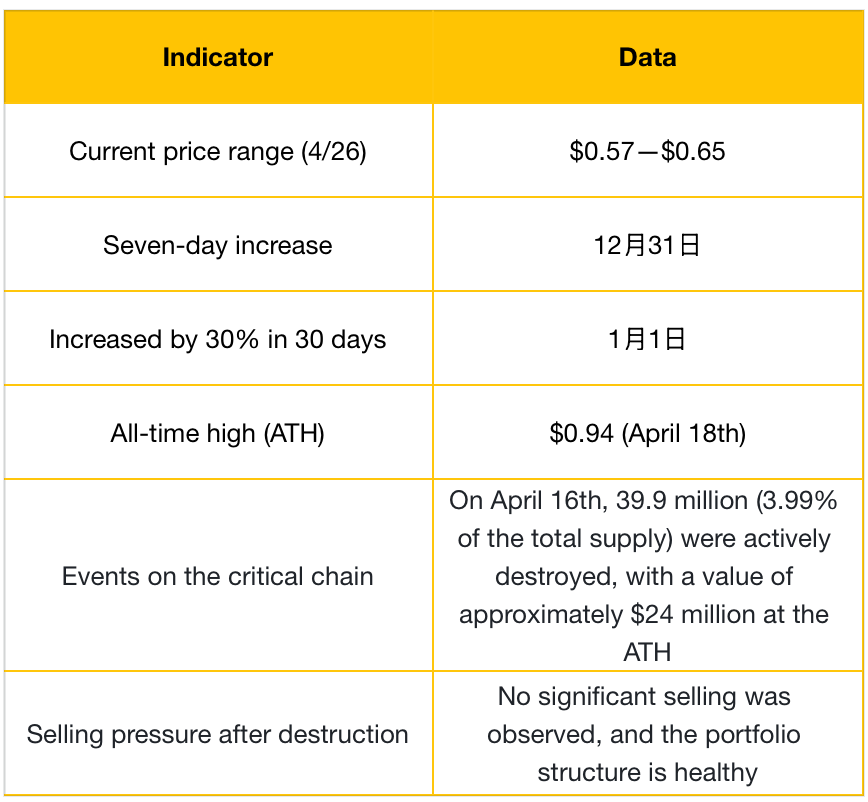
The voluntary destruction of $240 million worth of tokens is the largest single case of deflation on the chain this week. This destruction was not a passive response to price pressure, but a proactive contraction of supply by the project when the price was at a high level. After the destruction, the price remained high and there was no significant selling pressure, indicating a relatively healthy holder structure and sufficient market pricing of the deflation narrative.
Key lesson: A proactive deflation mechanism is more indicative of a project’s long-term commitment to managing the value of its tokens than a simple price increase. When the team destroyed nearly 4% of the supply around the ATH price after the TGE, it signaled a preference for reducing supply rather than liquidating through selling. This contrasts sharply with the implicit selling pressure of most projects. Keep an eye on the next destruction time node and whether the price can break the $0.94 ATH.
IV. Performance data after the unlocking of the token
The total unlocking scale this week (4/20–4/27) is about $724 million. The most alarming this week is not the largest RAIN, but the simultaneous unlocking of three extreme circulation ratios — HYPER, LMTS, and INIT. The real risk lies not in the absolute scale of the US dollar, but in the market depth caused by the extreme imbalance of the circulation ratio.

It is recommended to closely monitor large transfers on the chain and the influx of exchanges 2–3 days before the unlocking date, and the 24–72 hours after the cliff unlocking is a high-risk window.
Fifth, security incidents
5.1 KelpDAO — National attribution confirmation of the largest single DeFi security incident in 2026
This week, the cross-chain security agency officially attributed the largest on-chain attack in April to the Lazarus Group (Operation TraderTraitor) — a North Korean state-sponsored hacking group. The attackers deceived the cross-chain messaging layer into believing that a valid instruction had arrived from another chain, triggering the protocol to release 116,500 rsETH, approximately 18% of the circulating supply, worth approximately $293 million.This is another major DeFi attack confirmed to involve the Lazarus Group, following Ronin Bridge ($625 million, 2022) and Harmony Bridge ($100 million, 2022).
5.2 Chain Reaction and Continuous Fund Tracking

5.3 “DeFi United” — The first multi-protocol joint risk hedging mechanism in history

This is the first recorded “joint response to protocol-level systemic risk” in the history of DeFi. Its significance lies not only in the scale of funds, but also in setting a precedent: when a single protocol’s Black Swan event threatens the overall credit of the ecosystem, the leading protocols can coordinate resources for collective endorsement. However, this also reveals a deeper structural vulnerability — the quadruple risk resonance of LRT + high LTV E-Mode + non-isolated lending + cross-chain bridge configuration, which has not been systemically repaired yet. The cost of responding to the next similar trigger point will only be higher.
5.4 Other security incidents this week

In the Volo incident, XAUm (gold token) was stolen, which is a new type of RWA security risk case. RWA tokenization is not only a financial innovation, but also becoming a new target for hacker attacks. The price prediction mechanism protection of the underlying physical anchored token will become the standard security requirement of the RWA protocol.
Summary of Data-Driven Investment
For investors
- Reassess the Risk Premium pricing of LRT assets: The KelpDAO vulnerability exposed the systemic risk of LRT collateral under high LTV E-Mode and non-isolated lending models — 93% LTV with no liquidation buffer when the collateral is zero. Investors who hold LRT-related assets or use LRT collateral for lending in Aave E-Mode should reassess whether the actual risk exposure has fully reflected the tail Risk Premium.
- The unlocking calendar of tokens should be included in the standard positioning management framework: HYPER 97.05%, LMTS 65.04%, INIT 45.57%. The unlocking of these extreme proportions should occur simultaneously in the same week. It is recommended to incorporate the unlocking events of important holdings and positioning adjustments into a systemized process. The best window for position adjustment is 48 hours before the unlocking date.
- The AI x Financial Infrastructure track is moving from the narrative stage to the institutional pricing stage. Ribbit Capital’s first heavy investment in the AI x Crypto crossover track, coupled with YC’s fourth participation, indicates that traditional fintech capital has completed due diligence recognition of this track. Such institutional signals typically lead market price discovery by 6–12 months and are one of the most preferred indicators for judging the warming of the track.
- CLARITY Act Probability Tracking as Regulation β Source: Polymarket 56% is close to the uncertainty interval. If there is significant legislative progress in May, tokens related to DeFi/compliance narratives will be rapidly repriced. It is recommended to keep a weekly track of this probability indicator.
For the project party
- Cross-chain integration must add “configuration layer audit”: The KelpDAO vulnerability is not a bug in the protocol itself, but a configuration issue — a case that every project with cross-chain tokens needs to study today. Traditional smart contract audits can no longer cover the integrity check risk of cross-chain message verification mechanisms, and “configuration layer security audit” needs to be included in the mandatory process before going live.
- Establish a multi-protocol emergency coordination mechanism in advance: “DeFi United” provides a replicable template for inter-protocol coordination, but its initiation is a passive response rather than an active design. It is recommended that major DeFi protocols establish multi-signature emergency channels, backup liquidity commitment frameworks, and inter-protocol risk information sharing mechanisms in advance, transforming the temporary “fate community” into an institutionalized “security alliance”.
- RWA tokenization requires synchronous configuration of security infrastructure. The theft of XAUm in the Volo incident indicates that the RWA tokenization project needs to prioritize the protection of the underlying physical anchored token. TWAP oracle and circuit breaker should be standard rather than optional.
For market observers
- The long-term structural significance of the “DeFi Protocol Layer Union” narrative is that the emergence of DeFi United signifies the evolution of the ecosystem from “fighting alone” to a “community of destiny”. Protocols that can participate in the joint response mechanism will gain an additional “systemic importance premium”, accelerating the centralization process of the top TVL. The survival pressure on small and medium-sized protocols will further intensify.
- Tracking the allocation direction of Blockchain Capital’s $700 million dual fund: Announced the launch of the $700 million dual fund (early + growth stage), one of the largest crypto VC fundraising in 2026. The specific allocation track will be gradually disclosed through project announcements in the next 3–6 months, which is one of the best forward-looking indicators to judge the heat of the primary market track in the second half of 2026.
- The legislative clock for the CLARITY Act has entered its final critical window: Polymarket’s 56% is significantly lower than the 82% at the beginning of the year, and Senator Lummis has publicly warned that the next opportunity will not be until 2030. Whether the CLARITY Act is included in the Senate calendar for May is the most important regulatory signal source this monthSynchronously pay attention to the GENIUS Act AML rule proposal (review deadline 6/9, compliance effective 7/18), which is a hard deadline for stablecoin compliance infrastructure regardless of the fate of the CLARITY Act.
FAQ: Frequently Asked Questions about this Research Report
Q1: What is the total amount of financing in the primary cryptocurrency market this week?
From April 20th to April 26th, 2026, the primary market of encryption disclosed a total financing amount of about 144 million US dollars , a total of 4 financing events , a decrease of about 20% from last week, and a decrease of about 33% in the number of financing transactions.
Q2: What is the strongest Web3 track for financing this week?
The strongest track this week is AI financial infrastructure , with a financing scale of about 100 million US dollars , accounting for about 69% of the total financing this week. Slash Financial is the largest financing project this week.
Q3: Why should we pay attention to AI financial infrastructure?
AI financial infrastructure is moving from the narrative stage to the institutional pricing stage.
Slash Financial has received support from Ribbit Capital, Khosla Ventures, and Y Combinator, indicating that traditional financial technology capital has begun to pay attention to the efficiency gains brought about by the combination of AI and on-chain asset management.
Q4: Why is OpenGradient OPG important?
OpenGradient, a verifiable AI computing track, has completed a full market value discovery through top VC financing, Binance Launchpool, and simultaneous listing on multiple exchanges. This indicates that the AI × Crypto infrastructure is entering a more open and large-scale liquidity pricing stage.
Q5: Which tokens have the highest unlock risk this week?
The most noteworthy high-proportion cliff unlocking projects this week are HYPER, LMTS, INIT . The unlocking ratio of HYPER is as high as 97.05%, LMTS is 65.04%, and INIT is 45.57%. The risks of these projects mainly come from the mismatch between new supply and market depth.
Q6: What issues were exposed by the KelpDAO security incident?
The KelpDAO incident exposed systemic risks related to LRT assets, high LTV lending, non-isolated lending, and cross-chain configuration layers.
This indicates that the risk of DeFi is no longer just a single smart contract vulnerability, but may be triggered by multiple protocols, assets, and chain structures.
Q7: Why does the RWA project also need to pay attention to security?
The Volo incident shows that RWA tokenized assets may also become targets of hacker attacks.
In the future, RWA projects will not only need to prove the existence of assets, but also demonstrate the security of on-chain pricing, custody, redemption, and liquidity mechanisms.
Disclaimer
This report is based on public data and statistical information for analysis, aiming to verify market opportunities and innovation value through data-driven logic. It does not constitute any investment advice. Cryptocurrency investment involves high risks, and investors should make decisions carefully based on their own risk tolerance. This report does not guarantee the accuracy, completeness, or timeliness of the data, and is not responsible for any direct or indirect losses resulting from the use of this report.
Officially produced by Synbo.io | Data as of April 26, 2026

메타데이터
- post_id
- 2bf7c6c0b399
- slug
- from-april-20th-to-26th-2026-the-crypto-primary-market-financing-report-showed-that-ai-financial-2bf7c6c0b399
- url
- https://medium.com/@synbo001/from-april-20th-to-26th-2026-the-crypto-primary-market-financing-report-showed-that-ai-financial-2bf7c6c0b399
- canonical_url
- https://medium.com/@synbo001/from-april-20th-to-26th-2026-the-crypto-primary-market-financing-report-showed-that-ai-financial-2bf7c6c0b399
- author_url
- https://medium.com/@synbo001
- status
- ok
- fetched_at
- 2026-07-10 23:04:28