Some reflections on Bio-Rad vs 10X
In November 2018, Bio-Rad won an important patent infringement case against 10X Genomics after a jury trial. Here is my reflection on this…
Some reflections on Bio-Rad vs 10X
In November 2018, Bio-Rad won an important patent infringement case against 10X Genomics after a jury trial. Here is my reflection on this case from the perspective of someone “skilled in the art”.
The verdict
Bio-Rad acquired Rain Dance in 2017 and took over the latter’s lawsuit against 10X genomics dating back to 2015. In November 2018, the jury found 10X guilty of infringing the patents at issue and awarded Bio-Rad $23.8 million in damage. In July 2019, Bio-Rad’s request for permanent injunction of the infringing product was approved by the presiding judge.
The defeat effectively prevents 10X from selling their wildly successful single-cell sequencing product to new customers and allows Bio-Rad to collect 15% loyalty from 10X to its future sales of consumables to existing customers. 10X has started marketing a new generation of products in anticipation of the injunction.
It is not within my area of expertise to comment on its legal justification. As a person skilled in the very area at dispute, however, I am in a position to offer some personal reflection on this case and its ramifications.
The reflection
As someone “skilled in the art”, I can’t help but express my disappointment in the current status of the patent system.
Currently, there is a morass of conflicting case laws. Researchers don’t have the resource to confidently evaluate potential IP risks. Even attorneys are at a lost and find it difficult to guide their clients.
To gain an advantage in any potential patent dispute, people try to patent literally anything that could be of potential value as long as they can afford the practice. In this bazaar of claims, attorneys and examiners haggle over the “novelty” of the technology and the scope of the claims. To leave room for bargaining, claims are often written to be broader than it should be. Some people are lucky enough to get more than they deserve. Some other people aren’t.
The result is a jungle of patents with questionable technical values. They are most useful during the hair-splitting process of patent disputes. Hours and hours of attorney time are devoted to canvassing this patent jungle for anything that could be turned into a weapon.
In this expensive patent game, small innovators are the most vulnerable. They don’t have an army of corporate attorneys to perform free-to-operate analysis. They have limited resources to hire attorneys, let alone quality ones, to patent their innovation. Their innovation is not attractive to investors because of potential risks of expensive litigation with a big corporation. Their patent application and product is an open invitation to lawsuits from large corporations. But when their idea is stolen, litigation is way too expensive to be practical.
The progress of technology and its benefit to society is also hampered due to the unnecessary limitation arising from aggressive patent claims and litigation. Human knowledge evolves in an incremental fashion, but patent claims are often broad enough to preempt such kind of progress. In addition, if a new problem can be solved by a patented technology, it is up to the conciousness of the patent holder, oftentimes a large corporation, to decide if its potential profit amd benifit justifies the litigation risks.
This lawsuit between Bio-Rad and 10X is just one example of this funny game.
The backdrop
The story started from QuantaLife, a spin-off from Lawrence Livermore National Lab. QuantaLife was successful in developing a digital PCR system based on the generation of tens of thousands of droplets about 100-micrometer in diameter. Realizing the potential of droplet digital PCR (ddPCR) in both research and clinical settings, Bio-Rad acquired QuantaLife in 2011. ddPCR gained popularity thanks to its technical advantage over more traditional qPCR technology and the marketing effort affordable only to large corporations such as Bio-Rad.
Two of QuantaLife’s founders left Bio-Rad about a year after the acquisition, starting 10X Genomics. At the beginning, 10X avoided using droplet-based technology but with little success. Eventually, they picked up something familiar, i.e. droplets, to develop an instrument for single-cell RNA sequencing. To be fair, there are other equally if not more important technical innovations embodied in 10X’s product. It is irrelevant from a legal perspective, but must be kept in mind when we review the case as a whole.
The IP warfare between Bio-Rad and 10X started when 10X filed their first few patent applications even if they were not using droplets at all. Bio-Rad failed to extract anything meaningful.
Shortly after 10X genomics launched their first product of single-cell RNA-seq sample preparation platform, it was under attack from Rain Dance, founded by Harvard professor David Weitz. Similar to Quanta Life, Rain Dance started their business commercializing ddPCR and later expanded to single-cell sequencing. In 2017, Bio-Rad acquired Rain Dance. Because Bio Rad had been successful commercializing its ddPCR product line after its acquisition of QuantaLife, it is believed that the acquisition is mostly driven by the desire for Rain Dance’s patent portfolio. Following the acquisition, Bio Rad became the plaintiff against 10X. What happened to Rain Dance’s ddPCR and single-cell product? How about their existing customers? Well, for some people that’s not as important as the patents.
As shown in the table below, Bio-Rad gobbled up Quanta Life and Rain Dance. It already dominated the ddPCR market and aspired to take on 10X Genomics, the de facto leader in single-cell sequencing, in the court of law.
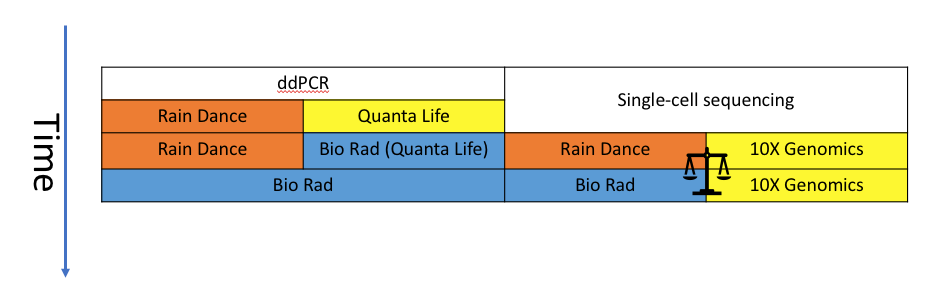
Evolution of players in ddPCR and single-cell sequencing. Quanta Life and 10X Genomics share co-founders. Other players not involved in the lawsuit omitted.
The patents-in-suit
As typical in a patent lawsuit, Rain Dance (later Bio-Rad) accused the defendant infringed the patents willfully and caused significant damage. As a defense, 10X tried every possible means to invalidate the patents-in-suit. Normally it boils down to how to interpret or construct a few key claims and sometimes a few key words in the patents. The level of absurdity reached in such a “construction” is amusing to say the least.
Non-fluorinated channel
Bio-Rad’s patent claims the use of non-fluorinated channel. The product offered by 10X, however, contains a small percentage of fluorine. It was added to the product with the purpose of circumventing Bio-Rad’s claim on non-fluorinated channel, according to the accounts of 10X board members. Unfortunately in this lawsuit, this strategy didn’t worked out well. By going back to how Bio-Rad’s patent was examined by patent office during prosecution, it was found that the limiting term of “non-fluorinated” was added to avoid conflict with a prior art which mentioned the possibility of coating the channel with fluorine. Along this line, to circumvent Bio-Rad’s claim one needs to use channels coated with fluorine; a channel with some fluorine atoms embedded, as is the case for 10X product, still counts as a “non-fluorinated” channel.
Had 10X been aware of this interpretation, they could have simply coated the channels before shipping them out. This process is so straightforward and well-known, it was not even claimed in the prior art; the inventor of that prior art simply mentioned this process in the description.
From the perspective of a person skilled in the art, the claim of “non-fluorinated” channel doesn’t have any usefulness. In the intended way to use the product, fluorinated molecules from the reagent would coat the channels in no time, whether or not the channel is coated or not in the first place. There is no technical value attached to the limitation of “non-fluorinated”, but it allowed the successful prosecution of the patent and then became a lethal “weapon” against the patent “infringer”.
Surface tension
One of the contested claims involves the surface tension between two immiscible fluids. What makes it complicated is that surface tension is better to be measured in the microchannel where all the action happens. Because it is not practical to do so, 10X argued that the patent is thus not valid. Bio-Rad, however, tried very hard to convince the jury that it is sufficient to measure the surface tension outside the microchannel. Unfortunately the expert witnesses from neither party brought up the significant difference between dynamic and static surface tension. I guess there had already been too much technical discussion in the trial.
Autocatalytic reaction
One of the items covered by Bio-Rad’s patents is autocatalytic reaction. It is impossible to enumerate autocatalytic reactions used in practice or those yet to be discovered. Such a broad coverage means only this patent holder can extend the platform to run a new autocatalytic reaction or a greatly improved version of a known reaction. If the patentee is not motivated to or incapable of doing so, anyone else doing that will be the target of patent litigation.
Equivalent
It is very common to find a so-called means-plus-function claim. The patentee basically claims the right to achieve a certain function WITHOUT specifying how it is achieved in the claim language. Instead, the implementation of the function is to be found in the description section. What is troubling is that any equivalent embodiment is covered by the claim. I appreciate that it is impossible to list all possible embodiments, although a lot of patents are already written that way. I also appreciate simply swapping a component with something equivalent but unavailable at time of filing doesn’t circumvent the patent. But how to determine the equivalence?
Prior arts
In principle, if an inventor attempts to claim something very broad, it might be rejected due to a conflict with prior art. For example, in the non-fluorinated channel issue mentioned above, the original claim has to be narrowed to cover only non-fluorinated channel in order to avoid the conflict with the prior art. One of the interesting byproducts of this lawsuit is the discovery that one of Bio-Rad’s patents copied almost verbatim from a previously published patent. Although boiler plate languages are very common in patents, what is copied here is very technical and specific to the core of the patent. Bio-Rad’s patent was invented by Prof. Ismagilov, then at the University of Chicago. The prior art belongs to Prof. Quake, then at California Institute of Technology. Ismagilov patent was filed about 42 days after Quake patent was made public. Had this been a peer-reviewed journal publication, some serious investigation would surely follow. One may wonder if Caltech, the assignee of the prior art, will try to get a scoop after this lawsuit. Well, Prof. Ismagilov has relocated to California Institute of Technology and Prof. Quake left Caltech for Standard more than 10 years ago.

The striking similarity between Quake and Ismagilov patents
The new season
On July 22, 2019, Bio-Rad submitted a complaint again another one of its competitors, Stilla, for infringing another two of the patents it acquired from Rain Dance. Stilla uses a completely different method to generate droplet and perform PCR reactions, at least from my personal technical perspective. Stilla doesn’t seem to have a patent on the droplet generation method for reasons unclear to me, although its founder had published a few papers on this technology. Is it because this method was initiated long time ago in Japan and the Japanese patents have expired? There is a US patent, though.
When you looked at the two patents used by Bio-Rad against Stilla, the one on droplet generation was filed in 2002 and granted in 2018. Prof. Ismagilov filed the application (also copied from his own as well as Quake’s prior art) in 2002, licensed to Rain Dance, which was acquired by Bio Rad and finally got approved in 2018, just in time for this litigation. Sixteen years!
Maybe this time Caltech will join the battle with the very original Quake patent. It’s a billion-dollar market!
10X has started shipping their next generation of consumables, claimed to be free of any patent conflict. The new consumable works with the existing instruments after updating the software. The following is from a head-to-head comparison between the new and the old workflow.

Excerpt from official documentation comparing old (left) and new (right) workflow.
Based on my understanding of the technology, there are quite a few points worth noting from this comparison:
- There is little visible change in the chip format.
- There is little visible change in the chip holder other than some of the labels.
- There is little change in well 1 (master mix + sample) and well 2 (gel beads).
- The volume of partitioning oil is reduced from 280 microliter to 45 microliter, or about 6 times reduction.
- The location of partitioning oil is moved from the bottom row to the top row.
- The sample preparation time is increased from 8.5 min to 18 min, or about doubled.
- There is no change in where the product is collected (top row).
Since each chip consists of eight identical unit, let me focus on one of them and try to come up with an educated guess on how the new process works. The following figure is my hypothesis.

My hypothesis on the new workflow.
Let’s start with the old process. It consists of two steps. The first step is to push the reagent from the bottom three rows toward the top row, forming droplets. Almost all of the reagents will be used. The final product is a lot of droplets floating on top of the partitioning oil Because we don’t need the extra partitioning oil on the bottom, the flow is reversed in step 2 to push some oil back.
For the new process, partitioning oil is dispensed on the top. A step zero is needed to first push the oil to the bottom, which is the oil reservoir in the old process. This step has to be done right after oil is added to the top, because oil can wick into the channel by itself and you won’t be able to control how much oil is pushed from the top to the bottom in step 0. More importantly, the step coats the channel to make it “fluorinated” and thus outside the scope of Bio-Rad’s claim. Step 1 and 2 of the new process is the same as the old process, but the amount of partitioning oil is much less in the new process. This means only part of the sample is used to make product in step 1. Afterwards, the extra oil has to be pushed back to the bottom (step 2) before starting another round. This recycling of the partitioning oil is well known in practice among people sensitive to its high cost. Based on the difference in oil volume, one may guess how many rounds of step 1 and step 2 are necessary. My guess is about six rounds. If you have access to an actual instrument, it is very easy to verify. Simply listen to the sound of the pump or valve. Because the flow is reversed switching from step 1 and step 2, the sound of the pump should be different. As for the increase in time, I think it’s because you have to wait for the droplets to float to the top between step 1 and step 2 to avoid inadvertently pushing droplets back.
In summary, the new process could be the addition of a “coating” step and the division of the a long process into shorter segments. Good luck to both Bio-Rad and 10X in their upcoming litigation about the new process.
메타데이터
- post_id
- 2bf8d1b70368
- slug
- some-reflections-on-bio-rad-vs-10x-2bf8d1b70368
- url
- https://medium.com/@yul.liuyu/some-reflections-on-bio-rad-vs-10x-2bf8d1b70368
- canonical_url
- https://medium.com/@yul.liuyu/some-reflections-on-bio-rad-vs-10x-2bf8d1b70368
- author_url
- https://medium.com/@yul.liuyu
- status
- ok
- fetched_at
- 2026-06-09 15:37:30