Saks Global Collapsed Because Leadership Forgot What Luxury Is
The most dangerous failures in business are often dressed up as strategy.
Saks Global Collapsed Because Leadership Forgot What Luxury Is
The most dangerous failures in business are often dressed up as strategy.
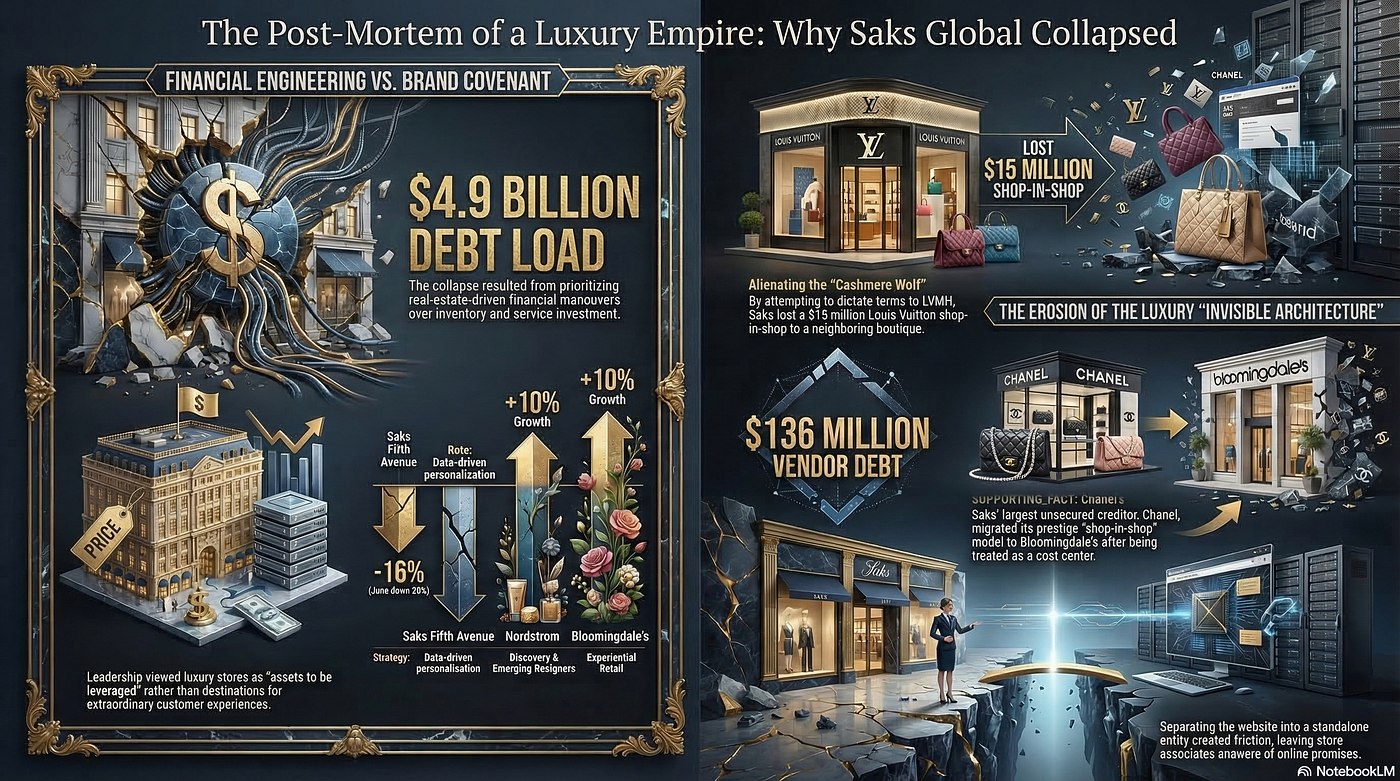
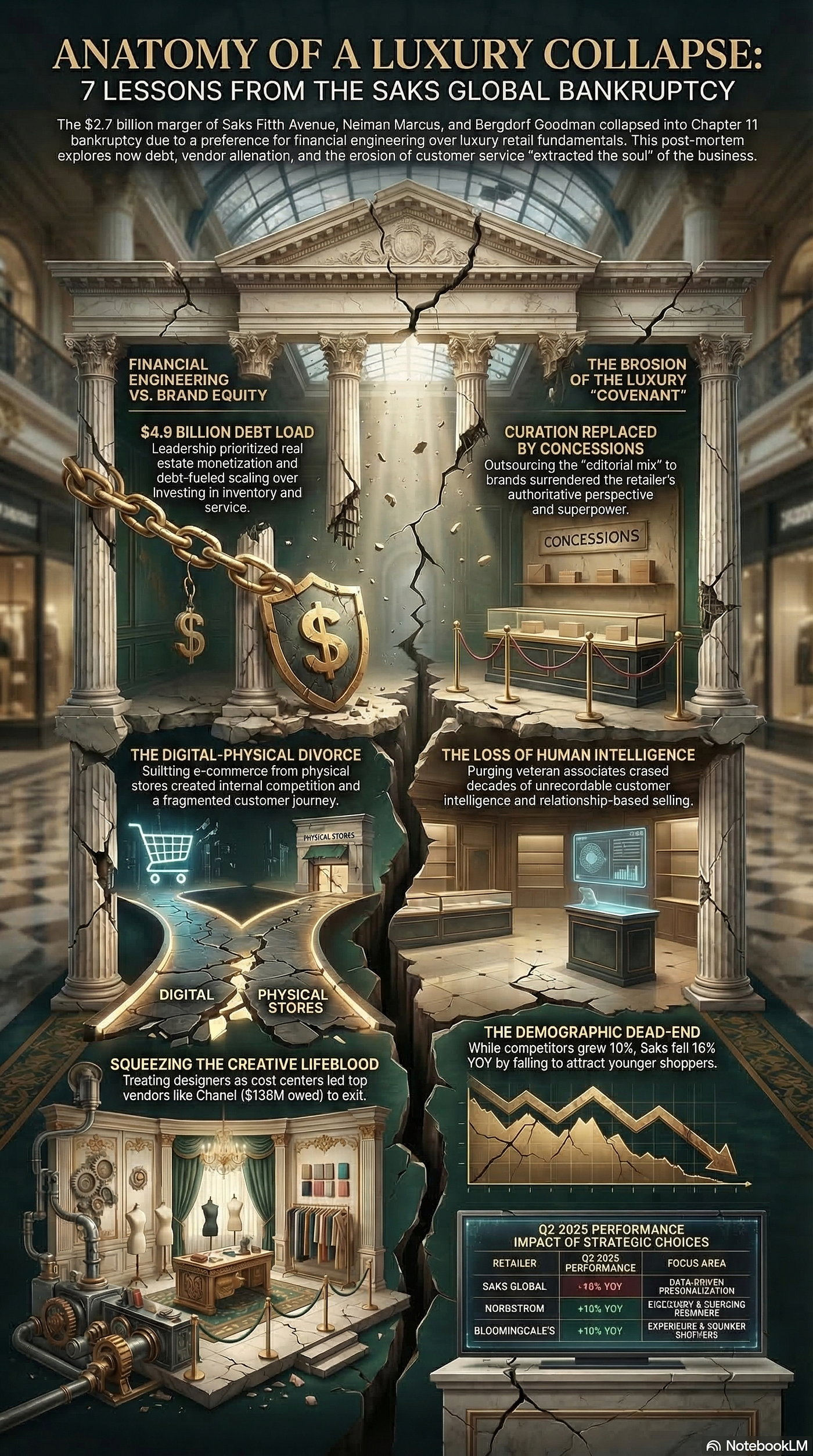
In just 13 months, a $2.7 billion merger involving Saks Fifth Avenue, Neiman Marcus, and Bergdorf Goodman collapsed into Chapter 11 under $4.9 billion in debt. The easy reading is the company lost to modern retail conditions. The more accurate reading is leadership kept making decisions violating the core mechanics of the category it claimed to lead. Saks failed because leadership tried to run luxury as if it were a balance-sheet exercise with attractive window displays attached.
The great temptation of modern leadership is to believe complexity can be solved through structure alone. Add more systems, more data, more financial sophistication. Add more dashboards, more segmentation, more integration, more operating leverage. While these things can improve a business, none can save one whose leadership no longer understands what customers are buying.
Luxury customers aren’t buying products alone. They are buying taste, trust, context, curation, emotional certainty, and social meaning. Saks leadership appears to have forgotten this at nearly every turn. My Forbes six-part series on Saks Gobal shows how debt, concessions, vendor pressure, digital-physical fragmentation, and the purging of experienced associates all eroded the human and symbolic architecture of the business.
These mistakes aren’t unique to luxury. Plenty of growth-stage companies do their own version of this, chasing scale before alignment. They expand distribution before clarifying the story. They professionalize operations while neglecting brand meaning. They cut the people closest to the customer because those people don’t fit the efficiency model. Then they wonder why the company feels busier but less potent.
That is the disease. Saks is simply the dramatic specimen on the table.

In an example of corporate myopia in its purest form, vendor relationships were treated as a negotiation problem rather than a source of brand value. In premium markets, the people and brands who choose to stand beside you are part of the story customers tell themselves about you. Once leadership starts extracting from that ecosystem instead of cultivating it, prestige begins to leak. And prestige rarely announces its departure — it just relocates. Chanel’s move to Bloomingdale’s is an example of the brand’s final verdict.
For founder-led businesses, your collaborators, top-tier hires, and best partners aren’t decorative. They’re external proof your company is worth believing in. Lose enough of them and your market position weakens whether your internal reporting admits it or not.
In the case of Saks, leadership discarded institutional intelligence. In categories where high-value sales depend on confidence, timing, personal memory, and objection handling, experienced frontline people are conversion infrastructure. Leadership often talks about customer centricity while firing the people who best understand the customer.
[embed]
If your internal teams can’t articulate why customers choose you, no amount of campaign activity will save you. If sales, leadership, product, and marketing don’t share one coherent narrative, execution becomes expensive improvisation. If customer experience is fractured between channels, teams, or incentives, the brand begins telling multiple, contradicting stories at once. Saks made this worse by separating e-commerce and stores into competing entities, producing a customer journey gap leadership created and customers paid for.
And then there’s the scale delusion.
The merger logic assumed a larger footprint would create power over vendors and better economics overall. But in luxury, power sits where desire sits. If the brands customers crave can open next door, your size doesn’t guarantee leverage. It may merely enlarge the cost of your misunderstanding. Richard Baker’s attempt to outmaneuver luxury’s most powerful players through debt and footprint now looks less like strategy and more like a long-form category misread. The wolf at the end of this story was never the retailer.
Saks kept leaning harder into an aging customer base instead of replenishing demand with younger shoppers. Competitors invested in discovery and experience while Saks over-indexed on personalization aimed at names already in the database. Spreadsheets can track lifetime value but can’t create the next generation of desire.
Relevance isn’t a museum asset. Brands plateau when leadership assumes past authority will keep compounding without deliberate cultural and narrative investment. But markets move along with expectations. Customers age and meanings shift. If your business still communicates like the world around it never changed, the market eventually starts translating on your behalf. Usually with less kindness than you would have preferred.
The Saks Global collapse is a warning about leadership philosophy more than retail tactics.
If you optimize extraction over trust, convenience over curation, structure over meaning, and control over partnership, decline will arrive as the logical conclusion of your operating model. Saks just made the ending unusually visible.
For any leader building a premium, design-led, or consumer-facing brand, the lesson is you can’t engineer your way around the laws of your category. You can only honor them or pay for ignoring them. Saks chose the invoice.
If your company is plateauing because the market no longer understands your value as clearly as it should, connect with me on LinkedIn at https://www.linkedin.com/in/lilianrajipr/. I help founders, operators, and marketing leaders close the gap between what they’ve built and how the market perceives it. You can also read more from me on Forbes at https://www.forbes.com/sites/lilianraji/.
메타데이터
- post_id
- 2c0a53baccd7
- slug
- saks-global-collapsed-because-leadership-forgot-what-luxury-is-2c0a53baccd7
- url
- https://medium.com/@lilianraji/saks-global-collapsed-because-leadership-forgot-what-luxury-is-2c0a53baccd7
- canonical_url
- https://medium.com/@lilianraji/saks-global-collapsed-because-leadership-forgot-what-luxury-is-2c0a53baccd7
- author_url
- https://medium.com/@lilianraji
- status
- ok
- fetched_at
- 2026-07-11 21:51:11




