Traditional Softphone vs AI-Powered Softphone: What Actually Changes
Quick Summary: A traditional softphone connects calls. An AI-powered softphone does that too, then goes further: translating conversations…
Traditional Softphone vs AI-Powered Softphone: What Actually Changes
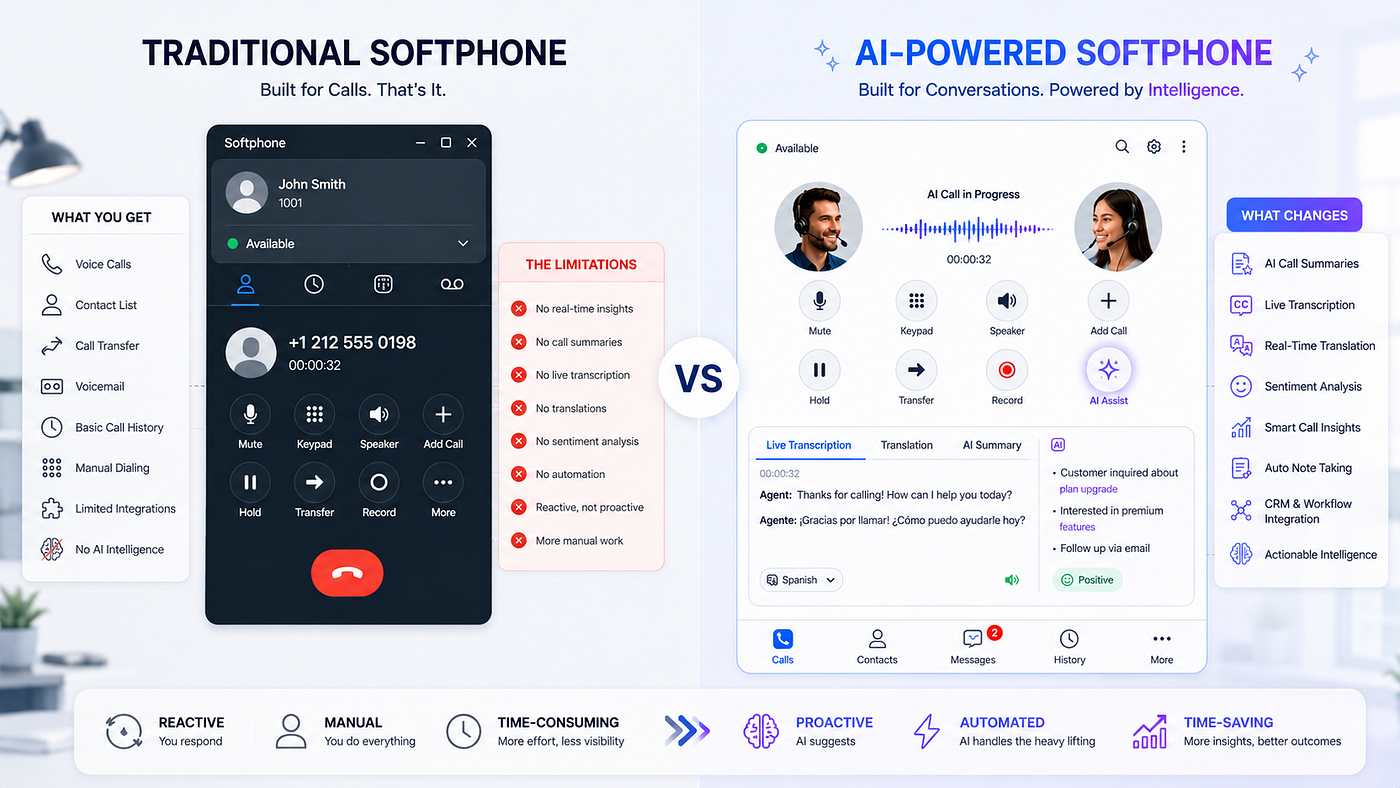
Quick Summary: A traditional softphone connects calls. An AI-powered softphone does that too, then goes further: translating conversations live across languages, transcribing and summarizing them, and turning what was said into something you can search later. The real change isn’t better call quality. It’s that the phone starts doing work that used to fall on the people using it.
For a long time, comparing softphones meant comparing roughly the same thing. Call quality, reliability, which platforms they ran on, how they were priced. All of them did the same core job, connect a call, and you picked based on who did that job a bit better or cheaper.
That comparison is starting to break down, because a genuinely different kind of softphone has shown up. The AI-powered kind doesn’t just do the old job slightly better. It does things the old kind couldn’t do at all. So instead of another “which one has clearer audio” piece, here’s an honest look at what actually changes when a softphone gets AI built into it.
So what is an AI-powered softphone?
An AI-powered softphone is a calling app that uses artificial intelligence to work with the content of a conversation, not just carry it. On top of making and receiving calls, it can translate speech between languages in real time, show a live transcript in the reader’s chosen language, summarize the call afterward, and turn conversations into searchable records. A traditional softphone connects people; an AI softphone also captures and understands what they said.
Put another way, a traditional softphone hands you a clear line and steps out of the way. An AI softphone stays on the line and does useful work with what it hears.
First, the honest bit: it still has to make good calls
Before getting into what AI adds, one thing worth saying plainly. Reliable calling is still the foundation, and it doesn’t stop mattering. An AI softphone that translates seamlessly but drops calls is a worse product than a plain one that just works.
So this isn’t “AI softphone replaces the fundamentals.” It’s “AI softphone does the fundamentals and then adds a layer on top.” Keep that in mind, because it’s the honest framing. The AI is only worth anything if the calling underneath it is solid.
With that said, here’s what the layer on top actually changes.
Talking to people who don’t speak your language
This is the biggest change, and it’s the one that’s hard to overstate if it applies to you.
A traditional softphone, faced with a customer who speaks a language your agent doesn’t, leaves you two options: hire someone who speaks it, or bring in an interpreter. Both cost money and add friction.
An AI-powered softphone can translate the conversation live, in both directions, as people speak. Each person talks in their own language and hears the other in theirs. Modern implementations cover a wide range of languages (Tragofone’s AI softphone, for example, handles real-time translation across 70+ languages), auto-detect what’s being spoken, and even remember a given contact’s language for next time. For a business serving customers across languages, that turns a staffing problem into a software feature.
Worth knowing how it works in practice: the translation runs on the side of the person who starts the call, which is on a desktop or web app where the processing sits. The person on the other end can be on their phone, a desktop, or an ordinary phone line, and it still works, because their device isn’t doing the translating.
Reading the call, not just hearing it
Traditional softphones give you audio. If you want a record, you record the call and re-listen later.
AI softphones turn the conversation into text as it happens, and here’s the part that matters: not just in the language spoken, but in the language you read. There’s a real difference between a transcript in a language you don’t speak and one rendered in your own. The three modes usually look like this: live speech-to-speech translation for the conversation itself, a live translated on-screen transcript so you can read along in your language, and after the call, the ability to translate a saved transcript into any language you choose. A traditional softphone gives you none of this. It gives you a recording you have to sit through.
Getting the summary instead of the whole recording
Anyone who’s had to review calls knows the pain of scrubbing through audio to find the one thing that was said.
A traditional softphone leaves you doing that manually. An AI softphone writes a summary when the call ends: what was discussed, what was decided, what the next steps are. You read the key points in seconds instead of replaying twenty minutes of audio. And because the transcript is searchable, finding “what did we promise that customer in June” becomes a keyword search rather than an archaeology project.
Turning conversations into something you can actually use
This is the quieter, longer-term change. In a traditional setup, everything said on a call basically evaporates once the call ends, unless someone took notes. The knowledge is trapped in people’s memories and the occasional recording nobody re-listens to.
An AI softphone treats conversations as data. Transcribed, summarized, searchable, translatable. Over time that turns your calls into a body of knowledge you can search and learn from, rather than a series of events that happened and then vanished. That shift, from conversations-as-events to conversations-as-intelligence, is the deeper thing the technology is doing.

Who gets the most out of an AI softphone?
Almost every business stands to gain something here, and the value shows up fast once you start looking for it.
If you deal with customers or partners across languages, an AI softphone is transformative: it turns a staffing challenge into a feature you simply switch on. If your team reviews calls, follows up on commitments, or needs to keep good records, the automatic summaries and searchable transcripts save real hours every week. And if you operate in a regulated industry, having documented, searchable, compliance-ready records built in is a genuine advantage rather than an afterthought.
The businesses that benefit most are the ones where communication is central: call centers, multilingual customer bases, teams spread across countries, and regulated industries that need documented records. For all of them, an AI softphone isn’t a nice-to-have, it’s an operational edge that compounds over time. And because the AI sits on top of reliable calling rather than replacing it, adopting it doesn’t mean giving anything up. You keep everything a great traditional softphone gives you, and gain a whole layer on top.
The bottom line
The old way of comparing softphones, feature for feature on call quality and price, still matters, but it no longer captures the whole picture. A traditional softphone and an AI-powered one aren’t two versions of the same product anymore. One connects your calls. The other connects them and then puts every conversation to work for you.
That’s the real opportunity here. An AI-powered softphone keeps everything you already rely on, dependable calls, familiar workflow, and adds a layer that translates in real time, captures what was said, and turns your conversations into something you can search, share, and learn from. For any business where communication drives the work, that’s not a small upgrade. It’s the difference between a phone that carries your conversations and one that actively helps your business grow.
Here are some frequently asked questions
What is the difference between a traditional and an AI-powered softphone?
A traditional softphone connects calls. An AI-powered softphone also works with the conversation: translating it live, transcribing and summarizing it, and making it searchable. The AI is a layer on top of reliable calling, not a replacement for it.
Can an AI softphone really translate calls in real time?
Yes. It translates speech in both directions as people talk, so each person speaks their own language and hears the other in theirs. It also produces a live transcript in the reader’s preferred language.
Who benefits most from an AI-powered softphone?
Businesses dealing with language barriers, heavy call review, or knowledge capture: call centers, multilingual customer bases, distributed teams, and regulated industries needing documented records.
메타데이터
- post_id
- 2c1fa09bb78d
- slug
- traditional-softphone-vs-ai-powered-softphone-what-actually-changes-2c1fa09bb78d
- url
- https://medium.com/@John-william09/traditional-softphone-vs-ai-powered-softphone-what-actually-changes-2c1fa09bb78d
- canonical_url
- https://medium.com/@John-william09/traditional-softphone-vs-ai-powered-softphone-what-actually-changes-2c1fa09bb78d
- author_url
- https://medium.com/@John-william09
- status
- ok
- fetched_at
- 2026-08-22 01:46:00