Decentralized Governance: A Case Study on Aave & Sky DAO
by Jordan Brewer
Decentralized Governance: A Case Study on Aave & Sky DAO
by Jordan Brewer
Case Study Overview
Decentralized Autonomous Organizations (DAOs) represent a transformative shift in organizational governance, leveraging blockchain technology to enable decentralized decision-making processes. The two fundamental aspects of human coordination and organizational operations are trust and incentives: I can trust that you will do something because you signed a legally binding hiring contract, and you agree to this because I will pay you. Blockchains take this further by fortifying trust through trustless technology, and by enabling creation of novel incentive mechanisms through tokens. The following is a case study that examines two successful DAOs, Aave and Sky (FKA MakerDAO), and proposes several commonalities that have led to their success as DeFi blue chips.
Please note that I will assume the reader has a baseline understanding of what a DAO is and the main products that Sky and Aave offer (an overcollateralized stablecoin, and collateralized debt positions (CDPs), respectively).
Aave
Background
Aave is a peer-to-peer borrow and lend market that was launched in 2017 as “ETHLend”. In 2018, ETHLend rebranded to Aave, launching Aave v1 in January 2020. In October 2020, the legal entity Aave Limited handed over control of the Aave protocol to the Aave DAO, consisting of Aave token holders that vote on proposals to make changes to the protocol. Since then, the primary product offerings of Aave have expanded to add more assets to supply and borrow, to enable flashloans, and to create a decentralized stablecoin GHO. GHO is the most profitable product line the protocol offers as it is comparable to DAI in that users can deposit collateral and borrow GHO against that which pays all interest fees directly to the Aave DAO rather than to the lender.
Governance
Voting
Aave’s decision making process, referred to as “Aavenomics”, is the process in which changes are made to the Aave protocol. The process of getting from idea to execution in the Aave DAO includes a series of 4 steps that typically takes 5 days for routine changes such as parameter adjustments.
Usually an idea will be introduced in the Aave Governance Forum as a forum discussion where feedback and debate refine the idea. If an idea gains traction, it will proceed to an offchain Temp Check vote. Here, an informal poll is launched that lasts ~3 days to gauge community sentiment where a positive outcome signals interest but is non-binding. Following a successful Temp Check, an idea will proceed to Aave Request for Final Comments (ARFC) where the proposal undergoes formal scrutiny from service providers and community members. After a successful ARFC, the idea is drafted as an onchain Aave Improvement Proposal (AIP). In order to create a new AIP, a certain amount of AAVE (owned or delegated) is required as proposition power. Voting must meet certain quorum requirements and reach a majority pass, and voting can occur on multiple networks. Occasionally, AIPs will take the form of Quarterly Upgrades, but it is not required that AIPs be included in a quarterly upgrade, nor does a quarterly upgrade happen every quarter. If the onchain vote succeeds, the proposal is queued in timelock and then executed by the governance smart contracts.
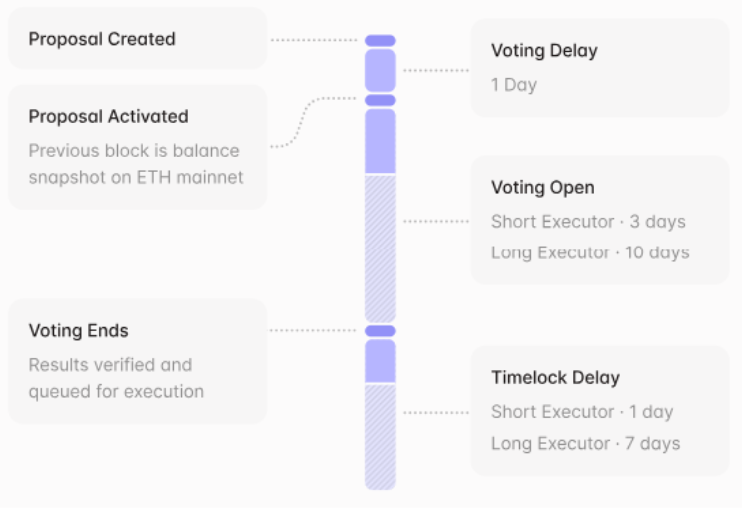
The Voting Period and Timelock Delay can slow down if the proposal is something major such as changes to the governance mechanism or protocol itself, rather than routine changes. Long Executor proposals are typically 13 days longer than Short Executor proposals.
Major AIPs
Aave v3: As the name suggests, Aave v3 was not an explicit initiative, but rather the next iteration of the Aave protocol intended to enhance protocol offerings. Launched in March 2022, This included cross-chain liquidity, higher loan-to-value ratios, and isolation mode and other forms of added risk management. While this is not the most groundbreaking initiative of the Aave DAO, it is constant evolutions like these that compound over time to enable DeFi protocols to compete with CeFi products.
GHO: In July 2022, Aave introduced the GHO stablecoin that was subsequently launched on mainnet in June 2023. GHO is a decentralized stablecoin that can be minted against collateral where 100% of the interest payments go to the Aave DAO rather than to the lender of other stablecoins such as USDC or USDT. GHO generates substantially more revenue than USDC borrowing and has been a big focus as a revenue driver. However, GHO also adds new risks that must be considered and different functions such as the GHO Stability Module to maintain the GHO peg. Aave has continued to iterate on its GHO strategy, but adoption has been slow rather than explosive. This slow adoption is surprising in some regards, but expected in others. On one hand the GHO stablecoin could offer significantly lower borrowing rates than something like USDC as Aave does not need to pay an LP to incentivize lending, which would make it the go-to solution for those looking for the cheapest way to borrow against their assets. On the other hand, GHO is new compared to DAI which is a more battle-tested decentralized stablecoin that has managed to maintain its peg and solvency over a much longer period of time. While there have been discussions of integrating RWAs, there has not been any effective execution here yet. Going forward, Aave’s strategy for pushing GHO adoption could emulate SkyDAO, or be something completely different.
Aavenomics Overhaul: Proposed by Marc Zeller and the ACI, the Aavenomics Overhaul (“Aavenomics”) started ARFC on March 4, 2025 and was proposed as a temp check in July 2024. The Aavenomics proposal includes many different aspects, but the two biggest are the token buyback and improvements to the Safety Module (SM). The token buyback was proposed at $1 million in AAVE per week for the first 6 months, and these tokens would then be available to use for incentives and redistribution as a form of distributing value back to tokenholders. Along with the token buyback itself, the proposal also included the creation of the Aave Finance Committee (AFC) which is composed of delegates and service providers. The motivation for the AFC is to facilitate the token buybacks and determine how the tokens should be utilized, or treasury management. The other major aspect of Aavenomics is modification to the SM. Previously, the SM consisted of staked AAVE and staked BPT (LP Balancer Pool Tokens for the AAVE/ETH pair) where these stakers were paid in AAVE tokens to serve as the first line of defense in the event the value of collateral drops too fast and liquidators cannot do their job, resulting in protocol insolvency. These staked AAVE tokens would then be sold on the open market to recover the capital needed to make the protocol solvent. While this SM has never needed to be used, the risk for token holders that a Black Swan event could be exacerbated by hundreds of millions of dollars of AAVE being market sold still existed. However, as part of the Aavenomics proposal, instead of staking AAVE as part of the SM, depositors to Aave can stake their aTokens such as aUSDC as a first line of defense. Under this design, in the event of a collateral shortfall, the staked aUSDC would be slashed and the original depositor would lose their claim to the USDC they had deposited. To compensate stakers for this risk, they will be compensated in a similar way to the legacy SM architecture.
ARC: Aave ARC was launched in January 2022 as an Aave deployment intended to onboard institutional investors through a permissioned and KYC-compliant environment. Fireblocks had whitelisted 30 institutions to use Aave ARC, and ARC had the ability to add multiple whitelisters with Securitize as a second whitelister. The Aave governance process was utilized to approve these whitelisters. While the Aave ARC deployment included features that were important to institutions such as siloed risk, custodian integration, KYC, and conservative parameters, the deployment failed to reach notable adoption as TVL remained around $6–8 million. On November 23, 2022, ARC’s TVL dropped from ~$8m to almost nothing as a major participant withdrew their funds, which suggests that there were very few institutions using the deployment. There are several possible reasons why this initiative didn’t succeed. The initiative launched around the same time the crypto market started to fall apart with FTX’s bankruptcy in 2022 and the implosion of Terra Luna. Additionally, a P2P lending market such as Aave succeeds when there is deep liquidity among an incredibly large set of users that are all geographically decentralized, and when participants do not care about who their counterparties are. This is fundamentally different from the ARC deployment where a small number of entities could participate, and all of these entities had to be whitelisted anyways. CeFi institutions already have access to more established capital market infrastructure, and when the ARC deployment requires whitelisting, many of these CeFi institutions could receive the same services but with less friction by working directly with other CeFi institutions.
Segmentation
The Aave DAO has several ecosystem roles that facilitate decision making, proposal origination, and overall ecosystem input. The Aavenomics paper that was launched in March of 2022 defines Aave DAO governance and describes the proposal process. It also identifies 4 key protocol policies that the DAO considers to effectively split up different initiatives and focal points of the protocol. The Aavenomics paper effectively outlines DAO operations at a high level, but the structure of the DAO, the specifics of the protocol, and the governance mechanism itself are all intended to be mutable through the governance process and successful AIPs.
Risk Policies define a set of rules that ensure safety of the protocol. The decision-making included under Risk Policies includes but is not limited to assets compatible for integration, modelling of the interest rates, risk parameters for overcollateralization and liquidation, behavior of the Safety Module (SM), and acceptance of new money markets.
Improvement Policies define the rules for improvement inception, development, and application. This includes improvements to smart contracts, governance processes, governance contracts, the Safety Module, and the AAVE token contract.
Incentive Policies define the rules around token generation to create financial incentives around a specified behavior. This includes Safety Incentives for the Safety Module, and Ecosystem Incentives for the liquidity providers and liquidators.
Market Policies establish a list of parameters that must be defined in order to create a new money market. These parameters include supported assets to provide liquidity and borrow from, supported collateral assets, market-specific component updates, asset risk configurations, and asset interest rate models.
These are all important distinctions to separate core functions and initiatives of the DAO, allowing ecosystem participants to properly assess AIPs and how they fit into the broader Aave architecture. The way that these different policies appear in governance participation can be seen in the different companies engaged by Aave DAO.
Aave engages 8 companies to provide essential services to the Aave DAO and are split into 5 different services:
Risk: Chaos Labs & Llama Risk
Finance: Karpatkey & Tokenlogic
Security: Certora
Development: BGD Labs & Aave Labs
Growth & Business Development: Aave Chan Initiative (ACI)
Separating out the types of services providers needed by the DAO prevents scope creep and allows specialization without sacrificing different objectives. For example, the GHO Stewards who are responsible for assessing the GHO borrow cap, borrow rate, and various GHO Stability Modules like exposure cap, bucket capacity, price strategy, and fee strategy consist of Karpatkey, Tokenlogic, the ACI, and Chaos Labs. The GHO Stewards are a perfect example of how clearly identifying the strengths needed for different aspects of the protocol allows for a better protocol offering as professionals work together to cover every aspect of the protocol. These service providers often also serve as delegates that propose AIPs and participate in governance.
In addition to the standard Delegate and Delegator structure seen by many DAOs, Aave also utilizes Contributors that engage in working groups, complete bug bounties, build on the protocol, or work through grants. These grants fall into one of 8 categories and include funding for hackathons, sponsorships, and rAAVEs: protocol development, applications and integrations, developer tooling, community, committees/subcommittees/DAOs that serve the Aave ecosystem, code audits, events and hackathons, and bounties.
Sky
Background
The idea of Maker was first articulated in 2014 when Rune Christensen wrote a reddit post about eMoney. In 2017, this post came to life when a single collateral (ETH) stablecoin was launched on the Ethereum blockchain. In 2019, this expanded to be multi-collateral, and in 2021, the foundation behind Maker was dissolved and the protocol decentralized in the creation of MakerDAO. Since then, MakerDAO (rebranded to Sky) has been the pinnacle of decentralized organization and coordination with intricate governance processes designed to achieve the goal of being a decentralized, onchain bank.
Governance
Voting
While the fundamental idea of token holders voting “yes” or “no” on changes to the protocol where the more tokens that are voted with represent greater voting power is simple, the process in which this happens is intricate. Sky Improvement Proposals (MIPs) are the changes that are voted on, and they follow a monthly cadence of six phases.
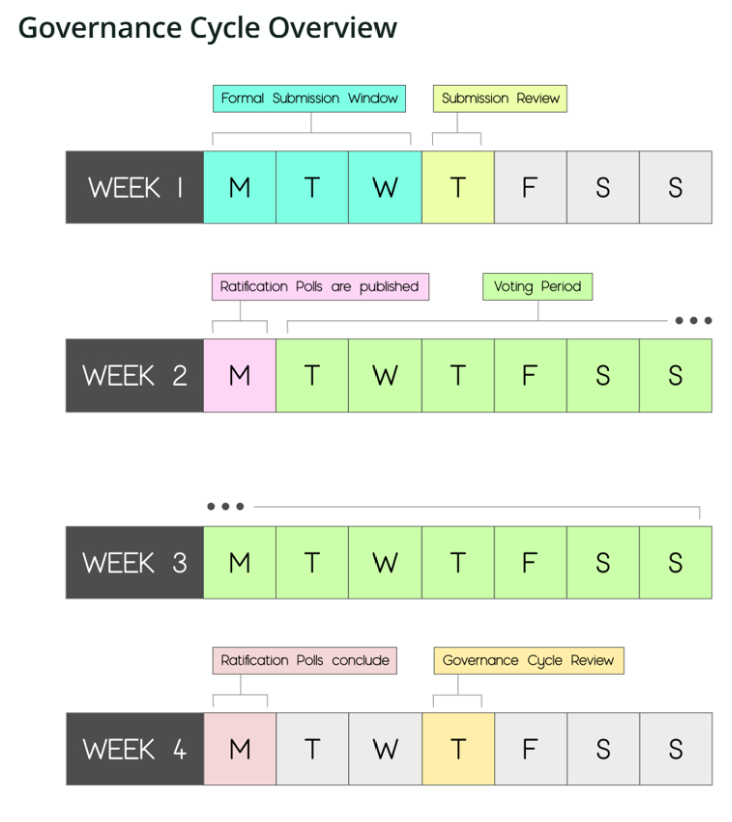
Week 1
Monday — Wednesday: MIP Authors move their proposals to Formal Submission
Thursday: Governance Facilitators perform the Submission review as part of the weekly Governance and Risk meeting to determine which proposals are in accordance with the relevant guidelines and come to consensus on which submissions should move forward.
Week 2
Monday: Governance Facilitators publish the set of Ratification Polls for a two week voting period.
Week 4
Monday: Ratification polls conclude and each proposal is marked as Accepted or Rejected.
Thursday: Governance Facilitators do a Governance Review Cycle as part of the weekly Governance and Risk meeting where they summarize and discuss the Governance Cycle with the community.
For decisions that require quicker action than the Monthly Governance Cycle, there is a consistent Weekly Governance Cycle. The Weekly Poll is a non-binding governance poll that dictates what will be included in the next Executive Vote. A Non-Standard Weekly Poll also exists for urgent changes and is restricted to Facilitators.
The final piece in the voting process are the Core Units. These are contributor teams that are voted into existence via three proposal types: a mandate, a budget, and a facilitator who is responsible for interfacing between governance and the Core Unit.
Core units: Risk, Growth, Sustainable Ecosystem Scaling, Oracles, DAI Foundation, StarkNet Engineering, Data Insights, Sidestream Auction Services, Strategic Finance, and TechOps.
Major MIPs
MIP 101: MIP 101 was proposed in March 2023 and was approved by 76% of voters. MIP 101 introduces the Sky Constitution which outlines the core principles, governance structures, and operational guidelines of the protocol. MIP101 also introduces the Sky Atlas to describe the governance processes in more detail. The Constitution and Atlas are considered “Immutable Alignment Artifacts”, which contrasts with “Mutable Alignment Artifacts”. As their names imply, Mutable Alignment Artifacts are a dynamic set of rules with the intention of being more specific and adapting to the initiatives of the DAO and the environment it operates in, while the Constitution itself is much more generalized to provide a framework for how the DAO operates. The Constitution also introduced 12 scopes, including 5 core scopes, that identify key aspects of the protocol itself to help guide the evolution of the scopes.
Endgame MIP Set: In October 2022, the ratification poll for a set of 8 different MIPs was approved by 80% of voters. This set of MIPs included the launch of Sky Core Units as “MetaDAOs” to drive specialization and focus in contrast to the previous generalized, more centralized Core Unit framework. By recognizing MetaDAOs, Sky is continuing to enable specialization to push development without sacrificing other initiatives. The Endgame MIP Set also included the ability for SkyDAO to open a vault itself and generate DAI using its own assets. This is part of the broader shift towards SubDAOs to use Sky as a pseudo-central bank to borrow DAI and allocate it to lucrative opportunities, such as an LP position in Aave. The MIP Set included several other changes, but MIP83 and MIP84 were the two largest modifications.
Smart Burn Engine: In June 2023, the Smart Burn Engine was voted on with 100% of voters approving of the proposal which included amendments described in MIP101 and MIP104. The previous burn engine used revenue to buy back the MKR token and burn it when there was more than 50M in the Surplus Buffer. The Smart Burn Engine proposed changing this from a “buy-and-burn” to a “buy-and-LP” where instead of burning the acquired MKR, it was deposited into a Uniswap v2 pool (now Uniswap v3 pool). This was a unique perspective to the buy-and-burn dynamic that was widely accepted at the time, and drove liquidity to $15 million, which is significantly deeper liquidity than many other blue chip pairs that typically sit around $7 million or less in liquidity, with Aave being a notable exception at $140 million in liquidity.
Real World Assets: In May 2023, the addition of Treasury Bills as DAI collateral was accepted by the DAO with 100% voter approval. The proposal was the first major DAO to initiate a large-scale RWA acquisition strategy. This was a big moment for DAOs as organizational bodies interacting with the world outside of strictly what lives onchain and in many ways was a Pandora’s Box moment for onchain entities. This brought $50 million in revenue from an offchain source to an onchain beneficiary in 2023. Prior to this initiative by SkyDAO, no DAO had meaningfully interacted with traditional finance in a truly decentralized manner.
Segmentation
A key aspect of SkyDAO governance is parsing apart different objectives and clearly defining each one. This enables the DAO to effectively execute on a variety of different initiatives in an organized manner. The Core Units are one instantiation of this segmentation, Scopes introduced by the Constitution are another. The Constitution introduced 12 scope frameworks, including 5 core scopes, that separate out the different initiatives and focuses of the DAO to mitigate scope creep. While all 5 of the core scopes are critical to SkyDAO’s success, this case study will focus on the Governance Scope as the decision making process for SkyDAO.
The SkyDAO governance manual states that the Governance Scope “Codifies rules that regulate the critical balance of power processes defined in the Sky Atlas, and adjudicates on appeals processes related to misalignment in the ecosystem.” The Governance Scope has a set of modifiable Governance Scope Artifacts to refine and iterate on the decision making process of the DAO itself. While the MIP process described earlier outlines how proposals are voted on, there are many steps in between idea origination and idea execution.
Atlas defined Governance Scope Flow
Within the Governance Scope, there are several different players and a set of rules outlined by the Atlas, or the Sky Core Alignment Artifact. Each of the 12 scopes has an Advisory Council that proposes improvements to the Mutable Alignment Artifacts of that scope. The Governance Advisory Council (GAC) is responsible for the Governance Scope Artifact, which is the ruleset that defines the processes of the Governance Scope.
The Atlas also defines 5 key parties involved throughout these processes in the governance scope. These parties are known as Alignment Conservers and consist of Alignment Voter Committees, Aligned Delegates, Facilitator DAOs, Facilitators, and Professional Ecosystem Actors.
Aligned Voter Committees (AVCs): The primary responsibility of AVCs is to produce quarterly reports for both the ratified Aligned Governance Strategy and ratified Aligned Scope Proposals for each of the 5 core scopes. While the Governance Scope Artifact defines the balances of power within the Governance Scope, the Aligned Governance Strategy is a Mutable Alignment Artifact that articulates the strategy and long term vision of the Governance Scope. AVCs receive support from the Support Scope and get input from both the Facilitator DAOs and the GAC regarding possible improvements to the Governance Scope Artifacts. There are certain requirements for AVC creation and requirements to stay as an active AVC.
Aligned Delegates (ADs): ADs are registered based on the Governance Scope Artifacts and fall into one of two categories: Prime Delegates (PDs) and Reserve Aligned Delegates (RDs). The Governance Scope Artifact dictates that there are an equal number of PDs and RDs, and the amount of delegates changes based on the total amount allocated to pay for ADs. ADs must participate in a certain number of Constitutional Voter Committee meetings, which are outlined in the Constitution.
FacilitatorDAOs: FacilitatorDAOs are subDAOs that are given responsibility over scopes of Sky or other subDAOs. The Sky Governance Scope Artifact must specify a process used to assign an Artifact to a particular FacilitatorDAO. Every scope has a FacilitatorDAO, and every FacilitatorDAO has a scope.
Facilitators: Are individuals who work with Core Units and engage with FacilitatorDAOs to access governance processes and smart contracts. Facilitators serve as the liaison between Core Units and the broader governance process.
Professional Ecosystem Actors (PEAs): PEAs include the members that make up the GAC as well as other Active Ecosystem Actors which has a broad application and can include professional organizations such as Blockworks or Steakhouse, other DAOs like Aave, and any other individuals or entities that work on the DAO in a professional capacity.
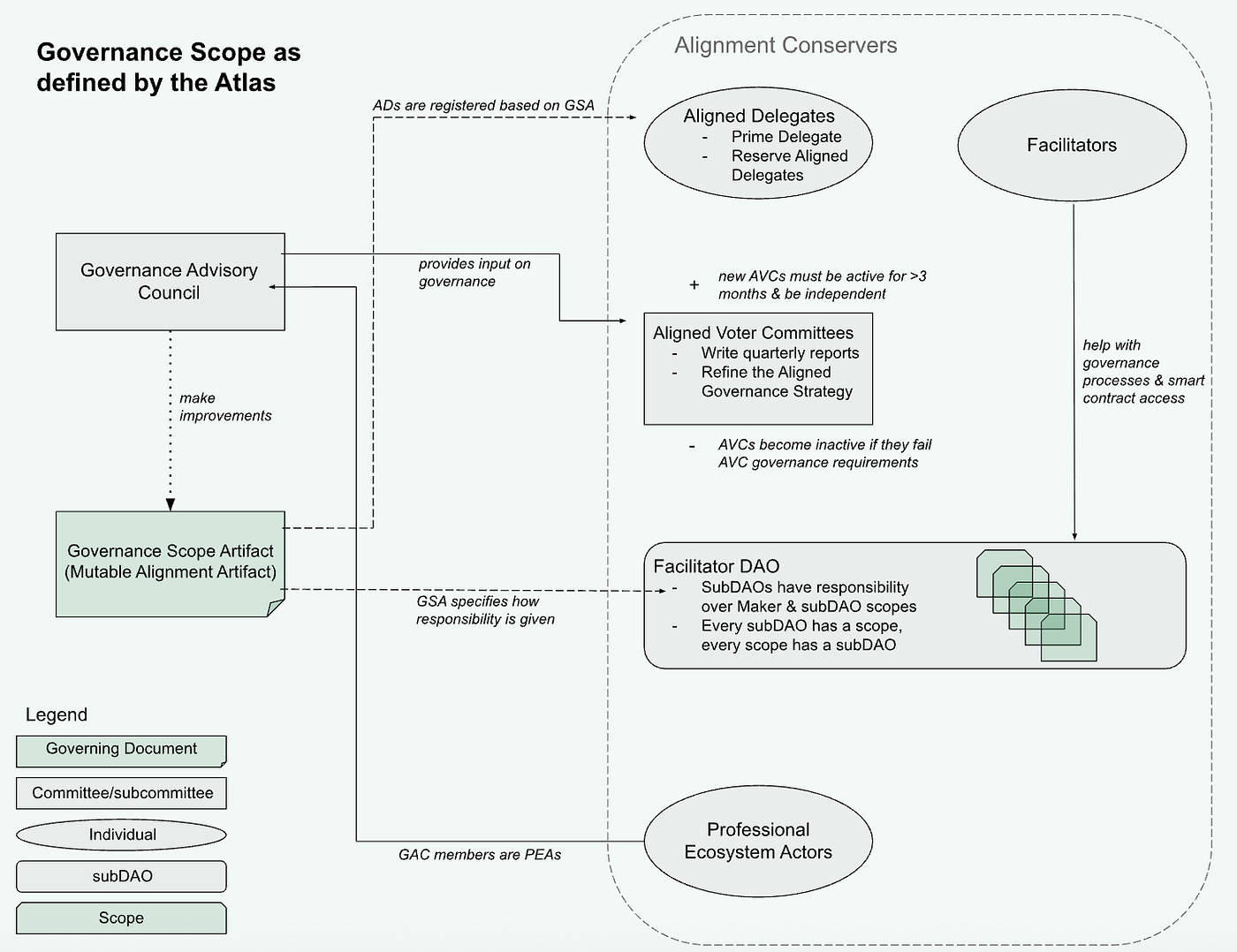
All of these different actors work synergistically in Sky governance and oversee the Governance Scope. These clear definitions and broad set of participants ensures that every aspect is captured to prevent scope creep and clearly articulate the organizational structure of the DAO. When comparing Sky to a traditional bank, this governance breakdown would be the equivalent of teams of teams in different divisions, all organizing based on business function and role within that business function. Without this clear breakdown of responsibilities and flow of information and decision making, the DAO would look like a company that discusses all of its decisions at the Board Meeting, everything from what snacks to have in the office and whether or not to work from home on Fridays, all the way to deciding whether to add a new product line.
Key Insights on DAO Structure
One Step Removed
A key feature of the SkyDAO Governance Scope is that it created a process for other people to follow to make improvements to the Sky protocol. Instead of making the changes itself, the protocol enables others to make these changes. An example of this can be seen in the Governance Scope. This intricate web of participant types establishes all the different roles that are available to support ideas and implement them into the protocol. This incentive structure encourages community participation by having clearly defined aspects of the protocol. The clarity and segmentation is incredibly important to prevent scope creep and is one of the reasons SkyDAO has been successful in a number of different initiatives such as RWA implementation, risk management, product expansion, security, and overall ability to scale to a $10 billion stablecoin issuer. By focusing on segmentation and encouraging participation from any individual or entity, the DAO does not need to rely on a core team — a core team is “one step removed”.
The emphasis on this can clearly be seen in the language around the mission of the Support Scope: “New SubDAOs are continuously created by the core protocol logic of NewChain, and SUP6 must ensure that the necessary infrastructure is available to maximally support this incubation process and support the new SubDAOs in generating as much value as possible for the Sky Ecosystem.” The details of this Support Scope objective state that the objective is to “ensure the necessary infrastructure is available to maximally support this incubation process”. This suggests that the emphasis is on the infrastructure itself rather than the job. The Support Scope’s responsibility is not to incubate the subDAO, it is the Support Scope’s responsibility to create a system that is conducive for subDAO incubation.
The same can be seen in Aave’s governance where the infrastructure is in place to incentivize work for the DAO and enable the DAO to engage with contributors and service providers, rather than needing to directly organize these service providers. Instead of the Aave DAO having outlines for how a company like the ACI should operate and what their objectives are within the Aave documentation and governance, the Aave DAO opens the door for a company like the ACI to be created by others and leveraged by the DAO to push Aave forward and evolve.
The clear definition of the different scopes and initiatives of the DAOs is key to making a system that is “One Step Removed”. The segmentation of Aave and Sky governance and initiatives defines the structure in which the governance and goals of these protocols operate within. By articulating the different games and the rules to play, the structure of these DAOs is such that anyone can contribute, creating a resilient system that does not rely on a single entity. Even if core contributors were to abandon the protocols, the protocols would continue to exist and generate revenue, enabling new participants to step up and fill the void in return for monetary incentives controlled and owned by the DAOs.
Token Bailout
The recent Aavenomics proposal described earlier removes the AAVE token as the liquidity backstop in the event of a collateral shortfall. The significance of this proposal cannot be overstated. The ability for blockchain protocols to create tokens and serve as a money printer can create resilient, robust systems, or it can be used as a crutch to fill in any financial mishaps. While token emission rigidity is important for base layers and infrastructure such as Layer 1s and Layer 2s, having a dynamic token structure to create more tailored behavior incentivization is important to push the frontier of human coordination. Incentive design through crypto primitives is what will enable the applications of the future. Tokens should be used for incentive design, not as a get-out-of-jail-free card. Similar to the One Step Removed ideas discussed above, the role of the token is to create the system, not provide the service. The token is the means to the ends, not the ends in and of itself. Through this upgrade to the Safety Module, Aave is removing the use of their token as a get-out-of-jail-free card. While the slashing of staked AAVE tokens to sell is less offensive than minting tokens to sell, it is still less resilient than the new proposal where the governance token isn’t impacted at all by protocol insolvency.
This contrasts to Sky’s current architecture where a $50 million surplus buffer exists, but if bad debt exceeds $50 million in DAI, the MKR token will be minted and sold to recover capital and regain solvency. In the March 2020 Covid crash there was a collateral shortfall and this minting mechanism had to be implemented to recover $4 million in bad debt. At the time, the Surplus Buffer was set to $4 million or less, substantially less than the $50 million today. While conversation around changing the insolvency mechanism in Endgame, it is not clear what Sky’s strategy is and it is not as defined as that proposed in the Aavenomics proposal.
Deep Liquidity
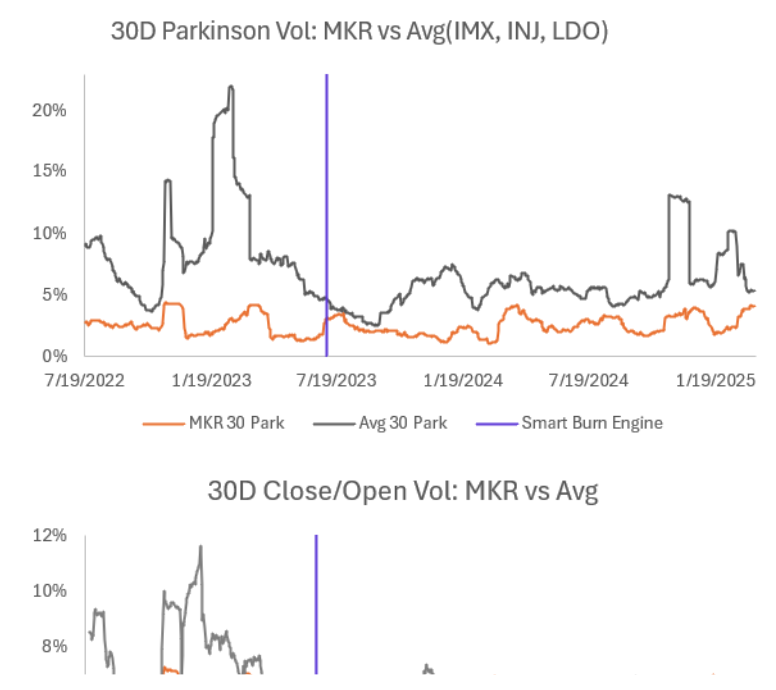
The Smart Burn Engine implemented by Sky drove deeper liquidity in a Uniswap pool for MKR through a token buyback, however Aave drove liquidity in a Balancer pool through direct LP incentives. These strategies vary in their implications. On one hand, AAVE has incredibly deep liquidity, in fact 10x deeper onchain liquidity than that of MKR. However, Sky’s mechanism removes these tokens from circulation in a much more defined way when compared to Aave’s mechanism where the token holders can withdraw their LP position and sell their tokens. Further, perhaps Aave is paying too much for liquidity incentives and has unnecessary excess token issuance for an unnecessary and excessive amount of liquidity. Prior to the Umbrella proposal, this deep liquidity was needed as the AAVE token was the backstop for bad debt. However, it is likely that Aave will reduce the unnecessary token emissions for Balancer LPs, which could affect token holders, ecosystem participants, and onchain liquidity. Regardless, both protocols are prioritizing token liquidity.
A simple 30-day volatility analysis using the Parkinson Volatility Estimator and the daily open/close volatility shows that there was no meaningful decrease in volatility after Sky implemented the Smart Burn Engine, however this does not mean that deep liquidity is not important. A majority of the liquidity improvements resulting from deeper liquidity are likely seen on a much smaller timescale such as CEX/DEX arbitrage on 1 block intervals, and transaction slippage. More details on this analysis can be found in Appendix A.
Token Buyback
Protocol income distribution has long been a point of discussion. The Aavenomic proposal previously discussed is Aave’s first proposal to redistribute value back to holders, and Sky’s burn engine has been acting as buy pressure on the MKR token for some time now. While this case study will not dive into the different considerations here as these buybacks do not currently pertain directly to governance, it is important to acknowledge the presence of this discussion. It is important to note that as buybacks and burns accumulate over time, the tokens in circulation decreases, which favors older holders. The decreasing token supply will make it more challenging, more expensive, for new entrants to purchase tokens and participate in governance. Thus, it makes it easier for older participants to entrench themselves in the governance process. Broadly speaking, Sky and Aave are some of the most mature DAOs that are cash flow positive, making income redistribution in the form of a buyback reasonable. In the future, it is possible that the Aave Finance Committee will decide to use these token buybacks that accumulate in the treasury as payments, incentives, and bigger budgets, in which case these buybacks will have a more direct impact on governance. However, native assets held on a protocol’s balance sheet cannot be treated the same (and valued the same) as non-native assets held on their respective balance sheets.
Further Areas of Research
- Voting arbitrage with Redacted Cartel and Hidden Hand
- Futarchy compared to legacy governance mechanisms
- Market convergence: DAI vs GHO and SparkLend vs Aave
- Product Ecosystem: Aave & Lens, Sky & non-DeFi SubDAOs
- Pushback to Sky Endgame (e.g. Hasu)
- SubDAO governance structure in Sky Endgame
- Sky MetaDAO governance dynamics
- Criticism of emergency proposal (allegedly) forced through by Rune
Appendix A
The Parkinson Volatility Estimator was used to capture intraday volatility to more accurately reflect the price action of crypto assets. The benchmark used to compare against MKR was an average of LDO, IMX, and INJ. These tokens were selected due to their comparable history of data, market capitalization, fully diluted valuation, and EVM deployment. The analysis used only Uniswap v3 pools and the pools for some of the comparable assets were intentionally selecting less liquid pools to further illustrate liquidity’s impact on volatility. A 30 day simple moving average (SMA) was utilized for both volatility metrics. Ultimately, there were no valuable insights from this analysis as there was no clear trend of decreased volatility after the implementation of the Smart Burn Engine. The liquidity pools used for analysis are below, with price data from TradingView. Initially CRV was also included in the average calculation, however, the pool price history had imperfect data that overstated volatility. As such, CRV was excluded from the average calculation.
https://dexscreener.com/ethereum/0xe8c6c9227491c0a8156a0106a0204d881bb7e531
https://dexscreener.com/ethereum/0xf4ad61db72f114be877e87d62dc5e7bd52df4d9b
https://dexscreener.com/ethereum/0x919fa96e88d67499339577fa202345436bcdaf79
https://dexscreener.com/ethereum/0xfd76be67fff3bac84e3d5444167bbc018f5968b6
https://dexscreener.com/ethereum/0x6c063a6e8cd45869b5eb75291e65a3de298f3aa8
Sources
https://manual.Skydao.com/governance-processes/governance-cycle/monthly-governance-cycle
MIP101: The Sky Constitution — Legacy / MIPs Archive — Sky Forum
Latest endgame-prelaunch-mip-set topics — Sky Forum
Introduction of Smart Burn Engine and Initial Parameters — Sky Core — Sky Forum
https://dexscreener.com/ethereum/0xe8c6c9227491c0a8156a0106a0204d881bb7e531
https://github.com/Skydao/governance-manual/blob/main/governance/scopes-and-artifacts.md
https://www.reflexivityresearch.com/free-reports/Skydao-overview
https://mips.Skydao.com/mips/details/MIP41#sentence-summary
https://github.com/Skydao/mips/blob/master/MIP101/MIP101.md
https://forum.sky.money/t/signal-request-adjust-the-surplus-buffer-2021-2/6250
https://aave.com/docs/primitives/governance
https://github.com/aave/aavenomics/blob/main/Aavenomics.pdf
https://aave.com/help/governance/aave-community
https://governance.aave.com/t/aave-chan-initiative-delegate-platform/10877
https://governance.aave.com/t/aave-grants-dao-update-renewal/11118
https://governance.aave.com/t/arfc-aavenomics-implementation-part-one/21248
https://governance.aave.com/t/introducing-aave-v3/6035#:~:text=,to%20a%20specific%20debt%20ceiling
https://governance.aave.com/t/introducing-gho/8730
https://governance.aave.com/t/temp-check-aavenomics-update/18379
https://open.spotify.com/episode/62V5yYQd9sm5z7QIWVlyGN?si=532760860bb647da
https://dexscreener.com/ethereum/0xe8c6c9227491c0a8156a0106a0204d881bb7e531
https://dexscreener.com/ethereum/0xf4ad61db72f114be877e87d62dc5e7bd52df4d9b
https://dexscreener.com/ethereum/0x919fa96e88d67499339577fa202345436bcdaf79
https://dexscreener.com/ethereum/0xfd76be67fff3bac84e3d5444167bbc018f5968b6
https://dexscreener.com/ethereum/0x6c063a6e8cd45869b5eb75291e65a3de298f3aa8
Link to full document pdf: https://docs.google.com/document/d/160kVmO0K95r16NjyNht6vv9sRv5luXWj/edit
메타데이터
- post_id
- 2c287d1f7cb2
- slug
- decentralized-governance-a-case-study-on-aave-sky-dao-2c287d1f7cb2
- url
- https://medium.com/@uoiflab/decentralized-governance-a-case-study-on-aave-sky-dao-2c287d1f7cb2
- canonical_url
- https://medium.com/@uoiflab/decentralized-governance-a-case-study-on-aave-sky-dao-2c287d1f7cb2
- author_url
- https://medium.com/@uoiflab
- status
- ok
- fetched_at
- 2026-06-21 15:33:18