Next trends in the Evolution of Spec-Driven Development
The Maturation of Spec-Driven Development in the Era of Agentic Orchestration
Next trends in the Evolution of Spec-Driven Development
The Maturation of Spec-Driven Development in the Era of Agentic Orchestration
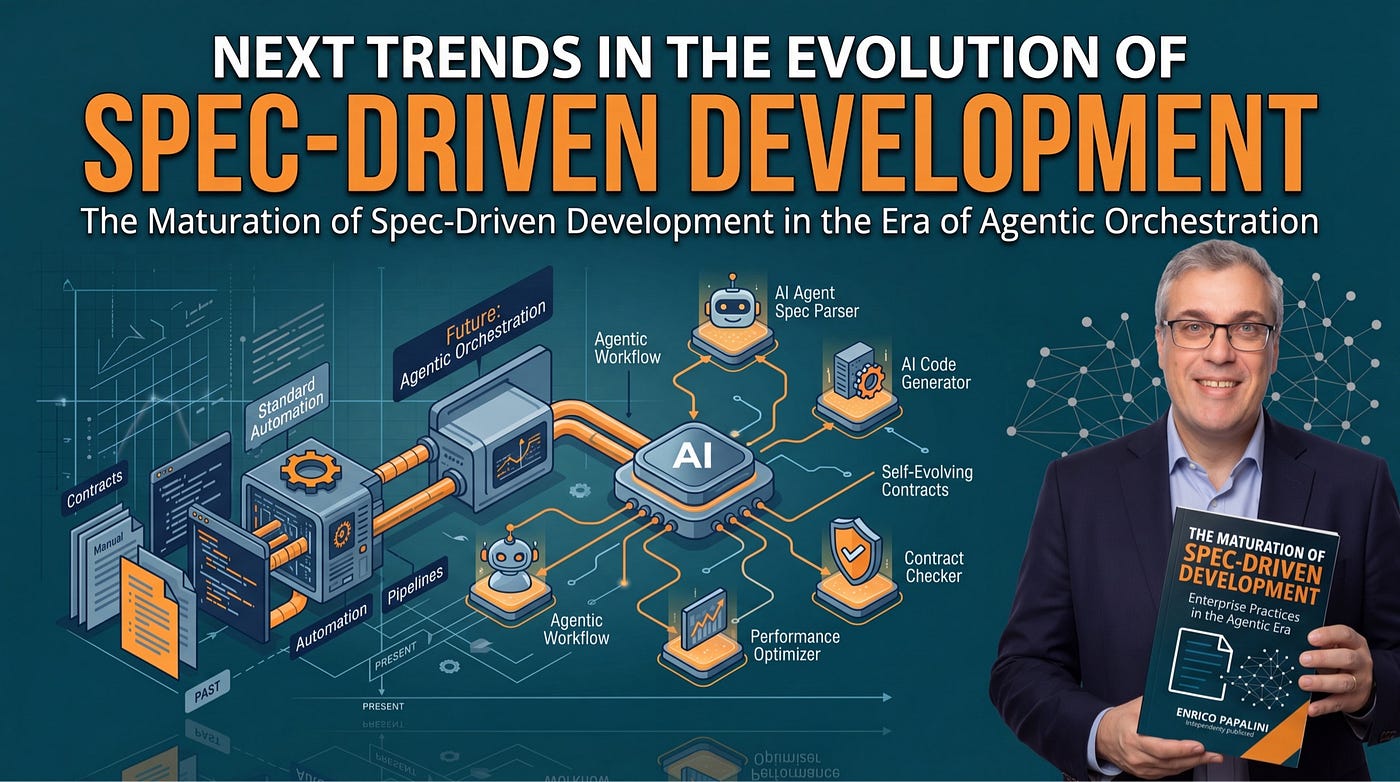
In my previous article, **The Evolution of Spec-Driven Development (1)*, I argued that Spec-Driven Development* (SDD) is the only logical path forward for software engineering in the age of non-deterministic, probabilistic AI tools. My thesis was simple: vibe coding is over. Vibe coding fails at scale because it relies entirely on the model’s ephemeral, increasingly polluted short-term memory. In a typical unconstrained session, a minor hallucination gets baked into the conversation history, burying critical architectural constraints and leading the agent to contradict earlier decisions, reinvent existing patterns, and generate unaligned code. I called this phenomenon context rot.
Spec-Driven Development (2) emerged to externalize that memory into durable, machine-readable, behavior-oriented specifications that serve as executable contracts. We treat the AI as a literal-minded pair programmer: highly capable, but only as reliable as the precision of the intent it receives.
Since that publication, the field has moved at a dizzying pace. We are no longer debating whether to write specifications before coding. Instead, we are witnessing an architectural race to build the ultimate control harness for autonomous agents. As a direct update to that article, and drawing from the latest updates in my Non-Deterministic Software Engineering series, I explore below the five key macro-trends reshaping the SDD landscape and survey the next-generation frameworks redefining the SDD maturity ladder.
Part 1: The Macro-Trends of Mid-2026
The transition from linear, heuristic code generation to multi-dimensional, constitutional, and neuro-symbolic agentic development represents a complete redefinition of the developer workspace. Five major trends have emerged.
Trend 1: From «Prose-as-Artifact» to «Structured-Data-as-Source-of-Truth» (The Projection Paradigm)
We are seeing a major architectural inversion. Static, hand-written markdown files like DECISIONS.md and KNOWLEDGE.md are ceasing to be the primary sources of truth. In advanced frameworks, the source of record is a centralized, durable memory and decision store. The markdown files on disk are merely ephemeral, read-only projections generated from this store. This shift enables deep querying, automated deduplication, and time-decay relevance scoring, matching the traceability expectations of enterprise systems.
Trend 2: Pre-Spec Intake and Intent Routing
Before a single line of a formal specification is written, frameworks are introducing a «Discovery» phase. Instead of forcing the AI to guess requirements from a messy user prompt, specialized routines (like /kiro-discovery or bmad-spec distillation) ingest unstructured data – such as Slack threads, meeting transcripts, or rough JIRA tickets – and distill them into a standardized five-field «intent kernel» (Problem, Capabilities, Constraints, Non-goals, Success signal). This kernel directly feeds the downstream spec generation, preventing scope creep and unstated assumptions before they reach a quality gate.
Trend 3: Mission Control Orchestration and Subagent Delegation
The «one-prompt-does-all» paradigm is dead. Modern SDD architectures rely on a «Mission Control» or parent orchestrator model. The primary agent coordinates highly specialized subagent specialists (focused independently on research, implementation, verification, and code review) rather than trying to execute everything within a single, massive context window. By dispatching a fresh, isolated subagent with clean context for each task, frameworks eliminate context rot and vastly accelerate development speeds.
Trend 4: Hardening the Handoff via Sealed File-Contracts
The translation layer between product, design, and engineering has historically been a major source of friction. In frontend workspaces, this boundary is being sealed using a two-spine file contract: DESIGN.md (capturing visual tokens and theme systems) and EXPERIENCE.md (capturing flow, interactive states, accessibility, and behavior). The behavioral document references the design tokens via explicit syntax (e.g., {path.to.token}), ensuring the implementation agent translates visual intent into functional code with absolute fidelity.
Trend 5: Package/Dependency Hygiene and Unmanaged-Artifact Auditing
As agents gain autonomy, they must be prevented from silently pulling in unpinned, unreviewed, or malicious third-party dependencies. SDD environments are enforcing rigorous package management. New commands are being deployed to reverse-index files on disk back to their originating source package, fail-closed the CI build if unpinned marketplace packages are used, and audit directories to flag any unmanaged scripts or skills that did not go through the formal registry installation process.
Part 2: Surveying the Next-Generation Frameworks
The frameworks of 2026 represent a massive leap in maturity. They are highly structured, deeply opinionated, and heavily governed.
Superpowers (Jesse Vincent / Prime Radiant)
Boasting massive community adoption (over 219,000 stars on GitHub) , Jesse Vincent’s superpowers (3) has emerged as the methodological heavyweight of the SDD ecosystem. It operates on a professional 7-phase methodology: Socratic Brainstorming, Isolated Git Worktrees, Detailed Planning, Subagent-Driven Development, Test-Driven Development (TDD), Systematic Code Review, and Branch Completion.
Superpowers aggressively solves context rot through Subagent-Driven Development. It dispatches a fresh subagent with an isolated, clean context window to execute each micro-task (utilizing the smallest-agent module and Git worktrees). It enforces TDD as a strict RED-GREEN-REFACTOR cycle, even going so far as to auto-delete code written before a failing test has been established. Additionally, the parent repository features cognitive-buffering helpers like private-journal-mcp – a lightweight Model Context Protocol server that gives the AI a private journaling workspace to process and resolve complex architectural constraints before outputting final code.
Don Cheli (doncheli/don-cheli-sdd)
For regulated, high-security enterprise environments, don-cheli-sdd (4) is the gold standard. Featuring over 88 commands, 51 skills, and support for 15 distinct reasoning models, this framework treats TDD not as a suggestion, but as an inescapable iron law.
Don Cheli’s primary differentiator is its 6 strict quality gates. Code cannot be merged into the main project unless it passes all 6 gates, which include a built-in OWASP Top 10 security audit to prevent the AI from introducing vulnerability patterns into production. Furthermore, it includes adversarial multi-role debate (forcing PM, Architect, and QA subagents to critique the plan) and features four distinct effort-estimation models (including COCOMO and Planning Poker AI) to predict feature scope before coding begins.
MUSUBIX (nahisaho/MUSUBIX)
Fusing artificial intuition with logical rigor, MUSUBIX (5) represents the neuro-symbolic frontier of SDD. It combines LLM generative power with a Knowledge Graph stored in .knowledge/ to enforce «Constitutional Governance».
Before the neural engine outputs any functional syntax, the code is evaluated against symbolic constraints using an OWL 2 RL inference engine and a ConsistencyValidator (checking for disjoint-class membership and circular dependencies). MUSUBIX features a complete traceability chain from EARS natural language requirements to code, utilizes Lean for formal theorem proving, and runs automated security scans with CodeQL-equivalent capabilities.
cc-sdd (gotalab/cc-sdd)
Representing the lightweight and highly adaptable end of the spectrum, cc-sdd (6) is a minimalist SDD harness designed to turn approved specifications into long-running autonomous implementations across multiple IDEs (Claude Code, Cursor, Windsurf, Copilot, and more).
cc-sdd enforces Kiro-style commands that guide developers through a structured requirements-> design-> tasks workflow. Its defining feature is /kiro-discovery, a dedicated entry point that evaluates incoming requests, refines scope, and writes brief.md and roadmap.md files. This ensures that teams can pause, resume, and hand off complex feature branches without losing historical context. Using gotalab’s companion tool skillport, developers can package their custom SDD skills and serve them universally via CLI or MCP.
sdd-skill (SpillwaveSolutions)
A highly focused skill set for Claude Code, sdd-skill (7) flips traditional Agile on its head by transforming specifications into directly executable, tracked feature sets.
Its core feature is a 10-Point Summary Template generated after every SDD command, showing key decisions, what was written, what requires manual review, watch-outs, and next steps. It eliminates the «black box» of AI code generation by forcing the model to explicitly document the rationale for every major design choice. It also features natural language feature management (allowing users to verbally add, reorder, or remove features) and provides a hybrid status dashboard mapping features from Specified to Complete.
JDS (Josip Musa)
A tailored adaptation of Superpowers built specifically for GitHub Copilot, jds (8) was created to bring methodological discipline to environments that often suffer from unconstrained conversational drift.
JDS enforces a strict think-> plan-> execute pipeline. It leverages Copilot’s built-in SQL todo dependencies, implements mandatory «rubber duck» reviews (requiring the agent to explain its implementation logic step-by-step to a virtual peer), and provides a live task graph visualizer to map out parallel execution paths and subagent workflows.
Comparative Architectural Matrix
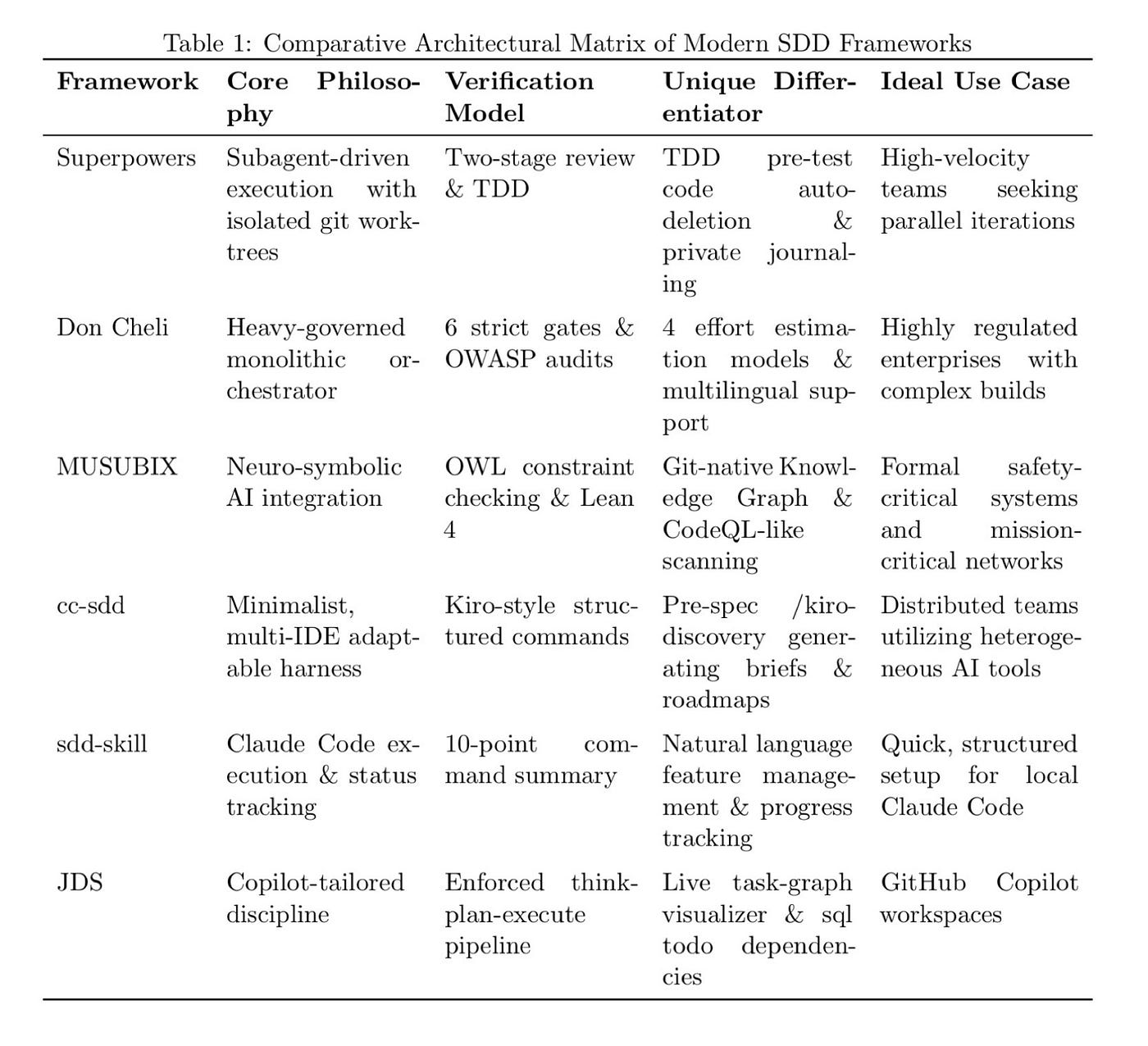
To help engineering leaders choose the correct toolset for their development pipeline, Table 1 evaluates each framework across four distinct operational dimensions.
Conclusion: A Durable New Discipline
As we look at the rapid progress made over the last month, the trajectory of Spec-Driven Development is clear. We are climbing a maturity ladder. We began with simple markdown-based prompt steering (like the original CLAUDE.md), moved to living specifications, and have now arrived at formal, neuro-symbolic, and subagent-driven verification harnesses. By moving away from stochastic, unconstrained “vibe coding” and moving toward these rigid, deterministic open-source frameworks, engineering organizations are capturing the immense 10x speed of AI without sacrificing their codebase quality, security, or sanity. The specifications we write are no longer just documentation; they are the architectural blueprints from which our machines compile our digital future.
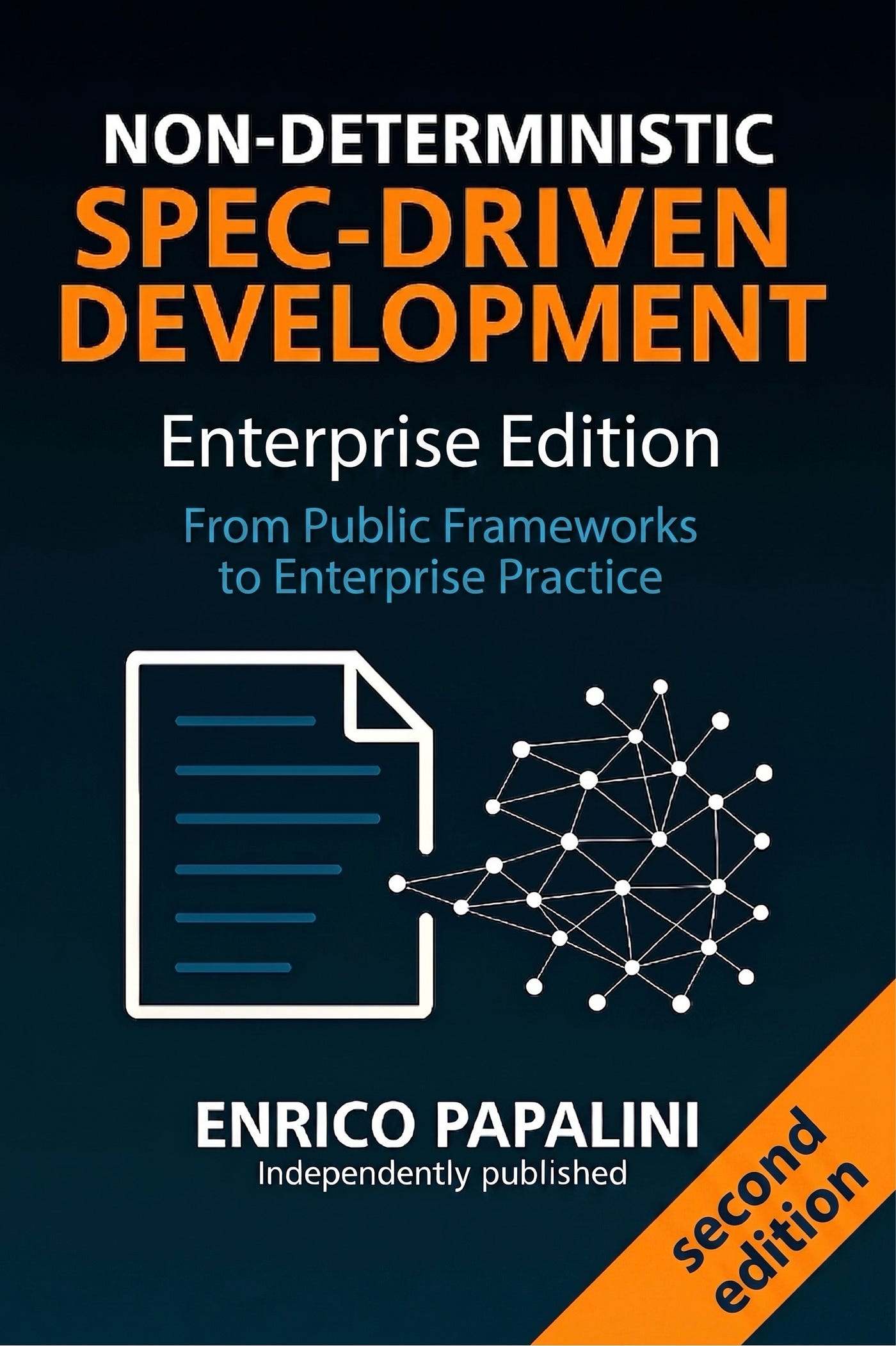
This article presents a condensed version of the theses developed in Non-Deterministic Spec-Driven Development: Enterprise Edition – available on Amazon.com and all local stores.
References
[1] E. Papalini. The evolution of spec-driven development: Architectures, methodologies, and frameworks in ai-assisted engineering. Medium, May 2026.
[2] E. Papalini. Non-Deterministic Spec-Driven Development: Enterprise Edition. Non-Deterministic Software Engineering Series, Book 4. Amazon, 2026.
[3] Gotalab. cc-sdd: Spec-driven development (SDD) for your team’s workflow. GitHub Repository, 2026. https://github.com/gotalab/cc-sdd.
[4] J. Vincent et al. Superpowers: An agentic skills framework & software development methodology that works. Prime Radiant, GitHub Repository, 2026. https://github.com/obra/superpowers.
[5] DonCheli. Don Cheli – SDD Framework: The most comprehensive Specification-Driven Development framework for AI agents. GitHub Repository, 2026. https://github.com/doncheli/don-cheli-sdd.
[6] Nahisaho. MUSUBIX: Innovative AI coding system integrating Neural (LLM) and Symbolic (Knowledge Graph) reasoning. GitHub Repository, 2026. https://github.com/nahisaho/MUSUBIX.
[7] SpillwaveSolutions. sdd-skill: A comprehensive Claude Code skill for guiding users through GitHub’s Spec-Kit and SDD. GitHub Repository, 2026. https://github.com/SpillwaveSolutions/sdd-skill.
[8] J. Musa. JDS: A Superpowers adaptation for GitHub Copilot enforcing strict think-plan-execute pipeline. GitHub Repository, 2026. https://github.com/josipmusa/jds.
메타데이터
- post_id
- 2c2c6a89c56f
- slug
- next-trends-in-the-evolution-of-spec-driven-development-2c2c6a89c56f
- url
- https://medium.com/@enrico.papalini/next-trends-in-the-evolution-of-spec-driven-development-2c2c6a89c56f
- canonical_url
- https://medium.com/@enrico.papalini/next-trends-in-the-evolution-of-spec-driven-development-2c2c6a89c56f
- author_url
- https://medium.com/@enrico.papalini
- status
- ok
- fetched_at
- 2026-06-21 12:17:11