Did Social Bots Shape Public Opinion? Uncovering How Opinion Forms Through Network Analysis
Today’s battlefield of public opinion is no longer occupied by humans alone.
Did Social Bots Shape Public Opinion?
Uncovering How Opinion Forms Through Network Analysis
Today’s battlefield of public opinion is no longer occupied by humans alone.
Automated social bots speak like people, trigger emotions, and spread messages at enormous speed.
The era in which traditional media led public opinion is over. We now live in a hybrid media environment where humans and algorithms compete side by side.
Against this backdrop, China’s “Dual Carbon” policy drew global attention.
The goals of peaking carbon emissions by 2030 and achieving carbon neutrality by 2060 are not just environmental targets. They have become a contested arena where economic, diplomatic, and political narratives collide. Who shapes how this issue is perceived has gained real influence.
This leads to a critical question.
Who actually drove the direction of public opinion? Global news media, or invisible social bots?
A study published in Humanities & Social Sciences Communications in 2025 tackles this question directly. It analyzes how social bots and legacy media competed to shape public perceptions of the Dual Carbon policy.
Key Idea
Viewing public debate as a matter of political identity
The central idea of this study is that public opinion is shaped not simply by who speaks the loudest, but by how meanings are connected within a network. In this view, social bots are not just tools for spreading information. They act as agents that reshape how people mentally connect issues and interpret them, effectively reorganizing cognitive networks.
Comparing Legacy Media and Social Bots
The study compares the meaning networks created by legacy media and by social bots, asking which of the two more closely resembles the structure of public perception.
Methodology
1. Data Collection
The dataset covers posts from X (formerly Twitter) during COP27, from November 1 to 30, 2022. Using hashtags related to China’s dual carbon policy such as #China, #CarbonPeak, and #CarbonNeutral, the researchers collected about 37,000 valid tweets from roughly 30,000 users.
To identify bots, they used Indiana University’s Botometer API. Accounts with a bot score above 3 were classified as social bots, accounting for about 26 percent of all users.
Legacy media accounts were defined separately, including major news agencies (Reuters, AP), broadcasters (CNN, BBC, CCTV), and newspapers (The New York Times, People’s Daily).
2. Network Regression Analysis: MRQAP
The core analytical method is MRQAP (Multiple Regression Quadratic Assignment Procedure).
MRQAP measures how similar two networks are while accounting for the interdependence inherent in network data. Traditional regression assumes independence between observations, an assumption that does not hold for networks. If A is connected to B and B to C, A and C are more likely to be connected as well.
MRQAP addresses this by using permutation tests. It repeatedly reshuffles rows and columns while preserving the overall network structure, allowing researchers to determine whether observed similarities are meaningful or simply due to chance.
Using MRQAP, the study tracks over time whether social bots or legacy media produce issue networks that more closely match public opinion.
3. Sentiment and Keyword Network Analysis
The researchers also examined how social bots and legacy media differed in emotional tone and narrative structure.
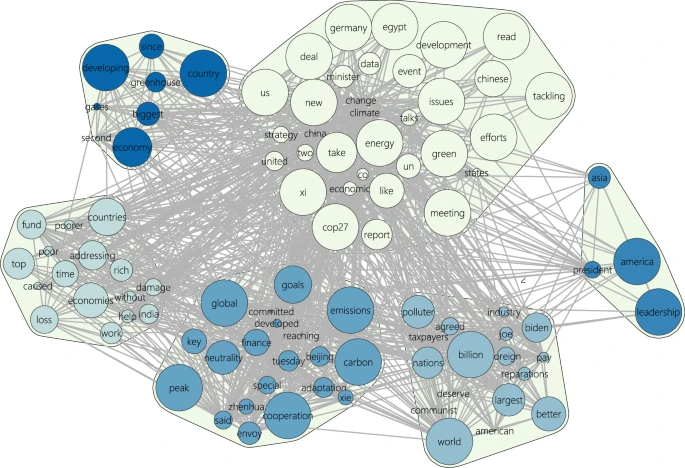
Tweets were classified as positive, neutral, or negative to identify which group relied more on emotional messaging and who drove negative sentiment. In addition, keyword co-occurrence networks were constructed and clustered using the Louvain algorithm to identify major themes.
This made it possible to see which issues dominated the debate, how narratives evolved, and which storylines each group reinforced.
Findings
Who wins public opinion: speed or structure?
The analysis compares the similarity between public opinion networks and both social bot and legacy media networks over time.
In the early stage of the issue, social bots had a very strong influence on public perception (correlation 0.87). Over time, this influence rapidly declined (-0.06), while legacy media regained dominance in shaping public opinion (0.81).
Sentiment analysis shows that social bots overwhelmingly spread negative messages.
Their average probability of negative sentiment was 0.54, far higher than positive or neutral content. This suggests a strategy focused on triggering strong emotions such as anger and fear to rapidly steer opinion.
Legacy media, by contrast, showed a more balanced emotional profile, with neutral and negative content coexisting and a meaningful share of positive messaging. In short, bots relied on emotional pressure, while traditional media followed a fact based journalistic approach.
Keyword network analysis further highlights this contrast. Social bot networks were dominated by a few dense clusters focused on accusatory frames such as blaming China, pollution responsibility, and compensation demands. These networks amplified simple, confrontational narratives.
Legacy media networks, on the other hand, featured multiple thematic clusters centered on COP27, cooperation, energy transition, and sustainability. Their narratives were more diverse and layered.
In essence, bots intensified conflict through narrow emotional frames, while media supported broader, multi dimensional discussions.
Conclusion
Social bots can dominate the early stage of an issue by rapidly spreading emotionally charged and simplified messages, setting the initial frame of public debate. However, as information accumulates and verification increases, trust based legacy media tends to reclaim its role at the center of public opinion.
The study offers important implications for public communication strategies and platform governance. The critical window for countering manipulation is the earliest phase of issue diffusion. It also shows that in debates mixing science, politics, and public opinion, we must understand the shifting influence of human and non human actors over time.
This marks a shift from simple information warfare to a competition over network structure and cognitive connections.
Reference Lin, H., Zhang, M., Qi, X., & Shen, W. (2025). Social bots shape public issue networks in China’s dual carbon agenda: a network analysis using MRQAP. Humanities and Social Sciences Communications, 12(1), 1–13.
→ *Explore Text Analysis in NetMiner → [Explore MRQAP in NetMiner](http://netminer.gitbook.io/netminer5/netminer-manual-kor/module-reference/statistics/multivariate/mrqap/linear)*
메타데이터
- post_id
- 2c2e158ce45b
- slug
- did-social-bots-shape-public-opinion-uncovering-how-opinion-forms-through-network-analysis-2c2e158ce45b
- url
- https://medium.com/@netminer/did-social-bots-shape-public-opinion-uncovering-how-opinion-forms-through-network-analysis-2c2e158ce45b
- canonical_url
- https://medium.com/@netminer/did-social-bots-shape-public-opinion-uncovering-how-opinion-forms-through-network-analysis-2c2e158ce45b
- author_url
- https://medium.com/@netminer
- status
- ok
- fetched_at
- 2026-07-31 04:37:07