Why n8n Belongs on Every Developer Resume
A practical edge for 2025: faster delivery, cleaner ops, and credible impact you can quantify.
Why n8n Belongs on Every Developer Resume
A practical edge for 2025: faster delivery, cleaner ops, and credible impact you can quantify.
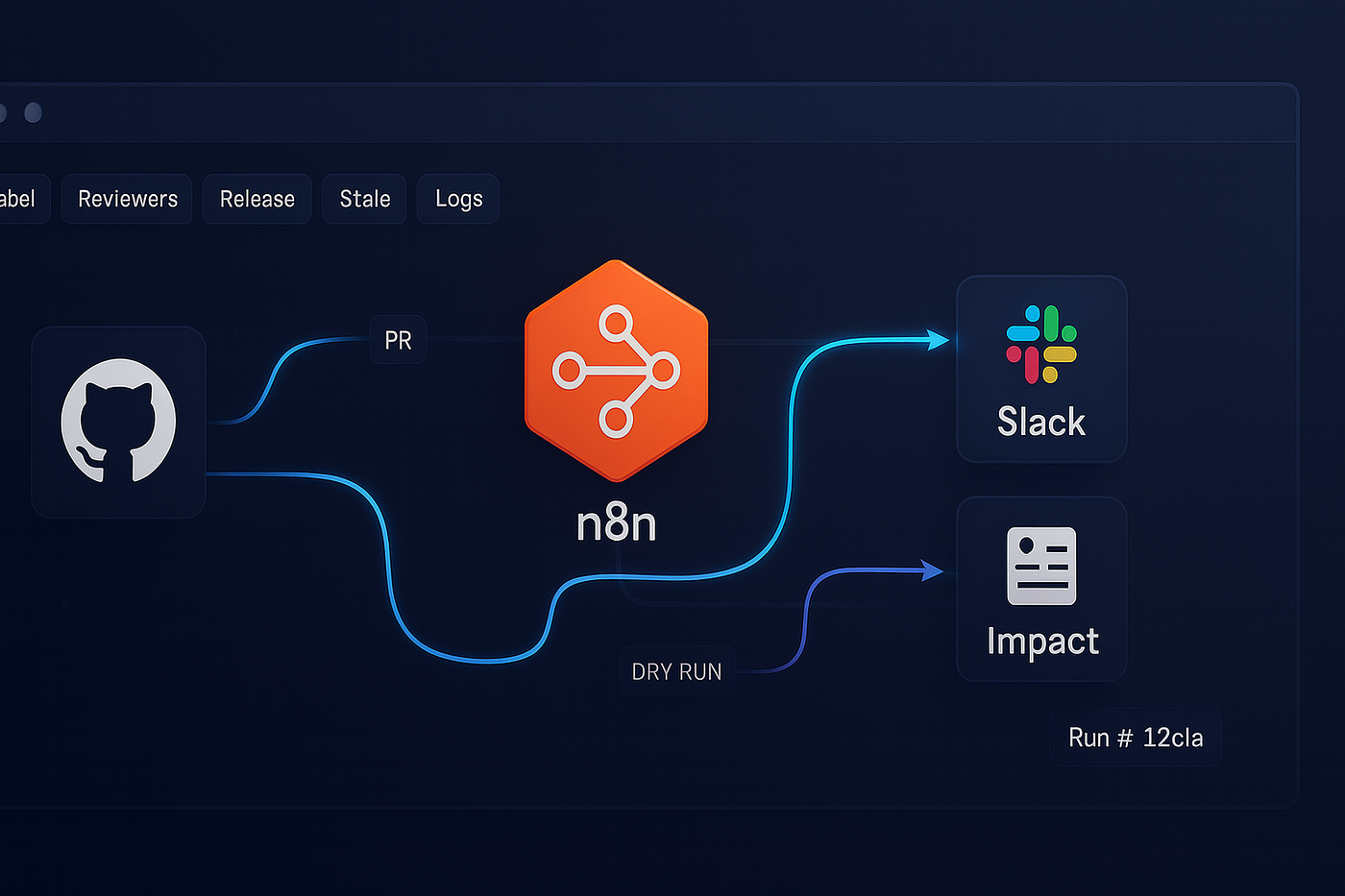
Learn why n8n skills boost a developer resume in 2025 — API orchestration, event-driven thinking, measurable impact, and real snippets you can showcase.
Hiring managers read between the lines. They don’t just want “hard-working team players.” They want people who unblock teams quickly without building a new microservice for every mundane task.
That’s where n8n becomes a signal, not a buzzword.
What “n8n on your resume” actually signals
API literacy without ceremony
You can connect GitHub, Slack, a database, and an internal API in one afternoon. You speak HTTP verbs, headers, and payloads fluently — and you know when to transform, cache, or paginate.
Event-driven instincts
You think in “moments that matter”: PR opened, invoice paid, user churned, cron at 09:00. You enrich first, decide second, fan-out third. That’s senior thinking.
The “some-code” mindset
You’re not dogmatic. Visual nodes do 80%; small, readable Function nodes handle edge cases. That keeps teams moving without another backend to maintain.
Operational empathy
You log, retry sanely, and keep secrets scoped. If an API coughs, you use circuit breakers — not blind loops that page everyone at 3 a.m.
The outcomes hiring managers can trust
Real teams using n8n consistently report improvements like:
- Time to first review: 10–11 hours → ~3 hours after automating reviewer assignment and Slack nudges.
- Release prep: ~40 minutes → under 5 with automatic release notes from merged PRs.
- Support triage: “new ticket → enrich → route” cuts noisy handoffs and repeat questions.
Those numbers are résumé-friendly because they’re easy to reproduce and verify.
Where to place n8n on your résumé
- Tech stack: n8n (self-hosted & cloud), HTTP/REST, OAuth2, GitHub Apps, Slack API, Postgres/SQLite nodes, Webhooks.
- Highlights / Impact bullets (quantified):
- “Built event-driven GitHub triage in n8n; reduced unlabeled issues 85% and cut first-review time from 11h to 3h.”
- “Automated release notes and stakeholder updates; reduced weekly release prep from 40m → <5m.”
- “Created CRM enrichment and routing flow; cut manual data entry >90% and improved first-response SLAs.”
- Projects: Include 2–3 workflows with a one-line outcome each. No fluff — just triggers, actions, and results.
A starter project you can ship in a weekend
Use case: Smart PR reviewer assignment with Slack summary
Trigger: GitHub → PR opened/updated Steps: Fetch changed files → map to team → round-robin reviewer → post concise Slack thread with diff size, labels, and ETA.
Function node (path → team + round-robin):
// input: files array from previous node
const files = items.map(i => i.json.filename);
const areas = new Set();

for (const f of files) {
  if (f.startsWith("web/")) areas.add("frontend");
  if (f.startsWith("api/") || f.endsWith(".py")) areas.add("backend");
  if (f.startsWith("infra/") || f.endsWith(".tf")) areas.add("infra");
}

// simple roster; could live in a DB
const roster = {
  frontend: ["alice","jose"],
  backend:  ["meera","li"],
  infra:    ["karim","sana"]
};

// static state survives runs
const state = this.getWorkflowStaticData('global');
const picks = [];
for (const a of areas) {
  const list = roster[a];
  const i = (state[a] || 0) % list.length;
  picks.push(list[i]);
  state[a] = i + 1;
}

return [{ reviewers: [...new Set(picks)] }];
What to claim on your résumé: “Implemented path-aware reviewer assignment in n8n; reduced assignment latency ~70% and balanced review load across six engineers.”
Another bite-sized win: Release notes that write themselves
Trigger: Git tag or release published
Flow: List merged PRs since previous tag → group by feat|fix|docs|perf|refactor → update release body → push summary to Slack.
Formatter snippet:
const prs = $json.mergedPRs || [];
const groups = { feat:[], fix:[], docs:[], perf:[], refactor:[] };

for (const pr of prs) {
  const kind = (pr.title.match(/^(feat|fix|docs|perf|refactor)/)?.[1]) || "feat";
  const line = `${pr.title} (#${pr.number}) - @${pr.author}`;
  groups[kind].push(line);
}

let body = "## Changes\n";
for (const [k, arr] of Object.entries(groups)) {
  if (!arr.length) continue;
  body += `\n### ${k}\n- ${arr.join("\n- ")}`;
}
return [{ body }];
Résumé line: “Automated release notes and stakeholder comms; weekly release ritual cut from ~40 min → <5 min; consistency improved across teams.”
How to talk about n8n in interviews
Use the STAR format (but keep it technical)
- Situation: “We had mounting ops toil — triaging issues, reviewer assignment, and noisy release days.”
- Task: “Create an auditable, low-ops orchestration layer that we can iterate on daily.”
- Action: “Built n8n flows: enrichment first, decision second, fan-out third. Added idempotent markers, scoped credentials, and circuit breakers.”
- Result: “Cut review latency to 3h; eliminated duplicate notifications; made releases predictable.”
Anticipate these follow-ups
- “How do you avoid duplicates?”
Sentinels in comments (
<!-- n8n:marker -->), deterministic labels, and upsert logic in a Function node. - “What about failures?” Exponential backoff + circuit breakers with static data; notify once with a run ID; pause noisy steps during outages.
- “How do you manage secrets?” n8n credentials vault; least-privilege GitHub App per workflow; environment-scoped tokens.
- “Can it scale?” Yes, if you keep flows small, use sub-workflows, export JSON to git, and treat deployments like code.
Portfolio notes that actually help recruiters
- Screenshots of the editor with short captions (“Trigger → Enrich → Decide → Fan-out”).
- Before/after metrics in a small chart or table.
- One paragraph per workflow describing the trigger, the decision rule, and the business outcome.
- Naming discipline in nodes — reads like a narrative, not spaghetti.
(Skip architecture diagrams if they distract — clean descriptions win.)
Common pitfalls to avoid
- Cramming everything into one mega workflow — prefer sub-workflows.
- Blind retries — add breakers for 429/5xx spikes.
- Secrets in Function nodes — use credentials only.
- No dry-run mode — add a DRY_RUN flag that diverts notifications to logs.
- Unbounded fan-outs — rate-limit and backoff when integrating email/Slack.
These are the differences between “played with a tool” and “runs this in production.”
Why n8n belongs on your résumé in 2025
Because it conveys pragmatism. You can ship useful automation in hours, keep it safe, and prove the impact with numbers. It shows you’re the kind of developer who saves the team time this week — not just after a six-month platform project.
You don’t need to evangelize. Just include two concise bullets with metrics, one short project note, and a sentence about your guardrails. Recruiters will do the rest.
Wrap-up
If your résumé reads “built scalable systems,” back it up with quiet, credible wins. n8n is a fast way to demonstrate them — event-driven thinking, API fluency, and operational maturity that hiring managers crave.
CTA: Want feedback on your résumé bullets or portfolio workflows? Drop a comment with one outcome metric and I’ll suggest an n8n phrasing that lands.
메타데이터
- post_id
- 2c2e681b65fa
- slug
- why-n8n-belongs-on-every-developer-resume-2c2e681b65fa
- url
- https://medium.com/@connect.hashblock/why-n8n-belongs-on-every-developer-resume-2c2e681b65fa
- canonical_url
- https://medium.com/@connect.hashblock/why-n8n-belongs-on-every-developer-resume-2c2e681b65fa
- author_url
- https://medium.com/@connect.hashblock
- status
- ok
- fetched_at
- 2026-07-14 22:02:17