The First Internal AI Tool a Video Editor Should Build
Do not start with a flashy app. Start with the admin mess you already hate.
The First Internal AI Tool a Video Editor Should Build
Do not start with a flashy app. Start with the admin mess you already hate.
Video editors keep getting sold the wrong AI dream.
Most demos show dramatic visual tricks.
One click animation. one click reels. one click captions. one click avatars.
Those tools get attention because they look fast on screen.
The real time leaks inside an editing business usually sit somewhere else.
Client notes.
Revision rounds.
Transcript cleanup.
Delivery prep.
Follow-up.
File naming.
Version confusion.
If you are a solo editor or small post team, the first internal AI tool you should build is not a fancy creative generator. It is a control layer for the admin work that keeps dragging every project.
The reason is simple.
Creative work still needs taste.
Admin work needs structure.
Structure is easier to improve first.
That gives you a faster win.
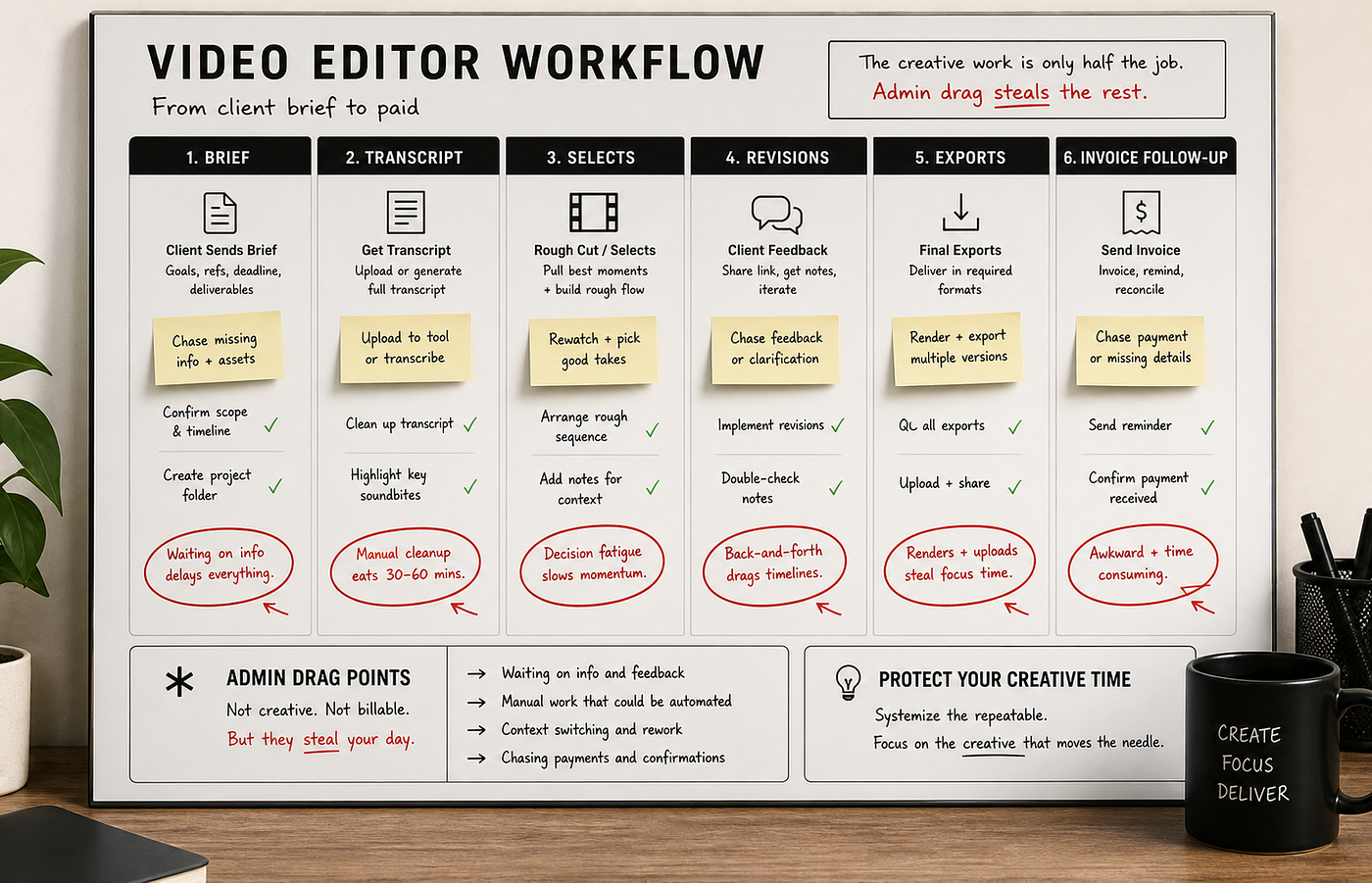
Look at a normal project week. A client sends notes by voice note, email, and chat. Someone copies those notes into a task list. The transcript has speaker issues. The next export needs a new filename. A delivery link has to be sent. The invoice reminder waits because the team is already on the next edit.
None of that feels exciting, but it all costs time.
Now imagine one internal tool sitting over the process.
New notes come in and get grouped by section.
Transcript cleanup gets a first pass.
Revision requests get turned into a single checklist.
Delivery assets get named by rule.
The client update draft appears with the right export version.
The invoice reminder triggers after delivery confirmation.
That is a better first tool than another flashy generation demo.
Follow the money.
If an editor spends twenty minutes per project rebuilding note context, fifteen minutes cleaning delivery language, and another ten minutes fixing folder and filename chaos, that is forty five minutes of non-editing work.
On twelve projects a month, that is nine hours.
At $30 an hour, the visible drag is $270 a month.
For a higher-end editor billing $60 an hour, the same drag is $540.
That is before you count the hidden damage. Slow delivery updates make clients feel ignored. Messy revisions make you look disorganized. Confused file versions create real trust loss.
This is why internal tools matter even if you never sell them.
A lot of people in the AI space only think in public offers. They ask what app to sell. What automation to pitch. What SaaS to launch.
That is too early for many editors.
The better move is to build one internal system you use every week. If it works, you already have proof of pain, proof of usage, and proof of what rules matter. Later, you can package it for other editors or agencies.
There is a simple test for whether your first tool choice is good.
Does it remove confusion before it tries to impress anyone.
If the answer is yes, you are closer to a useful internal system.
If the answer is no, you are probably chasing a demo.
Editors do not lose clients because their workflow lacks a futuristic interface. They lose clients because delivery feels scattered, revisions feel messy, and communication feels slower than it should.
Here is what people miss. The first tool is not supposed to remove your editing skill. It is supposed to protect it.
You want more of your hours spent on pacing, music, structure, emotion, and client taste.
You want fewer hours spent acting like a human patch cable between random files and messages.
That is why the first internal AI tool should sit between client communication and project execution.
A simple version could do five things.
It collects all notes from the channels you already use.
It summarizes those notes into one revision sheet.
It flags contradictions or unclear requests.
It prepares a clean delivery update.
It logs what was promised and what changed.
That alone would beat many “AI for editors” products on the market because it solves a real repeated pain.
Take a short-form editor handling content for three local businesses.
Each client wants two reels a week.
That is twenty four videos a month.
Even if each video only creates eight minutes of admin drag, that is more than three hours gone.
If the drag is fifteen minutes, the number jumps to six hours.
And those are not premium hours. Those are annoying hours.
This is also why off-the-shelf AI tools often disappoint editors. The vendor sells a broad promise, but your real process depends on your folders, your naming rules, your revision style, and your client rhythm.
An internal tool wins because it can be ugly and useful.
It does not need a giant launch. It does not need a polished landing page. It only needs to make Monday cleaner than last Monday.
The best part is that building this tool teaches you what an external offer would look like later.
You learn which client notes are messy.
You learn where revisions tend to break.
You learn how transcript issues create extra edit passes.
You learn which outputs clients keep asking for after delivery.
That turns vague “AI for video editing” talk into a narrow product idea.
“Revision control system for short-form editors.”
“Transcript and delivery assistant for podcast editors.”
“Client-note cleanup workflow for small post teams.”
Those are real offers.
They are real because they start with an annoying repeated task, not a fantasy about replacing the editor.
If you want to build one this month, log your next ten projects. Track where the notes arrived. Track where you had to rename something. Track where a client asked for a version you already sent. Track where invoice follow-up waited because delivery took all your attention. Those repeated moments are the blueprint.
The mistake is jumping straight to the offer before you have internal proof.
Build for yourself first.
Track the time saved.
Track the confusion removed.
Track the rules you keep repeating.
Then decide whether the workflow belongs inside your own business or inside a product.
There is another benefit. Internal tools create better content for your audience.
Instead of posting generic AI takes, you can explain a real workflow problem. You can show how editors lose time in the admin layer. You can show how a system restores attention to the actual edit.
That sounds more believable because it is work you already understand.
Most editors do not need another magical creative promise.
They need fewer dropped notes, fewer delivery mistakes, and a cleaner project spine.
That is the first internal AI tool worth building.
메타데이터
- post_id
- 2c302f9cdeff
- slug
- the-first-internal-ai-tool-a-video-editor-should-build-2c302f9cdeff
- url
- https://medium.com/@ButtonMashPhilosophy/the-first-internal-ai-tool-a-video-editor-should-build-2c302f9cdeff
- canonical_url
- https://medium.com/@ButtonMashPhilosophy/the-first-internal-ai-tool-a-video-editor-should-build-2c302f9cdeff
- author_url
- https://medium.com/@ButtonMashPhilosophy
- status
- ok
- fetched_at
- 2026-06-09 15:37:30



