Review: The Vampire Lestat Season 3, Episode 7: “The Failures”
Written by Hannah Moscovitch Directed by Alan Taylor
Review: The Vampire Lestat Season 3, Episode 7: “The Failures”
Written by Hannah Moscovitch Directed by Alan Taylor
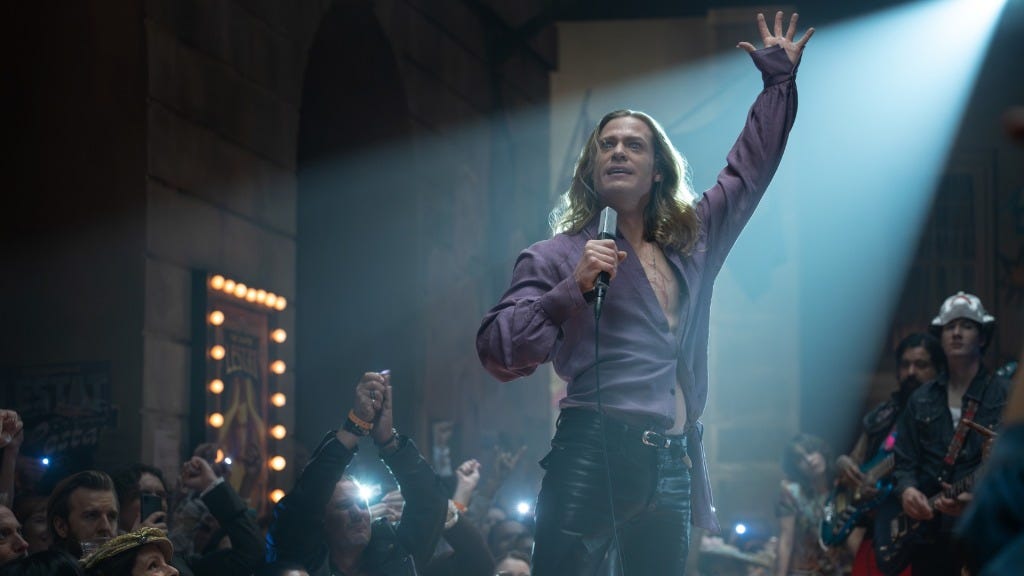
Throughout this season of The Vampire Lestat, we have been inching towards the big concert event that led, according to Lestat and others, to the devastation of the world. The previous episode was even on the eve of that concert. And so one might have expected that the season finale would be the perfect time for that plot thread to culminate.
We would be wrong.
I suppose the producers have a high confidence that the series will be renewed, because the concert itself is punted to a potential fourth season. (At the time of writing, that season still hasn’t been greenlit.) This episode continues to circle around that event. Some supportive material for the series indicated that Queen Akasha was not coming back this season, so I suppose we should have expected the concert to be “postponed”. Still, it’s a bit disappointing that something set up so strongly would be left to a season that doesn’t yet exist.
But we do get more of a picture of what we are dealing with. According to Raglan James, the tipping point has been reached. The Great Conversion has begun. More people are dying than are being born, thanks to the feeding needs of the greatly expanded vampire population. And this, among other things, is going to lead to the end of the world. We even get to see some of the devastation through Lestat’s window at the end of the episode. So if nothing else, they are apparently committing to the apocalyptic elements of the plot. It’s not just talk or exaggeration.
And Lestat is at the center of these events. So I suppose it makes sense that much of the episode is actually a study of his character. With his head separated from his body for much of the episode, he finds himself in a dream state where he sits at “the long table”, judged by his maker and his “progeny”. In essence, they deem him a failure. It takes some time, but he ultimately disagrees. (And if one attributes the impending apocalypse to him, then I suppose he accomplishes something, after all?)
It’s a bit of a mission statement on the part of the writers; regardless of the plot, it comes down to the psychology of the lead characters. What makes Lestat tick, if not a constant attempt to contextualize his failings and choices in some self-affirming way? Even while he admits, now and then, that he’s terribly broken. Why not break the world, too? Let the Beautifully Unwell inherit the ashes.
When all is said and done, regardless of the viewpoint character, this is the story of Louis and Lestat and their journey towards understanding themselves and each other enough to overcome their issues and be together. Or, at least, that’s where this season leaves us. Lestat’s self-examination is as chaotic and manic as the rest of the season has been. It defies linear examination, better experienced than “explained”.
One thread worth pulling is the one that’s been front and center all season: the role that Gabriella has played throughout his life. Many viewers (and reviewers) have noted how Gabriella is portrayed, even given that this is Lestat’s point of view: manipulative, to say the least. Lestat, when awake and restored, lashes out at her from the context of this revelation. But we must also remember that this season is a dramatization of Lestat’s recitation of “The Failures”, after the fact. So now we can look back on how Gabriella was portrayed, knowing that this is all through the lens of Lestat’s realizations. If it’s complicated, it’s because Lestat’s feelings towards her are. Recognizing the source and fuel of your trauma doesn’t automatically resolve it.
But is the damage done? Lestat chooses to defy her and the demands of his crazed audience, but we know that the show must go on. We’ve already heard that what happens dooms the world. But perhaps Gabriella’s role will be greatly diminished going forward, especially with the presence of the Queen looming. (And that’s fine, because haven’t we lingered long enough on Lestat’s incest?)
Going back to “the long table”, it’s somewhat telling that Lestat, even when running out of time, takes control of the situation. He may be damaged, but damned if he isn’t going to stay in the spotlight. And yet, there is growth, there is realization, and perhaps the first step towards some degree of self-compassion. It’s not Lestat’s arc in the novels, but considering that this show is setting up an actual apocalypse that the novels averted, anything beyond the culmination of Lestat’s story in the fourth season would have to be drastically altered from the source material. And frankly, that’s as it should be. This adaptation is firmly its own thing at this point. (And as I’ve said elsewhere, I’m very forgiving of adaptations being distinctive offshoots of the original works. I don’t need a strict translation from page to screen.)
But Lestat’s journey, coming face-to-face with his failures and mistakes and coming to grips with them (on some level), is not just his own. Because Louis goes through a trial of his own at the hands of Armand. With Louis’ head also separated from his body, carefully monitored to see how long he can survive in that state, Armand begins with his own confessions and “amends”. Of course, Armand also has other considerations in mind.
Armand, as it turns out, never truly loved Louis. He used Louis over the decades, even as he pined after Daniel. He used Louis’ never-ending guilt against him. Suddenly we are reminded that we saw the events of the first two seasons through Louis’ perspective. Even knowing that Louis was an unreliable narrator, this practically begs for a rewatch, to really understand how much we saw (and understood) was wrong.
I’m still not entirely clear on Armand’s endgame. He seems to want Louis to take responsibility for their toxic relationship over the years, but that doesn’t explain his larger moves with Lestat and vampires as a whole. But that’s perhaps plot for another day. Instead, we discover that everything that happened with Regina was really just a ploy on Armand’s part. And thus threatening Regina becomes another lever for Armand to use to push Louis into uncomfortable truths.
Louis confesses that he also never truly loved Armand; he never cared enough to truly understand the pain that Armand had endured in his life. Louis was always holding on to Lestat in his heart. The confession appears to be sincere enough for Armand’s taste. He lets Regina live, orders Louis’ head to be restored to his body, and leaves for parts unknown.
In the end, Lestat and Louis are reunited, their trails done. But the concert remains. Exactly why are so many insistent that the concert go on? And that the Great Conversion play out to its bitter end? I’m still not clear on the motivations of the Talamasca in this case. Of course, there are theories about where the story might go with Lestat and Raglan, should there be a future for the series.
On the face of it, postponing the big concert to a potential fourth season can be seen as a bit of a bait-and-switch. But the writers stuck with the emotional and psychological throughlines of the season, which was perhaps the right choice. If the series ends here, then we know the rough shape of what came to pass, but the character arc will have been served. Of course, I’m hoping that we get at least another season to see it all play out!
메타데이터
- post_id
- 2c40dfa5a3d8
- slug
- review-the-vampire-lestat-season-3-episode-7-the-failures-2c40dfa5a3d8
- url
- https://medium.com/critical-myth/review-the-vampire-lestat-season-3-episode-7-the-failures-2c40dfa5a3d8
- canonical_url
- https://medium.com/critical-myth/review-the-vampire-lestat-season-3-episode-7-the-failures-2c40dfa5a3d8
- author_url
- https://medium.com/@criticalmyth
- status
- ok
- fetched_at
- 2026-07-31 03:46:06