He Was Only 16. An Entire Army Had to Break the Rules to Kill Him.
A tale of bravery, betrayal, and the battle that forever changed the Mahabharata.
He Was Only 16. An Entire Army Had to Break the Rules to Kill Him.
A tale of bravery, betrayal, and the battle that forever changed the Mahabharata.
A War Unlike Any Other

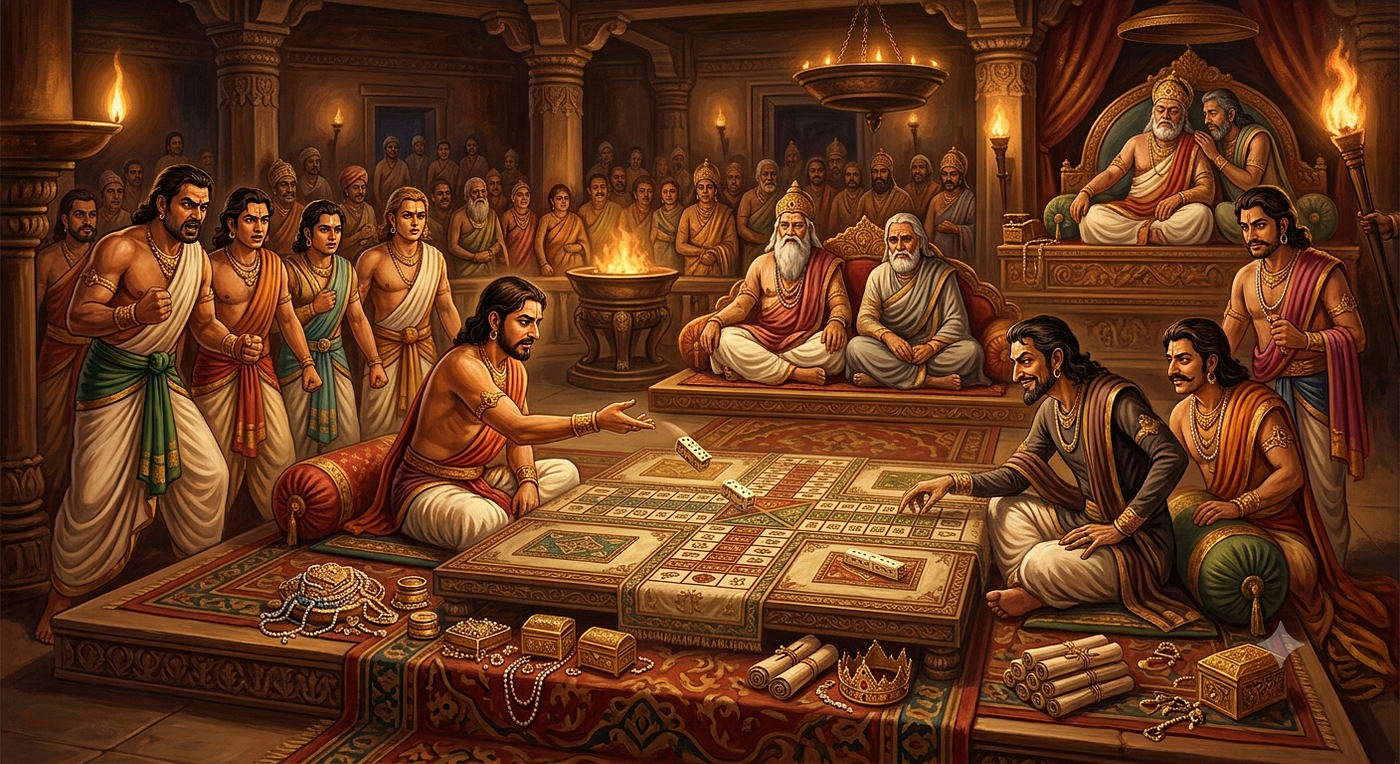
The War of Mahabharat using Gemini
Some battles decide the fate of kingdoms.
Others decide how history remembers the people who fought them.
The Mahabharata is one of the greatest epics ever written—not merely because of its scale, but because it explores timeless questions about power, justice, loyalty, and sacrifice. At its heart lies the Kurukshetra War, an eighteen-day conflict between the Pandavas and the Kauravas. Millions of warriors assembled on a single battlefield, where every sunrise brought new strategies, shattered alliances, and unimaginable loss.
Among legendary names like Bhishma, Drona, Karna, Arjuna, and Krishna, one warrior stands apart—not because he won the war, but because he became its greatest symbol of courage.
His name was Abhimanyu.
He was only sixteen.
A Lesson Before Birth

Arjun and Subhadra generated using Gemini
Abhimanyu was the son of Arjuna and Subhadra. According to tradition, his story began before he was even born.
While still in his mother's womb, he overheard Arjuna explaining the secrets of the Chakravyuha, one of the most complex battle formations ever devised. He learned how to enter it, but before Arjuna could explain how to escape, the lesson ended.
That unfinished lesson would shape his destiny.
As he grew older, Abhimanyu trained under Krishna, Balarama, and Pradyumna, becoming one of the most gifted young warriors of his generation.
The Deadliest Formation

Chakravyuh generated using Gemini
On the thirteenth day of the Kurukshetra War, Drona arranged the Kaurava army into the dreaded Chakravyuha.
There was one problem.
Arjuna—the only Pandava who fully knew how to break and escape the formation—had been deliberately drawn away from the battlefield.
Someone had to enter.
Only Abhimanyu knew how.
He also knew he didn't know the way back.
Yet he volunteered.
One Boy. One Army.

Abhimanyu against the entire army generated using Gemini
As Abhimanyu broke into the Chakravyuha, the Pandavas tried to follow.
They never got the chance.
Jayadratha blocked their advance, leaving the sixteen-year-old prince completely surrounded.
Inside the formation stood some of the greatest warriors of the age—Drona, Karna, Kripa, Ashwatthama, Duryodhana, and many others.
Abhimanyu didn't retreat.
He fought.
He shattered chariots.
He defeated seasoned warriors.
He pushed back an army that expected an easy victory.
The young prince fought with a ferocity that left even the greatest commanders stunned.
When Honor Collapsed

Death of honour generated using Gemini
Unable to defeat him fairly, the Kauravas abandoned the rules of war.
Several warriors attacked him together.
His bow was broken.
His chariot destroyed.
His horses killed.
His weapons shattered.
Still, he refused to surrender.
He fought with a sword.
Then with a chariot wheel.
Finally with a mace.
Only after being overwhelmed by multiple warriors at once did Abhimanyu fall.
It wasn't just the death of a warrior.
It was the death of honor on the battlefield.
A Father's Oath
When Arjuna learned how his son had died, grief became vengeance.
He swore that before the next sunset, Jayadratha—the warrior who had trapped Abhimanyu inside the Chakravyuha—would die.
If not, Arjuna would end his own life.
As the following day drew to a close, Krishna created the illusion of an eclipse. Believing the sun had already set, Jayadratha emerged from hiding.
The darkness disappeared.
The sun still shone.
Arjuna's arrow flew.
His vow was fulfilled.
A Legacy That Lived On
Abhimanyu died before the war ended.
But his story didn't.
His wife, Uttara, was carrying their unborn son, Parikshith. After the war, Parikshith became the sole surviving heir of the Kuru dynasty, ensuring that the Pandava lineage continued.
The young warrior never became king.
Yet his bloodline survived when almost every other branch of the dynasty was erased.
More Than a Hero
The Mahabharata remembers countless kings and conquerors.
But Abhimanyu occupies a different place.
He entered a battle knowing only half the path.
He stood alone against an army.
He lost his life but earned something far greater.
Immortality.
More than five thousand years later, his story continues to remind us that courage isn't the absence of fear. It is the willingness to do what is right, even when the odds make survival almost impossible.
메타데이터
- post_id
- 2c41d4d36cfd
- slug
- he-was-only-16-an-entire-army-had-to-break-the-rules-to-kill-him-2c41d4d36cfd
- url
- https://medium.com/the-pillionaire-diaries/he-was-only-16-an-entire-army-had-to-break-the-rules-to-kill-him-2c41d4d36cfd
- canonical_url
- https://medium.com/the-pillionaire-diaries/he-was-only-16-an-entire-army-had-to-break-the-rules-to-kill-him-2c41d4d36cfd
- author_url
- https://medium.com/@omkarkumarpatil001
- status
- ok
- fetched_at
- 2026-07-14 19:24:14