Difference between form15g and form15h for non deduction of tax on interest income
Watching your hard-earned interest income shrink due to Tax Deducted at Source (TDS) can be frustrating, especially when your total annual…
Difference between form15g and form15h for non deduction of tax on interest income
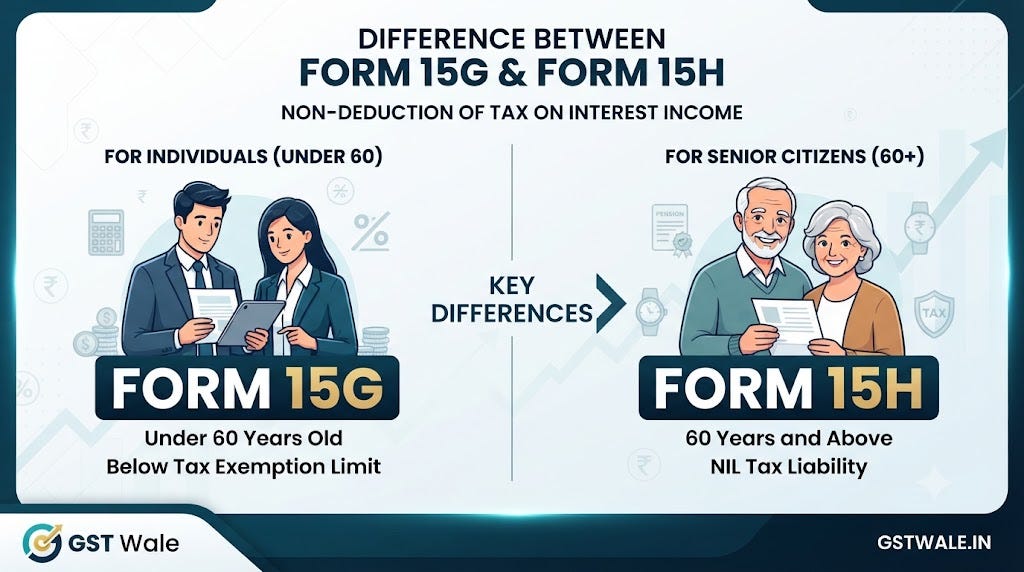
Watching your hard-earned interest income shrink due to Tax Deducted at Source (TDS) can be frustrating, especially when your total annual income is below the taxable limit. Many taxpayers often find themselves wondering how to prevent this deduction. This is where the importance of filing a declaration becomes clear. Whether you are looking into form15g or considering Form 15H, understanding these documents is essential for tax planning.
While both forms serve the same primary purpose — instructing your bank not to deduct TDS on interest — they are designed for different categories of taxpayers. Using the wrong form can lead to rejection by your financial institution, leaving you with unwanted tax deductions.
What is Form 15G?
Form 15G is a self-declaration form submitted by individuals (other than senior citizens), Hindu Undivided Families (HUFs), and trusts to ensure that no TDS is deducted from their interest income. By submitting this form, you are declaring to the bank that your total income for the financial year is below the basic exemption limit.
To be eligible for filing a form15g, you must satisfy two main conditions:
- You must be an individual or an HUF.
- Your total estimated income for the year should not exceed the basic exemption limit (Rs. 2.5 lakh for most taxpayers).
- The aggregate amount of interest income for which the declaration is made must not exceed the basic exemption limit.
What is Form 15H?
Form 15H is specifically curated for senior citizens. In India, the income tax laws provide specific benefits to elderly citizens, and this form is an extension of that support. Any resident individual who has attained the age of 60 years or more during the financial year is eligible to file this form.
Unlike the rules governing form15g, Form 15H does not mandate that your total income must be below the basic exemption limit. As long as you are a senior citizen, you can submit this form to claim non-deduction of TDS on interest income, provided your tax liability for the year remains nil.
Key Differences at a Glance
The most fundamental difference lies in the age and the income criteria required for submission. When you approach GST Wale to manage your financial documentation, they often highlight these specific distinctions to ensure compliance:
- Age Criteria: Form 15G is for individuals below 60 years of age, whereas Form 15H is exclusively for those aged 60 and above.
- Income Limits: For form15g, your total income must be below the basic exemption limit. For Form 15H, this constraint does not apply, provided your final tax liability is zero.
- Frequency: Both forms must be submitted at the start of every financial year to ensure the bank does not begin deducting TDS.
Why Submission Timing Matters
Many taxpayers make the mistake of submitting these forms late in the financial year. Banks generally process TDS deductions at the beginning of each quarter. If you submit your form15g after the bank has already deducted the tax for that quarter, you will have to claim a refund while filing your Income Tax Return (ITR).
To ensure a smooth process, it is advisable to submit your declaration as soon as the financial year begins in April. This proactive approach saves you from the administrative hassle of claiming refunds later.
Common Mistakes to Avoid
Submitting these forms correctly is vital. Here are common pitfalls to watch out for:
- Providing an incorrect Permanent Account Number (PAN).
- Filing the forms when your annual income actually exceeds the taxable threshold.
- Failing to update the bank about your current income status.
- Neglecting to submit separate forms for each bank branch where you hold a deposit.
Understanding the nuances between these two declarations is a simple yet powerful way to optimize your savings. If you are under 60 and qualify under the exemption limits, utilizing a form15g is your best route to ensure your interest income remains intact. Always remember to maintain records of your submissions and ensure your PAN details are correctly linked with your bank accounts. By staying informed and organized, you can effectively manage your tax liabilities throughout the financial year.
메타데이터
- post_id
- 2c5b0bed6554
- slug
- difference-between-form15g-and-form15h-for-non-deduction-of-tax-on-interest-income-2c5b0bed6554
- url
- https://medium.com/@singhmonday742/difference-between-form15g-and-form15h-for-non-deduction-of-tax-on-interest-income-2c5b0bed6554
- canonical_url
- https://medium.com/@singhmonday742/difference-between-form15g-and-form15h-for-non-deduction-of-tax-on-interest-income-2c5b0bed6554
- author_url
- https://medium.com/@singhmonday742
- status
- ok
- fetched_at
- 2026-07-20 00:23:16