Walking in History: Exploring Thai Heritage Through Place-Based Learning
“The best history lessons are not always found within the four walls of a classroom. Sometimes, they begin with a single step into the…
Walking in History: Exploring Thai Heritage Through Place-Based Learning
“The best history lessons are not always found within the four walls of a classroom. Sometimes, they begin with a single step into the places where history was made.”
History is often introduced through textbooks, lectures, and classroom discussions. While these approaches provide students with essential historical knowledge, they cannot fully capture the atmosphere, scale, and cultural significance of the places where history unfolded. Place-Based Learning bridges this gap by transforming authentic locations into living classrooms, allowing students to construct knowledge through direct experience.

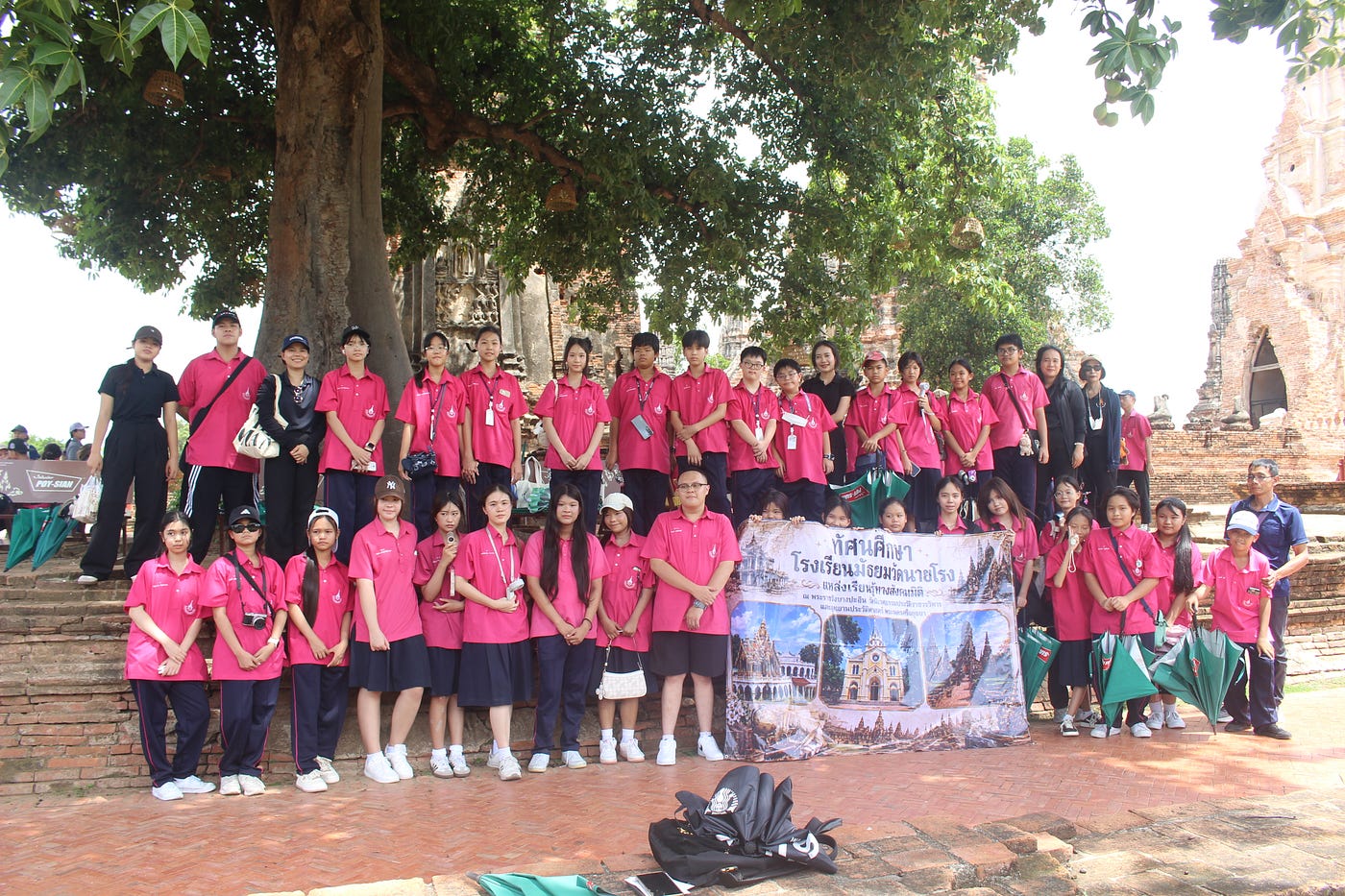
With this philosophy in mind, the Social Studies Department of Matthayom Watnairong School organized a History Camp in the historic city of Ayutthaya. The camp brought together students from Matthayom 1 (Grade 7) to Matthayom 6 (Grade 12), providing them with a unique opportunity to explore Thailand’s rich cultural heritage beyond the classroom. Throughout the journey, students visited two of Thailand’s most significant historical landmarks: Bang Pa-In Royal Palace and Wat Chaiwatthanaram.
Our First Stop: Bang Pa-In Royal Palace

Our journey began at Bang Pa-In Royal Palace, a magnificent royal residence that reflects centuries of Thai history and its cultural interactions with the wider world.

Before entering the palace grounds, students participated in an orientation where the tour guide explained the historical significance of the site, as well as the proper etiquette expected when visiting a royal heritage landmark. Learning the do’s and don’ts was more than following rules, it was an introduction to respecting cultural heritage and understanding the importance of preserving places of historical value.

As we explored the palace complex, students eagerly listened to the guide’s stories while taking in the beauty of the surroundings. One memorable experience was crossing the bridge using the cable cart, which added a sense of excitement to the beginning of our journey.

Being the first destination of the History Camp, the atmosphere was filled with enthusiasm. Students were naturally curious and excited to explore every corner of the palace grounds. While speaking with several students, I was impressed by their observations. Some recognized European-inspired architecture, while others pointed out Chinese influences in the design of various buildings. These spontaneous observations demonstrated that they were already connecting historical concepts discussed in the classroom with what they were experiencing firsthand.

Looking back, Bang Pa-In Royal Palace served as the perfect warm-up for our exploration of Ayutthaya. It invited students to observe carefully, ask questions, and appreciate how architecture reflects the historical and cultural exchanges that have shaped Thailand over time.
Experiencing Culture Through Food

Our lunch featured traditional Thai cuisine, providing another opportunity to engage with Thai heritage beyond historical landmarks.

Culture is preserved not only through monuments and ancient structures but also through everyday traditions, including food. Sharing a traditional meal reminded students that history is woven into daily life and that cultural identity is experienced through customs, flavors, and shared moments around the table.
The Heart of the Journey: Wat Chaiwatthanaram

If Bang Pa-In Royal Palace introduced students to Thailand’s royal heritage, Wat Chaiwatthanaram became the emotional and intellectual centerpiece of our History Camp.

As we entered the temple grounds, students were immediately captivated by the towering prangs and centuries-old brick ruins that have silently witnessed the rise and fall of the Ayutthaya Kingdom. Before exploring independently, the tour guide shared the temple’s history, explaining its significance during the Ayutthaya period and the devastation it suffered during the Burmese invasion.

What struck me most was the noticeable shift in my students’ engagement. Their curiosity deepened. Rather than simply admiring the ruins, they began asking thoughtful questions.

Many wondered why so many Buddha images were missing their heads. Others asked why Wat Chaiwatthanaram remained one of the most prominent surviving temples in the area despite the destruction brought by war. These were not questions prompted by an examination or classroom activity, they emerged naturally from direct interaction with the site.

Standing among the ruins, students were no longer memorizing historical facts. They were interpreting evidence, connecting historical events with physical remains, and reflecting on the consequences of conflict and the importance of cultural preservation.

For me, Wat Chaiwatthanaram represents one of Thailand’s greatest historical treasures. Its weathered structures stand as powerful reminders of the nation’s resilience, identity, and enduring cultural heritage. More importantly, it reminds us that understanding the past is essential not only for appreciating history but also for learning from it.
Reflections on Place-Based Learning

The experience reaffirmed my belief in the power of Place-Based Learning.
When students learn within authentic historical environments, they become active participants in constructing knowledge rather than passive recipients of information. They observe details that photographs cannot fully capture, ask questions that emerge from genuine curiosity, and develop a deeper appreciation for the stories embedded within the places they visit.

Throughout our History Camp, learning happened naturally. Students compared architectural styles, analyzed historical evidence, reflected on the effects of war, and connected classroom discussions with tangible cultural landmarks. These moments demonstrated that meaningful historical understanding develops not only through reading about history but also through experiencing the places where history unfolded.

As educators, we often hope our students will remember the lessons we teach. This journey reminded me that some lessons remain unforgettable because they are lived rather than simply learned.
History is not only something we study.
Sometimes, history is something we walk through.
A Personal Note of Gratitude

Before concluding, I would like to express my heartfelt gratitude to my colleagues in the Social Studies Department of Matthayom Watnairong School for inviting me to be part of this meaningful experience.

As the only foreign teacher in the department, I deeply appreciated being welcomed with such kindness and collegiality. Their invitation was more than an opportunity to join a History Camp. It was a gesture of trust, inclusion, and shared purpose. Throughout the journey, I never felt like an outsider; instead, I felt like a valued member of a team committed to providing our students with meaningful and memorable learning experiences.
Beyond its educational value, this experience also became a personal journey of cultural appreciation. As a Filipino educator teaching in Thailand, I had the privilege of witnessing Thai traditions not through books or documentaries, but through the people around me. I watched my students respectfully offer prayers, light incense with quiet reverence, and demonstrate customs that reflected the deep cultural and spiritual values woven into Thai society. Those moments reminded me that culture is best understood when it is experienced, observed, and shared.

One moment that I will always cherish was when my students presented me with a Buddha amulet as a token of good luck. I accepted it not merely as a souvenir, but as a heartfelt expression of kindness, respect, and generosity. It was a simple gesture, yet one that carried profound meaning. It made me feel welcomed, appreciated, and connected to the community that has become my second home.

This journey reminded me that education is never a one-way process. While I came to Thailand to teach, my students also became my teachers. Through their actions, traditions, and everyday expressions of respect, they offered me a deeper understanding of Thai culture and the values that continue to shape its identity.

As I left Ayutthaya that day, I carried home more than photographs and memories. I carried a renewed appreciation for Thailand’s remarkable heritage, a deeper understanding of its culture, and immense gratitude for the people who made me feel that, although I come from another country, I truly belong.

Perhaps that is the greatest gift of Place-Based Learning. It not only connects us to places, but it also connects us to people, cultures, and to one another. In walking through the historic landscapes of Ayutthaya, our students discovered the stories of the past, while I discovered something equally meaningful: that education has the power to bridge cultures, foster belonging, and remind us that learning is at its best when we journey together.
메타데이터
- post_id
- 2c5f1ec0fcc0
- slug
- walking-in-history-exploring-thai-heritage-through-place-based-learning-2c5f1ec0fcc0
- url
- https://medium.com/@ryanl_3785/walking-in-history-exploring-thai-heritage-through-place-based-learning-2c5f1ec0fcc0
- canonical_url
- https://medium.com/@ryanl_3785/walking-in-history-exploring-thai-heritage-through-place-based-learning-2c5f1ec0fcc0
- author_url
- https://medium.com/@ryanl_3785
- status
- ok
- fetched_at
- 2026-08-04 23:19:17