LLM exchange generator — Broad Tech Audience
# The LLM Exchange Generator: Structured Contracts for AI Systems
LLM exchange generator — Broad Tech Audience
# The LLM Exchange Generator: Structured Contracts for AI Systems
Intended Audience: Broad tech audience — This article is written for technical and non-technical readers interested in AI tooling, structured prompts, and spec-driven development. If you work with AI systems, manage technical teams, or are curious about making AI collaboration more reliable, this is for you.
— -
## Purpose
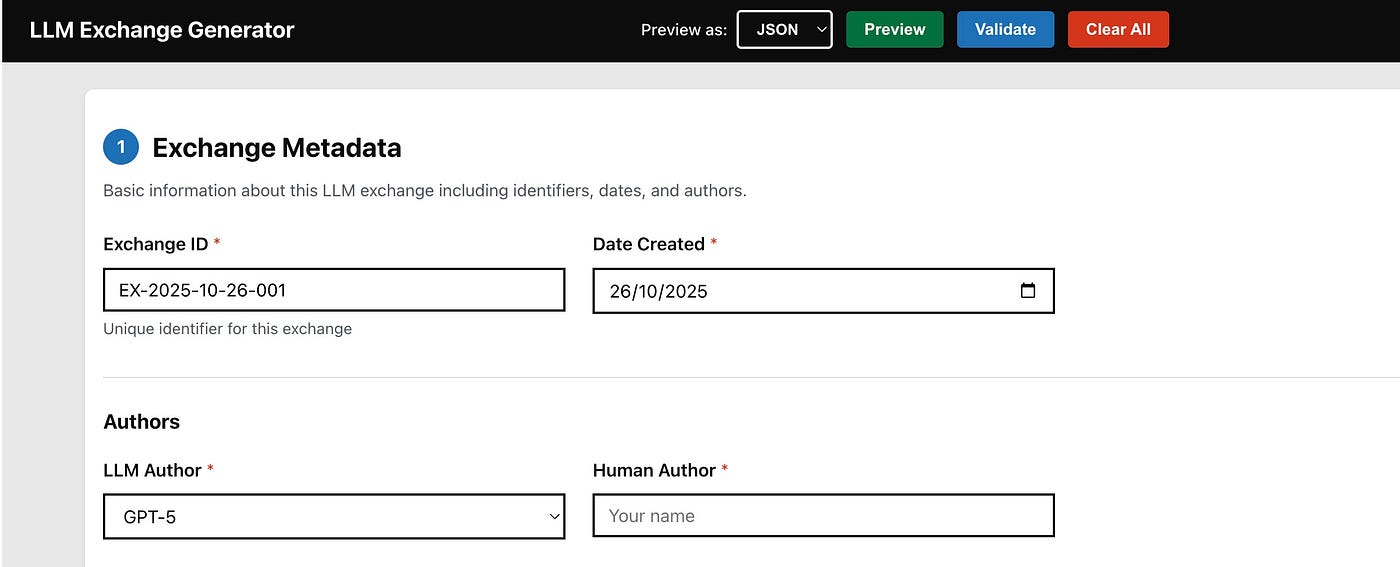
The LLM Exchange Generator is a web-based tool that transforms how we communicate with AI systems. Instead of ad-hoc prompts, it produces standardized XML and JSON contracts that capture the complete context of human-AI collaboration — from initial request to final response. Think of it as a structured handshake between humans and AI, ensuring nothing gets lost in translation.
## Rationale
Today’s AI interactions are ephemeral and unstructured. A prompt goes in, a response comes out, and the context — the business goals, constraints, intended models, lifecycle state — disappears. When you need to audit, reproduce, or evolve that work, you’re starting from scratch.
We needed a better way. Not just for one-off queries, but for enterprise-grade AI collaboration where prompts become reusable assets, responses are traceable, and the entire exchange adheres to a formal contract. The LLM Exchange Generator makes this possible by encoding the Software Development Lifecycle Prompt Framework (v3.8) into an interactive form.
## Alignment with Spec-Driven Development
Spec-driven development puts the contract first. You define the interface before you build the implementation. The LLM Exchange specification does exactly this for AI interactions — it defines what goes into a prompt (metadata, context, requirements, technology constraints, security expectations, output artifacts) and what comes back (design artifacts, recommendations, lifecycle state).
By generating exchanges that conform to this spec, teams can version-control their prompts, peer-review AI-generated designs, and build CI/CD pipelines that validate AI outputs against business rules. The generator doesn’t just help you talk to AI — it makes AI collaboration auditable, repeatable, and governance-ready.
## The Contract
An LLM Exchange is a two-part contract:
PromptRequest: The human’s structured input containing:
-
Metadata (exchange ID, authors, intended models, lifecycle status)
-
Context (initiating persona, business goal, system scope)
-
Inputs (requirements, technology stack, security constraints)
-
Output expectations (artifacts like architecture diagrams, threat models, infrastructure-as-code)
PromptResponse: The AI’s structured output containing:
-
Trace (links back to the request)
-
Generated artifacts (designs, code, documentation)
-
Recommendations (next steps, risks)
-
Lifecycle state (pending review, approved, rejected)
This bidirectional contract ensures both parties — human and AI — are accountable.
## Inputs
Users fill out a multi-section form that captures:
-
Metadata: Who’s involved, which AI models to use, review status
-
Intended Models: Primary and alternate LLMs (name, version, provider, purpose)
-
Lifecycle: Current status (pending review, approved, etc.) and approval flags
-
Context: Business goals, system scope, initiating persona
-
Requirements: Functional and non-functional constraints
-
Technology & Security: Stack choices, zero-trust requirements, encryption standards
-
Output Expectations: Specific artifacts needed (APIs, architecture diagrams, Terraform modules, runbooks, RACI matrices — over 40 types supported)
-
Response Data (optional): Fields for the AI’s response, including confidence scores and delivery personas
As you type, a live preview panel shows the JSON or XML being generated in real-time — a split-view design that keeps the contract visible throughout.
## Outputs
The generator produces two formats:
-
JSON: For programmatic consumption, API integrations, and storage
-
XML: For schema validation, XSLT transformations, and enterprise tooling
Both are downloadable, human-readable, and spec-compliant. They can be checked into version control, reviewed in pull requests, or fed into downstream systems that validate compliance, track AI-generated work, or trigger automation.
## Possibilities
When AI exchanges become contracts, new workflows emerge:
-
Prompt Libraries: Store proven prompts as versioned assets; reuse them across projects
-
AI Code Review: Submit LLM-generated designs for human approval before implementation
-
Audit Trails: Know exactly what was asked, who approved it, and what the AI delivered
-
Multi-Model Orchestration: Specify primary and fallback models; route exchanges based on capability
-
Compliance Pipelines: Validate that AI outputs meet security, accessibility, or regulatory requirements before they ship
## The Future
The LLM Exchange Generator is just the beginning. As AI systems proliferate, we’ll need:
-
Exchange Routers: Tools that select the best model based on the request’s complexity and constraints
-
Response Validators: Automated checks that ensure AI outputs meet quality gates
-
Cross-System Contracts: Exchanges that span multiple AI agents, each contributing specialized expertise
-
Human-in-the-Loop Workflows: Approval pipelines where exchanges move through review states like code PRs
## System of Systems
Here’s the key insight: the LLM Exchange isn’t just a single prompt. It’s a node in a network of collaborating systems — humans, AI models, validation pipelines, governance frameworks, and downstream tooling.
Each exchange is a contract between nodes. A product manager initiates an exchange requesting an architecture diagram. The AI responds. A security officer reviews the response, flags risks, and updates the lifecycle state. The approved exchange triggers Terraform generation, which gets validated by policy-as-code (OPA), then deployed via CI/CD.
Every step is traceable. Every artifact references its source exchange. The prompt becomes infrastructure. The response becomes documentation. The lifecycle state becomes a governance signal.
This is spec-driven development for the AI era: not just writing prompts, but composing systems where humans and AI collaborate through well-defined contracts. The LLM Exchange Generator makes that vision tangible — one structured conversation at a time.
— -
— -
Copyright © 2025 TRH Learning. All rights reserved.
The LLM Exchange Generator is deployable as a static site. No backend required. Your data never leaves the browser. Start building structured AI collaborations today.
메타데이터
- post_id
- 2c683bb07956
- slug
- llm-exchange-generator-broad-tech-audience-2c683bb07956
- url
- https://medium.com/therevisionhub/llm-exchange-generator-broad-tech-audience-2c683bb07956
- canonical_url
- https://medium.com/therevisionhub/llm-exchange-generator-broad-tech-audience-2c683bb07956
- author_url
- https://medium.com/@trhlearning
- status
- ok
- fetched_at
- 2026-06-20 20:29:01




