The Undersecretary of War Talk
With a Side of Gin and Tonic, a Straight Face, and Precision Strikes (Apparently)
The Undersecretary of War Talk
With a Side of Gin and Tonic, a Straight Face, and Precision Strikes (Apparently)
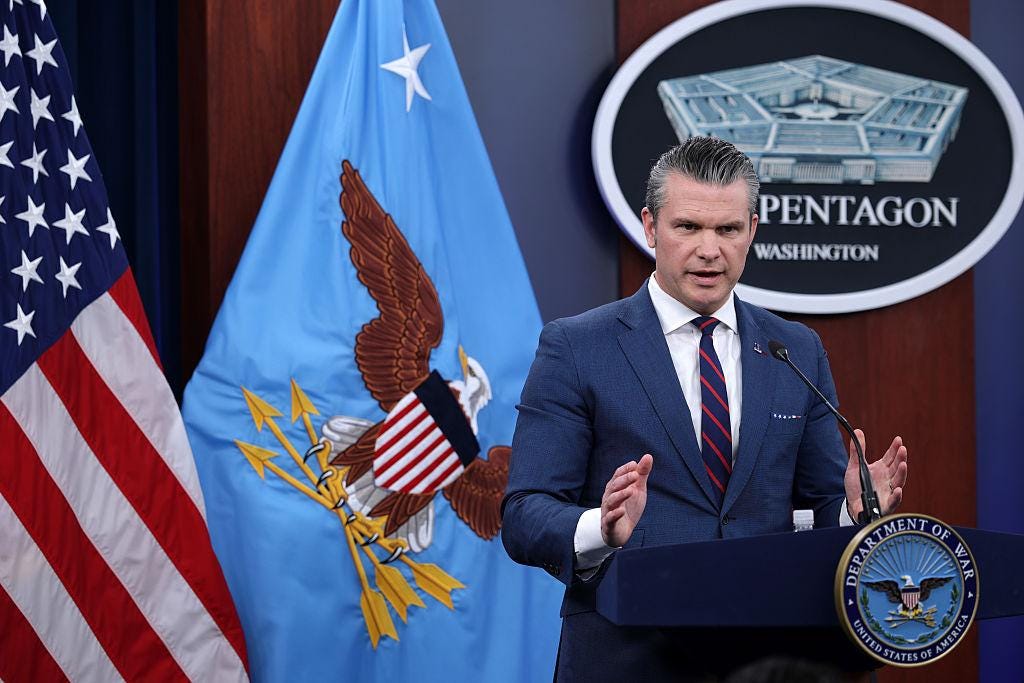
U.S. Secretary of Defense Pete Hegseth speaks during a Pentagon press briefing in Washington, D.C. Photo via Getty Images
There are two ways to deliver war news to the American public. One involves strategy, caution, and difficult briefings.
The other looks a lot like a television segment.
The Pentagon briefing room has excellent lighting. The podium is polished. The flags are arranged just so.
And behind it now stands a man who once explained the world from a Fox News studio.
‘Whiskey’ Pete Hegseth has traded one stage for another.
Sworn in as Trump’s hand-picked “Secretary of War” — because Trump tends to talk about FDR’s four terms like a man studying the instructions — Hegseth has already begun reshaping Pentagon culture.
His first great act of martial masculinity: banning beards.
But the real job isn’t grooming policy.
It is narration.
And right now, there is a lot to narrate.
As U.S.–Israeli strikes against Iran escalate into an active conflict, the Pentagon has held a rare on-camera briefing. President Trump has largely avoided extended live press conferences. So the role of defining the moment — its size, its limits, its justification — has fallen to the Secretary of ‘War’.
This is not a transition from media to governance.
It is governance performed as media.
The podium is the set. The briefing is the segment. The war is the developing story.
The Pentagon Purger
From day one, the reshaping begins.
Advisory boards dissolved — independent thinkers replaced with ideological loyalists. Military lawyers reassigned away from traditional guardrail roles. Generals sidelined for uttering words like diversity or inclusion, as though pluralism were insubordination.
None of this requires tanks in the streets.
It requires staffing charts.
Power rarely announces itself with sirens. More often it arrives through reorganization.
One memo. One reassignment. One quiet understanding that certain opinions are no longer career-enhancing.
Strength, after all, is easier to perform when the room contains fewer dissenting voices.
War Talk as Ritual
Hegseth does not govern through strategy. He governs through tone.
On cable, he learned that certainty wins airtime. At the Pentagon podium, that same certainty becomes policy posture. Whiskey Pete delivers it with unblinking assurance — chin lifted, cadence measured, conviction absolute.
But the mood never quite matches the moment.
The shoulders stay loose. The phrasing glides. There’s a faint cocktail-hour calm to the whole thing — as if escalation were something you pair with polished shoes and stage lighting rather than contested airspace and retaliatory timelines.
The only thing missing is someone asking if anyone needs another gin and tonic before the next briefing.
No one says anything about it.
No one reacts.
The tone remains lounge-level steady, even as the stakes climb.
It isn’t sloppiness. It’s composure — turned almost theatrical. The kind that makes you glance around and wonder whether you’re the only one noticing how relaxed everything feels.
War becomes ceremony. Strength becomes spectacle. Dissent becomes heresy.
His weapon is not intellect.
It is certainty.
Delivered smoothly. Absorbed as reassurance.
Certainty enters the room first. Facts arrive later — slightly out of breath.
War talk does not require agreement to succeed. It requires only professionalism — straight faces, forward posture, and the discipline not to react.
And when institutions learn not to react, they eventually learn not to resist.
Meanwhile, Over Iran
The United States and Israel have launched an active military campaign against Iran. Strikes are underway. Retaliation looms. The Pentagon held a rare on-camera briefing — and Hegseth was the one explaining it.
In that briefing, three ideas were repeated.
This is not an endless war. These are surgical strikes. This is not about regime change.
Those phrases are not filler. They are framing.
They define how big this feels. They define what it includes. They define whether it sounds justified.
Call it a regional war, and the public tenses.
Call it a limited precision campaign, and the temperature drops.
Language is an extraordinary thermostat.
Frame it quickly enough, and the emotional baseline sets.
By saying it is not endless, he distances it from Iraq. By calling it surgical, he narrows the scope before Congress can. By denying regime change while acknowledging leadership collapse, he leaves just enough ambiguity for everyone to hear what they want.
And while debate lags behind events, loyalty moves faster.
Once escalation begins, disagreement risks being reframed as disloyalty — not to policy, but to the troops executing it.
The Lighting Remains Excellent
From the podium, the strikes are precise — calibrated, contained, apparently controlled.
Outside the podium, escalation runs on physics.
Airspace does not respond to charm.
War talk may be ritual. War itself is not.
Missiles do not care about cadence.
메타데이터
- post_id
- 2c70939db276
- slug
- the-undersecretary-of-war-talk-2c70939db276
- url
- https://medium.com/the-haven/the-undersecretary-of-war-talk-2c70939db276
- canonical_url
- https://medium.com/the-haven/the-undersecretary-of-war-talk-2c70939db276
- author_url
- https://medium.com/@annalkuyperbellettiere
- status
- ok
- fetched_at
- 2026-06-27 18:20:27