MAIS JAMAIS
Joseph Broussard dit Beausoleil, the Acadian Journey, and the Human Forces That Shape History
MAIS JAMAIS
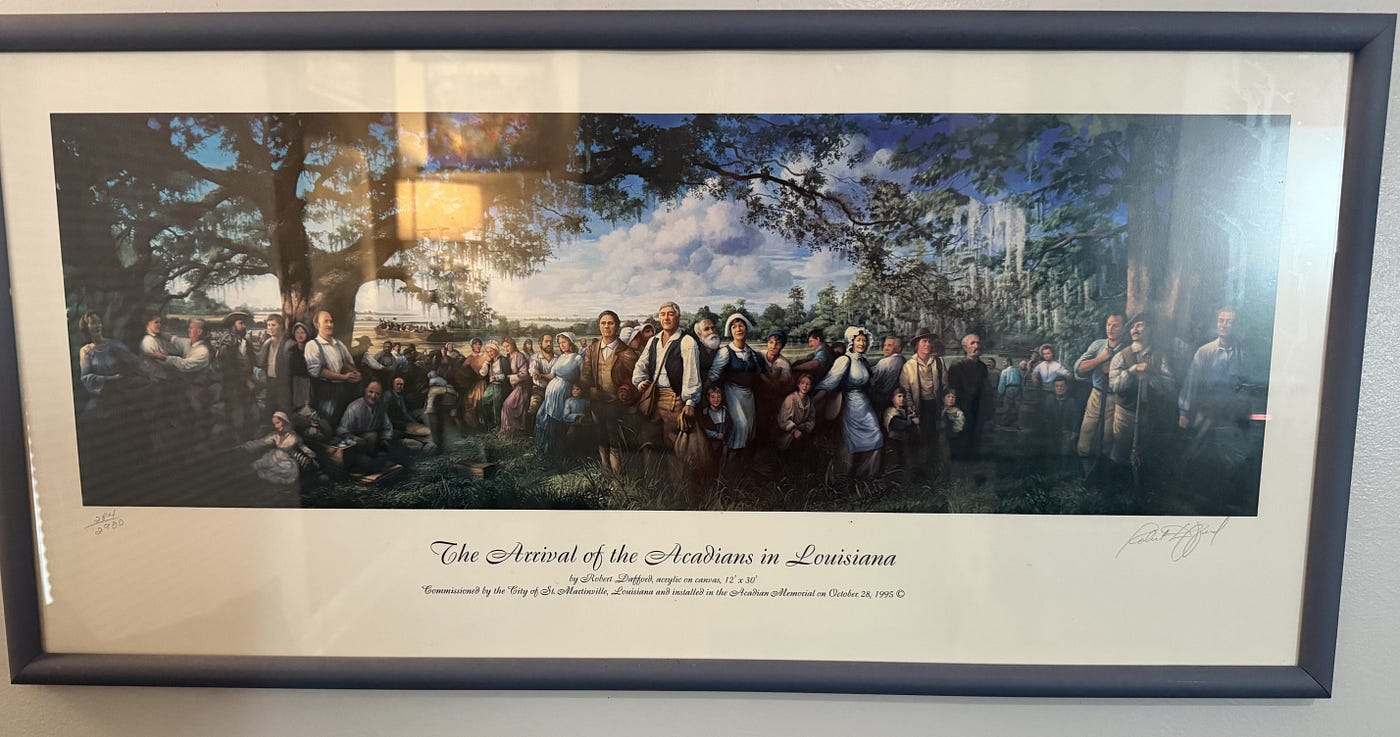
The Print
Joseph Broussard dit Beausoleil, the Acadian Journey, and the Human Forces That Shape History
EXECUTIVE SUMMARY
This paper examines the historical journey of the Acadian people from their origins in France to their eventual resettlement in Louisiana, with particular focus on the life and legacy of Joseph Broussard dit Beausoleil.
Rather than presenting a simplified narrative of displacement and survival, this work frames the Acadian experience as a sequence of decisions — some voluntary, others imposed — occurring within the broader geopolitical conflict between France and Great Britain.
At its core, this paper advances a central thesis:
History is shaped not only by systems and events, but by individuals whose traits — often flawed — align with the demands of specific moments.
The Acadian population was initially formed through voluntary migration from rural France in the early 17th century, driven by economic opportunity, land availability, and participation in French colonial expansion. Over time, these settlers developed a distinct, self-reliant society in Acadia characterized by agricultural innovation, communal cooperation, and relative political independence.
Following the Treaty of Utrecht, Acadia came under British control. The Acadians’ continued refusal to swear unconditional allegiance to the British Crown, combined with their cultural, linguistic, and religious differences, created increasing political tension.
This tension culminated in the Expulsion of the Acadians, one of the most significant forced migrations in North American history.
Within this context, individuals such as Broussard emerged — not as perfect figures, but as leaders whose traits aligned with the demands of a collapsing system.
This paper seeks to understand not only what happened, but why — exploring the interplay between human traits, environmental pressure, and mission alignment in shaping historical outcomes.
PREFACE
A couple weeks ago, a simple gesture stuck with me.
A conversation turned into a gift — an Acadian flag lapel pin and a sticker — handed to me by John Day after I mentioned, almost in passing, how much that heritage meant to me.
That moment pulled a thread.
It led back to one of the first meaningful gifts I ever gave my mother — a signed print of “The Arrival of the Acadians in Louisiana.” At the time, it was more money than I probably should have spent. But it mattered.

This Flag’s Pin Started this Ball Rolling!
She hung it with pride until she passed in 2013.
Now it hangs in my office.
Same frame. Same story.
That story is not just historical.
It is personal.
And like most stories worth understanding, it is more complex than it first appears.
This paper is an attempt to move beyond simplified narratives and take a closer look at the forces — human and historical — that shaped the Acadian journey.
SECTION I — INTRODUCTION: BEYOND HISTORY
History is often presented as a sequence of events.
Dates, treaties, migrations, outcomes.
But events alone do not explain outcomes.
At critical moments, individuals act within those events — and their decisions shape what happens next.
This paper adopts a dual lens:
- Historical Analysis — tracing the movement of the Acadian people
- Human Framework — examining how traits, pressure, and mission alignment produce impact
This framework can be summarized as:
- flawed humans
- powerful traits
- directed through mission
- producing meaningful impact
This is not a rejection of structural history.
It is an expansion of it.
The Acadian experience provides a compelling case study in how human behavior interacts with geopolitical forces to produce lasting cultural outcomes.
SECTION II — FRANCE TO ACADIA: ORIGINS OF A PEOPLE
Voluntary Migration, Not Exile
Contrary to common misconception, the Acadian people were not initially exiled from France.
Their migration to North America in the early 1600s was voluntary and aligned with broader patterns of European colonial expansion.
Many settlers originated from:
- Poitou
- Aunis
- Saintonge
- Normandy
These regions were characterized by:
- limited land ownership
- rigid social hierarchies
- constrained economic mobility
Colonial migration offered:
- access to land
- relative autonomy
- opportunity to build independent livelihoods
Formation of Acadian Society
The establishment of Port-Royal in 1605 marked the beginning of sustained French presence in Acadia.

The establishment of Port-Royal in 1605 marked the beginning of sustained French presence in Acadia.
Over time, settlers developed a distinctive society defined by:
- Agricultural Innovation The construction of dykes allowed reclamation of fertile marshland, enabling sustainable farming in a challenging environment.
- Decentralized Governance Geographic distance from France limited direct oversight, fostering local decision-making.
- Community Interdependence Survival required cooperation, reinforcing strong kinship networks.
- Cultural Adaptation Interaction with Indigenous populations, particularly the Mi’kmaq, influenced both survival strategies and cultural practices.
Key Insight
The Acadians were not passive colonists.
They were builders of a self-sufficient, semi-autonomous society.
This independence would later become a defining — and complicating — trait under British rule.
SECTION III — EMPIRE, PRESSURE, AND THE LIMITS OF NEUTRALITY (1713–1755)
Treaty of Utrecht
The Treaty of Utrecht fundamentally altered the geopolitical landscape.
France ceded control of Acadia to Great Britain.
Acadia became Nova Scotia.
A Population Out of Alignment
The Acadians remained:
- French-speaking
- Catholic
- agriculturally independent
Under a governing authority that was:
- British
- Protestant
- increasingly security-focused
This created a structural misalignment between: 👉 population identity 👉 governing power
The Strategy of Neutrality
Faced with competing empires, the Acadians adopted a strategy of neutrality.
They sought to:
- avoid military service
- maintain their land
- preserve their communities
This position was pragmatic.
But it was also fragile.
Neutrality depends on tolerance from those in power.
And tolerance diminishes under pressure.
Rising Tensions
Several factors eroded British trust:
- Ongoing conflict between Britain and France
- Strategic importance of Nova Scotia
- Suspected Acadian support for French and Indigenous resistance
- Refusal to swear unconditional allegiance to the British Crown
From the British perspective, neutrality became indistinguishable from risk.
The Breaking Point
By the early 1750s, British authorities concluded that Acadian neutrality was no longer acceptable.

The Migration Map
The issue was not simply loyalty.
It was control.
The Acadians represented:
- a culturally distinct population
- resistant to integration
- occupying strategically valuable land
In a time of war, this combination was viewed as untenable.
Analytical Insight
This moment illustrates a broader principle:
Systems under stress tend to reject ambiguity.
The Acadians’ identity and strategy — effective under stable conditions — became liabilities under wartime pressure.
Foreshadowing Collapse
By 1755, conditions had aligned toward a single outcome.
The Expulsion of the Acadians would not emerge from a single decision, but from:
- accumulated distrust
- geopolitical conflict
- structural incompatibility
Section II & III Synthesis
The movement from France to Acadia created a people defined by independence.

Port Rochelle in France
That independence, under British rule, became a source of tension.
And under pressure, that tension became conflict.
The same traits that allowed the Acadians to build a life in Acadia ultimately contributed to the forces that displaced them.
SECTION IV — COLLAPSE AND EXPULSION (1755)
When Systems Reject Ambiguity
Introduction: The End of Tolerance
By 1755, the conditions that had allowed Acadian society to exist in a state of relative autonomy had eroded.
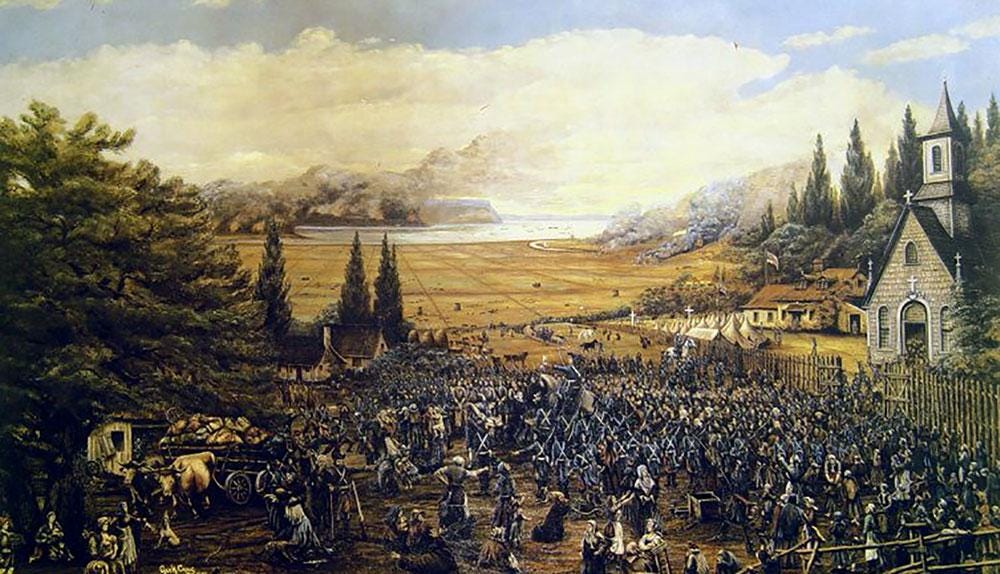
The Great Expulsion
The strategy of neutrality — once effective — had become untenable.
The governing authority no longer saw:
- neutrality as stability
- cultural difference as tolerable
- independence as manageable
Instead, it saw: 👉 risk
This shift did not occur suddenly.
It was the result of:
- decades of geopolitical tension
- accumulated distrust
- increasing military urgency
The Decision Framework of Empire
The British decision to deport the Acadians must be understood within the context of imperial strategy.
From a British perspective, the Acadian population represented:
- A non-assimilated group within a contested territory
- A population unwilling to provide unconditional loyalty
- A potential support base — real or perceived — for French and Indigenous forces
In wartime conditions, these factors combined into a single conclusion:
The cost of tolerating ambiguity exceeded the cost of removing it.
The Mechanism of Expulsion
Expulsion of the Acadians
The execution of the deportation was systematic and deliberate.
Key actions included:
- Summoning Acadian men under pretense of discussion
- Detaining them and confiscating land and property
- Burning homes and agricultural infrastructure
- Forcibly loading families onto ships
The process resulted in:
- Immediate displacement of approximately 7,000 Acadians
- Subsequent deportations increasing total displacement significantly
- Widespread family separation
Human Consequences
The outcomes were severe:
- Families permanently divided
- High mortality due to disease and poor conditions during transport
- Cultural fragmentation across multiple regions
Destinations included:
- British American colonies
- England
- France
- Caribbean territories
This dispersion was not coordinated for resettlement.
It was designed for: 👉 removal
Analytical Insight: Collapse as a Revealing Force
Collapse does not create traits.
It reveals them.
Under conditions of forced displacement:
- some individuals withdrew
- some adapted quietly
- some resisted
- some emerged as leaders
This variation is critical.
It demonstrates that: 👉 shared identity does not produce uniform response
The Emergence of Leadership Under Pressure
It is within this collapse that individuals such as Joseph Broussard dit Beausoleil become visible.
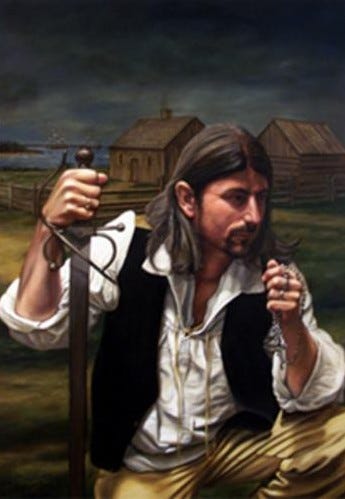
Joseph Broussard dit Beausoleil
Not because they were previously unknown.
But because: 👉 the conditions now required action
Leadership in this context was not:
- formal
- elected
- or institutionally defined
It was:
- situational
- reactive
- shaped by urgency
Key Principle
When systems collapse, leadership becomes less about authority and more about action.
Why This Moment Matters
The expulsion represents more than a historical event.

Broussard Steps Up as a Guerilla Warfare Speciliast to Lead the First Acadian Journey to Louisiana
It is a turning point where:
- structure gives way to chaos
- identity is tested under pressure
- individuals are forced into decision
It is also the moment where: 👉 the human framework becomes visible
- flawed humans
- powerful traits
- directed through mission
- producing meaningful impact
Foreshadowing the Next Phase
The expulsion did not end the Acadian story.
It transformed it.
From:
- a localized, self-sufficient society
To:
- a dispersed population navigating survival
This transition sets the stage for:
- the rise of key individuals
- the reformation of identity
- the eventual migration to Louisiana
The expulsion did not define the Acadians by what they lost — but by how they responded when everything was taken.
SECTION V — THE HUMAN FACTOR: WHO RISES AND WHY
Traits, Pressure, and Mission Alignment
Introduction: Beyond Events
Historical events explain what happened.
They do not fully explain: 👉 why certain individuals shape what happens next
Within the same conditions:
- some individuals withdraw
- some endure quietly
- some adapt
- some act decisively
This variation cannot be explained by circumstance alone.
It requires examination of:
- individual traits
- environmental pressure
- alignment with a mission
Core Thesis
Individuals who shape historical outcomes do so not because they are perfect, but because their traits align with the demands of a specific moment.
This alignment can be understood through a simple framework:
- Trait Presence
- Environmental Pressure
- Mission Alignment
When all three converge: 👉 meaningful impact becomes possible
I. Trait Presence: The Raw Material
All individuals possess traits.
Some traits, however, are more likely to influence outcomes under pressure:
- Intensity — sustained focus and drive
- Resilience — ability to endure adversity
- Decisiveness — willingness to act without full information
- Loyalty — commitment to people or cause
- Adaptability — ability to adjust to changing conditions
These traits are neutral.
They are not inherently positive or negative.
Their impact depends on: 👉 how they are directed
Critical Insight
Traits do not determine outcomes. They create potential.
II. Environmental Pressure: The Catalyst
Traits alone do not produce impact.
They must be activated by conditions.
Periods of:
- war
- displacement
- institutional breakdown
- resource scarcity
create environments where:
👉 inaction has consequences 👉 delay increases risk 👉 decisions cannot be avoided
Under these conditions:
- latent traits become visible
- individuals are forced into response
Key Principle
Pressure does not create character — it reveals it.
III. Mission Alignment: The Direction
Traits under pressure can lead to:
- constructive outcomes
- destructive outcomes
- or paralysis
The determining factor is: 👉 mission alignment
Mission provides:
- direction
- purpose
- prioritization
It answers:
👉 What is this intensity being applied to?
Important Distinction
Mission does not eliminate flaws.
It channels traits.
Illustrative Insight
The same individual traits can produce vastly different outcomes depending on alignment.
- Intensity without direction → fragmentation
- Intensity aligned with mission → cohesion and action
IV. Convergence: When Impact Occurs
Meaningful historical impact occurs when:
- Traits are present
- Pressure is applied
- Mission is clear
This convergence produces:
- decisive action
- leadership emergence
- influence over outcomes
Framework Summary
- flawed humans
- powerful traits
- directed through mission
- producing meaningful impact
V. Variation in Response
Not all individuals respond the same way under identical conditions.
This is critical.
Within the Acadian population during the expulsion:
- some sought survival through compliance
- some dispersed and adapted
- some resisted
- some emerged as leaders
This variation demonstrates:
👉 shared identity does not produce uniform behavior
VI. Emergence of Leadership
Leadership in collapsing systems is rarely:
- formal
- structured
- or predetermined
It emerges through:
- action
- decision-making
- willingness to assume risk
Key Principle
Leadership is not assigned in crisis — it is revealed.
VII. Implications for Historical Analysis
Traditional narratives often:
- elevate individuals to heroic status
- or reduce them to symbolic figures
This framework offers an alternative:
Evaluate individuals based on:
👉 their contribution within the conditions they faced
Not:
- perfection
- hindsight judgment
- or simplified moral categorization
VIII. Transition to Case Study
This framework provides the basis for examining individuals such as Joseph Broussard dit Beausoleil
He did not exist outside the system.
He operated within:
- pressure
- uncertainty
- collapsing structures
His relevance lies not in myth, but in: 👉 alignment with the moment
🔥 Closing Line for Section V
When traits, pressure, and mission align, individuals do not become perfect — they become consequential.
SECTION VI — CASE STUDY: JOSEPH BROUSSARD DIT BEAUSOLEIL
A Flawed Leader in a Collapsing System (1702–1765)
Introduction: Separating Man from Myth
Joseph Broussard dit Beausoleil is often remembered as a symbol.
A resistance leader. A cultural figure. A bridge between Acadia and Louisiana.
But symbols are simplified.
This paper treats Broussard as something more useful:
👉 a human case study in leadership under pressure
He was not:
- universally admired
- morally uncomplicated
- operating with perfect information
He was:
- a farmer
- a militia leader
- a man forced into decision by circumstance
I. Early Life: Formation Without Forecast (1702–1740s)
Broussard was born in 1702 in Port-Royal, Acadia.
His early life reflects the broader Acadian experience:
- agricultural labor
- family-centered community
- relative independence from centralized authority
There is no evidence that he was groomed for leadership.
No indication of:
- formal military training
- political office
- elite status
Analytical Insight
Leadership capacity often develops without formal recognition.
Traits such as:
- resilience
- independence
- adaptability
were not exceptional in Acadia — they were necessary.
Broussard’s early life did not predict leadership.
It prepared him for it.
II. Escalation: From Farmer to Fighter (1740s–1755)
As conflict between Britain and France intensified, Acadia became a contested space.
Neutrality grew increasingly fragile.
Within this environment, Broussard emerged as a militia leader aligned with:
- French interests
- Mi’kmaq allies
His activities included:
- guerrilla-style engagements
- disruption of British positions
- defense of Acadian communities
Trait Analysis
At this stage, Broussard demonstrates:
- Intensity → sustained engagement in conflict
- Decisiveness → willingness to act without institutional backing
- Loyalty → alignment with community and cultural identity
- Adaptability → operating outside conventional military structure
Critical Distinction
Broussard did not create conflict.
He responded to it.
The system shifted — and he adapted faster than most.
III. Collapse: Leadership Under Expulsion (1755–1760)
Expulsion of the Acadians
The expulsion marked the breakdown of Acadian society.
At this stage:
- formal structures disappeared
- communities fragmented
- survival became immediate
Broussard’s role becomes more difficult to categorize.
He:
- continued resistance efforts
- evaded capture for a period
- operated within shrinking options
Eventually, he was captured and imprisoned by British forces.
Analytical Insight
Leadership in collapse is not clean.
It involves:
- incomplete information
- limited resources
- constrained choices
Actions taken in this context are: 👉 often imperfect 👉 often reactive 👉 often judged differently in hindsight
IV. Constraint: Imprisonment and Limitation
Broussard’s capture represents a shift from:
- active leadership → constrained agency
This period highlights a critical truth:
Even highly capable individuals are subject to structural limits.
His influence during this time was reduced — not eliminated — but significantly constrained.
V. Transition: From Resistance to Relocation (1760–1765)
Following his release, Broussard joined efforts to relocate Acadian populations.
This phase reflects a shift in mission:
From:
- resistance
To:
- survival and resettlement
He became associated with the movement of Acadians through:
- the Caribbean
- ultimately to Louisiana
Mission Realignment
This transition demonstrates:
👉 traits remain constant 👉 mission changes
His intensity, loyalty, and decisiveness were now applied to:
- migration
- regrouping
- rebuilding
VI. Final Chapter: Louisiana and Legacy (1765)
Broussard arrived in Louisiana in 1765.
He died the same year.
His time in Louisiana was brief.
His impact was not.
Why His Legacy Endures
Not because he:
- led a formal government
- established institutions
- or lived to see long-term outcomes
But because he contributed at critical moments:
- resistance during conflict
- cohesion during fragmentation
- transition during displacement
VII. Framework Application: Why Broussard Matters
Applying the Section V framework:
Trait Presence
- intensity
- resilience
- decisiveness
Environmental Pressure
- war
- displacement
- societal collapse
Mission Alignment
- protection
- resistance
- resettlement
Result
👉 Meaningful impact within constrained conditions
VIII. Flaws and Limitations
To maintain analytical integrity, it is necessary to acknowledge:
- His actions were not universally accepted
- His methods were shaped by conflict
- His decisions occurred within moral ambiguity
Key Principle
Impact does not require perfection.
IX. Comparative Insight
Broussard’s trajectory aligns with broader patterns observed in leaders such as George S. Patton:
- strong traits
- controversial characteristics
- effectiveness within specific contexts
X. Synthesis
Broussard’s legacy is not best understood through:
- hero worship
- or reduction to symbol
It is best understood through:
👉 function
What role did he play within the system?
What did he contribute when it mattered?
🔥 Closing Line for Section VI
He was not perfect. He was not inevitable.
But when his world required action — he acted.
And because he did, the outcome was different than it would have been otherwise.
SECTION VII — COMPARATIVE LEADERSHIP: GEORGE S. PATTON
Intensity, Direction, and the Acceleration of Outcomes
Introduction: Capability in High Gear

George S. Patton remains one of the clearest modern examples of a leader whose traits amplified outcomes when aligned to mission.
He was:
- highly driven
- aggressive to the point of controversy
- uncompromising in standards
Those same traits:
- created friction in peacetime settings
- proved highly effective in wartime operations
I. Context: War Demands Momentum
World War II created conditions defined by:
- urgency
- large-scale coordination
- time-sensitive opportunity
In such environments:
- delay carries cost
- hesitation compounds risk
- speed creates advantage
II. Trait Profile
Patton’s effectiveness correlates strongly with:
- Intensity → relentless pursuit of objectives
- Decisiveness → rapid decision cycles
- Aggression → preference for forward movement
- Discipline → strict standards of performance
These traits were not universally positive.
They were: 👉 situationally effective
III. Mission Alignment
Patton’s traits aligned with a specific operational need:
👉 rapid maneuver warfare
His command of the U.S. Third Army during the European campaign:
- emphasized speed
- exploited breakthroughs
- maintained operational pressure
This alignment produced:
- accelerated advances
- disruption of enemy positioning
- increased strategic momentum
IV. Friction and Limitation
Patton’s leadership also produced:
- interpersonal conflict
- controversial decisions
- disciplinary incidents
These reflect an important principle:
Traits that create advantage in one context can create liability in another.
V. Framework Application
Applying the Section V model:
Trait Presence
- intensity
- decisiveness
- aggression
Environmental Pressure
- global conflict
- high stakes
- time-sensitive operations
Mission Alignment
- speed
- breakthrough
- sustained pressure
Result

👉 Acceleration of operational outcomes
VI. Comparative Insight
Patton and Joseph Broussard dit Beausoleil share a structural similarity:
- both operated under pressure
- both exhibited strong, sometimes controversial traits
- both aligned those traits to immediate mission demands
Different:
- scale
- system
- resources
Same: 👉 pattern of impact
🔥 Closing Line for Section VII
Capability alone does not shape history.
Capability aligned with the right mission, at the right moment, can accelerate it.
SECTION VIII — THE ENIGMA: JEAN LAFITTE
Ambiguity, Incentives, and Unexpected Contribution
Introduction: Outside the System

Jean Lafitte does not fit traditional leadership categories.
He operated:
- outside formal authority
- within illicit trade networks
- across shifting political alignments
And yet: 👉 he contributed to a defining historical moment
I. Context: The Gulf and the War of 1812
The Gulf Coast in the early 1800s was:
- commercially active
- lightly regulated
- strategically important
During the Battle of New Orleans, control of the region became critical.
II. Trait Profile
Lafitte demonstrates:
- Adaptability → ability to navigate shifting conditions
- Pragmatism → alignment with opportunity
- Network leverage → access to resources and information
- Decisiveness → willingness to act when advantageous
III. Mission Shift
Initially:
- smuggler
- operating outside legal systems
Later:
- aligned with U.S. forces
This shift was driven by:
- strategic incentive
- survival calculus
- opportunity for legitimacy
IV. Contribution
Lafitte’s involvement contributed:
- artillery support
- intelligence
- local knowledge
These factors played a role in: 👉 U.S. defensive success
V. Analytical Insight
Lafitte illustrates a critical expansion of the framework:
Mission alignment can change.
Individuals are not fixed in:
- role
- loyalty
- contribution
VI. Framework Application
Trait Presence
- adaptability
- decisiveness
- opportunism
Environmental Pressure
- wartime instability
- economic incentives
- political uncertainty
Mission Alignment
- shifting from self-interest to cooperative action
Result
👉 Unexpected but meaningful contribution
VII. Comparative Synthesis
Across:
- Joseph Broussard dit Beausoleil
- George S. Patton
- Jean Lafitte
We observe:
- different moral profiles
- different systems
- different motivations
But consistent elements:
- strong traits
- action under pressure
- alignment (fixed or shifting) with mission
🔥 Closing Line for Section VIII
History is not shaped only by those within the system — but often by those willing to act when the system is not enough.
SECTION IX — LOUISIANA: REFORMATION OF IDENTITY
From Displacement to Definition
Introduction: Not an Ending — A Transformation
The arrival of Acadian populations in Louisiana during the 1760s did not represent the conclusion of their story.
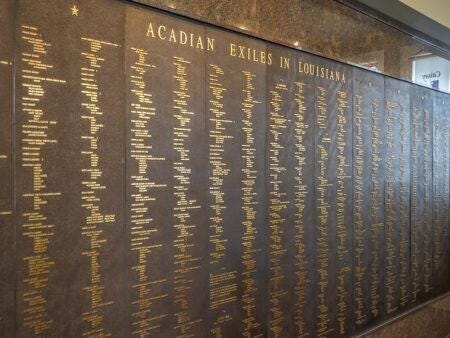
The Acadian Exiles In Louisiana
It marked the beginning of something new.
Displacement had:
- fractured communities
- dispersed families
- stripped away structure
What remained was: 👉 identity 👉 shared experience 👉 and the traits that had carried them through collapse
I. Why Louisiana Worked
Louisiana offered conditions that allowed for reformation:
- Cultural Compatibility French and Spanish governance supported Catholic practices and linguistic continuity
- Geographic Opportunity Land availability along bayous and coastal regions allowed for settlement
- Relative Autonomy Distance from centralized authority once again enabled local adaptation
II. Adaptation Over Preservation
The Acadians did not recreate Acadia.
They adapted.
Environmental realities required:
- new agricultural methods
- integration with local ecosystems
- interaction with diverse populations
Over time, this produced:
👉 Cajun identity
III. Cultural Synthesis
Cajun culture emerged through:
- French Acadian roots
- Spanish governance
- African and Caribbean influences
- Indigenous knowledge systems
This was not preservation.
It was: 👉 reinvention under pressure
IV. Trait Continuity
Despite transformation, core traits persisted:
- independence
- resilience
- adaptability
- community orientation
These traits were not tied to location.
They were carried forward by people.
🔥 Closing Line for Section IX
They did not rebuild what they lost.

They built something new from what remained.
SECTION X — SYNTHESIS: TRAITS, MISSION, AND IMPACT
A Framework for Understanding History
I. Pattern Recognition
Across this study, a consistent pattern emerges:
- Joseph Broussard dit Beausoleil
- George S. Patton
- Jean Lafitte
Different:
- backgrounds
- moral frameworks
- systems
Shared:
- strong traits
- action under pressure
- alignment with mission
- measurable impact
II. The Model
The framework developed in this paper can be expressed as:
1. Traits
Raw human capabilities:
- intensity
- resilience
- decisiveness
- adaptability
2. Pressure
Environmental conditions:
- conflict
- instability
- constraint
3. Mission
Direction and purpose:
- protection
- expansion
- survival
- opportunity
Convergence
When these elements align:
👉 individuals become consequential
III. Flawed but Effective
A central conclusion:
Perfection is not a requirement for impact.
All individuals examined:
- possessed flaws
- operated under uncertainty
- made imperfect decisions
Yet: 👉 their contributions influenced outcomes
IV. Direction Determines Outcome
Traits are neutral.
Mission determines consequence.
- aligned traits → constructive impact
- misaligned traits → destructive impact
Closing Line for Section X
History is not shaped by perfect people.
It is shaped by flawed individuals whose traits, under pressure, are directed toward a mission that produces impact.
SECTION XI — MODERN IMPLICATIONS
Why This Still Matters
I. Leadership
Modern leadership operates under similar dynamics:
- imperfect individuals
- complex systems
- time-sensitive decisions
The lesson:
👉 effectiveness depends on alignment, not perfection
II. Organizational Culture
Organizations succeed when they:
- recognize individual strengths
- align those strengths with mission
- create environments where traits can be applied productively
III. Strategic Thinking
Understanding adversaries, competitors, and partners requires:
- recognizing shared human traits
- identifying mission alignment
- avoiding oversimplification
IV. Identity and Legacy
For Louisiana, this framework explains:
- cultural resilience
- community strength
- adaptability across generations
🔥 Final Closing Line
We do not inherit perfect heroes.
We inherit the impact of flawed people who acted when it mattered.
And in understanding them, we better understand ourselves.
CONCLUSION — MAIS JAMAIS
Flawed People. Decisive Moments. Lasting Impact.
History is easy to sanitize.
We smooth the edges. We simplify the people. We turn complex lives into clean narratives.
But that’s not how anything meaningful gets built.
The story traced in this paper — through the Acadian journey, through Joseph Broussard dit Beausoleil, and reflected in figures like George S. Patton and Jean Lafitte — points to something far more real:
History is not shaped by perfect people. It is shaped by flawed individuals who act when it matters.
The Acadians did not begin as victims.
They were settlers who chose opportunity over certainty. They built a society defined by independence and cooperation.
Those same traits — strengths in one context — became liabilities in another when empire demanded control over autonomy.
And when that pressure reached its breaking point in 1755, everything familiar was taken.
Land. Community. Structure.
What remained was not perfection.
What remained was:
- identity
- resilience
- and the capacity to act
Some endured quietly. Some adapted. Some disappeared into the margins of history.
And some stepped forward.
Not because they were chosen. Not because they were destined.
But because they were capable — and willing to act when action was required.
Broussard represents that moment.
Not as a symbol of perfection — but as proof of function.
He did not control the system. He did not determine the outcome alone.
But he contributed — meaningfully — when the system was collapsing.
And because he did:
the outcome was different than it would have been otherwise.
That is the measure.
Not purity. Not hindsight judgment. Not myth.
Contribution under pressure.
This same pattern appears across time.
The traits we associate with heroes — loyalty, intensity, courage, discipline — are not rare.
They exist in many people.
What separates those who shape outcomes is not the presence of those traits.
It is:
- how they are directed
- what mission they serve
- and whether action is taken when it matters
The difference between destruction and contribution is not capability. It is direction.
And direction is a choice.
The Acadians who arrived in Louisiana did not recreate what they had lost.
They built something new.
Cajun identity is not preserved history.
It is adapted history — formed under pressure, carried forward by people who refused to disappear.
That refusal is the legacy.
Mais Jamais.
Not “never again” as a promise against hardship.
But “never again” as a refusal:
- to disappear quietly
- to surrender identity
- or to stand still when action is required
We do not inherit perfect heroes.
We inherit the impact of flawed people who stepped forward when it mattered.
And in understanding them, we are left with a question that is not historical.
It is personal.
When pressure comes — because it always does — what will we do with the traits we carry?
메타데이터
- post_id
- 2c76979f3c1d
- slug
- mais-jamais-2c76979f3c1d
- url
- https://medium.com/@jodybrou/mais-jamais-2c76979f3c1d
- canonical_url
- https://medium.com/@jodybrou/mais-jamais-2c76979f3c1d
- author_url
- https://medium.com/@jodybrou
- status
- ok
- fetched_at
- 2026-07-13 06:23:13