4 Reasons why DMBOK matters in the Age of AI
Is DMBOK Obsolete?
4 Reasons why DMBOK matters in the Age of AI
Is DMBOK Obsolete?
With the rise of powerful AI and large language models (LLMs), a common assumption is that traditional, comprehensive data management frameworks like the DMBOK (Data Management Body of Knowledge) are becoming obsolete.

The reality, however, is more complex and surprising. Not only do core data management principles remain relevant, but they are now more critical than ever, forming the foundation of a much larger strategic picture.
1. AI Makes “Boring” Data Fundamentals More Critical, Not Less
Foundational DMBOK disciplines — including data governance, data quality, metadata management, master data management, and data architecture — are amplified in importance in the age of AI. These are not legacy concerns but prerequisites for successful and responsible AI implementation.
The “garbage in, garbage out” principle applies with even greater force to AI. Models that train on massive datasets can propagate errors from poor-quality data at an unprecedented scale, making foundational data integrity non-negotiable.
DMBOK principles directly support AI initiatives in several key ways:

- Data Quality: Ensures the integrity of training data, directly mitigating the risk of biased or inaccurate model outputs.
- Metadata Management: Provides crucial data lineage and provenance, which is essential for achieving the transparency and explainability required to understand model behavior and meet regulatory demands.
- Data Governance: Establishes the policy framework for responsible AI use, defining data access rights, sensitive data handling protocols, and clear accountability structures.
However, where DMBOK needs extension is in addressing concepts native to the modern AI stack. Developed before the current wave of generative AI, the framework does not directly cover challenges like managing unstructured data at LLM scale, the use of vector databases, prompt engineering as a data practice, or the feedback loops between model outputs and future training data. This highlights why a single framework is no longer enough.
2. DMBOK Isn’t a Static Relic — It’s Actively Evolving
A common misconception is that the DMBOK is an unchanging document from a pre-AI era. In reality, the framework is actively being updated by DAMA International to address modern data challenges.
Evidence of this evolution includes:
- The 2024 maintenance revision of DMBOK 2.0, which integrated considerations for AI governance and ethics directly into the framework.
- The DAMA-DMBOK 3.0 project, a major community-driven update that started in 2025. Its goal is to modernize the framework by incorporating emerging topics such as AI and cloud platforms.
This ongoing evolution shows that the core body of knowledge for data management is adapting to new technologies rather than being replaced by them.
3. DMBOK’s place in the modern AI Governance stack
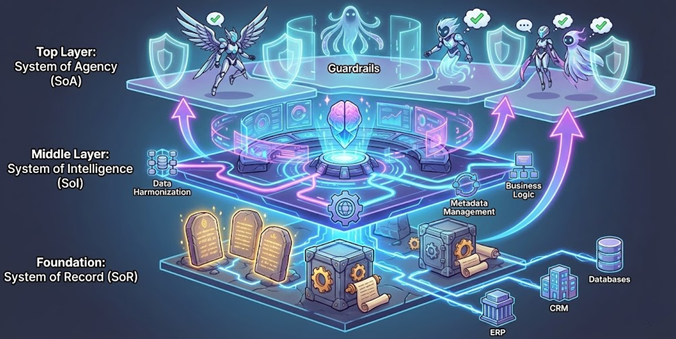
The unique, multifaceted risks and opportunities of AI demand a strategic shift from a monolithic approach to a modular, risk-aware strategy. Organizations succeeding with AI recognize that DMBOK principles are a necessary starting point, but they are not sufficient on their own.
The most successful organizations treat DMBOK principles as necessary but not sufficient, layering AI-specific practices on top of solid data management foundations rather than replacing them.
To build a comprehensive strategy, organizations now complement DMBOK with other specialized frameworks. This “team” approach allows for a more robust and tailored governance model:
EDM Council’s DCAM (Data Management Capability Assessment Model)
DCAM focuses on assessing data management capabilities and maturity. While DMBOK tells you what data management is, DCAM tells you how well you’re doing it. It provides a scoring methodology (1–6 scale) with 34 capabilities and 101 sub-capabilities, enabling organizations to benchmark against peers and demonstrate progress to stakeholders. Version 3 includes enhanced capabilities for cloud-native architectures, AI/ML integration, and modern data pipelines.
NIST AI Risk Management Framework (AI RMF)
Traditional data governance frameworks weren’t designed for AI systems, while AI risk frameworks often lack deep data management foundations — which is precisely why integration matters. The NIST AI RMF, structured around four functions (Govern, Map, Measure, and Manage), addresses AI-specific risks that DMBOK wasn’t designed for: algorithmic bias detection, model drift monitoring, adversarial robustness testing, and model explainability requirements. These are fundamentally new technical challenges that don’t exist in conventional data management.
ISO/IEC 38505
This standard serves a different audience than the others — it’s aimed at governing bodies and boards, not practitioners. While DMBOK provides practitioner knowledge and DCAM enables capability measurement, ISO 38505 answers strategic oversight questions: How should the board evaluate data governance? What accountability structures should exist? How does data strategy align with business objectives? It provides guiding principles for executives on the effective, efficient, and acceptable use of data for analytics and AI.
Putting the team to work:

Practitioners often use this integrated approach: DMBOK as the foundational guide for understanding the breadth of data management, DCAM to assess current capabilities and create actionable improvement plans, NIST AI RMF for AI-specific risk management, and ISO 38505 to ensure board-level governance alignment.
4. Assessment Is Now as Important as Knowledge
Here’s a truth that catches many organizations off guard: understanding data management is no longer enough — you must be able to measure and prove your capabilities.
This shift explains why both DMBOK and DCAM exist and why organizations need both.
They emerged from different needs:
- DMBOK emerged from DAMA International, a professional association, to codify the discipline itself — to establish what data management is and create a common vocabulary for practitioners.
- DCAM emerged from the EDM Council, originally established by financial services firms facing regulatory pressure. They needed to measure and demonstrate their data management capabilities to regulators, not just understand them conceptually.
Why measurement matters now:
When leadership asks “How mature is our data management program?” or “How do we compare to competitors?” or “What should we prioritize next?” — DMBOK alone cannot answer these questions. You need:
- Objective scoring with defined criteria for each capability
- Evidence requirements that can withstand audit scrutiny
- Benchmarking data to compare against industry peers
- Progress tracking to demonstrate improvement over time
This is especially critical for AI initiatives. Regulators increasingly want to see evidence of data management capability before approving AI deployments. Having a score, showing improvement over time, and benchmarking against peers has become essential for regulatory conversations.
The organizations that thrive will be those that invest in both: deep knowledge of data management principles and rigorous, measurable assessment of how well they execute.
Conclusion: From a Foundation to a Future-Proof Strategy
Far from being obsolete, DMBOK remains the essential foundation for data management. However, the structure built on top of that foundation must now include specialized frameworks for AI governance, risk management, and cloud capabilities.
The stakes are high. Organizations deploying AI without robust data governance face:
- Regulatory exposure under emerging AI legislation worldwide
- Operational failures from poor data quality propagating through models at scale
- Reputational damage from biased or unreliable AI outputs
- Competitive disadvantage from slower, less trustworthy AI adoption
Practical Steps to start building on Solid Ground
Practical steps to start building on solid ground:
- Assess your current state. Use DCAM or a similar framework to objectively measure your data management maturity — not what you think it is, but what evidence demonstrates.
- Identify your AI-specific gaps. Traditional data governance likely doesn’t cover model drift, algorithmic fairness, or adversarial threats. Map your existing capabilities against the NIST AI RMF to find blind spots.
- Engage leadership. Data governance can no longer be a purely technical concern. Use ISO 38505 principles to establish board-level accountability and strategic alignment.
Is your organization building its AI house on a solid data foundation — or on digital sand? The answer will determine not just your AI success, but increasingly, your regulatory standing and competitive position.
메타데이터
- post_id
- 2c76af8ced0f
- slug
- 4-reasons-why-dmbok-matters-in-the-age-of-ai-2c76af8ced0f
- url
- https://medium.com/schoolforaisolutionarchitects/4-reasons-why-dmbok-matters-in-the-age-of-ai-2c76af8ced0f
- canonical_url
- https://medium.com/schoolforaisolutionarchitects/4-reasons-why-dmbok-matters-in-the-age-of-ai-2c76af8ced0f
- author_url
- https://medium.com/@edyau
- status
- ok
- fetched_at
- 2026-06-24 11:06:28