How We Optimized International Team Payments
And saved a lot of hours
How We Optimized International Team Payments
And saved a lot of hours
I’ve been working with the Selfwork team since the very beginning. At first, there were only three of us, but over time the team grew. It just so happened that all of our employees were located in different countries. I personally moved several times, and today, for example, we have team members in Spain, Brazil, and Serbia.
At some point, we faced a simple question: how were we actually going to pay everyone? And that’s when what felt like endless headaches began.
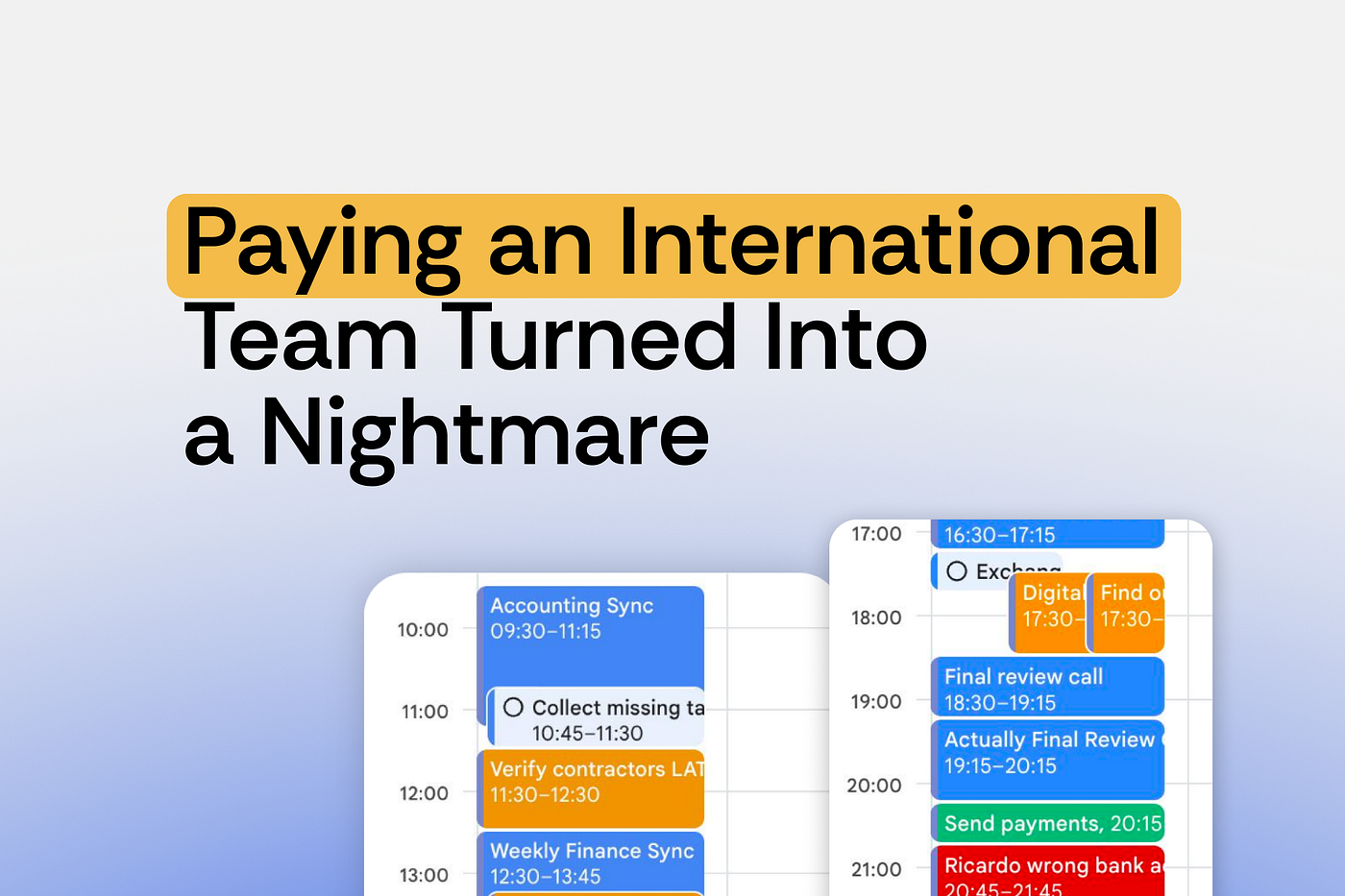
Illustration by Selfwork
The Challenges of Paying an International Team
Every payout day consisted of countless tasks. We had to collect employees’ banking details, double-check them, and keep track of changes. Someone would register as a sole proprietor, someone else would close their business, and another person would move to a different country. Some wanted to receive payments in cryptocurrency, others preferred euros, and others needed Georgian lari. Managing all of this manually was becoming almost impossible.
At one point, we even had recurring seven-hour blocks in Google Calendar dedicated solely to making sure payments were processed correctly and legally for our relatively small team. Meanwhile, the company kept growing, and the number of payments grew with it. That’s when we started asking ourselves: what should we do next?
We identified a list of problems that needed to be solved urgently.
The first was the sheer amount of time spent processing payments. Even for a relatively small team, this required hours of attention every month, and the workload only increased as the company grew.
The second was the volume of information spread across different people. The process involved not only accounting and finance but also me as CPO. Banking details, tax information, contractor records, and payout preferences were constantly changing, and some information inevitably became outdated or got lost.
The third challenge was handling payments across multiple jurisdictions. We wanted everything to be done fairly, transparently, and correctly. At the same time, it was important to find efficient ways to transfer funds without losing significant amounts to fees.
The fourth challenge was legal and compliance management. We needed to maintain up-to-date documentation, comply with regulations across different countries, and keep all required information in one place. This became increasingly difficult, especially as regulations continued to evolve.
The fifth challenge was dealing with multiple currencies. Some people wanted to be paid in euros, others in dollars, and others in cryptocurrency. We had to account for different withdrawal methods, payment systems, and exchange rate fluctuations. As the team grew, managing all of this manually became more and more difficult.
The Solution: We Built Payroll
I’ll be honest here: we had one advantage. Many members of our team came from fintech backgrounds, so we approached the problem together and thought about it on a larger scale. We decided to build our own Payroll system — one that would solve all of our pain points and save us a significant amount of time (we’ll skip the part about how long it took to build).
So we created our own Payroll solution and started using it to pay both employees and contractors, including freelancers. Which features made the biggest difference for us?
The first was automated contracts and invoices.
Today, all required documents for our employees and contractors are automatically generated and stored in their personal accounts. If we work with an external contractor or freelancer, all documentation is handled correctly and centrally.
This is important not only for us as a company. Many contractors operate as sole proprietors and use invoices and other documents for tax reporting. Others need this documentation to prove income, open bank accounts, or support immigration and relocation processes in another country. As a result, both the company and the professionals always have access to the documents they need.
The second feature was the ability to pay people in any currency and let them withdraw funds whenever it suits them.
The process is simple: funds appear in the employee’s Selfwork account, and the employee decides when to withdraw them and where to send them. If someone prefers to receive money in their European Revolut account, they can do that. If someone else prefers to receive payments in USDT, they can do that too.
The third advantage was time savings.
Today, we have a clear and transparent process. Documents and data are pulled automatically, so there’s no longer a need to handle every individual case separately with each employee or contractor. We simply review the information before processing payments, make sure the required tasks are completed and approved, and that’s it. After that, employees decide for themselves when and how they want to withdraw their funds.
The fourth advantage is data transparency.
We no longer need spreadsheets with multiple versions of the same information that constantly require manual updates. All data is stored in one place, and management can view everything they need through a clear and intuitive dashboard. Special thanks to our UI/UX designer for making it genuinely pleasant to use on a daily basis.
This has significantly simplified process management and reduced the likelihood of errors.
We even ran the numbers. On average, automating our payout process now saves us around 12 working hours every month. And, of course, it greatly reduces the risk of mistakes while eliminating the stress of missing or incorrectly prepared documents.
Good News: You Don’t Have to Build Payroll Yourself
Once we started actively using our own product, we regularly received positive feedback from employees about how much easier the payment process had become. Later, we decided to show Payroll to some of our partners. And without being overly modest, I can say that the reaction was extremely positive.
That’s when we thought: if this tool helps us this much, why not turn it into a full-fledged product?
Today, companies using our Payroll solution tell us that it significantly simplifies international payments, helps them handle compliance and documentation requirements, and removes a large number of routine administrative tasks. Some employees have even used the automatically generated documentation to support applications for Digital Nomad visas.
And we’re glad that we’ve been able to make life at least a little easier for their finance teams.
메타데이터
- post_id
- 2c819e5d2b29
- slug
- how-we-optimized-international-team-payments-2c819e5d2b29
- url
- https://medium.com/selfwork-insights/how-we-optimized-international-team-payments-2c819e5d2b29
- canonical_url
- https://medium.com/selfwork-insights/how-we-optimized-international-team-payments-2c819e5d2b29
- author_url
- https://medium.com/@ai_16210
- status
- ok
- fetched_at
- 2026-07-16 14:44:18