Inquiry Needs Navigation
Designing Inquiry That Moves Students from Knowledge to Meaningful Action
Inquiry Needs Navigation
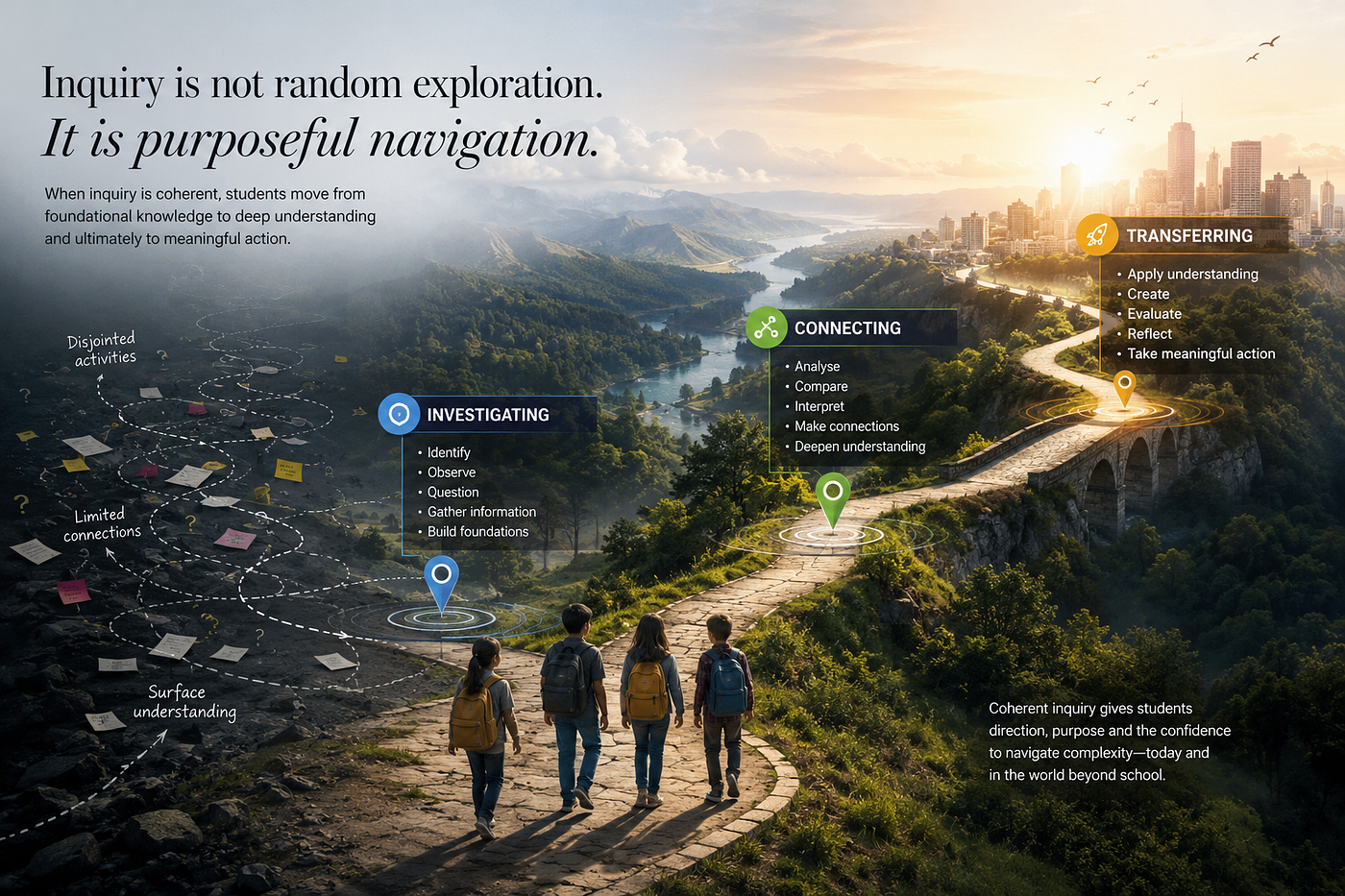
Travelling the road of inquiry
Designing Inquiry That Moves Students from Knowledge to Meaningful Action
I remember sitting in planning meetings surrounded by intelligent, experienced and deeply committed teachers who still quietly felt frustrated.
We understood the language of the PYP: inquiry, concepts, agency, transdisciplinary learning, reflection and action. We believed in those ideas. We could see their potential. Yet many teachers were still left asking the same question:
“How does this actually fit together in practice?”
Not philosophically.
Practically.
How does a six-week unit move from an opening provocation to deep conceptual understanding? How do the Lines of Inquiry connect? How do we know which engagements belong where? How do we avoid simply doing enjoyable activities around a theme? How do we move students toward meaningful action rather than surface-level projects?
Too often, the pieces were there, but the direction was unclear.
Students might spend weeks analysing persuasive media, debating ideas and completing research tasks while still struggling to explain the deeper understanding connecting those experiences together. The activities related loosely to the same theme, but they did not always build toward lasting conceptual understanding.
The issue was rarely effort.
And it certainly was not care.
The issue was coherence.
Over time, one of the clearest patterns to emerge from successful inquiry planning was this: the strongest units consistently moved students through a progression of understanding. They guided students through a journey — building foundations, deepening understanding and eventually transferring that understanding into reflection, creation or meaningful action.
Without that progression, inquiry can fragment into disconnected experiences orbiting a common theme. With it, students begin to understand not only the topic itself, but how meaning grows, connects and evolves.
This became especially important when planning conceptually.
Conceptual inquiry is not primarily about memorising isolated facts or subject content. Facts matter, but conceptual understanding allows learning to travel. A student may forget vocabulary, dates or definitions, yet powerful concepts continue shaping how they interpret the world long after the unit itself is over.
A student who deeply understands influence, systems, responsibility or change can continue applying those ideas years later in completely different contexts.
This means planning cannot begin simply with:
“What activities would be engaging?”
Instead, planning must begin with a deeper question:
“What do we want students to still understand years from now?”
Those enduring understandings become the navigational point for the entire inquiry.
Once those big takeaways become clear, the rest of the planning process starts aligning more naturally. The central idea sharpens. The Lines of Inquiry begin functioning as stages within a larger journey. Engagements become more purposeful. Assessment begins tracking growth rather than task completion. Even action starts emerging more organically as an end-point.
Planning also becomes more conceptually anchored. The central idea is no longer driven primarily by topic coverage, but by the understanding students are expected to carry forward beyond the unit itself.
The inquiry begins feeling less like a collection of lessons and more like a meaningful intellectual journey.
What follows is a structure that has consistently helped inquiry feel more coherent, more purposeful and more meaningful for both students and teachers.
The Problem Isn’t Inquiry, It’s Structure
One of the biggest misunderstandings about inquiry learning is the assumption that inquiry itself is the problem.
It isn’t.

Learning moves from a curiosity to action
When inquiry works well, it is powerful. Students are curious, reflective and genuinely invested in learning. Questions deepen. Connections begin forming across subjects. Understanding moves beyond memorisation and toward interpretation, perspective and meaning.
The problem begins when inquiry loses structure.
And this often happens with the best of intentions.
A team plans a strong provocation. Someone discovers an engaging activity online. A creative project sparks excitement. A discussion opens an interesting but unexpected direction. Slowly, the unit fills with experiences that are individually valuable.
But valuable experiences alone do not guarantee conceptual understanding.
This is the difference between thematic learning and conceptual inquiry.
A thematic unit often asks:
“What activities fit this topic?”
Conceptual inquiry asks:
“How does understanding deepen over time?”
That distinction matters enormously.
Strong inquiry does not simply expose students to interesting experiences. It moves thinking forward. Each provocation, discussion, investigation or reflection should deepen understanding, strengthen connections, challenge assumptions or prepare students to apply learning in increasingly meaningful ways.
Without that progression, inquiry begins to fragment for both teachers and students.
Teachers often feel this during planning itself. Concepts sit in one section of the planner. Skills appear somewhere else. Assessments are mapped separately. Activities are brainstormed independently. Lines of Inquiry can unintentionally become three disconnected statements rather than stages within a larger conceptual journey.
Students feel this too, even if they cannot always articulate it.
They may enjoy the unit. They may participate enthusiastically. They may complete every task successfully. Yet underneath the surface, many still struggle with the deeper questions:
Why does this matter?
How do these ideas connect?
What understanding should I leave this unit with?
And what should I now do with that understanding?
Progression gives inquiry coherence.
The unit begins feeling less like a collection of activities and more like a meaningful intellectual journey where each stage builds naturally upon the last.
Inquiry, in other words, needs navigation.
Start With the Big Takeaways
One of the most important shifts we made in inquiry planning came from changing where the process actually began.
For many teachers, planning naturally starts with activities, resources or curriculum requirements. We look at standards. We think about projects. We search for strong provocations and engaging experiences.
But the strongest inquiry units rarely begin there.
They begin with clarity about understanding.
Before building engagements, before writing Lines of Inquiry and sometimes even before drafting the central idea itself, we began asking:
“What do we want students to still understand years from now?”
That distinction changes the entire shape of planning.
Knowledge matters, of course. Students need vocabulary, examples, information and experiences. But knowledge alone rarely creates lasting transfer. Facts fade surprisingly quickly when they remain disconnected from deeper meaning.
Conceptual understanding travels further.
A student may forget the details of a particular media campaign studied in Grade 4 but still carry a deep understanding of how influence shapes human behaviour. They may forget the name of a persuasive technique while still recognising when emotion, fear or bias is being used to manipulate an audience years later.
This is why the “big takeaways” matter so much in inquiry planning.
The strongest units are usually built around a small number of enduring understandings powerful enough to transfer across time, cultures and disciplines.
In a media influence unit, students might explore advertisements, social media, influencers, persuasive techniques, misinformation and digital citizenship. Those experiences matter, but they are not the deepest layer of the inquiry.
Underneath them sits the larger conceptual understanding:
media influences how people think, feel and act.
That understanding becomes the navigational point for the entire unit.
Assessment changes too.
The focus shifts away from:
“Did students complete the task?”
toward:
“What understanding did this experience deepen?”
Knowledge is no longer treated as the final destination.
It becomes the foundation students stand upon before moving into interpretation, connection, reflection and eventually meaningful action.
Strong inquiry planning therefore begins less like assembling a checklist and more like establishing direction.
What experiences might help students uncover these ideas?
What misconceptions are likely to emerge?
What kinds of questions, investigations and discussions might deepen understanding over time?
And perhaps most importantly:
In what kind of world will these concepts come alive for students?
Because concepts alone are not enough.
Children need somewhere for the inquiry to live.
Concepts Need Somewhere to Live
Even powerful concepts can remain strangely abstract if students never encounter them inside meaningful contexts.
Children do not naturally connect to concepts in isolation.
They connect to stories, problems, roles, systems, challenges and experiences that feel real.

The ARENA is a space where students can take on roles real or imagined
One of the most effective shifts in our planning came from treating inquiry less like a sequence of lessons and more like an immersive arena students could step into. Instead of simply learning about media influence, students might become journalists, documentary filmmakers, advertising agencies, social media analysts or digital citizens investigating how information shapes public opinion.
The concepts remain the same.
But suddenly the learning has identity, purpose and emotional investment.
This is where role, narrative and GRASPS-style thinking become powerful. Students are no longer completing isolated classroom activities. They are operating inside a larger situation with a purpose, an audience, a challenge and a genuine reason to care about the understanding they are developing.
The inquiry becomes something they participate in rather than something delivered to them.
That shift changes the energy of the classroom.
Questions become more authentic because students are trying to solve problems from within the role they have assumed. Research becomes more purposeful because students need information to navigate the challenge in front of them. Discussions deepen because concepts are now connected to decisions, perspectives and consequences inside the arena itself.
In a media influence unit, students might investigate how advertising affects consumer behaviour before eventually designing public service announcements for a real audience. Along the way they analyse persuasive techniques, study misinformation, interview community members about media habits and debate ethical questions surrounding influence and responsibility.
The inquiry stops feeling like a collection of school tasks.
It begins feeling like meaningful work.
Strong inquiry units also begin feeling connected from week to week because the arena itself creates coherence. Students are not starting fresh every lesson. They are gradually navigating a larger unfolding journey.
The classroom itself can begin reflecting this progression. Wonder walls evolve. Thinking boards fill with developing questions, conceptual connections and emerging reflections. Earlier ideas are revisited and refined as students encounter more complex perspectives and experiences.
The inquiry starts feeling less static.
More alive.
Inquiry Needs Navigation
Once the arena is established and the enduring understandings are clear, the next challenge becomes sequencing the inquiry itself.
Strong inquiry does not move randomly from one interesting experience to another. It moves through a progression of understanding. Students build foundations, deepen relationships between ideas and eventually apply those understandings in meaningful ways.
One of the most useful ways to think about this progression is through three broad phases:
- building foundational knowledge,
- deepening conceptual understanding,
- and eventually transferring understanding through reflection, creation or meaningful action.

The well-mapped path leads from curiosity to action.
These phases are not rigid boxes. Strong inquiry remains responsive, flexible and alive. Students may revisit earlier ideas, uncover misconceptions or loop back toward previous understandings as the unit develops.
But the overall direction still matters.
The inquiry begins by building foundations.
At this stage, students are tuning in, investigating and gathering knowledge. They identify, observe, define, question and develop shared language around the inquiry itself. In a media influence unit, students might analyse advertisements, identify persuasive techniques, sort different forms of media or observe how information appears throughout their daily lives.
This stage can sometimes appear deceptively simple.
In reality, it provides the grounding students need before deeper conceptual thinking becomes possible.
Gradually, the inquiry moves into relationships and conceptual understanding.
Students begin asking:
Why does this happen?
How are these ideas connected?
What patterns are emerging?
How does perspective shape interpretation?
The inquiry becomes more analytical and interpretive. Students compare perspectives, examine systems, analyse cause and effect, challenge assumptions and connect individual experiences to larger conceptual understandings.
Eventually, the inquiry moves toward transfer.
Students begin asking:
So what?
What should we do with this understanding?
How might we apply it?
What responsibilities come with what we now know?
This is where understanding becomes visible through creation, reflection and action. Students design, produce, present, evaluate, advocate and reflect.
In the media influence unit, students might create responsible media campaigns, design public service announcements or propose solutions connected to ethical digital citizenship.
Importantly, this final phase is not simply “doing a project at the end.”
It represents the transfer of understanding.
The action matters because it emerges from the conceptual journey that came before it.
And over time, inquiry stops being just a unit structure.
It becomes a way of thinking.
The Role of the Teacher
Strong inquiry does not emerge accidentally.

The teacher is more than a guide; they help build the path.
Behind every coherent inquiry unit is a teacher carefully shaping the intellectual journey students move through. Questions are anticipated. Misconceptions are identified. Experiences are sequenced intentionally. Concepts are revisited at the right moments. Opportunities for reflection, transfer and connection are deliberately designed.
This means the role of the teacher in inquiry is far more complex than simply “stepping back.”
Inquiry is sometimes misunderstood as minimal teacher direction, where students independently discover understanding through exploration alone. In practice, however, the strongest inquiry classrooms are usually guided by highly intentional teaching.
The teacher is not controlling every outcome.
They are holding the larger conceptual map.
Students need freedom to investigate, question and construct meaning. At the same time, they also need intellectual structure, emotional safety and purposeful progression. They need someone carefully designing the conditions that allow understanding to deepen over time.
In many ways, the teacher becomes less like a lecturer and more like an architect, navigator and curator of thinking.
They design provocations that uncover prior understanding. They notice when misconceptions begin emerging. They recognise when students are gathering information without yet making meaning from it. They ask the questions that redirect thinking toward deeper relationships and larger concepts.
Importantly, they also know when not to intervene.
Strong inquiry requires patience. Students sometimes need time to wrestle with uncertainty, encounter conflicting perspectives or sit inside unresolved questions before deeper understanding emerges. Not every silence needs filling. Not every misunderstanding needs immediate correction.
The teacher holds the direction of the journey while still leaving space for students to think authentically within it.
This balance matters.
Too little structure and inquiry fragments into disconnected activity. Too much control and inquiry loses curiosity, ownership and agency. The strength lies in the intentional balance between guidance and exploration.
Over time, students begin internalising this process themselves. They become more capable of asking stronger questions, recognising conceptual relationships and transferring understanding independently.
The goal is not dependency on the teacher.
The goal is developing students who can increasingly navigate complex thinking for themselves.
Assessment as Growth
Assessment in inquiry should not feel separate from learning.
It should help make learning visible.
Too often, assessment becomes heavily associated with final products, grades or performance tasks completed at the end of a unit. In strong inquiry classrooms, however, assessment is woven throughout the entire process. It tracks the development of understanding over time rather than simply evaluating what students produce at the end.
This changes both the purpose and the culture of assessment.
Assessment stops functioning primarily as judgement and begins functioning more as reflection, feedback and growth.

Students learn to use assessment to better direct their own lerarning
At the beginning of an inquiry, assessment may help uncover prior understanding, misconceptions, curiosities and existing perspectives. Early provocations, discussions and tuning-in activities give teachers valuable insight into how students are initially making sense of the concepts being explored.
As the inquiry develops, formative assessment becomes increasingly important. Teachers observe how students are connecting ideas, asking questions, analysing perspectives and refining their thinking. Wonder walls evolve. Reflections deepen. Discussions shift from surface observations toward conceptual interpretation.
The growth becomes visible.
Importantly, students themselves also become part of the assessment process. They reflect on how their thinking is changing. They compare earlier assumptions with later understandings. They identify gaps in their own reasoning. Peer feedback, conferencing, self-assessment and collaborative reflection help students see learning as an evolving process rather than a fixed outcome.
This creates a healthier relationship with assessment itself.
Assessment becomes less about proving intelligence and more about developing understanding.
Even summative experiences begin changing shape. Rather than functioning as isolated end-point tasks, they become opportunities for students to transfer understanding meaningfully through creation, action, reflection or communication.
The assessment is no longer disconnected from the inquiry journey.
It emerges from it.
In a media influence unit, students might eventually create public service announcements, ethical media campaigns or awareness projects connected to digital citizenship. The final product matters, but the deeper evidence often lies underneath it:
- the conceptual understanding developed,
- the perspectives considered,
- the misconceptions refined,
- the questions explored,
- and the thinking made visible throughout the process.
When assessment is approached this way, students begin seeing reflection as a normal part of learning rather than something reserved only for evaluation.
Growth itself becomes visible.
And that visibility matters.
Because students are far more likely to take ownership of learning when they can genuinely see how their understanding has evolved over time.
Designing Inquiry That Lasts
At its best, inquiry is not simply a teaching strategy.
It is a way of helping students make sense of the world.
Strong inquiry invites students to move beyond collecting information and toward recognising relationships, patterns, systems, perspectives and responsibilities. It helps them understand not only what they are learning, but why that understanding matters and what might be done with it.
That kind of learning rarely emerges from isolated activities alone.
It emerges from carefully designed progression.

Learning is a process that manifests into creating positive change.
When inquiry is coherent, students begin experiencing learning differently. Knowledge stops feeling fragmented. Subjects begin connecting more naturally. Reflection becomes more meaningful. Action becomes more authentic because it grows from understanding rather than compliance.
Importantly, this kind of inquiry also changes the classroom itself.
The room becomes more than a place where tasks are completed. It becomes a space where ideas evolve over time. Questions deepen. Thinking becomes visible. Students begin recognising themselves not simply as receivers of information, but as thinkers capable of interpreting, creating and contributing meaningfully to the world around them.
And perhaps most importantly, the learning lasts.
Students may not remember every activity, vocabulary term or individual lesson years later. But they often remember the larger understandings that helped them see the world differently. They remember the concepts that continued travelling with them beyond the unit itself.
That is why coherence matters so deeply in inquiry design.
Not because inquiry needs more control.
But because meaningful freedom requires thoughtful structure.
Inquiry is not random exploration.
It is purposeful intellectual journeying.
When designed carefully, inquiry becomes far more than a unit planner framework.
It becomes a way of thinking students carry with them long after the classroom journey has ended.
메타데이터
- post_id
- 2c844d947fe1
- slug
- inquiry-needs-navigation-2c844d947fe1
- url
- https://medium.com/@kesterevans2020/inquiry-needs-navigation-2c844d947fe1
- canonical_url
- https://medium.com/@kesterevans2020/inquiry-needs-navigation-2c844d947fe1
- author_url
- https://medium.com/@kesterevans2020
- status
- ok
- fetched_at
- 2026-06-24 04:09:36



