Emotional Awareness : Role of Water Element in our life
From cosmic dust to consciousness, water is the bridge connecting life, emotions, and awareness.
Emotional Awareness : Role of Water Element in our life
From cosmic dust to consciousness, water is the bridge connecting life, emotions, and awareness.
Are We More Connected to the Cosmos Than We Realize?
Human beings have always gazed at the stars and wondered about their place in the universe. Ancient sages, philosophers, and mystics offered a profound answer: the same consciousness that permeates the cosmos also exists within us. Modern science approaches the question differently, yet both science and spirituality acknowledge one remarkable fact the human body is predominantly composed of water.
Water is the foundation of life. Every cell, tissue, organ, and biological process depends upon it. Yet in many spiritual traditions, water is more than a biological necessity. It is viewed as a sacred medium through which life, emotion, awareness, and consciousness are expressed.
This raises a fascinating question:
Could the water-rich human body serve as the bridge between cosmic existence and human experience?
To explore this possibility, we must begin not with humanity, but with the story of water itself a story that began long before the first human emotion was ever felt.
Water and the Creation of Planet Earth
Long before water became part of the human body, it played a central role in shaping our planet.
Approximately 4.5 billion years ago, Earth formed from a cloud of cosmic dust and gas left behind by earlier generations of stars. In its earliest stages, Earth was a molten world of extreme heat and volcanic activity.
As the planet gradually cooled, water vapor present in the atmosphere condensed into liquid form. Additional water may have arrived through collisions with icy asteroids and comets during the early history of the solar system.
The emergence of liquid water transformed Earth forever.
Water enabled:
• The formation of oceans • Climate stabilization • Geological and weather cycles • Chemical interactions necessary for life • The eventual emergence of biological organisms
Scientists often describe water as the “universal solvent” because it facilitates countless chemical reactions. Without water, the complex molecular interactions necessary for life would likely never have occurred.
In this sense, water was not merely an ingredient of life it was one of the primary architects of Earth’s transformation from a barren rocky world into a living planet.
And once Earth became a living planet, water assumed an even more extraordinary role: it became the cradle in which life itself emerged.
Water: The Cradle of Life
Nearly every scientific model concerning the origin of life places water at the center of the story.
The earliest forms of life are believed to have emerged in aquatic environments where water provided the conditions necessary for organic molecules to interact, combine, and evolve into increasingly complex structures.
Every living organism on Earth ultimately traces its ancestry back to these primordial waters.
The water circulating through our bodies today participates in the same planetary water cycle that has operated for billions of years. The molecules we drink may once have existed in ancient oceans, glaciers, clouds, rivers, or even within prehistoric organisms.
Viewed from this perspective, the water within us is not separate from Earth’s history it is part of an unbroken continuum stretching back to the origins of life itself.
As life evolved from simple organisms into increasingly complex forms, water remained its constant companion. Eventually, this evolutionary journey produced a species capable not only of living, but of reflecting upon life itself: human beings.
The Water-Rich Human Body
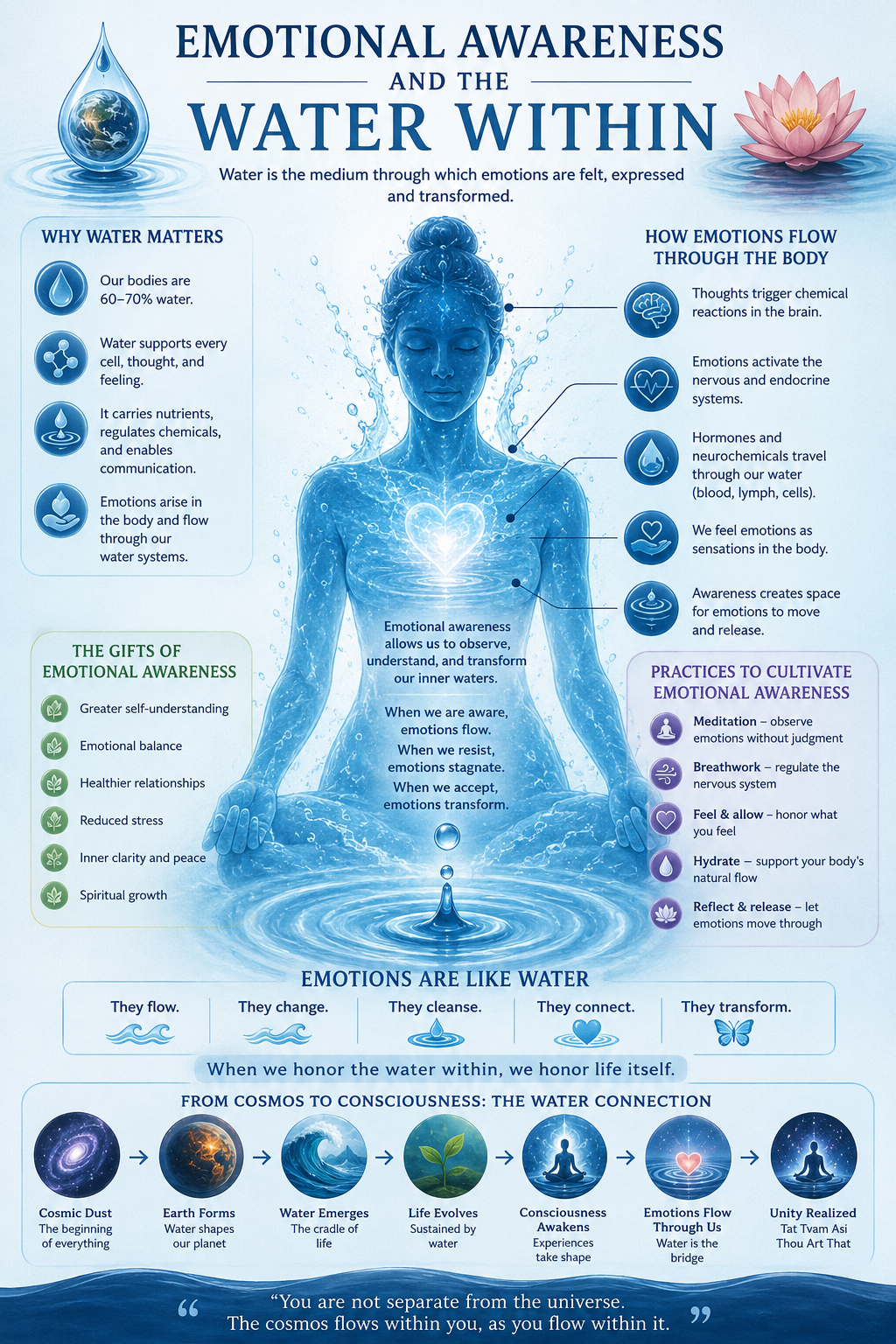
From a biological perspective, the human body is approximately 60–70 percent water.
This water performs numerous vital functions:
• Transporting nutrients and oxygen • Supporting cellular communication • Regulating body temperature • Facilitating biochemical reactions • Maintaining neurological function • Supporting metabolic processes • Enabling circulation and detoxification
Every thought, emotion, sensation, and physiological process unfolds within this water-rich environment.
When we experience joy, love, fear, gratitude, stress, or excitement, measurable physiological changes occur throughout the body. Hormones are released, neural pathways activate, heart rhythms shift, and cellular responses adapt.
Emotions are not merely psychological events. They are embodied experiences occurring within a living system composed largely of water.
This observation leads to an intriguing realization: if emotions are expressed through the body’s biological systems, then understanding human emotions requires understanding how consciousness interacts with the physical body.
Human Emotions and the Water Within
Emotions are among the most powerful forces shaping human experience.
Love can elevate us. Fear can protect us. Grief can transform us. Joy can inspire us. Yet every emotional experience is accompanied by measurable physiological activity occurring throughout the body.
When we experience stress, stress hormones circulate through the bloodstream. When we feel compassion or affection, neurochemicals associated with bonding and well-being are released. Even subtle emotional shifts influence heart rhythms, breathing patterns, muscle tension, and brain activity.
Because these processes occur within a body composed largely of water, the body’s internal water environment becomes the medium through which emotions are physically experienced.
Water itself does not create emotions. Rather, it provides the biological foundation that allows emotional states to be expressed throughout the body.
For thousands of years, spiritual traditions have sought methods for understanding and transforming these emotional experiences. Their insights eventually gave rise to practices designed to influence both mind and body.
Spiritual Practices and the Nervous System
Across cultures and civilizations, contemplative traditions developed methods for influencing human consciousness.
These include:
• Meditation • Prayer • Mantra recitation • Breathwork • Yoga • Mindfulness practices
Modern research increasingly demonstrates that such practices can influence:
• The autonomic nervous system • Heart rate variability • Emotional regulation • Stress responses • Attention and awareness • Brain-wave patterns
From a holistic perspective, these changes ripple throughout the body.
Because the body is largely composed of water, one may view water as the physical medium through which emotional and spiritual experiences become embodied.
This does not imply that water possesses supernatural powers or stores mystical information. Rather, water provides the biological environment within which consciousness, physiology, and emotional experience interact.
Ancient yogic traditions explored this relationship in remarkable depth, developing symbolic models that connected the physical body, emotional life, and higher states of awareness.
The Yogic View: Prana, Nadis, and Chakras
Ancient yogic traditions developed a sophisticated framework for understanding consciousness and human experience.
According to this model:
• Universal life force is known as Prana. • Prana flows through subtle channels called Nadis. • Energy centers known as Chakras regulate the movement of this life force. • The human being serves as a meeting point between physical and subtle dimensions of existence.
The chakra system can be understood as a symbolic map describing different levels of human consciousness and development.
Each chakra represents a different dimension of human experience, ranging from physical survival to spiritual realization.
Among these energy centers, one chakra is especially relevant to our exploration of water, emotion, and human experience.
The Special Role of the Water Element
Among the seven chakras, the Sacral Chakra (Svadhisthana) is uniquely associated with the element of water.
Water symbolizes:
• Emotional flow • Creativity • Adaptability • Sensitivity • Receptivity • Connection • Transformation
Just as water naturally moves and adapts, the sacral chakra governs our capacity to experience emotions, relationships, imagination, pleasure, and personal growth.
When this center is balanced, individuals often experience emotional resilience, creativity, and healthy relationships.
When blocked, emotional stagnation, rigidity, fear, or creative inhibition may arise.
The symbolism is profound. The same element that enabled the formation of oceans, nurtured the emergence of life, and sustains every cell of the human body is also associated with the energetic center governing emotional experience.
This symbolic connection naturally leads toward one of the deepest insights of the Upanishadic tradition.
Tat Tvam Asi: The Water That Connects Us All
The symbolic connection between water, emotion, and consciousness naturally leads toward one of the deepest insights of the Upanishadic tradition:
Tat Tvam Asi — “Thou Art That.”
This Mahavakya, or great wisdom statement, suggests that the deepest essence of the individual is inseparable from the ultimate reality that permeates the cosmos. It does not imply that human beings are separate entities striving to become divine. Rather, it points to a profound realization: the apparent separation between self and universe may be far less absolute than it appears.
When viewed through the combined lenses of science and spirituality, water offers a remarkable metaphor for this interconnectedness.
The water within our bodies is not isolated from the rest of existence. It is part of the same planetary cycle that has flowed through oceans, rivers, clouds, glaciers, forests, and countless living organisms for billions of years. The hydrogen atoms in that water were formed shortly after the birth of the universe, while the oxygen atoms were forged in the hearts of ancient stars long before the Earth existed.
In a very real scientific sense, every human being carries within them a history that stretches back to the origins of the cosmos.
At the same time, water serves as the biological medium through which life unfolds. Every heartbeat, every thought, every emotion, every act of creativity, every moment of love, and every spiritual experience occurs within a body sustained by water. It is the silent participant in every chapter of human existence.
Ancient yogic traditions recognized this connection symbolically through the Sacral Chakra, the center associated with the water element, emotional flow, creativity, adaptability, and human relationships. Modern science approaches the subject differently, focusing on physiology, neuroscience, and biological systems. Yet both perspectives point toward a common insight: water is inseparable from the processes that make life and experience possible.
Perhaps, then, the true significance of water lies not in mystical claims that it stores hidden cosmic codes, but in the extraordinary role it plays as a living bridge between matter and experience, biology and awareness, Earth and cosmos.
From cosmic dust emerged the stars.
From stars emerged the elements.
From the elements came water.
From water came life.
From life emerged consciousness.
And through consciousness, the universe gained the ability to observe itself.
Seen in this light, every human emotion becomes part of a much larger story a story that began billions of years ago among the stars and continues to unfold within every living being today.
The oceans of Earth, the water within our cells, the breath that sustains us, the emotions that move us, and the consciousness through which we experience reality are not isolated phenomena. They are interconnected expressions of a single unfolding process.
The cosmos is not merely something we observe in the night sky.
It is present within every drop of water that sustains life, within every emotion that shapes our humanity, and within every moment of awareness through which we experience existence.
Perhaps that is the deeper message hidden within both science and spirituality:
We are not separate from the universe.
We are one of the ways in which the universe experiences itself.
메타데이터
- post_id
- 2c9446bec4fa
- slug
- emotional-awareness-role-of-water-element-in-our-life-2c9446bec4fa
- url
- https://medium.com/@drshilpashinde/emotional-awareness-role-of-water-element-in-our-life-2c9446bec4fa
- canonical_url
- https://medium.com/@drshilpashinde/emotional-awareness-role-of-water-element-in-our-life-2c9446bec4fa
- author_url
- https://medium.com/@drshilpashinde
- status
- ok
- fetched_at
- 2026-07-10 00:23:36