AI Agentification of Software Developer Jobs — Open Questions Galore
Evaluating the impact of AI Agents on jobs, one job role at a time
AI Agentification of Software Developer Jobs — Open Questions Galore
Evaluating the impact of AI Agents on jobs, one job role at a time
TL; DR
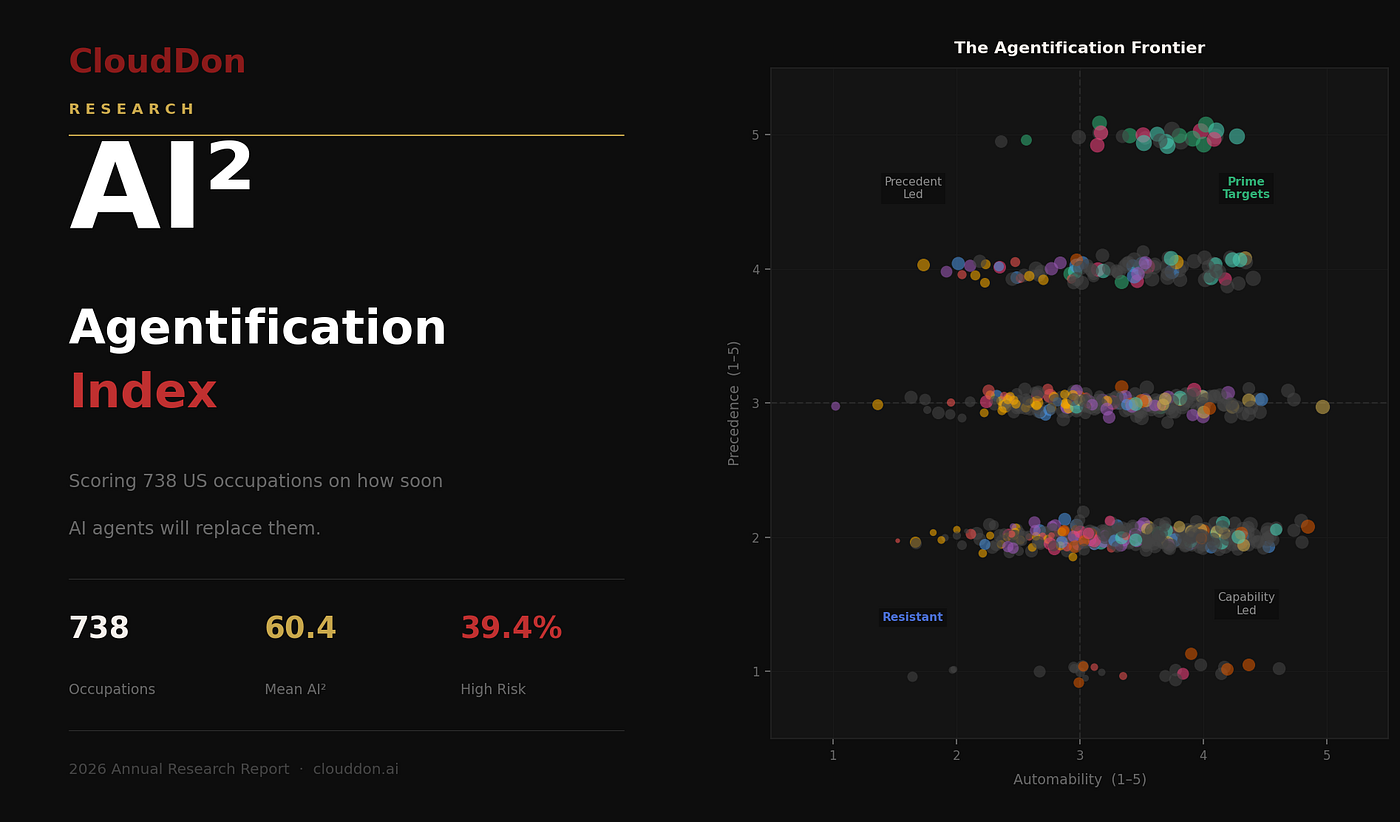
We discussed the impact of AI Agentification on Software Development jobs in our post on Day 1. With a normalized AI² score of 94.37, software development faces systematic displacement as the most agentifiable white-collar profession. While widespread job elimination is underway, critical operational and economic questions remain. This analysis examines these open questions and reveals why the transformation has become irreversible.
If you’re developing tools in this space, please contact us to schedule a briefing or support this series through sponsorship.

Image created using ChatGPT)
Introduction
Our previous post examined whether AI agents will replace humans in software development, tracing the evolution from AI assistance toward workforce displacement. This post addresses some of the open questions raised there and presents empirical evidence of the operational consequences currently manifesting across the industry. This analysis also examines the critical operational challenges and economic disruptions that emerge when AI adoption outpaces institutional capacity for strategic integration.
The open questions surrounding AI’s impact on software development fall into two categories: fundamental technical and economic challenges that are already manifesting, and deeper operational disruptions that organizations are only beginning to recognize. Let us examine the most critical questions first.
1. Is “Vibe Coding” ready for production systems?
Former OpenAI co-founder Andrej Karpathy’s term “vibe coding” has become the de facto descriptor for contemporary AI-assisted development — a methodology wherein developers generate code through natural language prompts without a comprehensive understanding of the underlying implementation. Karpathy coined the term in February 2025 to describe his experimental approach to building applications like MenuGen, explicitly noting both the “exhilarating speed of initial prototyping” and the “immediate, frustrating hurdles of real-world implementation” that characterize AI-generated software systems.
Despite Karpathy’s careful positioning of vibe coding as best suited for “low-stakes projects and prototypes” where you can “just let it rip,” industry adoption has proceeded at unprecedented scale. Current deployment statistics reveal:
- 42% of developers report their codebases are now predominantly AI-generated.
- Microsoft’s codebase contains up to 30% AI-generated content.
- Google’s AI systems generate over 25% of new code.
Verdict: Vibe Coding is not production-ready.
2. Will AI-Generated Code Create a Technical Debt Crisis?
The most insidious consequence of widespread AI adoption manifests as accelerated technical debt accumulation. As API evangelist Kin Lane observes: “I don’t think I have ever seen so much technical debt being created in such a short period of time during my 35-year career in technology.”
GitClear’s documentation of an 8x increase in code duplication and the systematic violation of fundamental software architecture principles suggests we are witnessing not technological progress but architectural regression at scale. The organizations racing to implement AI-first development will face the consequences when their systems become unmaintainable and their reduced workforces lack the expertise to address the mounting complexity. They are optimizing for speed without sustainability, automation without institutional wisdom, creating new categories of operational problems that may prove more expensive than the challenges AI was intended to solve.
Verdict: Long-term code quality concerns are severe and require immediate action.
3. Are Productivity Gains from AI Real?
Analysis of entry-level employment trends reveals systematic elimination of traditional developer career pathways. Organizations increasingly rely on AI systems for tasks historically assigned to junior developers, creating a fundamental disruption in knowledge transfer mechanisms.
Cost of Productivity
Contrary to prevailing industry narratives, empirical analysis reveals significant performance degradation accompanying AI adoption:
- 48% of AI-generated code contains identifiable security vulnerabilities.
- Google’s 2024 DORA report documented a 1.5% decrease in delivery throughput and a 7.2% reduction in delivery stability following AI adoption.
- Most significantly, developers now spend more time debugging AI-generated code than they save through AI assistance, fundamentally negating the productivity proposition that drives adoption decisions.
Architectural Degradation Patterns
- Code Duplication Epidemic: GitClear’s comprehensive analysis documents an 8x increase in duplicated code blocks following AI assistant deployment. AI systems, operating without architectural context or institutional knowledge, generate solutions based on statistical pattern matching rather than system-wide design principles, systematically recreating existing functionality.
- Violation of Fundamental Design Principles: The “Don’t Repeat Yourself” (DRY) principle — a cornerstone of maintainable software architecture — suffers systematic degradation as AI tools prioritize immediate functionality over architectural coherence, GitClear’s analysis shows.
- Context-Free Implementation: AI systems cannot comprehend existing system architecture, internal conventions, or long-term design intentions, resulting in parallel, inconsistent implementations that fragment system coherence.
Economic Impact of Technical Debt
The financial implications of AI-driven technical debt accumulation present immediate operational challenges:
- CISQ projects that 40% of IT budgets will be allocated to technical debt remediation by 2025.
- Annual technical debt costs have reached $2.41 trillion in the United States.
- Organizations consistently underestimate AI implementation costs by 500–1,000% during pilot-to-production transitions.
The Expertise Development Paradox
Industry observers note: “At some point, current software development jobs will be eliminated; junior software developers will be the first to go.” Current data indicates:
- AI systems have assumed responsibility for simple coding and debugging tasks that traditionally provided learning opportunities for junior developers.
- 77% of AI-related positions now require master’s degree qualifications, with 18% requiring doctoral credentials.
This employment pattern generates a critical feedback loop: as AI eliminates entry-level learning opportunities, the pipeline for developing senior-level expertise contracts. The industry faces a fundamental question: How will future practitioners acquire the deep system understanding necessary to effectively guide AI systems when the traditional pathways for developing such expertise no longer exist?
Verdict: The Developer Paradox represents an existential threat to software engineering.
4. How Severe Are the Security Risks in AI-Generated Code?
Security analysis reveals that AI-generated code introduces substantial vulnerability rates. Comprehensive studies document that 30–50% of AI-generated code contains vulnerabilities, particularly when utilized by less experienced developers.
Critical Vulnerability Categories
- Package Hallucinations: Research indicates that over 5% of commercial model output and 22% of open-source model output contain references to non-existent software packages. This phenomenon enables “slopsquatting” attacks wherein malicious actors create packages with similar names to exploit AI-generated dependencies.
- Training Data Contamination: Malicious actors can deliberately manipulate training datasets to introduce systematic vulnerabilities, enabling the creation of AI systems that generate code containing predetermined backdoors or security weaknesses.
- Trust-Deployment Disconnect: Despite documented security concerns, 39% of survey respondents report minimal trust in AI-generated code, yet organizational deployment continues at scale, creating a dangerous misalignment between technical assessment and operational practice.
Verdict: Critical security risks from AI-generated code are immediate and substantial.
5. Does AI Lead to Job Creation or Workforce Displacement?
The economic transformation accompanying AI adoption demonstrates clear patterns of workforce concentration rather than expansion. Technology sector layoffs have affected more than 80000 workers in 2025, with organizational leaders explicitly citing AI capabilities as justification for workforce reductions.
Corporate leadership communications reveal explicit intentions regarding AI-driven workforce optimization:
- Microsoft CEO Satya Nadella: “The clear focus as a company is to define the AI wave and empower all our customers to succeed in the adoption of this transformative technology.”
- Amazon CEO Andy Jassy: “As we roll out more Generative AI and agents, it should change the way our work is done. We will need fewer people doing some of the jobs that are being done today.”
These statements indicate strategic workforce reconfiguration rather than temporary economic adjustment.
Verdict: Economic distribution will favor concentrated wealth and significant workforce displacement.
These five questions reveal the scope of AI’s immediate impact on software development, but they represent only the visible surface of a much deeper transformation. Beyond productivity metrics and employment statistics lie systemic operational challenges that threaten the fundamental infrastructure of software development itself.
1. Will AI Adoption Cause Operational Infrastructure Collapse
AI adoption could precipitate systematic operational challenges that extend far beyond individual developer productivity metrics.
Resource Planning Dysfunction
Traditional agile development methodologies demonstrate fundamental incompatibility with AI-driven development patterns. Sprint planning processes encounter severe challenges as AI tools create unpredictable development velocity patterns.
Specific operational breakdowns include:
- Velocity Prediction Collapse: AI-driven development generates unpredictable sprint outcomes where traditional story point estimation becomes ineffective due to variable AI performance and debugging complexity requirements.
- Capacity Modeling Obsolescence: Traditional capacity planning assumes predictable human output patterns, but AI introduces variables, including model availability, token limitations, and computational constraints that fundamentally undermine sprint commitment reliability.
- Infrastructure Cost Explosions: Google’s AI code generation systems require computational resources that create unexpected operational expenses. AI workloads can cost 15 times more than standard CPU instances, with one SaaS organization discovering $280,000 in monthly unaccounted cloud expenditures from 23 undocumented AI services.
Caution: The possibility of operational infrastructure collapse should not be ignored.
The operational breakdown described above creates cascading effects that extend far beyond sprint planning and capacity management. Organizations discovering infrastructure incompatibilities soon encounter an even more fundamental problem: the systematic failure of traditional cost management approaches.
2. Why Do AI Implementation Costs Consistently Exceed Projections?
AI implementation costs consistently exceed organizational projections due to hidden operational requirements:
- Infrastructure Cost Multiplication: AI deployment can increase cloud computing costs by 30% through unexpected computational requirements. Cross-regional data transfer fees for European user data processed through U.S.-based AI models can incur $0.09/GB charges on AWS.
- Storage Proliferation: Individual PyTorch model checkpoints average 12GB storage requirements, meaning 100 experimental implementations can consume 1.2TB storage indefinitely, costing approximately $275 monthly.
- Development Efficiency Inversion: Developer time spent debugging AI-generated code exceeds time saved through AI assistance, creating hidden labor costs ranging from 50–200% of initial development investments.
Caution: Fundamental budget restructuring is needed to prevent systemic cost management failures.
While cost overruns and infrastructure explosions create immediate financial pressure, they pale beside the challenge of budgeting for an entirely new category of worker. The emergence of AI agents as economic entities requires financial planning models that traditional accounting and HR systems were never designed to handle.
3. How Do Organizations Budget for Human-AI Hybrid Teams?
Organizations face unprecedented challenges in budgeting for teams combining human developers with AI agents, requiring fundamentally different financial planning approaches than traditional human resource models.
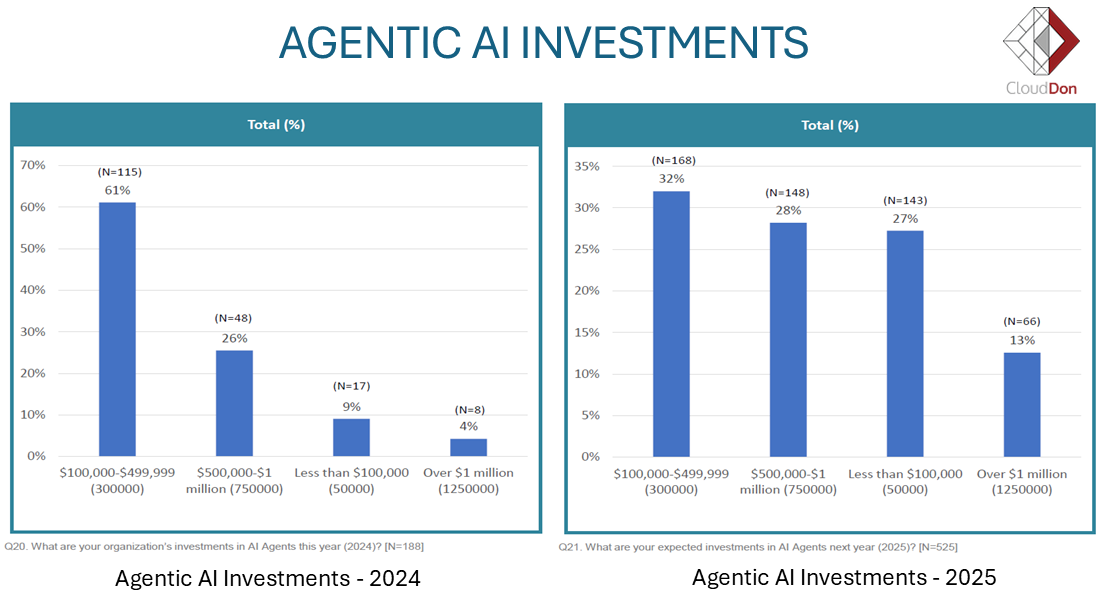
- Digital Worker Economic Models: Projections indicate $80 billion in labor cost savings through AI by 2026, with the AI agent market reaching $7.6 billion. However, 66.5% of IT leaders report exceeding AI budgets due to unforeseen usage patterns, indicating systematic underestimation of implementation complexity.
- Hybrid Team Resource Allocation: Microsoft’s 2025 Work Trend Index conceptualizes human employees as “agent bosses” managing AI workforces, requiring budget allocations for:
- Variable AI agent licensing and computational costs
- Human oversight and AI management skill development
- Infrastructure supporting human-AI collaboration workflows
- Continuous organizational adjustment as AI agents evolve, requiring ongoing modifications to workforce structure, budgeting approaches, and organizational capabilities
- Dynamic Cost Structure Management: Unlike predictable human salary models, AI operational costs fluctuate based on computational demand, token consumption, and model complexity. Organizations can no longer rely on traditional five-year planning cycles and must implement real-time workforce management systems. Financial planning must accommodate:
- Variable AI operational costs with unpredictable usage spikes.
- Licensing models ranging from per-conversation pricing ($2 per interaction) to usage-based token pricing ($15 per 1 million input tokens).
- Hidden integration, training, and adaptation costs.
- ROI measurement frameworks encompass both productivity metrics and risk mitigation expenditures.
Verdict: Traditional financial planning models are not enough for hybrid workforce budgeting needs.
The budgeting complexity outlined above reflects a deeper question about the nature of work itself in an AI-augmented environment. As organizations struggle to account for AI agents economically, they must simultaneously grapple with the fundamental question of human-AI workforce composition.
4. Will AI Displace Software Developers or Augment Them?
We explored this question in our previous analysis of production complexity and workforce implications
Verdict: [Referenced from previous analysis — workforce displacement is systematic and accelerating.]
The displacement patterns emerging from production-scale AI deployment create immediate management challenges that existing organizational frameworks cannot address. Leading organizations that successfully navigate workforce transitions discover they must simultaneously reinvent the fundamental practices of team leadership and performance management.
5. What New Management Challenges Do Human-AI Teams Create?
The emergence of hybrid human-AI teams introduces management complexities that extend far beyond traditional workforce oversight, creating unprecedented challenges that we are only beginning to understand.
Behavioral Dynamics and Team Psychology: The psychological impact of humans managing AI agents while being managed by other humans creates multilayered authority structures that defy conventional management theory. Research shows that 92 percent of companies plan to increase their AI investments over the next three years, but only 1 percent of leaders call their companies “mature” on the deployment spectrum, indicating organizations are unprepared for the psychological complexities of hybrid teams. Structural equation modeling analysis revealed that AI adoption has a significant negative impact on psychological safety, which in turn increases levels of depression, suggesting that human employees experience psychological stress when working alongside AI systems. Upwork found that while 85% of executives are mandating or encouraging the use of GenAI to drive efficiency, 77% of employees feel that the tools have decreased their productivity, highlighting the disconnect between leadership expectations and employee experiences in hybrid teams.
Performance Evaluation and Accountability Gaps: Traditional performance metrics become obsolete when human productivity is inextricably linked to AI agent performance. 75% of employees surveyed responded positively to the idea of AI-generated performance reviews, as long as their manager reviewed and adjusted them for accuracy, indicating employee acceptance but continued need for human oversight. However, transparency, regular audits for bias, and human oversight are critical to ensuring that AI systems are trusted and perceived as fair by employees. The challenge intensifies as AI systems are only as good as the data they’re trained on, and if the historical data is biased, AI can inadvertently reinforce these biases, creating accountability gaps when determining whether poor outcomes result from human oversight failures or AI limitations.
Organizational Culture and Identity Shifts: The fundamental nature of work relationships changes when team members include non-human entities with different operational rhythms and capabilities. The growing use of AI has led to concerns about whether it will lead to a hyper-rational organizational culture that prioritizes AI output over human contributions, as it is seen as efficient, objective, and undertaking structured, unbiased analyses. Cybersecurity risks are cited by 51 percent of respondents, inaccuracies by 50 percent, and concerns about personal privacy by 43 percent, with workforce displacement being a concern for 35% of respondents, indicating significant employee anxiety about AI integration that threatens organizational cohesion.
Scalability and Management Complexity: As AI agent capabilities advance, organizations face the paradox of needing to scale AI adoption while maintaining human control and oversight. By 2030, tasks are expected to be nearly evenly divided between human, machine, and hybrid approaches, with 47% of work tasks currently performed primarily by humans shifting to a more distributed model. Research from the 2024 State of Performance Enablement report found that 2 in 3 managers need more support to effectively manage performance, and 35% are already leveraging AI tools to enhance efficiency and effectiveness. However, scholars highlight challenges such as opacity, integration, and data management, arguing that the opacity and uncertainty of AI systems present key challenges to Human-AI augmentation, making it difficult to determine optimal management ratios and oversight structures.
Trust and Collaboration Challenges: Building effective human-AI partnerships requires addressing fundamental trust issues that traditional management approaches cannot resolve. Empirical evidence suggests that users address the opacity and uncertainty of AI in two primary ways: by either engaging through various interrogation practices or by disengaging, which involves accepting or ignoring AI outcomes without further investigation. Managers in the intelligent organization lead a hybrid workforce of intelligent human and digital actors, and they must understand what the members of their workforce can do, which problems they can solve, and how to mobilize them in complementary teams, requiring entirely new management competencies that organizations are still developing.
Verdict: Hybrid workforce management represents an entirely new organizational discipline requiring fundamental reinvention of management practices.
The management complexities outlined above demonstrate why the transformation of software development represents more than technological adoption — it constitutes a fundamental restructuring of the profession itself. The convergence of technical, economic, and organizational pressures has created a situation where strategic adaptation is no longer optional.
Conclusion: The Point of No Return
With a normalized AI² score of 94.37, software development represents the most vulnerable white-collar profession to AI displacement. The industry has crossed irreversible thresholds — competitive, financial, and structural — that make retreat impossible regardless of the challenges identified.
Converging Crises Drive Forward Momentum
Four systemic failures create a paradox: they make AI adoption more necessary, not less. GitClear’s documentation of an 8-fold increase in code duplication creates maintenance burdens that require AI tools to manage AI-created problems, establishing dependency loops too complex to manually resolve. The systematic elimination of entry-level positions — where 77% of AI roles now require advanced degrees — represents permanent destruction of knowledge transfer mechanisms that would take decades to rebuild. Meanwhile, AI workloads costing 15 times more than standard instances and shadow implementations creating hundreds of thousands in unaccounted expenses force organizations toward systematic AI management rather than abandonment. Most critically, as 30–50% of AI-generated code contains vulnerabilities while 39% of developers distrust the output they deploy, organizations respond by demanding better AI security tools, not AI elimination.
Economic Lock-In Makes Reversal Impossible
The financial commitments have created irreversible momentum. With 92% of companies increasing AI investments, enterprise AI spending rising 5.7% in 2025, and AWS reducing GPU prices by 45% to signal permanent infrastructure shifts, retreat becomes economically catastrophic. When major tech companies generate 25–30% of their code through AI and 76% of developers are using AI tools in their development process, competitive pressure eliminates the option of reversal — any organization abandoning AI while the competition acclerates faces immediate disadvantage in speed-to-market and cost structure. Amazon CEO Andy Jassy’s directive that “we will need fewer people” represents not a prediction but economic necessity, as over 80,000 tech layoffs in 2025 demonstrate strategic workforce reconfiguration that cannot be undone.
Implementation Problems Demand Better AI, Not Less AI
Every challenge identified creates market demand for more sophisticated AI solutions rather than retreat. The productivity paradox — where 85% of executives mandate AI usage despite 77% of employees reporting decreased productivity — drives investment in better integration tools and training platforms. Management complexity arising from hybrid human-AI teams creates new markets for AI management systems. Cost overruns and infrastructure breakdowns force the development of more efficient AI operations platforms. Security vulnerabilities drive AI-powered security solutions at enterprise scale. Each problem becomes a business case for advancing AI capabilities, not abandoning them.
The Choice: Strategic Adaptation, Not AI Adoption
The question is not whether AI will transform software development — organizations have already crossed the point where reversal is possible. The choice facing the industry is between strategic adaptation to irreversible change or becoming casualties of their failure to respond effectively. The future of software development depends not on AI capabilities but on the wisdom of human integration choices being made now, with competitive pressure ensuring that those who adapt poorly will be displaced by those who adapt well. The transformation cannot be stopped, only managed.
[This post was edited and refined with assistance from Claude, an AI assistant developed by Anthropic.]
메타데이터
- post_id
- 2c95ae3a4593
- slug
- ai-agentification-of-software-developer-jobs-open-questions-galore-2c95ae3a4593
- url
- https://blog.clouddon.ai/ai-agentification-of-software-developer-jobs-open-questions-galore-2c95ae3a4593
- canonical_url
- https://blog.clouddon.ai/ai-agentification-of-software-developer-jobs-open-questions-galore-2c95ae3a4593
- author_url
- https://medium.com/@sriramhere
- status
- ok
- fetched_at
- 2026-08-20 07:50:21