DP-900 Certification Guide: Your Gateway to Azure Data Mastery
If you’re stepping into the world of cloud data or aiming to validate your foundational knowledge, Microsoft’s DP-900: Azure Data…
DP-900 Certification Guide: Your Gateway to Azure Data Mastery
If you’re stepping into the world of cloud data or aiming to validate your foundational knowledge, Microsoft’s DP-900: Azure Data Fundamentals is the perfect launchpad. This certification isn’t just about passing an exam — it’s about understanding how data lives, moves, and transforms in the cloud.
In this guide, we’ll walk through the core topics you need to master, with real-world Azure examples and role-based context to help you connect theory to practice.
Understanding Database Workloads: OLTP vs OLAP
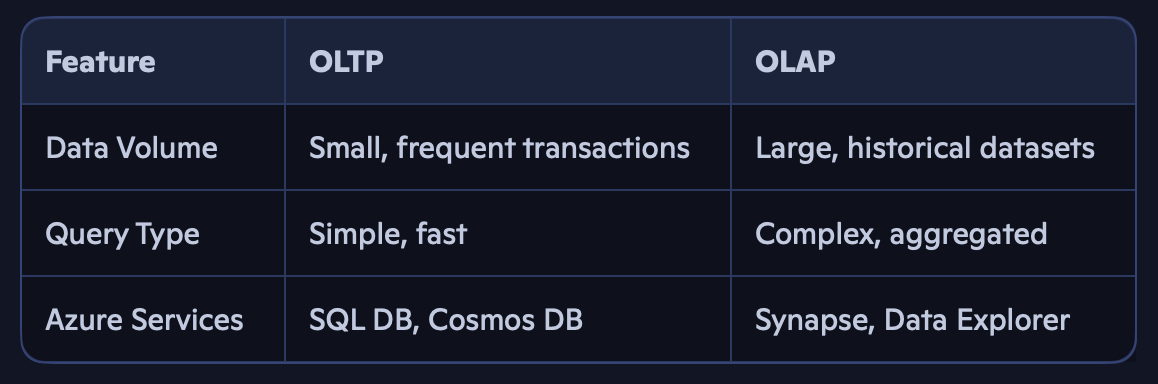
Before diving into services, it’s crucial to distinguish between the two major types of database workloads:
OLTP (Online Transaction Processing)
• Handles frequent, real-time transactions
• Prioritises speed and consistency
• Examples: banking systems, e-commerce platforms
- Azure Services: Azure SQL Database, Azure Cosmos DB
OLAP (Online Analytical Processing)
• Designed for complex queries and data aggregation
• Powers dashboards, reports, and forecasting
- Azure Services: Azure Synapse Analytics, Azure Data Explorer
Cloud Models: IaaS, PaaS, SaaS
Understanding cloud service models helps you choose the right level of control and abstraction:
IaaS (Infrastructure as a Service)
• You manage VMs, storage, and networking
• Azure Example: Azure Virtual Machines
PaaS (Platform as a Service)
• Azure manages infrastructure; you manage data and logic
• Azure Example: Azure SQL Database, Azure App Service
SaaS (Software as a Service)
• Fully managed applications
- Azure Example: Power BI, Microsoft 365

Data Roles in the Azure Ecosystem
DP-900 introduces you to key roles in the data lifecycle:
• Database Administrator (DBA): Manages performance, backups, and security
• Data Engineer: Builds pipelines, transforms and orchestrates data
• Data Analyst: Extracts insights, builds reports and dashboards
Each role interacts with Azure services differently — understanding their scope helps you align tools with responsibilities.
Relational vs Non-Relational Databases
Relational Databases
• Structured schema: tables, rows, columns
• Use SQL for querying
• Azure Examples: Azure SQL Database, Azure Database for PostgreSQL/MySQL
Non-Relational Databases
• Schema-less or flexible schema
• Ideal for JSON, key-value, graph, document models
- Azure Examples: Azure Cosmos DB, Azure Table Storage, Azure Blob Storage

Data Formats: Structured, Semi-Structured, Unstructured
Understanding data formats helps you choose the right storage and processing tools:
• Structured: Tabular, schema-defined (SQL tables, Excel)
• Semi-Structured: JSON, XML (IoT payloads, logs)
- Unstructured: Images, videos, PDFs (media, documents)

Graph Databases in Azure
Graph databases model relationships as nodes and edges, ideal for:
• Social networks
• Fraud detection
• Recommendation engines
Azure Example: Azure Cosmos DB (Gremlin API)
Conclusion
DP-900 is more than a certification — it’s a strategic foundation for anyone working with data in Azure. Whether you’re building GenAI agents, optimising BFSI pipelines, or designing scalable analytics, these concepts will shape every decision you make.
메타데이터
- post_id
- 2c9e8a03d062
- slug
- dp-900-certification-guide-your-gateway-to-azure-data-mastery-2c9e8a03d062
- url
- https://medium.com/@maheswararedypr/dp-900-certification-guide-your-gateway-to-azure-data-mastery-2c9e8a03d062
- canonical_url
- https://medium.com/@maheswararedypr/dp-900-certification-guide-your-gateway-to-azure-data-mastery-2c9e8a03d062
- author_url
- https://medium.com/@maheswararedypr
- status
- ok
- fetched_at
- 2026-07-17 11:44:46