The Undiscovered Caribbean: Nevis, St. Eustatius & St. Kitts
Three tiny islands, three empires’ worth of history, and not a mega-resort in sight — this is the Caribbean before it was flattened into an…
The Undiscovered Caribbean: Nevis, St. Eustatius & St. Kitts
Three tiny islands, three empires’ worth of history, and not a mega-resort in sight — this is the Caribbean before it was flattened into an all-inclusive postcard.

St. Kitts
There’s a bell on St. Eustatius that has rung three times a day, every day, for more than 300 years. 6 a.m., noon, 6 p.m. — sounded from the walls of Fort Oranje by a bell ringer whose motto is simple: never sick, never late, always on time. She took over the job from her father, who did it for twenty years before her.
bell on St. Eustatius
That’s the Caribbean most travelers never see. Not the one with swim-up bars and cruise-ship crowds, but the one where a single family can be trusted with a 300-year-old tradition, because nothing here has moved fast enough to forget it.
Nevis, St. Eustatius, and St. Kitts — three small islands scattered across the Leeward chain — are that Caribbean. Here’s why they deserve a place on the list of the world’s most underrated destinations.
Nevis: The Island Alexander Hamilton Left Behind

Nevis
Long before Lin-Manuel Miranda put him on Broadway, Alexander Hamilton was just a kid born in 1755 on a 36-square-mile volcanic island so small it’s often mistaken for a footnote to its sister, St. Kitts. Nevis is, in fact, the only Caribbean birthplace of a U.S. Founding Father — and the island still wears that history quietly, without turning it into a theme park.
Nevis draws fewer than 50,000 visitors a year, a fraction of what floods nearby destinations. What fills that void instead: 17th-century plantation houses turned inns — Montpelier, Golden Rock, Nisbet, the Hermitage — where guests sleep in restored sugar mills and dine where enslaved laborers once worked the cane fields that built the British Empire’s wealth. It’s not history sanitized for a brochure; several of these properties address that legacy directly, including it in the story they tell guests.
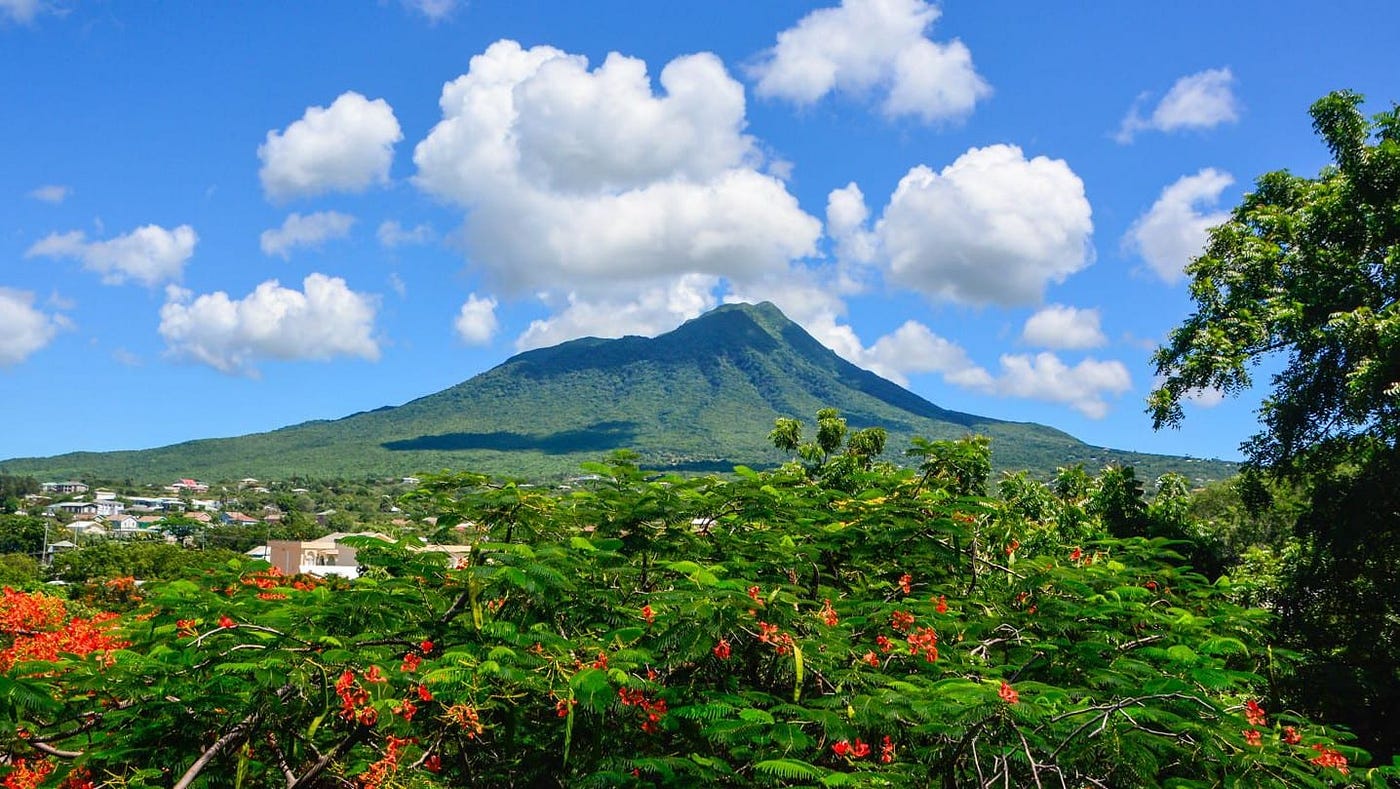
Nevis Peak
Above it all sits Nevis Peak, its summit almost permanently wrapped in cloud — the same cloud cover that led Columbus to name the island “Nuestra Señora de las Nieves,” Our Lady of the Snows, in 1493. Hike up through the rainforest and you’ll likely hear vervet monkeys moving through the canopy before you see them; they’ve called the island home for over 300 years, descendants of animals brought over during the colonial era. Come back down to Charlestown, the tiny capital of about 1,500 people, and soak in the therapeutic hot springs that made the Caribbean’s very first hotel — the 1778 Bath Hotel — a destination in its own right.
And if you’re chasing an odd little superlative: Nevis grows 44 varieties of mango and calls itself the Mango Capital of the Caribbean, throwing an annual festival every July to prove it.
St. Eustatius: The Rock That Armed a Revolution
The Golden Rock
Sail an hour northwest and you’ll reach an island so small — just eight square miles — that most maps barely have room for its name: Sint Eustatius, known to everyone who lives there simply as Statia.
In the 1700s, this speck of Dutch territory was one of the richest trading ports on Earth. Because the Dutch declared it a free port with no customs duties, up to 3,500 ships a year — more than ten a day at its peak — funneled goods through its harbor, earning the island its nickname: the Golden Rock.

Fort Oranje St. Eustatius
Then, on November 16, 1776, Statia did something no other government on the planet had done: it recognized the newly declared United States of America. When the American brigantine Andrew Doria sailed into port flying the new nation’s flag, the island’s Dutch governor ordered an 11-gun salute in return — the first time any foreign power formally saluted the American flag. The British were furious. They’d eventually invade the island in retaliation. But the moment — now called the First Salute — is still commemorated every November 16th on Statia Day, and a plaque marking it still hangs on the walls of Fort Oranje.
Today Statia’s history is written into its landscape as much as its records: sunken 18th-century shipwrecks scattered across the harbor floor (over 300 of them, drawing scuba divers from around the world), the ruins of a Jewish community that once thrived here as merchants and blockade-runners, and an active excavation at the Golden Rock plantation site uncovering what may be one of the largest African burial grounds in the Caribbean outside Barbados. National Geographic named Statia’s waters the best diving in the Caribbean in 2022 — and with fewer than 4,000 residents and almost no mass tourism infrastructure, you’ll likely have those reefs mostly to yourself.
St. Kitts: Sugarcane Rails and a Fortress in the Clouds

St. Kitts
Just a ten-minute water taxi from Nevis sits St. Kitts, the livelier of the two — but “lively” here still means something closer to lived-in than overrun.
The island’s defining landmark is Brimstone Hill Fortress, an 800-foot volcanic stronghold so formidable the British and French fought over it for a century, earning it the nickname “the Gibraltar of the West Indies.” Today it’s a UNESCO World Heritage Site — one of the best-preserved forts in the Americas — and on a clear day, from its ramparts you can see six neighboring islands scattered across the horizon.
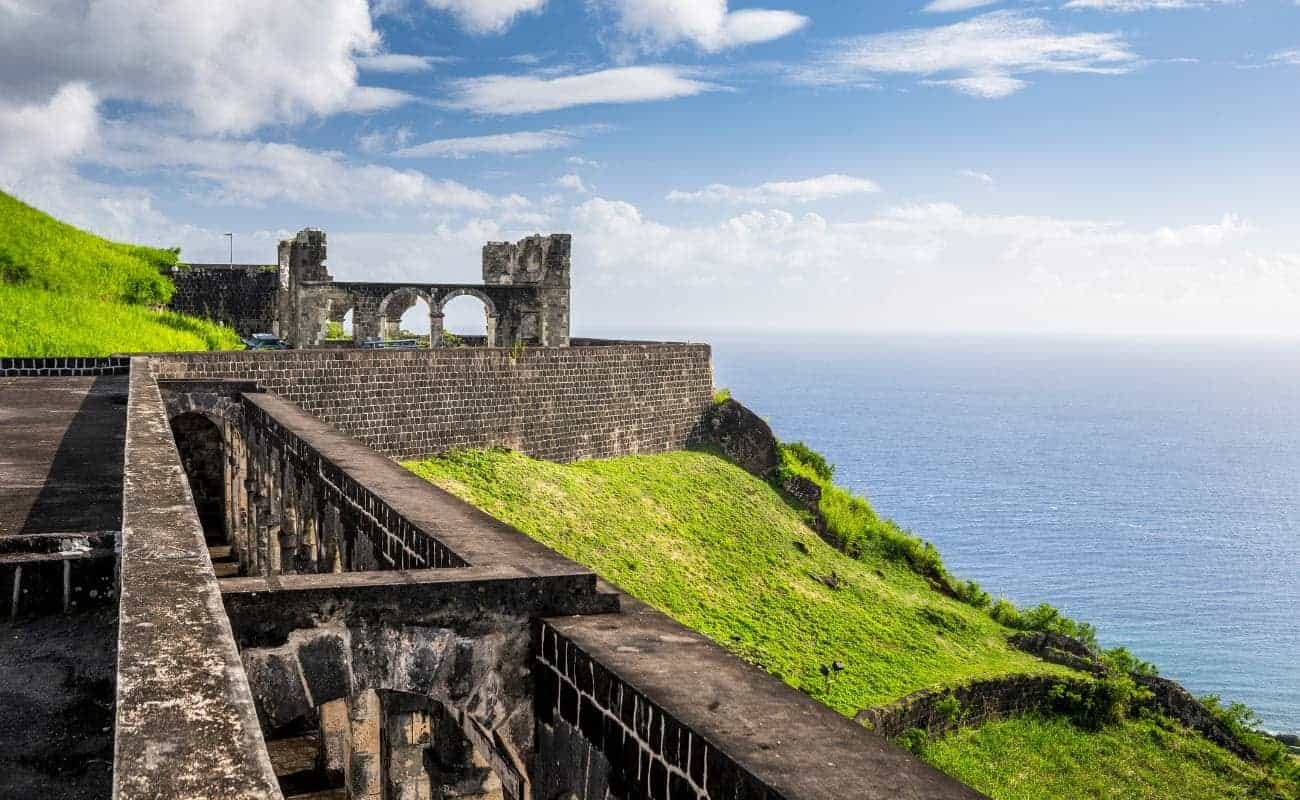
Brimstone Hill Fortress
The most memorable way to see the island’s interior is aboard the St. Kitts Scenic Railway, a narrow-gauge line originally built in the early 1900s to haul sugarcane down from the plantations to Basseterre. The double-decker cars — open-air observation deck up top, air conditioning below — now carry travelers instead of cane, winding 30 miles past old plantation ruins, fishing villages, and the slopes of Mount Liamuiga, all while rum punch gets passed around and a local choir sometimes sings you down the mountain.
St. Kitts’ story, like its neighbors’, is one of empires colliding in a very small space. English and French colonists first landed within a year of each other in the 1620s, and their rivalry defined the island for a century before the British finally won out for good. Basseterre, the capital, has served as the island’s gateway since 1627 — its streets still lined with the churches, government buildings, and colonial-era architecture from that long tug-of-war.
What Ties Them Together
None of these three islands are trying to be Cancún. There’s no mass-market resort strip, no cruise-ship megaport dictating the pace. What they offer instead is what’s becoming rarer every year in Caribbean travel: real history you can walk through, small communities that still run on tradition rather than tourism infrastructure, and enough quiet that a hike, a dive, or a train ride actually feels like discovery instead of a checklist item.
That’s exactly the trip Highroads Traveler built. Their 10-day, 9-night Undiscovered Caribbean tour takes small groups (couples, friends, and solo travelers) through all three islands — four nights at Nevis’s Montpelier Plantation (Princess Diana’s own favorite retreat, complete with a private beach and afternoon tea), three nights at the 40-acre Golden Rock Resort on St. Eustatius, and a final stretch on St. Kitts hitting Brimstone Hill Fortress and the 1681 Caribbean’s oldest rum distillery. The whole thing is personally hosted by founder Joe Sacchetti — a former U.S. Army Ranger and Bronze Star recipient who’s visited 160 of the world’s 227 countries and leads every trip himself.
👉 See the full 10-day itinerary and book your spot at Highroads Traveler
메타데이터
- post_id
- 2cac42b684f0
- slug
- the-undiscovered-caribbean-nevis-st-eustatius-st-kitts-2cac42b684f0
- url
- https://medium.com/@benp82247/the-undiscovered-caribbean-nevis-st-eustatius-st-kitts-2cac42b684f0
- canonical_url
- https://medium.com/@benp82247/the-undiscovered-caribbean-nevis-st-eustatius-st-kitts-2cac42b684f0
- author_url
- https://medium.com/@benp82247
- status
- ok
- fetched_at
- 2026-07-10 03:02:36