Why Powerful Systems Keep Archives
Memory is not nostalgia. It is how patterns survive the reset.
Why Powerful Systems Keep Archives
Memory is not nostalgia. It is how patterns survive the reset.
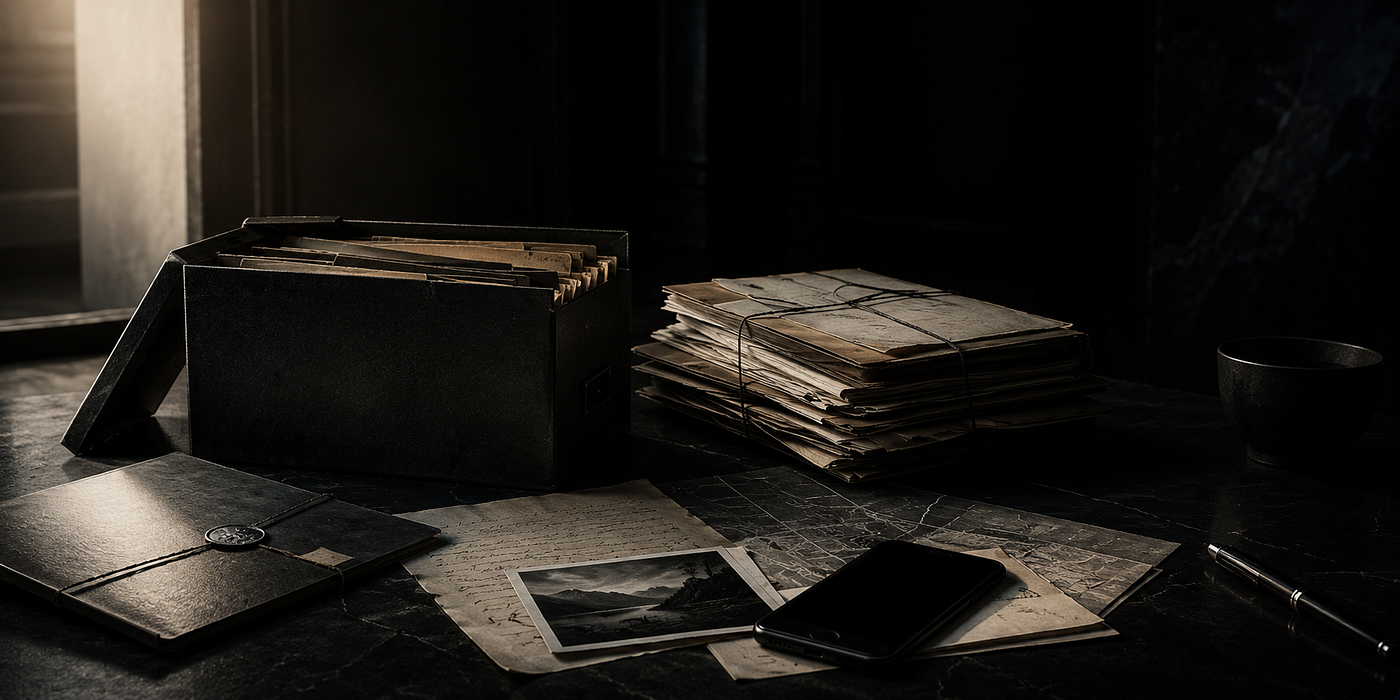
Image created by the author.
The thing about powerful systems is that they do not forget the way ordinary people are made to forget.
That is the part I keep coming back to.
They keep records.
Not just because records are useful in some boring administrative sense. They keep records because memory is power.
A family that knows where the land went is not living in the same reality as someone who only remembers that a relative owned something once.
An institution that knows who funded what, who opened which door, who protected whom, who failed under pressure, and who still owes a favor is not starting from zero every time the faces change.
It has continuity.
And continuity compounds.
That is what most people are missing.
Not intelligence.
Continuity.
Most ordinary people are pushed from one cycle into the next. A bill. A crisis. A relationship reset. A new job. A new platform. A new outrage. A new thing to react to before the last thing was ever understood.
So everything becomes fragmented.
Screenshots. Old emails. Notes in three apps. Half-remembered family stories. Receipts somewhere. A text saved because something in the body knew it might matter later.
That instinct is not paranoia.
It is the part of a person trying to keep reality from being rewritten.
Because rooms rewrite things.
Families do it. Companies do it. Institutions do it. Public life does it constantly.
A conversation happens. A promise is made. A boundary is crossed. Something gets named for half a second.
Then the tone changes.
Everyone acts normal again.
And now the person who remembers what happened is carrying the burden of proof.
That is one of the most exhausting positions a person can be put in.
Not just holding the memory.
Holding the memory while the room pressures them to doubt it.
This is why archives matter.
Not because every receipt is sacred. Not because life should become an evidence folder. Not because a person should record every wound and live inside it.
Because without a record, the pattern has to be rebuilt from scratch every time pressure returns.
One strange moment can be explained away.
Five strange moments begin to form a shape.
One conversation can be misunderstood.
Ten conversations that end with the same person carrying the emotional debt are not random anymore.
That is what usable memory does.
It lets the pattern survive the reset.
And once the pattern survives, judgment becomes possible.
A person can begin to tell the difference between repair and reset. Between guilt and conviction. Between a one-time wound and a recurring structure. Between something that should be forgiven and something that should no longer have access.
This is the deeper archive.
Not the folder.
The faculty.
The ability to remember cleanly enough that the room cannot keep renaming reality.
Powerful systems understand this.
That is why they preserve land records, trusts, contracts, letters, meeting notes, donor lists, family lines, ownership documents, private correspondence, old favors, old scandals, and quiet obligations.
They understand that memory is not nostalgia.
Memory is leverage.
Memory is continuity.
Memory is how a system knows what belongs to it, what happened before, who can be trusted, what pattern keeps returning, and what must not be renegotiated every time someone becomes uncomfortable.
Ordinary people need that too.
Not in a cold, obsessive way.
Not as surveillance.
Not as a life lived in suspicion.
But as a way of refusing to be erased by every reset.
A personal archive can be simple.
What happened.
What repeated.
What was decided while clear.
What needs to be carried forward.
What can finally be released.
That is enough.
The point is not to collect everything.
The point is to stop losing what matters.
Because a person without continuity is easier to rewrite.
And a person who can remember cleanly starts to become harder to move.
Not hard.
Not bitter.
Not suspicious of every room.
Just harder to disorient.
There is a difference.
A healthy archive does not make a person colder.
It gives them somewhere to place what the body has been carrying.
And sometimes that is the whole shift.
The body stops having to remember everything alone.
The Alignment Archive studies the hidden structures people feel before they have language for them. Follow for field notes on power, pressure, perception, and the patterns that survive the reset.
메타데이터
- post_id
- 2cba625d5c33
- slug
- why-powerful-systems-keep-archives-2cba625d5c33
- url
- https://medium.com/the-alignment-archive/why-powerful-systems-keep-archives-2cba625d5c33
- canonical_url
- https://medium.com/the-alignment-archive/why-powerful-systems-keep-archives-2cba625d5c33
- author_url
- https://medium.com/@thealignmentarchive
- status
- ok
- fetched_at
- 2026-07-09 16:18:44