Beyond the English Kitchen: Building an AI Culinary Assistant for 50 Languages
The realization didn’t hit me in a tech lab or while staring at a terminal line. It hit me in a kitchen filled with the sharp, warm aroma…
Beyond the English Kitchen: Building an AI Culinary Assistant for 50 Languages
The realization didn’t hit me in a tech lab or while staring at a terminal line. It hit me in a kitchen filled with the sharp, warm aroma of crushed cardamom, looking at a screen that was confidently telling my family to put cheddar cheese in a traditional curry.
We’ve all been told that Artificial Intelligence is a global, boundaryless entity. We speak to it, and it answers instantly, an omniscient digital oracle. But one evening, while trying to bridge the gap between a family recipe and a modern Large Language Model, I discovered a strange, invisible wall in the digital landscape:
AI thinks like a Westerner, and it cooks like one, too.
If you ask a standard vanilla LLM for a recipe in French, Japanese, or Hindi, it rarely taps into the deep, ancestral culinary logic of those cultures. Instead, it behaves like an American tourist with a pocket dictionary. It translates English datasets on the fly, substitutes hard-to-find local ingredients with generic Western supermarket alternatives, and completely hallucinates complex, regional cooking techniques.
I realized that for all its brilliance, AI was suffering from a massive case of culinary ethnocentrism. So, I decided to build a backdoor into the global kitchen.
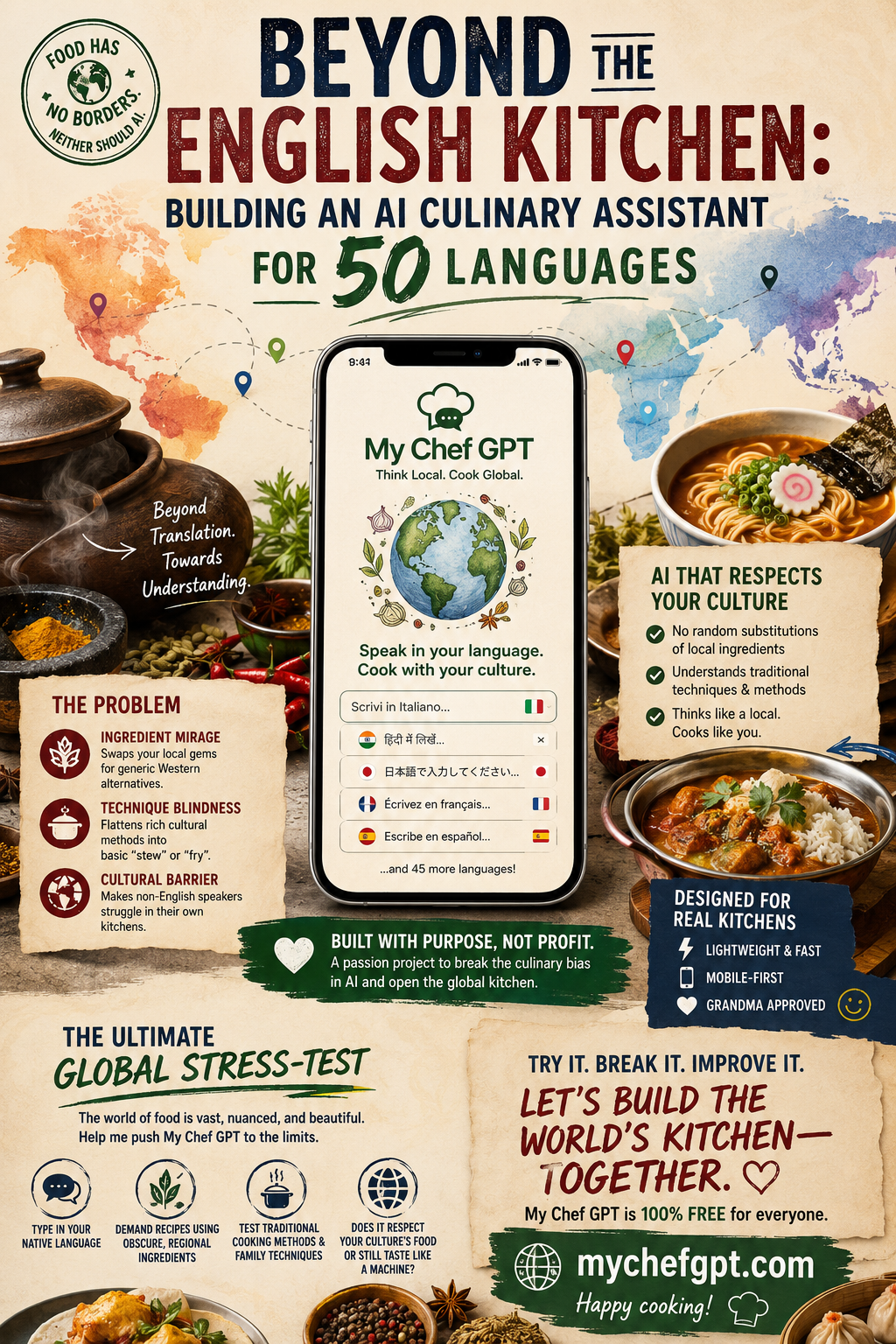
I built **My Chef GPT** — not as a business, but as a translation-defying experiment to see if an AI could actually learn to think in 50 different languages.
The Ghost in the Recipe: Why Translation Isn’t Understanding
To understand the problem, you have to look at how AI views language. Translation is mathematical; cooking is cultural.
When you push a mainstream AI outside its English comfort zone, the culinary logic breaks down in fascinatingly subtle ways:
- The Ingredient Mirage: If you ask for a recipe using a hyper-local vegetable in Southeast Asia, a standard model will often panic and swap it for zucchini, entirely altering the chemistry and tradition of the dish.
- Technique Blindness: Complex cultural methods — like specific types of clay-pot cooking, precise fermentation timelines, or the delicate art of tempering spices — get flattened into generic terms like “stew” or “fry.”
- The Cultural Barrier: For my own family members who don’t speak English as their first language, trying to navigate these clunky, Western-optimized AI tools felt like trying to read a blueprint just to scramble an egg.
I didn’t want an app that merely translated an American casserole into 50 languages. I wanted an AI that understood that a kitchen in Milan operates on fundamentally different rules than a kitchen in Kyoto or Mumbai.
Teaching a Machine to Taste in 50 Tongues
Building My Chef GPT became a masterclass in prompt architecture and cultural engineering. The goal was to strip away the “Anglo-centric” default lens and force the model to look at food through a native eye.
If you tell the app what is left in your fridge in Italian, it shouldn’t just run those words through a translator; it should immediately adopt Italian culinary philosophy. It should think about olive oil, soffritto, and regional simplicity — not a translated version of a processed Western dish.
Beyond the prompts, the interface had to survive the chaos of a real kitchen. I didn’t want messy login screens, heavy data-tracking, or walls of text before you even get to the ingredients. It needed to be a lightweight, lightning-fast canvas that a grandmother could easily use on an old smartphone while holding a flour-dusted rolling pin.
The Ultimate Global Stress-Test
Today, the app speaks and understands 50 languages. It can scale portions on a whim, salvage a near-empty fridge, and answer the strangest, most specific culinary questions you can throw at it.
But a machine is only as good as the community that tests its limits. The world of food is too vast, too nuanced, and too beautiful for one developer to map alone.
This is why I’m opening it up completely free at **mychefgpt.com**. I want to invite the foodies, the travelers, the developers, and the skeptics to help me break it.
- Type in your native language.
- Demand a recipe using the most obscure, regional ingredient from your hometown.
- Test its understanding of your family’s traditional cooking methods.
Does it respect your culture’s food, or does it still taste a little bit like a machine? Try it out, leave a comment below, and let’s see just how far outside the English kitchen we can take this technology.
Happy cooking.
메타데이터
- post_id
- 2cbfd40e13b0
- slug
- beyond-the-english-kitchen-building-an-ai-culinary-assistant-for-50-languages-2cbfd40e13b0
- url
- https://medium.com/@ebastiban/beyond-the-english-kitchen-building-an-ai-culinary-assistant-for-50-languages-2cbfd40e13b0
- canonical_url
- https://medium.com/@ebastiban/beyond-the-english-kitchen-building-an-ai-culinary-assistant-for-50-languages-2cbfd40e13b0
- author_url
- https://medium.com/@ebastiban
- status
- ok
- fetched_at
- 2026-06-24 18:57:25




