Multi-Cloud & Multi-Tool Security Model (MCMTSM) — or Cloud Security Model(CSM)
“Having no Security Posture is itself a Security Posture”.
Multi-Cloud & Multi-Tool Security Model (MCMTSM) — or Cloud Security Model (CSM)
“Having no Security Posture is itself a Security Posture”.
For practicality, we will use Cloud Security Model (CSM) as the short name; it subsumes the Multi-Cloud & Multi-Tool Security Model (MCMTSM). In other words, MCMTSM = CSM.
What It Is
CSM is a proposed Security-First Approach (S-FA) in which a clearly defined and adopted Security Posture (SP) is established for a cloud or multi-cloud environment, with or without on-premises components, and for one or several tools across CI/CD and related platforms.
Cloud Security Model (CSM) — Illustrative Formula

Legend:
- C = Cloud Security Model (the resulting security state)
- SP = Security Posture
- a = Amazon Web Services
- b = Microsoft Azure
- c = Google Cloud Platform (GCP)
- n = Any other cloud, on-premises environment, CI/CD system, or tool
- i = Resources
- j = Resource configurations
Equivalent expression. We can also express the aggregation as:

Thus: C = SP (ɲ)

Cloud Security Model (CSM) Formula.
Where ɲ means “the sum of all multi-cloud and multi-tool resources and their configurations.”
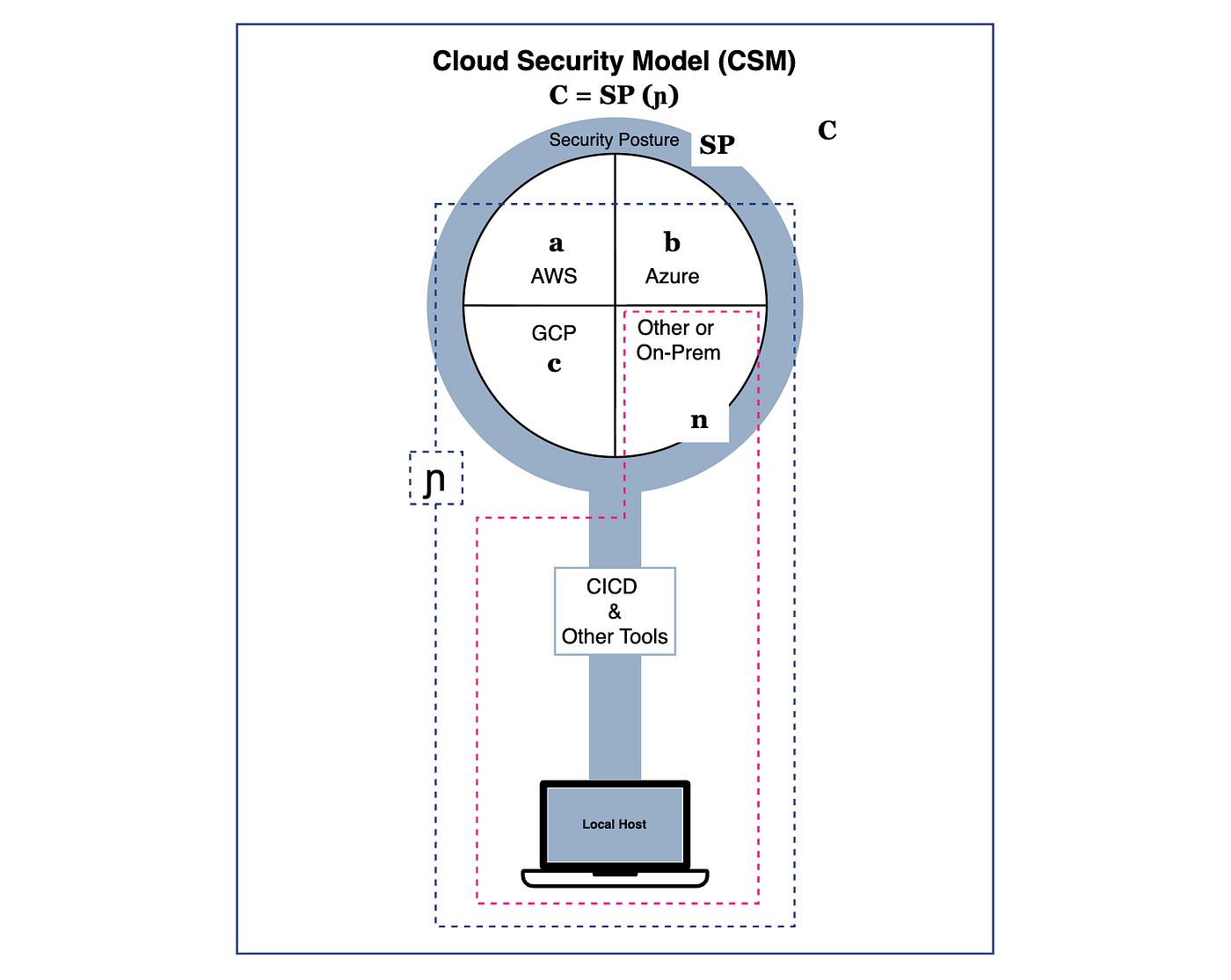
Cloud Security Model (CSM) Illustrative Diagram.
Security Posture (SP)
To be determined by the team or company. In practical terms, SP is the composition (or “sum”) of your GRC elements, frameworks (e.g., CIS, NIST, PCI DSS, HIPAA, etc.), guardrails, principles, and related controls applied to ɲ.
- Goals & methodologies: e.g., DevSecOps, security-by-design, shift-left security.
- Governance, Risk & Compliance (GRC): ownership, decision rights, risk treatment.
- Frameworks & standards: CIS Benchmarks, NIST CSF/800–53, PCI DSS, HIPAA, ISO/IEC 27001/2 (as applicable).
- Guardrails & patterns: policy-as-code, approved (golden) modules and images, DR/BCP procedures, etc.
- Documentation: well-structured, traceable, version-controlled, and adopted.
CSM Implementation & Continuous Improvement
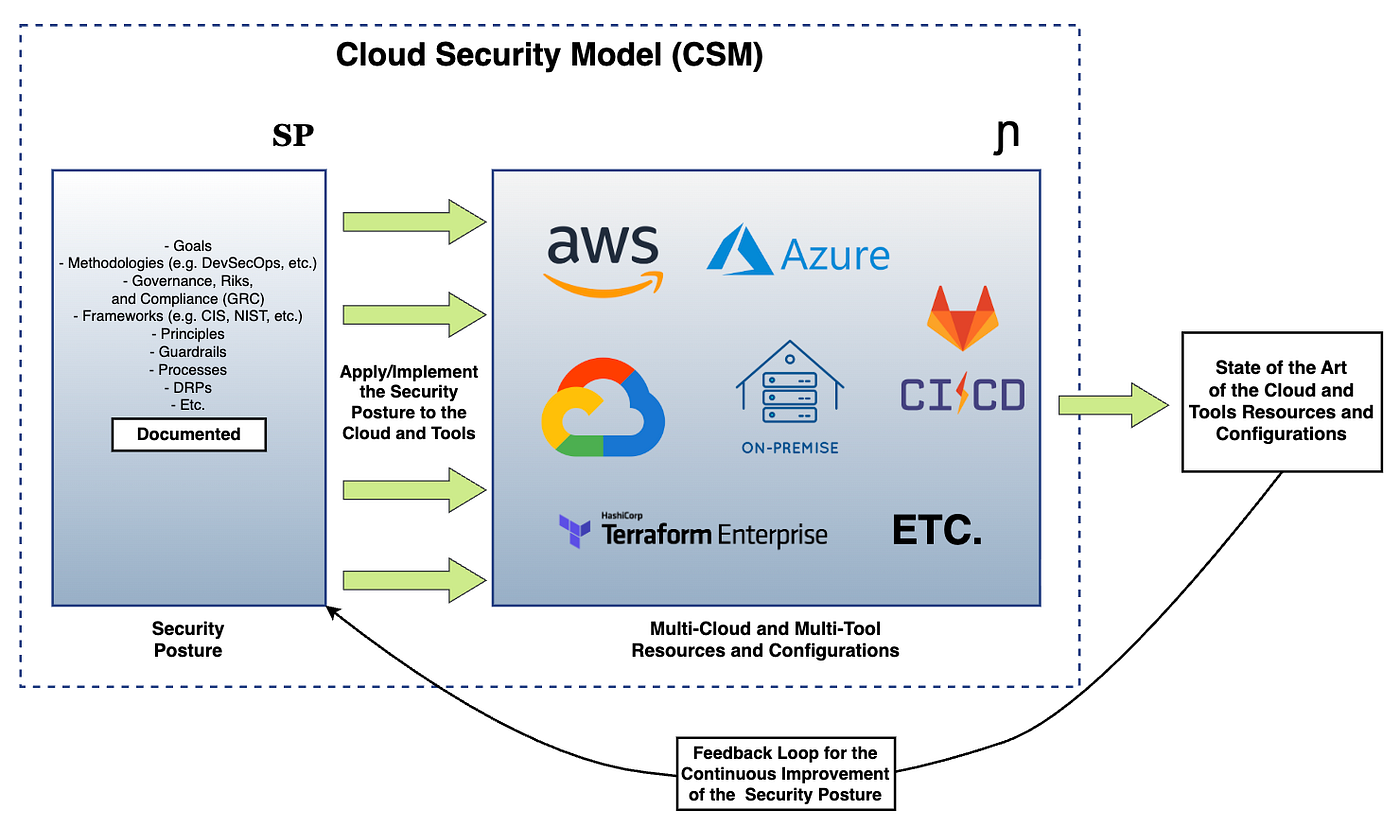
Cloud Security Model (CSM) Implementation & Continuous Improvement Flow.
On one side, we have the Security Posture (SP), where we define — in a well-documented manner — goals, methodologies (e.g., DevSecOps), governance, risk, and compliance, applicable frameworks (e.g., CIS, NIST, PCI DSS, HIPAA, etc.), principles (e.g., shift-left security, principle of least privilege), processes, disaster recovery plans (DRPs), and related artifacts.
On the other side, we have ɲ, which represents all multi-cloud and multi-tool resources and their configurations.
When we implement/apply the defined and documented SP to ɲ (i.e., to all the multi-cloud and multi-tool resources and their configurations), we obtain the Cloud Security Model (CSM) and, with it, the state of the art of these resources and configurations. This state of the art then becomes part of a feedback loop that supports the continuous improvement of the Security Posture, which is then re-applied/re-implemented to all resources and their configurations, resulting in the continuous improvement of the Cloud Security Model according to the evolving security needs of the team/organization.
Summarization
- We need two things for the Cloud Security Model:
- Define the Security Posture (SP).
- Define the multi-cloud and multi-tool resources and their configurations (ɲ).
2. (Implicit from 1; retained for completeness.) Ensure both SP and ɲ are completely documented and owned.
3. By implementing/applying the Security Posture to the multi-cloud and multi-tool resources and their configurations, we obtain the Cloud Security Model.
- Within the Cloud Security Model we obtain the “State of the Art” of the multi-cloud and multi-tool resources and their configurations.
5. With the CSM’s state of the art, and as a feedback loop, we can improve the Security Posture of the CSM.
6. With the improvement of the Security Posture we improve the CSM, and that is how the Security of the Team or Organization is continuously improved.
The “How” and the “With What”
The specific mechanisms and tools are defined by each Team or Organization based on their own needs and constraints. Examples include: Jamf, Git, GitLab, GitHub, GitLab CI, GitHub Actions, Jenkins, Argo CD, Terraform, Pulumi, AWS SAM, Checkov, Sentinel, Vault, Azure, AWS, GCP, Wiz, and others.
Compact notation recap

Proposal status: Draft v0.1 (2025–10–16) — seeking feedback from practitioners. This article proposes a model for discussion and refinement.
메타데이터
- post_id
- 2cc071bc3bbc
- slug
- multi-cloud-multi-tool-security-model-mcmtsm-or-cloud-security-model-csm-2cc071bc3bbc
- url
- https://medium.com/@abelopz/multi-cloud-multi-tool-security-model-mcmtsm-or-cloud-security-model-csm-2cc071bc3bbc
- canonical_url
- https://medium.com/@abelopz/multi-cloud-multi-tool-security-model-mcmtsm-or-cloud-security-model-csm-2cc071bc3bbc
- author_url
- https://medium.com/@abelopz
- status
- ok
- fetched_at
- 2026-08-08 22:49:35

