Dr. Babatunde Bello, B.A.,
As an independent researcher and macroeconomic strategist, analyzing the bond market is fundamental to understanding global liquidity…
Dr. Babatunde Bello, B.A., M.Fin: How Does Yield Curve Stabilization and Treasury Issuance Affect Capital Markets?
As an independent researcher and macroeconomic strategist, analyzing the bond market is fundamental to understanding global liquidity. Misinterpreting fixed-income signals frequently leads to severe wealth destruction among individual investors. The current analysis examines the structure of the yield curve, the impact of federal borrowing, and the critical necessity of duration management.
The Mathematics of the Curve
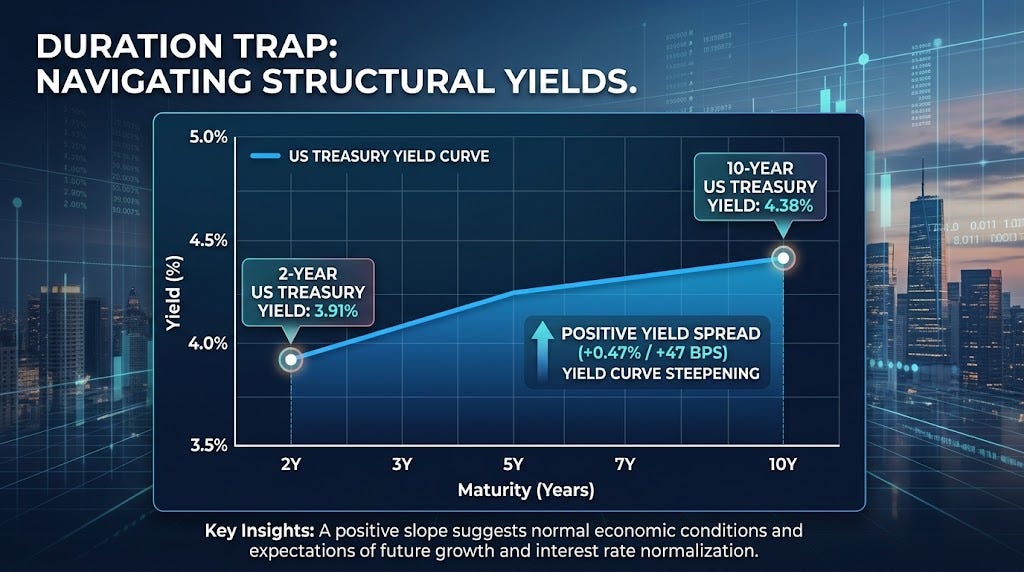
The anchor points of the yield curve define the economic environment. The US 10-Year Treasury yield is currently transacting near 4.38%, while the 2-Year Treasury yield is positioned around 3.91%. This configuration creates a positive spread of approximately 47 basis points.
The critical observation is not merely the positive slope, but the altitude of this stabilization. The curve has normalized at highly elevated levels, indicating that the market demands a substantial term premium. Capital requires significant compensation to lock into long-term debt, reflecting ongoing caution regarding sticky inflation and the elevated cost of capital across the broader economy.
The Supply Shock Mechanism
Beyond inflation expectations, the supply side of the macroeconomic equation is shifting. The U.S. Treasury projects borrowing $189 billion in net marketable debt for the current quarter.
In institutional asset management, supply and demand mechanics are absolute. Introducing massive debt supply to the open market naturally exerts upward pressure on yields to attract sufficient buyer liquidity. This heavy issuance schedule places a firm floor under long-term interest rates, ensuring that borrowing costs for corporations and consumers will remain structurally high for the foreseeable future.
Navigating the Duration Trap
A disciplined response to these metrics requires rigorous duration management. Duration measures asset sensitivity to interest rate changes. When long-term yields remain elevated due to heavy bond supply and sticky inflation, long-duration assets suffer extreme valuation compression. Companies lacking immediate profitability and relying on the promise of distant future cash flows are mathematically penalized in this environment.
Defending purchasing power requires prioritizing assets with short duration and high immediate cash generation. Allocating capital to businesses with impenetrable balance sheets and independent pricing power is essential. The foundational philosophy remains constant: survive steadily first, then focus on returns. Respecting the structural reality of the yield curve is the only reliable method to insulate capital from systemic risk.
learn more: https://www.drbabatundebellobamfin.com/
Author’s Declaration & Disclaimer: This macro analysis serves as a personal academic reflection on global financial trends. It is published independently and strictly for educational and informational purposes. I am not promoting any financial services or products. This content contains no affiliate links and is not sponsored. The views expressed do not constitute financial, legal, or investment advice. Always conduct independent research before making financial decisions.
메타데이터
- post_id
- 2cc8bc4d978b
- slug
- dr-babatunde-bello-b-a-2cc8bc4d978b
- url
- https://medium.com/@DrBabatundeBelloBAMFin/dr-babatunde-bello-b-a-2cc8bc4d978b
- canonical_url
- https://medium.com/@DrBabatundeBelloBAMFin/dr-babatunde-bello-b-a-2cc8bc4d978b
- author_url
- https://medium.com/@DrBabatundeBelloBAMFin
- status
- ok
- fetched_at
- 2026-06-27 07:40:21