The Hidden Waste in Construction: Why Lean Construction Starts by Changing Your Perspective
There is a form of waste in the construction industry that is rarely called by its true name. It isn’t just found in leftover materials…
The Hidden Waste in Construction: Why Lean Construction Starts by Changing Your Perspective
There is a form of waste in the construction industry that is rarely called by its true name. It isn’t just found in leftover materials, rework, or duplicate checks. Above all, it lies in a flawed view of the system.
A project can appear to be excellently organized while simultaneously being structurally unstable.
It can have a detailed schedule and still fail to produce reliable weekly output.
It can report high capacity utilization and yet have little flow.
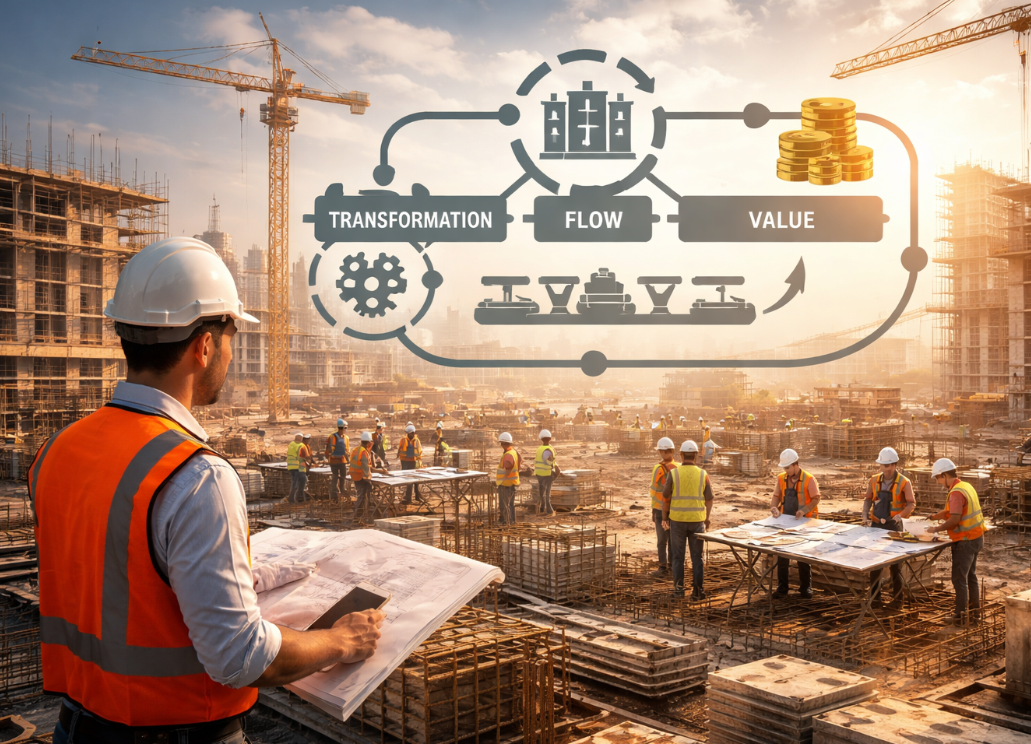
Lean Construction is therefore more than just a toolkit. At its core, it is a shift in perspective. This can be well explained by Lauri Koskela’s TFV framework: Production is not only transformation, but also flow and value generation. For construction projects, this is far more than theory. It is an operational diagnostic tool.
The classic transformation perspective is deeply rooted in construction. Services are broken down, assigned, priced, contracted, and scheduled. That is important. But this logic overlooks what happens between the packages: waiting times, disruptions, uncoordinated handovers, uncertain approvals, search movements, fluctuating team workload, and a lack of readiness for decision-making.
In other words: It sees work, but not always the path of the work.
The Lean Construction perspective is more precise here. The Lean Construction Institute describes Lean Construction as a production management-based approach that emphasizes customer value, aims to reduce waste, and is built on collaboration and respect. This definition already contains an important shift: The object of management is not just the work package, but the entire system of its creation.
This has consequences.
If we understand construction as a production system, then a delayed work step is not just a scheduling problem. It may be an indication of poor preparation quality.
Rework is not just a quality problem. It is often also a flow problem.
A conflict at the interface is not just a communication failure. It can be an indication of a system that rewards local rather than shared optimization.
This is precisely why effective lean practice does not begin with perfection, but with stabilization.
For me, this is where HSC becomes relevant: not selling concepts first, but establishing operational reliability. In construction, bringing order to complexity does not mean controlling more. It means making the prerequisites for good work visible and controllable.
I consider three measures to be particularly effective.
The first is a strict make-ready logic.
Only what is truly ready for construction is planned in the short term.
The second is reliable weekly management with root-cause analysis.
The Last Planner System is important for this because it does not merely plan, but aims to strengthen the reliability of the planning system. The quality of commitments thus becomes a leadership issue.
The third is early and repeated clarification of value.
In construction, value is not merely aesthetic satisfaction. It is about usability, operational logic, sequence, handover readiness, and the question of whether what is built truly serves its purpose.
Of course, metrics are also needed.
In my view, useful metrics include PPC (prepared work percentage), the rework rate, and the lead time per phase. These metrics are not exhaustive, but they help prevent confusion between instability and busyness.
Lean Construction, however, comes at a price.
It shatters some cherished illusions.
The illusion that more pressure automatically generates better performance.
The illusion that heroes on the construction site can replace a good system.
The illusion that a project is managed simply because many people are very busy.
The trade-off is clear: less spontaneous improvisation, more discipline in preparation. Less local pride, more responsibility for the overall flow. This often feels slower at first. In reality, it is usually the first step toward robust speed.
Anyone who wants to improve the construction industry should therefore not just ask for better methods.
They should first ask for a better understanding of production.
Transformation is important.
Flow is crucial.
Value is not an option, but a benchmark.
Everything else is, at best, just well-organized chaos.
메타데이터
- post_id
- 2cd2b47e775b
- slug
- the-hidden-waste-in-construction-why-lean-construction-starts-by-changing-your-perspective-2cd2b47e775b
- url
- https://medium.com/@thomasarnosander/the-hidden-waste-in-construction-why-lean-construction-starts-by-changing-your-perspective-2cd2b47e775b
- canonical_url
- https://medium.com/@thomasarnosander/the-hidden-waste-in-construction-why-lean-construction-starts-by-changing-your-perspective-2cd2b47e775b
- author_url
- https://medium.com/@thomasarnosander
- status
- ok
- fetched_at
- 2026-06-09 15:37:30