What Would My Backrooms Look Like?
Backrooms (2026, dir. Kane Parsons)
FILM CRITICISM
What Would My Backrooms Look Like?
Backrooms (2026, dir. Kane Parsons)
0.
Am I… next?
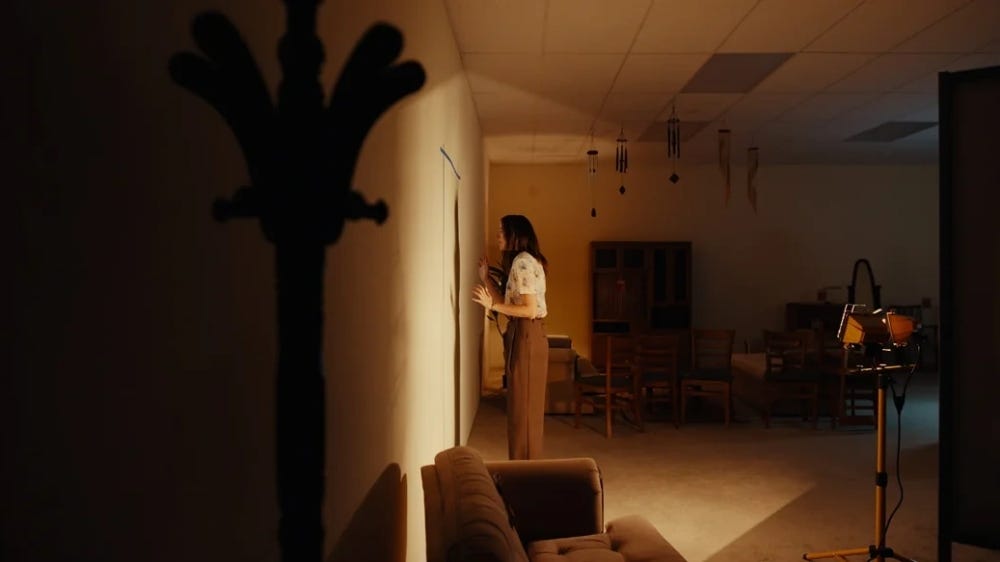
Still from Backrooms (2026) © A24
1.
Let’s be honest. Were you really curious about what kind of person Clark was? Were you worried about whether Mary would survive? Probably not. Most people were wondering what kind of new space the Backrooms would reveal next, what might suddenly emerge, or what this mysterious place actually was. From beginning to end, the protagonist is neither Clark nor Mary, but the space itself.
While the film follows Clark’s point of view, the Backrooms appear as an abstract space. Once Mary begins searching for the missing Clark, however, the Backrooms become a space constructed from Clark’s psyche. By the ending, the camera itself assumes the point of view rather than any character, and the space is then constructed from Mary’s psyche. The Backrooms therefore seem like a place that devours the memories and emotions of whoever entered most recently, endlessly reconstructing and multiplying itself from them. Once the audience intuitively accepts this rule, one question becomes inevitable: Am I… next? In that sense, the film is remarkably classical horror, sending its audience out of the theater burdened with the possibility that they could become the next victim. The contradictory feeling of fearing — and at the same time wanting to know — what my Backrooms would look like is a pleasure that only well-made horror can offer.
Films that visualize the human psyche are actually more common than they might seem. Sometimes they do so through apparitions, sometimes through monsters. Sometimes through hallucinations, sometimes through flashbacks. Horror films also frequently enlist architecture, but in those cases the space usually functions as little more than an environment for atmosphere, while the real focus lies on whatever controls it. Kane Parsons’ Backrooms, on the other hand, realizes the psyche through architecture alone, and that is what makes its world so distinctive. Mysterious creatures do occasionally appear, but even they never seem like entities ruling over the Backrooms. Rather, they resemble lifeless beings produced by the space itself, capable of moving only to the extent that the Backrooms permit.

Still from Backrooms (2026) © A24
2.
The more I dwell on it, the more fascinating this space becomes. It is at once abstracted and concretized. It is a physical space that could, in theory, be built, yet at the same time one that is almost never built in ordinary architecture, making it experientially unfamiliar. Every path forces you to round a corner or open a closed door, making it impossible to anticipate the next room. In other words, abstraction and concreteness coexist here. Experience and imagination coexist. It may be metaphorical, or it may not. The principle of the Backrooms lies in this contradictory otherness, forever branching into unpredictable forms. It is also the shape of human memory and emotion — something everyone recognizes a priori yet finds almost impossible to explain.
Reducing the human psyche into space and realizing it through architecture and cinematography is unquestionably an achievement. The film simply places objects before us with almost no explanation, yet from those material remnants we are able to reconstruct not only Clark’s and Mary’s memories, but even the emotions they felt in those moments. Some have criticized the film for its underdeveloped characters and narrative. I think that is a shallow reading. This is a film whose narrative works precisely because its characters are intentionally left vacant. Rather than explaining human beings directly, it reflects them through the peculiar mirror called the Backrooms, allowing us to see even what could not otherwise be seen.
In translating the psyche into the language of architecture, the film employs several metaphors. Clark’s profession as a failed architect and Mary’s as a psychiatrist serve as signposts for the film’s central connection between architecture and the psyche. Clark’s pirate costume reflects his Thanatos while gently conveying images of exploration and plunder. Windows function both as observable boundaries separating the psyche from the outside world and as expressions of the moments when Mary’s trauma is activated. The inverted STOP sign becomes an elegant metaphor, simultaneously expressing the irregularity within the Backrooms and their sharply defined boundaries. The chair with the broken leg symbolizes Clark, while the block engraved with a palm represents Mary. The film keeps speaking about the same thing, crossing between incomplete people, incomplete objects, and incomplete architecture in order to approach a complete memory and a complete psyche.

Still from Backrooms (2026) © A24

Still from Backrooms (2026) © A24
3.
It is not actually that frightening. Even so, it remains thoroughly engaging horror simply because watching its production design and cinematography is such a pleasure. The fading of peripheral memories, objects rendered sparsely abstract, memory’s tendency to center on people at every moment, and the movement of another person’s turning head — fragmented, layered, and taxidermied — all create a contradictory sensation that is at once chilling and beautiful. It is like sorrowfully contemplating a Futurist still life depicting a tragic narrative.
The decision to bring Bobby and Cat into the story and transform the middle section into found footage is, I think, both reasonable and clever, giving welcome variation to what could otherwise have been a monotonous plot. The film’s ability to create a gradually intensifying atmosphere of paranoia without relying heavily on jump scares is astonishing for a debut feature.
Still, reducing human beings into an architectural structure inevitably makes the film somewhat theoretical and emotionally rigid. I understand why. Had Parsons tried to compensate by stuffing too much into the Backrooms, it would have ceased to be liminal-space horror and become little more than a dungeon adventure. Even so, reducing the film’s overall scale in order to increase its density might ultimately have been the better choice.
Although I praised the variation introduced through the found-footage sequence, the repetition of essentially the same Backrooms four separate times nevertheless contributes to a sense of monotony. The laboratory section, in particular, feels strangely detached, and that is a fairly serious weakness. I do not know what kind of mythology the original web series establishes. But there is no reason why the audience should have to study that mythology before watching the film. If the film cannot explain the laboratory’s role on its own, then it simply fails to achieve artistic self-sufficiency.

Still from Backrooms (2026) © A24
Appreciate you reading.
If this analysis offered a meaningful perspective, feel free to clap, comment, or follow for more cinematic insights.
Note: Originally written in Korean. The English translation was assisted by AI to share these cinematic thoughts with global readers.
메타데이터
- post_id
- 2cd9eb15427f
- slug
- what-would-my-backrooms-look-like-2cd9eb15427f
- url
- https://medium.com/@realpierr/what-would-my-backrooms-look-like-2cd9eb15427f
- canonical_url
- https://medium.com/@realpierr/what-would-my-backrooms-look-like-2cd9eb15427f
- author_url
- https://medium.com/@realpierr
- status
- ok
- fetched_at
- 2026-08-20 04:26:24