Should the UK Continue Extracting North Sea Oil?
Imagine standing on the coast of Aberdeen, Scotland, before sunrise. The North Sea stretches endlessly into the horizon, its grey waters…
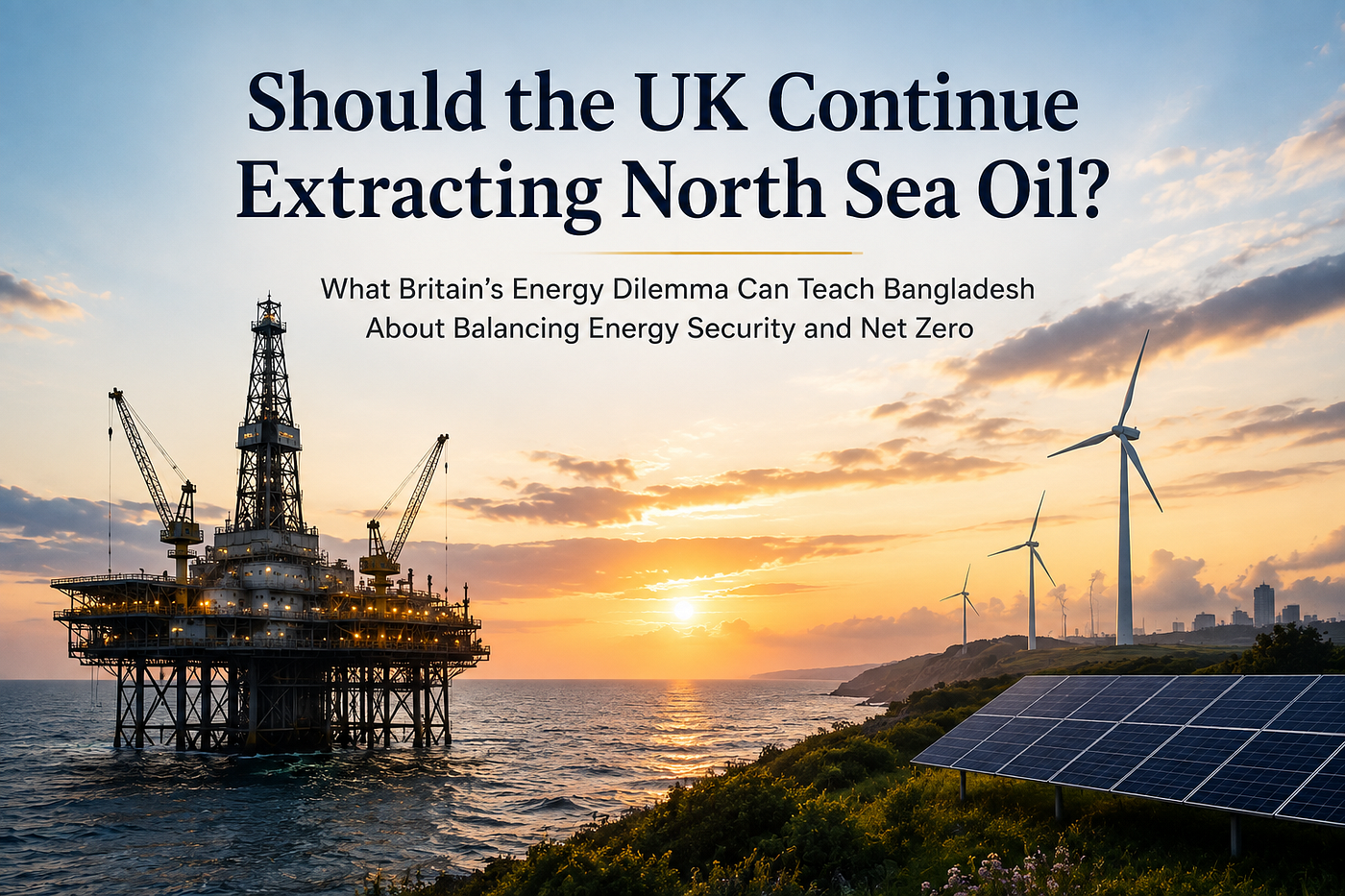
Should the UK Continue Extracting North Sea Oil? What Britain’s Energy Dilemma Can Teach Bangladesh About Balancing Energy Security and Net Zero
Imagine standing on the coast of Aberdeen, Scotland, before sunrise. The North Sea stretches endlessly into the horizon, its grey waters constantly shaped by powerful winds and rough waves. In the distance, helicopters carry engineers and technicians to offshore oil platforms that have become a familiar part of Britain’s skyline. For over half a century, these platforms have quietly fuelled homes, powered industries, and supported one of Europe’s largest economies.
To many people, they represent progress.
To others, they represent a past that should be left behind.
Today, these same platforms have become the centre of one of Britain’s most important national debates. As the United Kingdom strives to achieve Net Zero carbon emissions by 2050, one difficult question continues to divide politicians, engineers, environmentalists and economists alike.
Should Britain continue extracting oil and gas from the North Sea, or is it time to leave these resources beneath the seabed?
At first glance, the answer appears obvious. If climate change is the defining challenge of this century, surely the solution is to stop producing fossil fuels.
Yet the deeper I explored this debate, the more I realised that the answer was anything but simple.
The North Sea debate is not merely about oil. It is about how countries manage difficult transitions, balance competing priorities, and prepare for an uncertain future. More importantly, although Bangladesh lies thousands of kilometres away, the questions Britain is asking today may soon become questions that Bangladesh must answer as well.
The Sea That Changed Britain’s Economy
The story begins more than fifty years ago.
During the late 1960s, significant reserves of oil and natural gas were discovered beneath the North Sea. For Britain, the discovery arrived at exactly the right time. The country was experiencing economic challenges. Energy demand was increasing, and dependence on imported oil had become a growing concern.
The North Sea transformed everything.
By the 1970s and 1980s, Britain had become one of Europe’s leading oil and gas producers. Aberdeen, once primarily known for fishing and shipbuilding, rapidly evolved into Europe’s energy capital. Thousands of engineers, geologists, offshore technicians, marine specialists and support workers found employment in the growing offshore industry.
Entire communities flourished because of the North Sea.
Universities expanded petroleum engineering programmes. Local businesses supplied equipment for offshore operations. Ports became busier than ever before. The British government collected billions of pounds through taxes and licensing revenues to help fund public services and economic development.
For decades, the North Sea was more than an energy resource.
It became a symbol of Britain’s economic strength and energy independence.
Unlike many European countries, Britain possessed domestic oil and gas resources capable of reducing its dependence on foreign suppliers. During periods of global instability, this provided a degree of security that many neighbouring countries could only wish for.
However, no energy story lasts forever.
As the years passed, production gradually declined. Many of the largest oil fields matured, requiring greater investment to maintain production levels. Britain slowly shifted from being a major exporter of natural gas to importing increasing quantities from overseas.
Yet even today, the North Sea remains an important part of Britain’s energy system.
Millions of homes still rely on natural gas for heating. Gas-fired power stations continue to generate electricity, particularly during periods when wind and solar production are lower. Industries ranging from chemicals to manufacturing continue to depend on fossil fuels for processes that currently have limited alternatives.
The question, therefore, is not whether Britain still uses oil and gas.
It unquestionably does.
The real question is whether Britain should continue producing them.
A New National Priority: Net Zero
While the North Sea was shaping Britain’s economy, another global challenge was becoming impossible to ignore.
Climate change.
Scientific evidence increasingly demonstrated that greenhouse gas emissions were driving rising global temperatures, more frequent extreme weather events, rising sea levels and biodiversity loss.
Governments around the world began discussing how to reduce emissions while maintaining economic growth.
Britain decided to position itself as a global leader.
In 2019, it became the first major economy to legally commit to achieving Net Zero greenhouse gas emissions by 2050. The commitment meant that, over time, emissions released into the atmosphere would need to be balanced by emissions removed, dramatically reducing the country’s dependence on fossil fuels.
The transformation began quickly.
Coal-fired power stations closed across the country.
Offshore wind farms expanded rapidly along Britain’s coastline.
Solar power has become increasingly common.
Electric vehicles gained popularity.
Investment in battery storage and green hydrogen accelerated.
For many people, Britain’s direction seemed clear.
The future belonged to renewable energy.
The North Sea belonged to history.
Or so it seemed.
Then the World Changed
On 24 February 2022, Russia invaded Ukraine.
Although the conflict was taking place thousands of kilometres away, its consequences spread rapidly across Europe.
Russia had long been one of Europe’s largest suppliers of natural gas. As political tensions intensified and gas supplies became increasingly uncertain, energy markets reacted immediately.
Gas prices surged.
Electricity prices reached record highs.
Millions of households faced dramatically higher energy bills.
Factories reduced production because energy costs became unaffordable.
Governments spent billions supporting families and businesses struggling to cope with the crisis.
Suddenly, a debate that had focused almost entirely on climate change expanded to include another critical issue.
Energy security
Countries realised that producing clean energy was only one part of the challenge.
Energy also needed to remain affordable.
Reliable.
Accessible.
And resilient to geopolitical shocks.
Britain was affected differently from countries such as Germany, which had relied much more heavily on Russian gas. Nevertheless, the crisis forced policymakers to reconsider an uncomfortable possibility.
What if reducing domestic fossil fuel production simply increased dependence on imported energy?
That question lies at the heart of today’s North Sea debate.
Two Different Visions of Britain’s Future
Supporters of continued North Sea production often begin with a straightforward argument.
Britain still consumes oil and natural gas.
Even under the most optimistic transition scenarios, these fuels will remain part of the energy mix for years to come. Homes continue using gas boilers, aircraft still require aviation fuel, shipping depends on petroleum products, and many industrial processes cannot yet be fully electrified.
If Britain is going to use oil and gas regardless, they ask, wouldn’t it make more sense to produce them domestically rather than import them from overseas?
Domestic production, they argue, strengthens energy security, protects highly skilled jobs, generates tax revenue and reduces dependence on unpredictable international markets.
Some also point out that importing liquefied natural gas requires energy-intensive processing and long-distance shipping. This potentially increases emissions compared with domestically produced gas.
Opponents view the issue from an entirely different perspective.
They argue that approving new oil and gas projects sends the wrong signal during a climate emergency.
Every new investment in fossil fuel infrastructure, they believe, risks delaying investment in renewable energy and locking countries into decades of continued dependence on hydrocarbons.
Instead of investing billions in extracting more oil, Britain should accelerate offshore wind, battery storage, hydrogen production and energy efficiency.
From their perspective, the transition will only happen if governments demonstrate the political courage to move away from fossil fuels.
Both sides present convincing arguments.
Neither offers a perfect solution.
And perhaps that is what makes the North Sea debate so important.
It is not a debate between right and wrong.
It is a debate between competing priorities.
Different Countries, The Same Question
As I continued following Britain’s debate, I realised something surprising.
Bangladesh does not have vast offshore oil reserves like the North Sea. It cannot simply decide whether to continue drilling or leave fossil fuels underground. At first glance, the two countries appear to face completely different energy challenges.
But beneath the surface, they are asking remarkably similar questions.
Britain is asking:
“How can we maintain energy security while reducing fossil fuel production?”
Bangladesh is asking:
“How can we reduce dependence on imported fossil fuels while continuing to meet rapidly growing energy demand?”
The circumstances differ, but the challenge is the same: how do you build an energy system that is reliable, affordable and sustainable at the same time?
Over the past decade, Bangladesh has made remarkable progress in expanding electricity access. Today, electricity reaches millions of households that previously had limited or no access. Industrial growth, urbanisation and rising living standards have significantly increased electricity demand, making energy one of the country’s most important development priorities.
To satisfy this growing demand, Bangladesh has increasingly relied on imported liquefied natural gas (LNG) and coal. These imports have helped reduce electricity shortages and supported economic growth, but they have also created a new vulnerability. Unlike domestic energy resources, imported fuels expose Bangladesh to global price fluctuations, geopolitical tensions and disruptions in international supply chains.
The Russia–Ukraine war demonstrated this reality. Although Bangladesh was not directly involved in the conflict, global LNG and coal prices increased sharply. Electricity generation became more expensive, pressure on foreign exchange reserves intensified, and the government had to make difficult decisions about fuel imports, subsidies and electricity tariffs.
The lesson was clear.
In today’s interconnected world, an energy crisis does not need to occur within your borders to affect your economy.
Britain’s Debate Offers More Than Answers
One mistake many developing countries make is trying to copy the policies of wealthier nations.
Bangladesh should not simply imitate Britain’s approach.
The two countries have vastly different economic capacities, energy resources, industrial structures and financial capabilities.
Britain has offshore oil and gas reserves.
Bangladesh largely depends on imports.
Britain has one of the world’s largest offshore wind industries.
Bangladesh is only beginning to explore the potential of offshore wind in the Bay of Bengal.
Britain possesses an advanced electricity grid capable of integrating large amounts of renewable energy.
Bangladesh is still modernising its transmission and distribution infrastructure.
Copying policies without considering these differences would be ineffective.
Instead, Bangladesh should learn something far more valuable.
It should learn how Britain approaches difficult energy decisions.
One of the most striking aspects of the North Sea debate is that Britain is not searching for a perfect solution. Policymakers recognise that every energy decision involves trade-offs.
Continuing domestic oil production may strengthen energy security but could complicate climate commitments.
Stopping new drilling may reinforce climate leadership but increase dependence on imported fuels.
Neither choice is entirely free from consequences.
That way of thinking is perhaps Britain’s most valuable lesson.
Energy Security Is About More Than Producing Electricity
For many years, energy discussions in Bangladesh focused on one central objective: producing enough electricity to eliminate shortages.
That objective was understandable.
Reliable electricity is essential for education, healthcare, manufacturing and economic development.
However, recent global events have demonstrated that generating electricity is only one part of the challenge.
The real question is whether electricity remains available when global conditions become unstable.
An energy system that depends heavily on imported fuels can become vulnerable to events far beyond its control.
Wars, trade disputes, shipping disruptions, currency fluctuations, extreme weather; any of these can increase fuel costs or interrupt supply.
The North Sea debate reminds us that energy security is not measured solely by installed generation capacity. It is measured by resilience.
Can the system continue operating when unexpected events occur?
Can households still afford electricity?
Can industries continue producing without excessive cost increases?
Can governments respond without placing unsustainable pressure on national finances?
Bangladesh’s Opportunity
Although Bangladesh does not possess North Sea oil, it has something equally valuable.
It can learn from other countries before facing similar crises.
Rather than waiting for another geopolitical shock, Bangladesh can begin strengthening the resilience of its energy system today.
This does not mean abandoning imported fuels overnight.
Nor does it mean pursuing renewable energy without considering practical limitations.
Instead, it means gradually building a more balanced energy system.
Expanding domestic renewable energy can reduce long-term dependence on imported fuels.
Modernising the electricity grid can improve flexibility as renewable energy grows.
Exploring offshore wind in the Bay of Bengal could diversify future electricity generation.
Strengthening regional electricity trade with neighbouring countries may reduce reliance on a single source of energy.
Improving energy efficiency across industries and buildings can lower overall demand, reducing pressure on fuel imports.
None of these measures alone will guarantee energy security.
Together, however, they create a more resilient energy system.
That, perhaps, is the greatest lesson from Britain’s debate.
Energy resilience is not achieved through a single technology.
It is achieved through diversification, long-term planning and the willingness to prepare for uncertainty.
Looking Beyond Oil
As I thought about the North Sea, I realised that the debate is no longer really about oil.
Oil happens to be the symbol.
The real discussion is about something much bigger.
How should societies manage change?
Should governments prioritise today’s economic stability or tomorrow’s environmental sustainability?
How much risk should countries accept in exchange for greater energy independence?
Can climate ambition succeed if people cannot afford their energy bills?
Can energy security be achieved without slowing the transition to cleaner technologies?
These are difficult questions.
Perhaps that is why they matter.
Too often, energy debates are presented as simple choices between fossil fuels and renewable energy.
Reality is rarely that straightforward.
Engineering systems are complex.
Economies are interconnected.
Political decisions carry long-term consequences.
The best solutions are usually not the simplest ones.
Conclusion
Every morning, helicopters continue flying offshore from Aberdeen, carrying workers to platforms that have fuelled Britain for generations.
Some people see those platforms as symbols of economic prosperity.
Others see them as reminders of a fossil fuel era that must come to an end.
Perhaps they represent both.
Britain’s North Sea debate is not simply about whether more oil should be extracted. It is about how countries navigate one of the most difficult transitions in modern history, moving towards a low-carbon future without sacrificing energy security, economic stability or public confidence.
Bangladesh’s challenge is different, but no less significant.
The country may not possess vast offshore oil reserves. Yet it faces its own difficult decisions about imported fuels, renewable energy, affordability and long-term resilience.
Rather than copying Britain’s policies, Bangladesh should learn from Britain’s questions.
Because the countries that succeed in energy transition may not be those that simply build the most renewable energy or produce the most fossil fuels. They will be the countries that recognise energy systems are built on trade-offs, plan for uncertainty instead of reacting to crises, and make decisions that remain resilient for decades to come.
The North Sea debate is, in many ways, Britain’s story.
But the questions it raises belong to all of us.
메타데이터
- post_id
- 2cdfd444144f
- slug
- should-the-uk-continue-extracting-north-sea-oil-2cdfd444144f
- url
- https://medium.com/@faisalhossain050505/should-the-uk-continue-extracting-north-sea-oil-2cdfd444144f
- canonical_url
- https://medium.com/@faisalhossain050505/should-the-uk-continue-extracting-north-sea-oil-2cdfd444144f
- author_url
- https://medium.com/@faisalhossain050505
- status
- ok
- fetched_at
- 2026-08-12 03:33:47