NNPC’s New “Cawthorne” Crude Grade and the 250,000 Fuel Station Dream: Nigeria’s Oil Sector…
Light, sweet crude for premium export pricing. Automated retail stations replacing traditional operations. Production sophistication meets…
NNPC’s New “Cawthorne” Crude Grade and the 250,000 Fuel Station Dream: Nigeria’s Oil Sector Evolution
Light, sweet crude for premium export pricing. Automated retail stations replacing traditional operations. Production sophistication meets retail modernization. Both signal an oil sector transforming beyond recognizable patterns.
Fuel Price Watch • February 25, 2026 • 8 min read
Two announcements this week reveal how profoundly Nigeria’s oil sector is evolving:
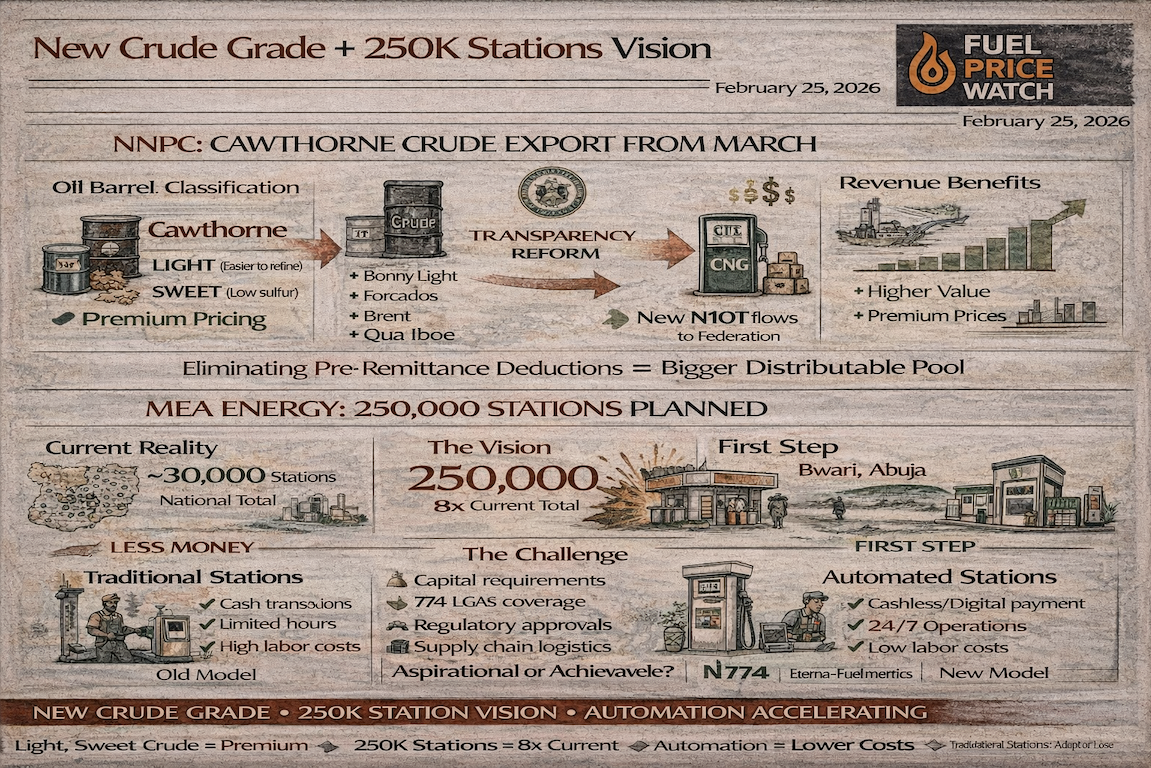
The Nigerian National Petroleum Company Limited will begin exporting a new light, sweet crude grade called “Cawthorne” from March 2026.
MEA Energy Limited launched its first automated retail station in Bwari, Abuja, while announcing plans to build 250,000 fuel stations nationwide.
One represents production sophistication — Nigeria diversifying crude export portfolio with premium-grade oil commanding higher prices.
The other represents retail ambition — private sector confidence in Nigeria’s fuel market leading to expansion targets that dwarf existing infrastructure.
Together, they illustrate an oil sector transforming at both upstream (production) and downstream (retail) ends simultaneously.
Cawthorne Crude: What “Light, Sweet” Actually Means
NNPC’s announcement that it will export a new crude grade named Cawthorne starting March 2026 matters because of two technical characteristics: the crude is “light” and “sweet.”
These aren’t marketing terms. They’re specific classifications with significant economic implications.
Light Crude Oil
“Light” refers to API gravity — a measure of how dense crude oil is relative to water. Higher API gravity means lower density (lighter crude).
Light crude (API gravity >31.1°) is easier and cheaper to refine than heavy crude because:
- It flows more readily through pipelines and refining equipment
- It requires less energy to heat and process
- It yields higher percentages of valuable light products (gasoline, diesel, jet fuel)
- It produces less residual fuel oil and asphalt (lower-value products)
Refineries prefer light crude because operational costs are lower and product yields are more profitable. This preference translates to price premiums.
Sweet Crude Oil
“Sweet” refers to sulfur content. Sweet crude contains less than 0.5% sulfur by weight.
Low sulfur matters because:
- Sulfur is corrosive to refining equipment (increases maintenance costs)
- Removing sulfur requires expensive processing (hydrotreating units)
- Environmental regulations limit sulfur in finished products (gasoline, diesel)
- Sweet crude requires less processing to meet environmental standards
Refineries pay premiums for sweet crude because it’s cheaper to process and easier to produce environmentally compliant fuels from.
The Price Premium
Light, sweet crude commands significant premiums over heavy, sour alternatives:
- West Texas Intermediate (light, sweet): Benchmark price
- Brent (light, sweet): Typically $2–4 premium over WTI
- Dubai/Oman (medium, sour): Typically $2–5 discount to Brent
- Venezuelan heavy (heavy, sour): Can trade $10–20 discount to Brent
For Nigeria, exporting light, sweet Cawthorne crude means capturing these premiums on every barrel sold.
Nigeria’s Existing Crude Grades
Nigeria already exports several crude grades with varying characteristics:
Bonny Light: Light, sweet (API 32–37°, sulfur <0.2%) — Nigeria’s flagship grade, commands premium prices
Forcados: Light, sweet (API 30–31°, sulfur ~0.2%) — Another premium Nigerian crude
Qua Iboe: Light, sweet (API 36°, sulfur ~0.1%) — High quality, premium pricing
Brass River: Light, sweet (API 43°, sulfur <0.1%) — Extremely light, very high premiums
Escravos: Light, sweet (API 36°, sulfur ~0.1%)
Nigeria’s crude is generally high quality — light and sweet across most grades. This is why Nigerian crude commands global premium prices.
Why Add Cawthorne?
If Nigeria already exports multiple light, sweet grades, why add another?
Several possible explanations:
1. New Field Development
Cawthorne may be crude from a newly developed field with distinct characteristics requiring separate classification. If a new field produces crude with API gravity or sulfur content differing from existing grades, it gets its own designation.
2. Production Optimization
Existing fields may have been optimized to produce crude meeting specific quality parameters, warranting separate grade classification. Enhanced oil recovery techniques or production changes can alter crude characteristics.
3. Marketing Differentiation
Creating distinct grades allows targeted marketing to specific refineries. Some refineries are optimized for particular crude characteristics. More grades = more flexibility matching Nigerian crude to refinery requirements.
4. Export Portfolio Diversification
Multiple grades reduce dependence on any single crude designation. If one grade faces quality issues or market challenges, others continue without contamination.
The introduction suggests either new production coming online (most likely) or operational changes enabling quality differentiation from existing production.
The 250,000 Station Ambition: Audacious or Achievable?
MEA Energy Limited’s announcement that it plans to build 250,000 fuel retail stations nationwide is, to put it mildly, ambitious.
The Current Baseline
Nigeria has approximately 30,000 fuel retail stations currently operating. This includes:
- NNPC Retail (formerly NNPC Mega stations): ~500–800 stations
- Major marketers (11 companies like Conoil, MRS, Oando, Total, Mobil): ~5,000–7,000 stations combined
- Independent marketers: ~22,000–25,000 stations
30,000 stations serve Nigeria’s 200+ million population across 774 local government areas.
MEA’s Target: 8 Times Existing Infrastructure
250,000 stations would represent:
- 8.3 times Nigeria’s current total station count
- Approximately 323 stations per LGA (if evenly distributed)
- One station per 800 people (if Nigeria’s population is 200 million)
For comparison:
- United States: ~150,000 stations for 330 million people (one per 2,200 people)
- China: ~110,000 stations for 1.4 billion people (one per 12,700 people)
- United Kingdom: ~8,400 stations for 67 million people (one per 8,000 people)
MEA’s target would give Nigeria one of the world’s densest fuel station networks relative to population.
The Capital Requirement
Building a single fuel retail station in Nigeria costs approximately:
- Land acquisition: N20–100 million (depending on location)
- Construction: N50–150 million
- Equipment (tanks, pumps, canopy): N30–80 million
- Automation systems: N10–30 million
- Regulatory compliance: N5–15 million
Conservative average: N150 million per station
250,000 stations × N150 million = N37.5 trillion
At current exchange rates (~N1,350/$), that’s approximately $28 billion.
For context:
- Dangote Refinery cost $20 billion
- Nigeria’s 2026 total budget is approximately N35 trillion
MEA’s station network would require capital exceeding Dangote Refinery investment and rivaling Nigeria’s entire annual federal budget.
The Execution Challenge
Beyond capital, building 250,000 stations requires:
Locations: Identifying, acquiring, and developing 250,000 suitable sites across Nigeria’s 774 LGAs. Many rural LGAs may not have 323 commercially viable station locations.
Regulatory Approvals: Each station requires approvals from:
- Department of Petroleum Resources (DPR)
- State Environmental Protection Agency
- Local government authorities
- Fire service certification
- Land use permits
Multiply approvals × 250,000 locations = regulatory nightmare.
Fuel Supply: 250,000 stations need consistent fuel supply. Even if each sells just 10,000 litres daily, that’s 2.5 billion litres daily demand — exceeding Nigeria’s total consumption (50–60 million litres daily) by 40–50 times.
Clearly, not all stations would operate at full capacity simultaneously. But supply chain logistics for 250,000 locations are exponentially complex versus 30,000.
Competition: MEA would compete with:
- NNPC Retail (government-backed)
- Major marketers (decades of market presence)
- 30,000 existing independents (established customer bases)
Capturing sufficient market share to justify 250,000 stations against entrenched competition is extraordinarily difficult.
Aspirational vs. Operational
Given these realities, how should we interpret MEA’s 250,000-station announcement?
Possibility 1: Long-Term Vision
250,000 stations may be a 10–20 year target rather than near-term operational goal. Building 12,500 stations annually over 20 years is more plausible than 250,000 immediately.
Even this requires ~$1.4 billion annual investment sustained for two decades.
Possibility 2: Franchise Model
MEA may not build all stations directly. A franchise model where independent operators build stations under MEA branding could dramatically reduce MEA’s direct capital requirement.
MEA provides technology platform (SmartPump automation), branding, and fuel supply agreements. Franchisees provide capital, locations, and operations.
This model has precedent globally and could make 250,000 stations theoretically achievable over decades.
Possibility 3: Strategic Positioning
Announcing audacious targets generates:
- Media attention (achieved — we’re writing about it)
- Investor interest (signals ambition and market confidence)
- Regulatory engagement (government notices companies with large-scale plans)
- Recruitment advantage (top talent wants to join ambitious ventures)
Even if MEA builds 5,000 stations (2% of stated goal), that’s still significant expansion from zero. The announcement creates positioning regardless of ultimate achievement.
Possibility 4: Market Confidence Signal
Following Dangote’s success demonstrating domestic refining viability, private sector sees opportunities in downstream fuel retail. MEA’s announcement — regardless of achievability — signals that Nigeria’s fuel market is viewed as sufficiently stable and profitable to warrant massive expansion plans.
This confidence matters. For years, fuel sector was characterized by scarcity, price volatility, and supply uncertainty. Now companies announce plans to build hundreds of thousands of stations. The psychological shift is significant.
The Automation Revolution
MEA’s model — and Eterna-Fuelmetrics’ earlier announcement — represents fundamental transformation of Nigeria’s fuel retail from labor-intensive to technology-driven operations.
Traditional Nigerian Fuel Station
- 4–8 pump attendants (per shift)
- 3 shifts daily = 12–24 staff for pump operations alone
- Additional staff: cashiers, security, supervisors, maintenance
- Total: 20–30 employees per station
- Cash-based transactions
- Limited operating hours (many close overnight)
- Theft vulnerabilities (fuel, cash, inventory)
Automated Station (SmartPump Model)
- Zero pump attendants (customers self-serve)
- 1–2 staff total (monitoring, basic maintenance)
- Cashless/digital payments only
- 24/7 operations with no labor scaling
- Real-time monitoring and inventory tracking
- Reduced theft opportunities
The Economics
Traditional station labor costs: N5–10 million monthly (at 20–30 staff) Automated station labor costs: N500,000–1 million monthly (at 1–2 staff)
Savings: N4–9 million monthly = N48–108 million annually
At N774/litre retail price with typical N20–30/litre margin, savings of N48–108 million annually equals margin on 1.6–3.6 million litres additional sales.
Automation directly improves profitability without requiring additional fuel sales volume.
Why Automation Now?
Fuel price stabilization at N774/litre post-Dangote creates conditions favoring operational optimization:
When prices are volatile (Nigeria’s historical pattern), retail competition focuses on securing supply and pricing at whatever margin possible. Operational efficiency is secondary to having fuel to sell.
When prices are stable (post-Dangote supply security), retail competition shifts to operational efficiency. All stations get fuel at similar wholesale prices. Profitability depends on cost management.
Automation becomes competitive advantage: lower costs = higher margins = better returns.
Traditional attendant-based stations must either:
- Modernize (adopt automation to match competitors’ cost structures)
- Accept lower margins (operate with higher costs vs. automated competitors)
- Exit market (unable to compete profitably)
The automation wave isn’t optional. It’s existential for traditional operators.
What February 25 Reveals
Production Sophistication
NNPC introducing Cawthorne crude demonstrates Nigeria’s upstream sector isn’t static. New grades, field developments, and production optimization continue despite challenges. Nigeria maintains position as premium crude exporter.
Retail Transformation
MEA’s 250,000-station ambition — even if aspirational — combined with automation adoption shows downstream sector rapidly evolving. Technology replacing labor. Scale ambitions growing. Private sector confidence post-Dangote enabling expansion plans unthinkable during scarcity years.
The Dangote Effect Cascades
Dangote Refinery’s success (650,000 bpd, N774 pricing, 42.2% import decline, IPO in 5 months) creates conditions enabling:
- Price stability (wholesale supply predictable)
- Supply security (domestic production reliable)
- Market confidence (private sector sees opportunities)
- Retail expansion (companies plan massive station networks)
- Technology adoption (stable market enables operational focus)
One successful refinery catalyzes transformation across entire value chain.
Ambition Exceeds Realism
250,000 stations requiring $28 billion over decades is likely unachievable as stated. But ambition matters. Even achieving 10% (25,000 stations) would nearly double Nigeria’s retail infrastructure.
Aspirational targets create momentum. Perfect execution isn’t the point. Direction and scale of ambition signal sector confidence.
Nigeria’s oil sector is transforming faster than institutional frameworks can adapt, creating opportunities and chaos simultaneously — progress and problems coexisting in ways that frustrate neat analysis but reflect messy reality of rapid change.
About Fuel Price Watch
Fuel Price Watch provides real-time, crowd-sourced fuel price data across Nigeria. Our mission is transparency in Nigeria’s fuel market. We report what’s happening without modification or spin.
Track fuel prices in your area and contribute updates at **app.fuelpricewatch.com**
Stay informed. Stay fueled.
Sources:
- NNPC Cawthorne crude grade announcement, February 24, 2026
- MEA Energy Limited retail station launch and expansion plans, February 24, 2026
- Nigeria fuel retail infrastructure data, 2026
- Crude oil classification and pricing data, February 2026
메타데이터
- post_id
- 2ce7ef759d3b
- slug
- nnpcs-new-cawthorne-crude-grade-and-the-250-000-fuel-station-dream-nigeria-s-oil-sector-2ce7ef759d3b
- url
- https://medium.com/@fuelpricewatchteam/nnpcs-new-cawthorne-crude-grade-and-the-250-000-fuel-station-dream-nigeria-s-oil-sector-2ce7ef759d3b
- canonical_url
- https://medium.com/@fuelpricewatchteam/nnpcs-new-cawthorne-crude-grade-and-the-250-000-fuel-station-dream-nigeria-s-oil-sector-2ce7ef759d3b
- author_url
- https://medium.com/@fuelpricewatchteam
- status
- ok
- fetched_at
- 2026-06-20 20:29:01