Oil Just Dropped To A Two-Month Low On An Iran Deal That Has Not Been Signed Yet.
This Is What That Tells You About Markets.
Oil Just Dropped To A Two-Month Low On An Iran Deal That Has Not Been Signed Yet.
This Is What That Tells You About Markets.
On Thursday evening, President Trump stood in the White House and told reporters a great settlement had been reached with Iran. He said the Strait of Hormuz would officially open as soon as a signing took place. He suggested Vice President JD Vance could sign on behalf of the United States as early as this weekend in Europe.
Within the same hour, Iran’s Foreign Ministry said no final decision had been taken on any agreement with Washington.
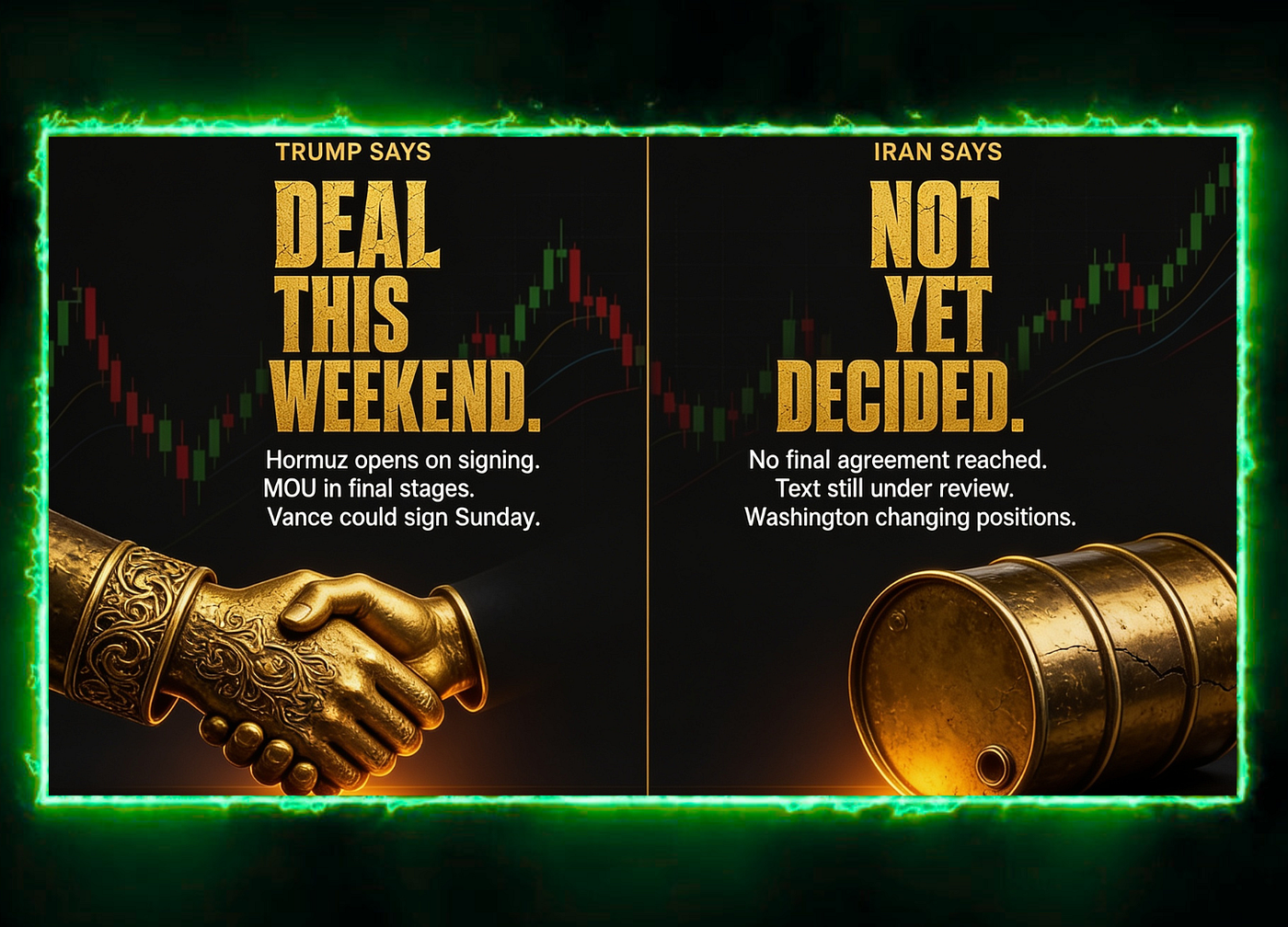
Two statements. Two completely different descriptions of the same negotiation. And yet oil dropped over 5.5% in a single session, gold fell to its lowest level since November before recovering, and equity futures pushed higher in anticipation of a deal that has not been confirmed by one of the two parties to it.
This is not a story about Iran or oil specifically. It is a story about how markets process uncertainty, and why understanding that process is one of the most valuable things a trader or investor can learn.
How Markets Price Events That Have Not Happened Yet
The oil price on any given day does not just reflect current supply and demand. It reflects the market’s collective expectation of future supply and demand, discounted back to the present. When Trump suggested a deal was imminent, the market did not wait for confirmation. It immediately repriced the probability that a Hormuz reopening would happen soon, and that repricing showed up as a 5.5% drop in WTI crude in a single session.
This is rational behaviour. If the probability of a deal closing this weekend moved from, say, 20% to 60% on Thursday’s announcement, then the market should adjust oil prices to reflect that higher probability of lower future supply constraints. The price movement was not irrational exuberance. It was a logical response to new information.

The problem is that the new information was incomplete. Trump described a conceptual memorandum of understanding. Iran described a process still under review by their decision-making bodies. The market priced the optimistic interpretation of a genuinely ambiguous situation, which is what markets almost always do when the stakes are high enough.
The Cost Of This Pattern Over Four Iterations
This is the fourth time since March that this exact sequence has played out. Trump announces progress. Markets move significantly. Iran’s response creates ambiguity. The move partially reverses over 24 to 48 hours.
In the most dramatic iteration of this pattern, WTI swung between $107 and $88 in a single week during early May when peace negotiations surfaced and then stalled. Traders who positioned on the initial headline and held through the reversal experienced both the gain and the loss in the same week. The ones who sized their positions for a probability shift rather than a confirmed event managed the volatility more cleanly.
This week has its own additional layer of complexity. Thursday’s US producer price data showed inflation running at 6.5% year-on-year, the highest since late 2022. The European Central Bank raised interest rates for the first time since 2023. Gold fell to $4,080 on Thursday before recovering to $4,189 Friday morning as deal hopes reduced inflation expectations slightly. The same asset moved $109 in either direction over 24 hours as two competing macro forces, inflation driving it down and deal hopes lifting it back, hit simultaneously.
Understanding which force is structural and which is transitory matters enormously for how you position around an event like this weekend’s potential signing.
What An Iran Deal Actually Does And Does Not Do
A confirmed peace deal with a Hormuz reopening commitment removes one specific thing from markets: the geopolitical supply premium embedded in oil since the conflict began in late February. That premium has been estimated at $10 to $20 per barrel above what oil would otherwise trade at given current supply and demand fundamentals. A credible reopening removes that premium over days and weeks, not in a single session.
What it does not remove is the inflation that the premium already caused. Six months of elevated energy prices have worked their way through supply chains and into consumer and producer prices. The PPI data on Thursday confirmed that process is still running. A peace deal stops new inflation from arriving via the energy channel. It does not reverse the inflation that is already in the system.
This distinction matters most for understanding gold’s position. Gold’s bid over the past six months has come from three sources: the geopolitical safe-haven premium, the inflation driving real rates negative, and the Fed’s inability to cut in a growth-slowing environment. A confirmed deal removes the first source partially. It leaves the other two entirely intact. The gold dip that a deal confirmation would produce is a short-term repricing of the geopolitical component, not a structural reversal of the investment case.
The Part Of This Story That Gets Lost In The Noise
The most important number from this week did not come from Trump’s press conference or from Iran’s Foreign Ministry. It came from the US Bureau of Labor Statistics.
PPI at 6.5% year-on-year is the highest reading since November 2022. It means the prices that businesses pay for inputs are rising at a pace that is still accelerating at the producer level before it reaches the consumer. CPI data earlier in the week showed consumer prices rising at the fastest pace in three years. The ECB responded to its own version of this problem by hiking rates for the first time since 2023.
None of those data points go away because of a peace deal this weekend. The energy price shock from the Hormuz closure has been building in the system for four months. The unwinding of that shock takes time regardless of when the deal closes. The Fed is not cutting rates in an environment where PPI is running at 6.5% even if oil falls back toward $75 on a confirmed deal.
The market that has been rallying on Iran deal hopes since March has been trading the near-term relief. The data that has been building underneath those headlines is telling a different story about where rates, inflation, and the cost of capital are heading through the rest of 2026.
What The Next 48 Hours Will Tell You
If Iran’s decision-making bodies issue a statement confirming the final agreement this weekend, the immediate market reaction will be significant. Oil falls further toward $75 to $80. Gold dips toward $4,000 as the geopolitical premium fades. Risk assets rally. The dollar softens against risk currencies.

If the deal does not close this weekend, the pattern of the past four months says the move partially reverses early next week. Oil recovers toward $90. Gold reclaims the levels it lost Thursday. The stalemate continues and the inflation data from this week becomes the dominant market narrative again rather than the deal headlines.
The difference between these two outcomes is enormous. The right response to that uncertainty is not to guess which one happens. It is to know precisely what you own going into the weekend, where your stop is if the wrong scenario plays out, and how much of your account is exposed to an outcome you cannot control.
That question, what do I actually own and what happens to it in each scenario, is the only question that matters before Friday close.
Follow Inside the Trade on Substack for weekly trade setups, market analysis, and the full methodology behind every idea in this piece.
메타데이터
- post_id
- 2cecd12a2293
- slug
- oil-just-dropped-to-a-two-month-low-on-an-iran-deal-that-has-not-been-signed-yet-2cecd12a2293
- url
- https://medium.com/inside-the-trade/oil-just-dropped-to-a-two-month-low-on-an-iran-deal-that-has-not-been-signed-yet-2cecd12a2293
- canonical_url
- https://medium.com/inside-the-trade/oil-just-dropped-to-a-two-month-low-on-an-iran-deal-that-has-not-been-signed-yet-2cecd12a2293
- author_url
- https://medium.com/@rb_tradingltd
- status
- ok
- fetched_at
- 2026-06-20 20:29:01