Replit Agent 4 vs. Lovable: The Honest Enterprise Comparison No One Else Is Writing
Both platforms raised hundreds of millions in the last six months. Both claim enterprise-readiness. The decision matrix most buyers are…
Replit Agent 4 vs. Lovable: The Honest Enterprise Comparison No One Else Is Writing
Both platforms raised hundreds of millions in the last six months. Both claim enterprise-readiness. The decision matrix most buyers are using is the wrong one — built for solo developers, not for operations directors managing governance and long-term infrastructure ownership.
Most comparisons of these two platforms are written by indie developers building MVPs on a weekend. This one is written for the operations director whose CTO just forwarded them a briefing, the VP of Engineering evaluating platforms for a 200-person team, and the IT leader who will own whatever decision gets made. Those readers need a different analysis than “which one builds a prettier landing page.”
Both platforms are real, well-funded, and capable. Lovable closed a $330M Series B at a $6.6 billion valuation in December 2025, reaching $200M ARR. Enterprise customers include Klarna — whose CEO Sebastian Siemiatkowski noted “I used to bring an idea to a meeting. Now I bring a Lovable prototype.” (Source: Lovable Enterprise) Replit raised $400M at a $9 billion valuation in March 2026. Neither is an experiment. The question is which one is right for your specific operational workload — and the answer is not the same for every organization.
What Each Platform Is Actually Built For
This is the sentence most comparisons get wrong: both platforms create software from natural language, but they are optimized for fundamentally different problems.
Lovable is optimized for speed to beautiful. It generates complete React/TypeScript applications from conversational prompts, automatically provisions a Supabase backend, and produces UI that looks production-ready in under a minute. The design quality out of the box is genuinely impressive. For non-technical founders building a customer-facing product who need to move from idea to investor demo in a week, Lovable is often the right tool.
Replit Agent 4 is optimized for depth of ownership. It operates as a cloud IDE with an AI agent — building, testing, and deploying across 50+ languages and frameworks, with integrated infrastructure (database, authentication, hosting, security scanning) that is yours from the moment you hit publish. The build takes longer to first visual. The output is more completely owned.
The enterprise question — and the SMB question, for that matter — is which problem you actually have.

Figure 1: Platform optimization map — Lovable is built to win on speed to beautiful, Replit Agent 4 is built to win on depth of ownership. Choose based on your primary success criterion. Sources: lovable.dev/enterprise-landing · replit.com/enterprise · March 2026.
The Decision Matrix

Figure 2: Replit Agent 4 vs. Lovable across 14 dimensions relevant to SMB and enterprise buyers. Honest assessment — neither platform wins every dimension. Lovable hosting is Supabase-integrated and included; Replit hosting is vertically integrated in one dashboard. ISO 27001
Where Lovable Genuinely Wins
The compliance posture is the first place to acknowledge Lovable’s advantage. Lovable is certified through SOC 2 Type II and ISO 27001:2022 and explicitly supports GDPR compliance. Replit has SOC 2 Type II. For European enterprise procurement and healthcare-adjacent contexts, Lovable’s certification stack is meaningfully stronger right now. This matters and should not be glossed over. One important nuance: SSO/SAML on Lovable requires the Business tier ($50/month shared). SCIM provisioning is Enterprise only. Teams on the Pro tier ($25/month shared) do not get SSO — worth confirming your required tier before procurement.
The design story is also real. Lovable’s automated pre-publish security scanning, zero-credit visual edits, and point-and-click UI editor produce aesthetically polished applications faster than Replit Agent 4 does by default. For organizations whose primary deliverable is customer-facing products with high visual quality requirements — consumer apps, marketing properties, investor demos — Lovable’s speed to beautiful is a genuine advantage.
Lovable’s enterprise pitch is worth quoting directly: it lets “entire teams build together — PMs, designers, and operators create working software while engineers keep control via a standard tech stack and GitHub PRs.” For design-led, product-first organizations where the engineering team wants to stay in their own toolchain, this handoff model (Lovable generates → GitHub PR → engineering reviews) is genuinely well-designed.
For an SMB design-led team: An agency or product studio with a designer, a PM, and one engineer will likely find Lovable’s workflow more natural. The engineer reviews GitHub PRs from Lovable output rather than learning a new environment.
For an enterprise design organization: The Lovable → engineering handoff via GitHub is the standard enterprise design-to-development workflow, made faster. If your organization already has this pattern, Lovable accelerates it without disrupting it.
On total cost: Lovable’s pricing model deserves acknowledgment here. Business tier is $50/month shared across unlimited users — meaning a 20-person product team pays $50/month total. Replit Teams is $35/user/month, making the same team $700/month. For large design-led teams primarily using Lovable for prototyping and handoff, the shared-seat economics are a meaningful advantage.
Where Replit Agent 4 Wins — The Operational Build Case
The infrastructure ownership argument is where Replit’s advantage is clearest. Lovable does include hosting — the platform provisions Supabase-backed cloud infrastructure for authentication, database, and deployment. The distinction from Replit is not presence vs. absence of hosting. It is integration simplicity. On Lovable, your frontend, backend, and database are configured across the Lovable builder, Supabase, and your deployment target — each a separate service with its own dashboard. On Replit, all three live in one integrated environment under one dashboard, one vendor relationship, and one compliance review. For an operations director or product manager without engineering support, that consolidation is the operational advantage — not whether hosting exists.
Replit Agent 4’s integrated environment means the app that is built is also hosted, database-provisioned, authenticated, security-scanned, and deployed — in the same place, under the same governance, from one dashboard. For enterprise IT administrators, this matters enormously: one vendor, one compliance review, one security posture to manage.
For an enterprise data team: The Databricks, BigQuery, and Snowflake connectors are the capability Lovable simply does not have. If your team needs to build operational analytics applications against governed data warehouses — without moving sensitive data outside the warehouse — Replit Agent 4 is the only platform on this list that supports it directly.
For an SMB ops team with a mixed stack: Python scripts, Node.js APIs, custom integrations against internal systems — Replit’s 50+ language support and autonomous debugging means the agent can build against your actual stack, not a prescribed React/TypeScript framework. This matters the moment your business logic requires anything beyond standard web application patterns.
The autonomous debugging advantage compounds over time. Lovable requires the operator to paste errors into chat manually. Replit Agent 4 reads terminal output, identifies errors, and self-corrects — often without human intervention. On a complex build with fifteen interdependencies, this difference is the difference between a two-hour build and a six-hour debugging session.
The Hybrid Workflow — The Sophisticated Practitioner’s Path
Multiple independent practitioners have arrived at the same pattern organically: generate UI in Lovable → export to GitHub → build backend in Replit.
This is not compromise — it is using each platform at its peak capability. Lovable produces polished UI faster than any alternative. Replit handles the backend, authentication, deployment, and ongoing iteration against the integrated infrastructure. The GitHub handoff between them is clean because both platforms treat code as a first-class exportable asset.
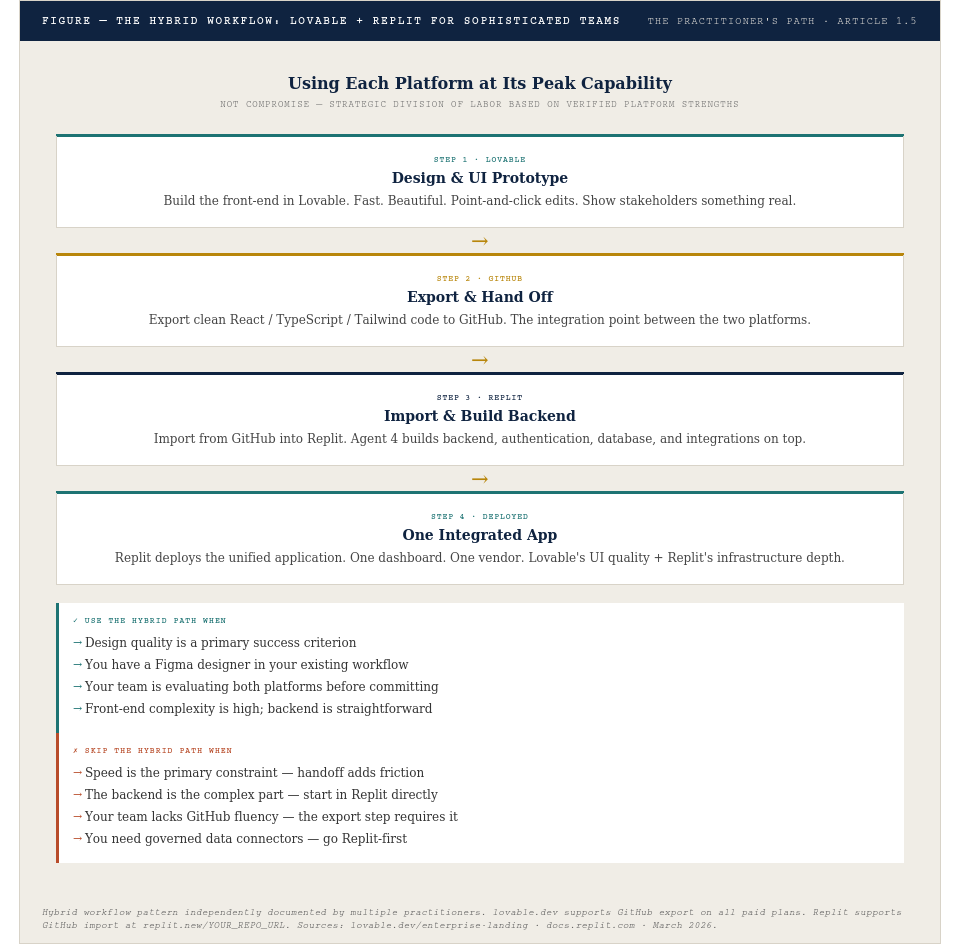
Figure 3: The Lovable → GitHub → Replit hybrid workflow — four steps from prototype to deployed full-stack application. Use when design quality is a primary criterion and your team has GitHub fluency.
When to use the hybrid path:
- Design-first product builds where visual quality is a primary requirement
- Teams that have a Figma designer who wants to stay in their existing workflow before the Replit build begins
- Organizations evaluating both platforms in parallel and wanting the best of both before committing to one
When NOT to use the hybrid path:
- When speed is the primary constraint (the handoff adds friction)
- When the backend is the complex part (start in Replit where the backend is native)
- When your team doesn’t have GitHub fluency (the export/import step requires it)
The Verdict for the Audience That Actually Matters
Most people writing this comparison are optimizing for a different reader. Here is the verdict for yours:
If you are an operations director, product manager, or business analyst who just got empowered to build internal tools — and your organization runs on a mixed technology stack with governance requirements — Replit Agent 4 is the platform built for your workload. The integrated infrastructure means you own what you build. The parallel execution means you build it faster. The compliance posture means IT can approve the pilot.
If you are the same person, but your first build is a customer-facing product where design quality is the primary success criterion — consider starting in Lovable and moving to Replit for the backend and ongoing iteration. The hybrid path is real and it works.
If you are an enterprise IT leader evaluating both for your organization: Lovable has the stronger certification stack (ISO 27001:2022 advantage). Replit has the stronger data governance story (warehouse connectors, integrated deployment, SCIM provisioning). Your evaluation should weigh those against the specific compliance requirements and data workloads your organization actually runs.
The competitive clock is not waiting for a perfect platform decision. Both are ready for the workloads described above. Start with the one that matches your first use case — not the one with the better marketing.
The Decision Map your first build against two questions: Is the primary output a customer-facing UI where design quality determines success? (Lovable.) Or is it an internal operational tool where infrastructure ownership, data integration, and autonomous operation determine success? (Replit Agent 4.) If the answer is unclear, run a two-week trial of both on the same use case and compare results. The platforms are inexpensive enough that empirical evaluation is always available.
Up Next
The Parallel Advantage — How Agent 4 Compresses Weeks Into Hours for Business Teams. The mechanism that makes the time compression real — and why it changes the competitive math for every team with a backlog.
→ Ready to build the same app in both platforms and see what actually happens? The hands-on comparison guide with real build results and screen recordings is on Substack: **I Built the Same App in Both — Here’s What Actually Happened**
메타데이터
- post_id
- 2d072ee8b400
- slug
- replit-agent-4-vs-lovable-the-honest-enterprise-comparison-no-one-else-is-writing-2d072ee8b400
- url
- https://medium.com/@rmowery/replit-agent-4-vs-lovable-the-honest-enterprise-comparison-no-one-else-is-writing-2d072ee8b400
- canonical_url
- https://medium.com/@rmowery/replit-agent-4-vs-lovable-the-honest-enterprise-comparison-no-one-else-is-writing-2d072ee8b400
- author_url
- https://medium.com/@rmowery
- status
- ok
- fetched_at
- 2026-06-15 20:49:13





