Scrum Guide Series #9: Scaled Scrum
What is Scaled Scrum?
Scrum Guide Series #9: Scaled Scrum
What is Scaled Scrum?
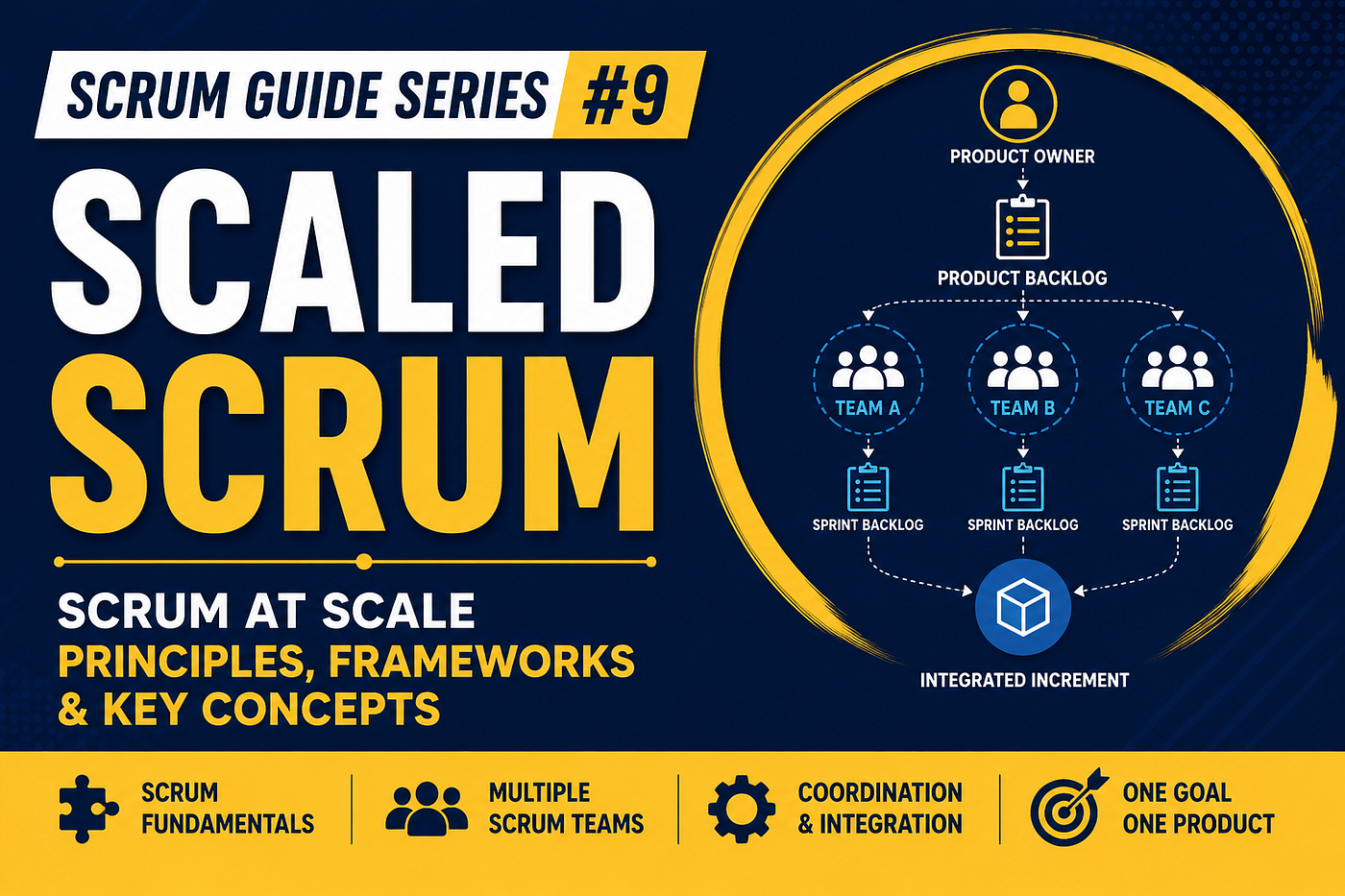
As products grow in complexity, a single Scrum Team may no longer be sufficient. Organizations often need multiple Scrum Teams collaborating toward a common Product Goal.
Scaling Scrum is the practice of applying Scrum across multiple teams working on the same product while preserving the core Scrum framework.
Core Principles
When Scrum is scaled, several fundamental principles remain unchanged:
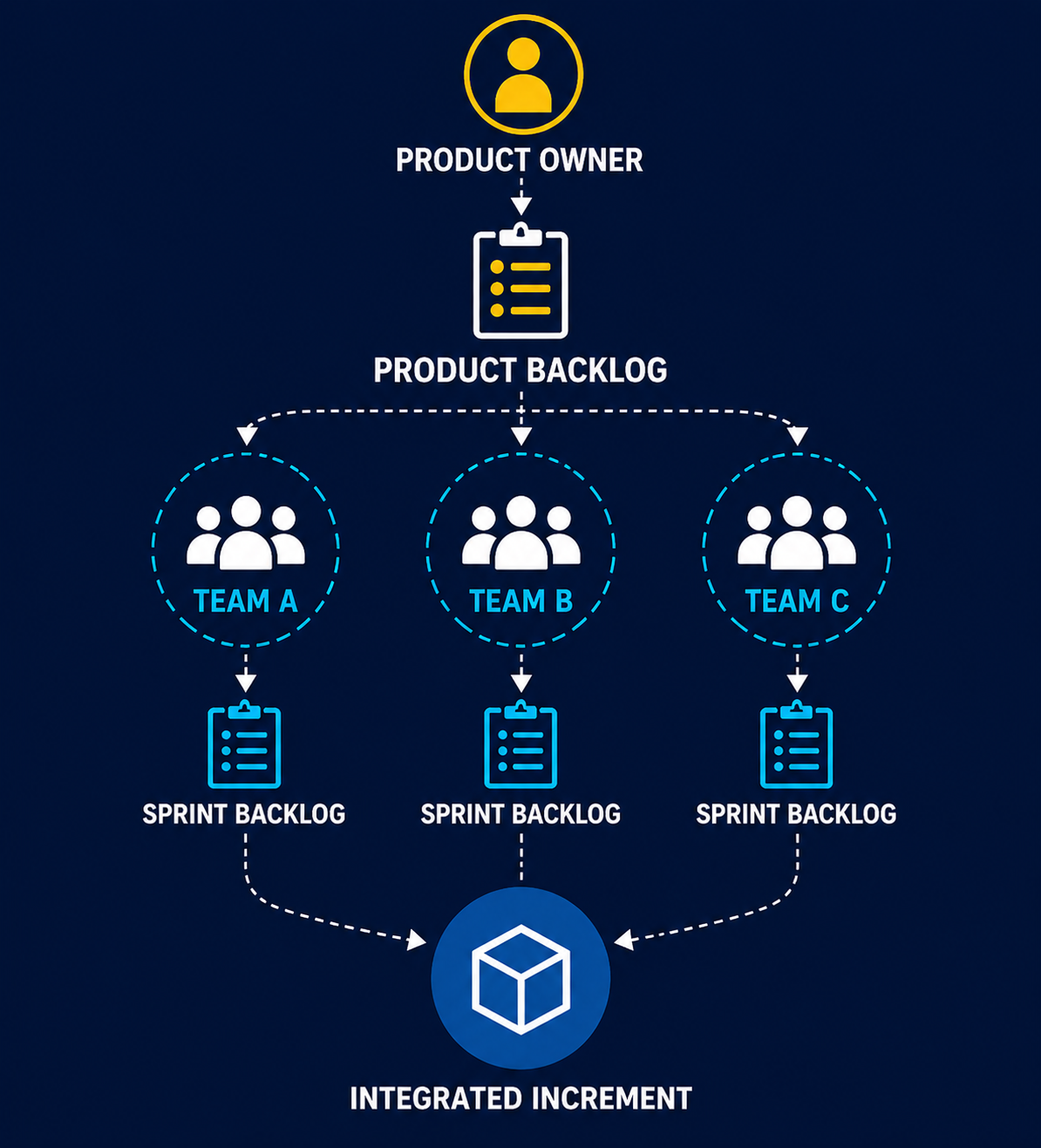
- One Product has one Product Owner. The Product Owner remains accountable for maximizing the value of the product.
- One Product has one Product Backlog. All Scrum Teams work from a shared Product Backlog aligned to the same Product Goal.
- Each Scrum Team maintains its own Sprint Backlog. Teams independently plan and manage the work they will perform during the Sprint.
- One Product has one Definition of Done. A shared Definition of Done ensures consistent quality across all teams.
- Teams produce a single Integrated Increment. The work completed by all Scrum Teams is combined into one usable Increment at the end of the Sprint.
- All Scrum Events still occur. Sprint Planning, Daily Scrum, Sprint Review, Sprint Retrospective, and the Sprint itself continue to exist. Scaling frameworks may introduce additional coordination events, but they do not replace the core Scrum Events.
Challenges of Scaling
As the number of teams increases, additional coordination becomes necessary.
New challenges emerge:
- Managing dependencies between teams
- Integrating work from multiple teams
- Coordinating releases
- Maintaining transparency
- Aligning teams toward a common Product Goal
Scaling frameworks introduce additional practices to address these challenges.
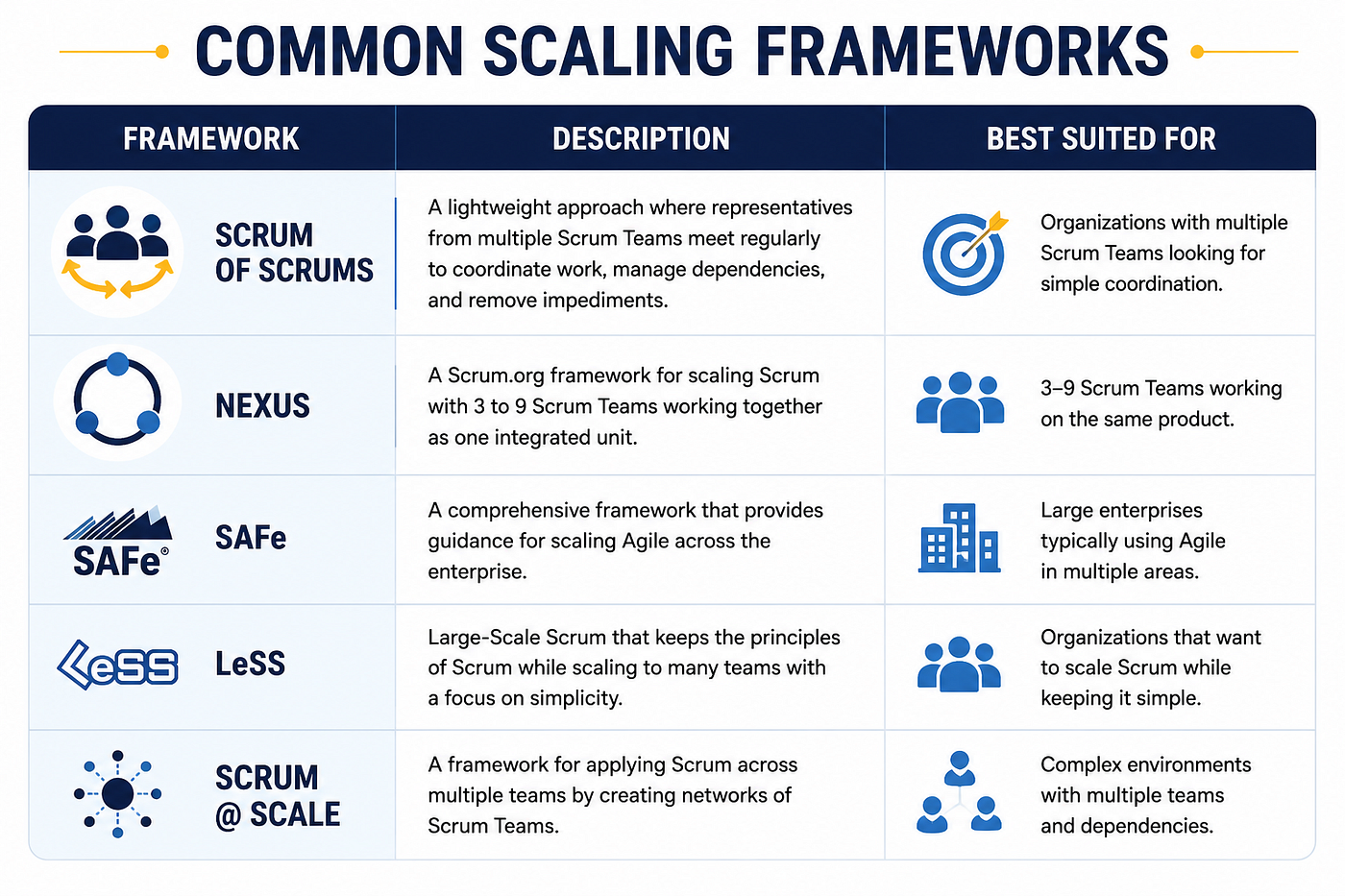
Common Scaling Frameworks
Feature Team vs Component Team
When multiple Scrum Teams work on the same product, teams can be organized in different ways.
Feature Team
A Feature Team can build an entire feature from start to finish. They own end-to-end customer features.
Example:
Consider Team A consisting of:
- Frontend Developer
- Backend Developer
- Tester
- UX Designer
Feature: User Registration
UI → API → Database → TestingThe team can deliver the feature independently.
Component Team
A Component Team owns a specific technical component. They own a specific layer of the system.
Example:
- Frontend Team → UI changes
- Backend Team → APIs
- Database Team → Database changes
- Testing Team → Testing
For a single feature, the work passes between multiple teams.
Frontend Team
      ↓
Backend Team
      ↓
Database Team
      ↓
Testing Team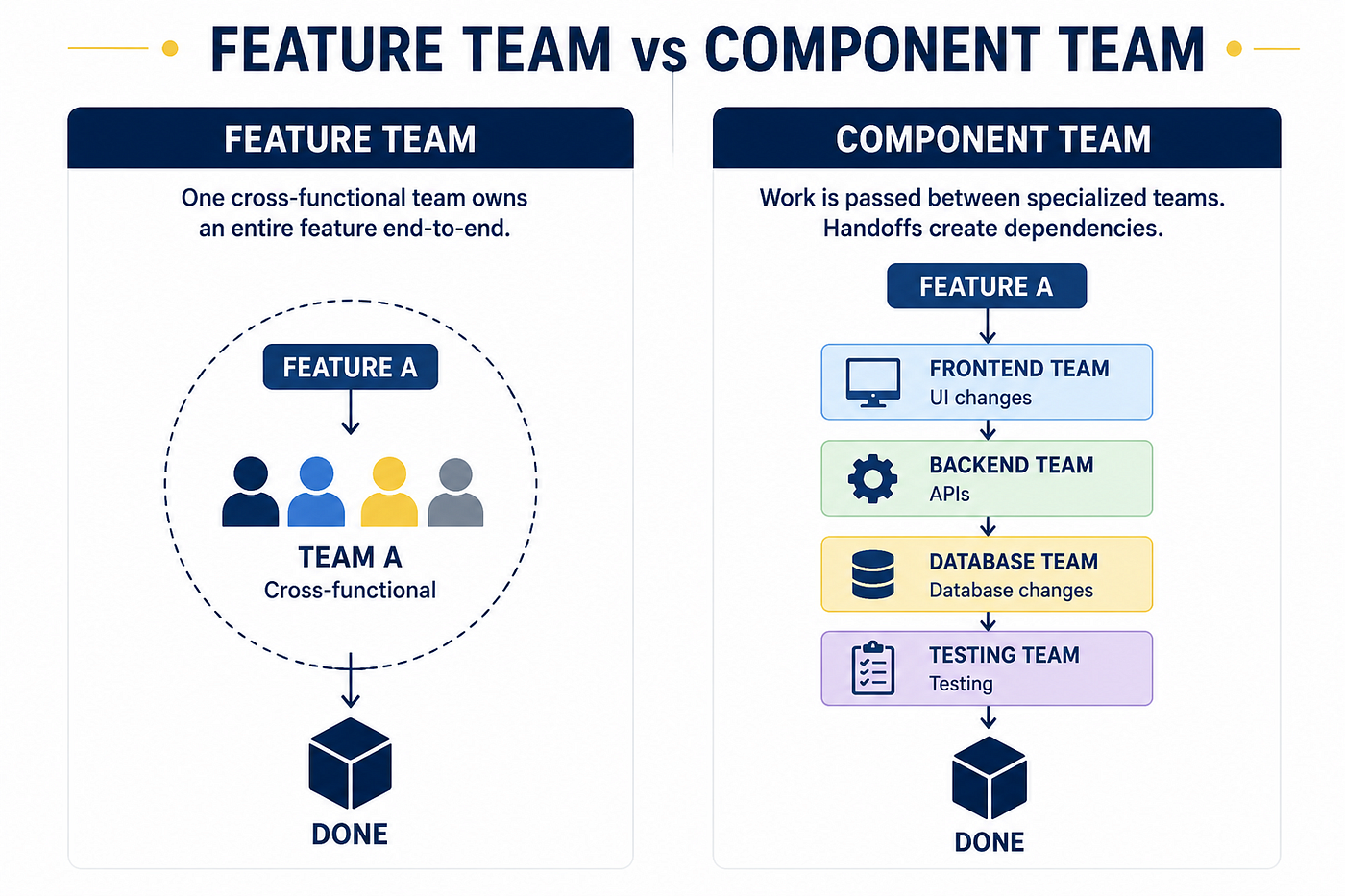
Feature Teams are generally preferred over Component Teams because they reduce dependencies and deliver value more independently.
Sprints Cadency for Multiple Scrum Teams
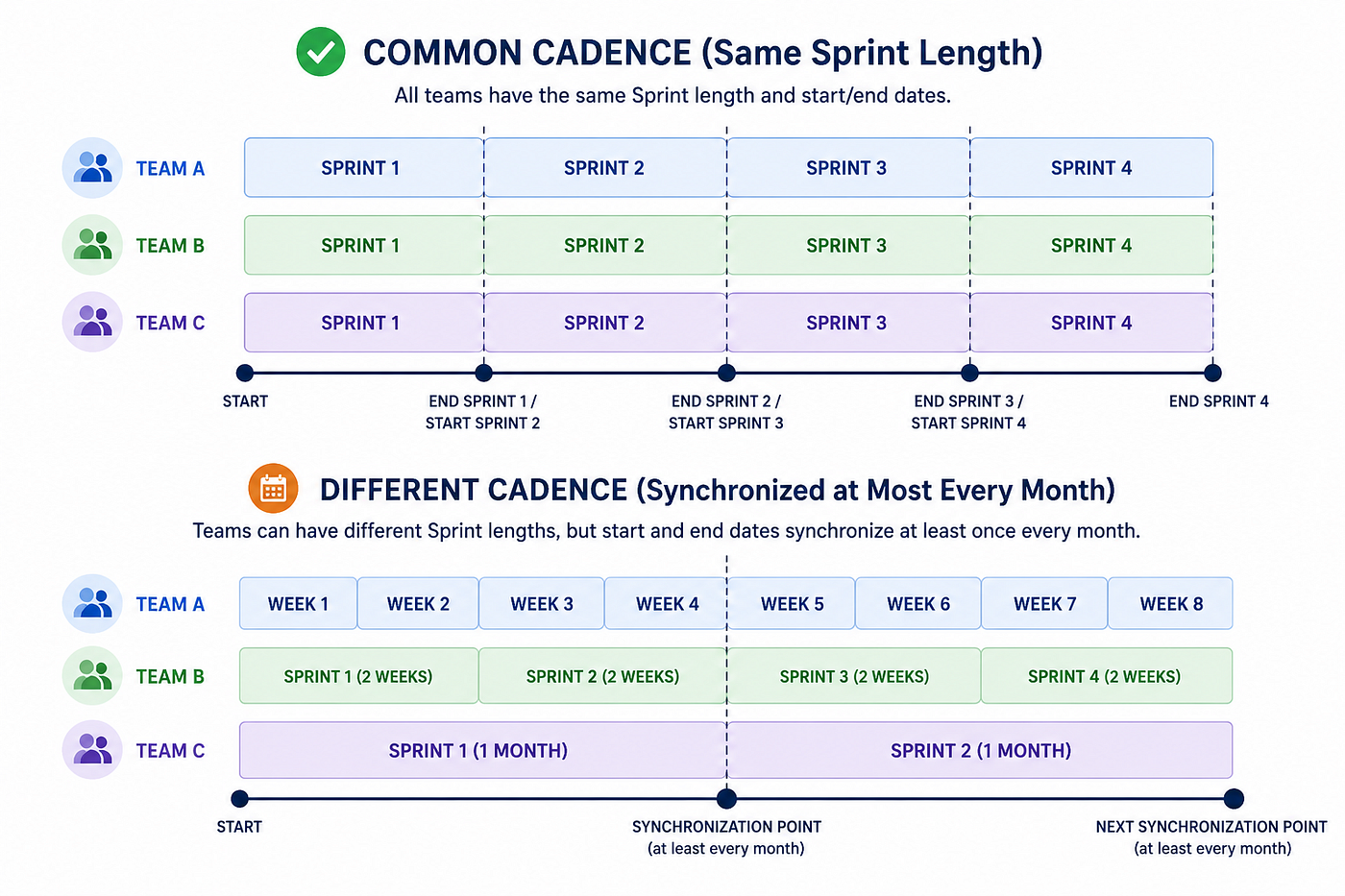
Sprint Cadence refers to the regular rhythm at which Scrum Teams operate. Ideally, all Scrum Teams should be synchronized and start and end their Sprints on the same day.
A shared Sprint Cadence helps teams:
- Coordinate work more effectively
- Reduce complexity
- Manage dependencies
- Integrate work frequently
- Conduct joint reviews and planning activities
However, there may be situations where different teams require different Sprint lengths. For example
- A software team may be able to deliver value every week.
- A hardware team may only be able to deliver meaningful results once per month.
In such cases, teams can operate with different Sprint lengths. But they should synchronize their Sprint start/end dates at least once every month to maintain alignment across the product.
🧩 Key Takeaways
- Scaling Scrum is the practice of applying Scrum across multiple teams working on the same product.
- A single product should have: One Product Owner, One Product Backlog, One Product Goal, One Definition of Done
- Each Scrum Team maintains its own Sprint Backlog.
- All Scrum Teams contribute toward a single Integrated Increment.
- Scaling introduces additional coordination challenges.
- Several frameworks exist to help organizations scale Scrum.
- Feature Teams are generally preferred over Component Teams because they reduce dependencies and deliver value more independently.
- Teams often share a common Sprint Cadence to simplify coordination and integration. Teams may have different Sprint lengths, but should synchronize regularly (typically at least once per month).
💡Quiz
- How many Product Backlogs should exist for a single product in Scaled Scrum?
A. One per Scrum Team B. One per Product Owner C. One per Product D. Multiple Product Backlogs are recommended
2. Each Scrum Team should have its own Definition of Done when working on the same product. A. True B. False
3. True or False: Teams in Scaled Scrum must always have identical Sprint lengths.
A. True B. False
4. Which scaling framework was created by Scrum.org?
A. SAFe B. LeSS C. Nexus D. Scrum@Scale
Answers
- C
- B
- B
- C
Next in the Series
Scrum Guide Series #10: Scrum Anti-Patterns
Full Reading List
메타데이터
- post_id
- 2d1f4a6c1bb7
- slug
- scrum-guide-series-9-scaled-scrum-2d1f4a6c1bb7
- url
- https://medium.com/agile-pm-playbook/scrum-guide-series-9-scaled-scrum-2d1f4a6c1bb7
- canonical_url
- https://medium.com/agile-pm-playbook/scrum-guide-series-9-scaled-scrum-2d1f4a6c1bb7
- author_url
- https://medium.com/@harita-ravindranath
- status
- ok
- fetched_at
- 2026-06-28 14:26:31