We Automated Everything — Except Common Sense (in DevOps)
The allure of full automation in DevOps is a powerful one, promising unparalleled speed, efficiency, and the elimination of human error. We.
We Automated Everything — Except Common Sense (in DevOps)
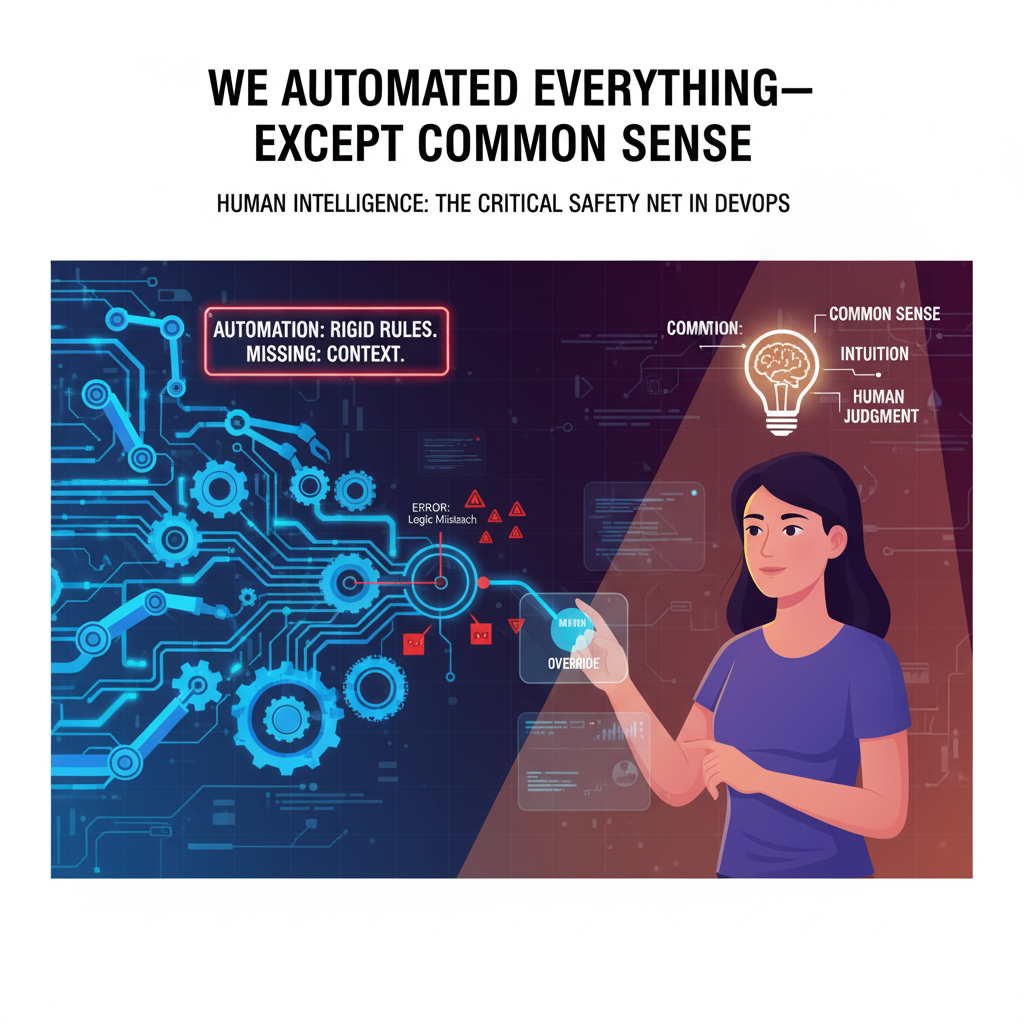
The allure of full automation in DevOps is a powerful one, promising unparalleled speed, efficiency, and the elimination of human error. We strive to automate repetitive tasks, build robust CI/CD pipelines, and orchestrate complex deployments with machine-like precision. However, this pursuit often leads to a dangerous trap: while we can automate processes, we cannot automate common sense. The most critical and often overlooked component of a resilient, truly intelligent system remains the human element, which is indispensable for nuanced decision-making in unforeseen circumstances. Automation works flawlessly on predictable tasks, but it fundamentally lacks the contextual awareness, intuition, and judgment required to handle the inevitable edge cases and cascading failures that arise in complex production environments. This is a crucial distinction between a fast pipeline and a smart, safe one, separating mere “DevOps” from “DevOps with common sense.”
The ultimate goal of DevOps is to shorten the system’s development life cycle and provide continuous delivery with high software quality. Automation is the engine that drives this process. Yet, relying solely on automated guardrails without human oversight is akin to building a self-driving car that adheres perfectly to traffic laws but cannot react intelligently to a child suddenly darting into the road. The machine follows its code; the human applies judgment to the unknown.
The Fallacy of “NoOps”
The goal of “NoOps” — a vision where automation is so complete that no manual intervention is ever needed — is a dangerous myth. The appeal of a fully autonomous pipeline is that it eliminates human error, a common cause of outages. But in doing so, it also eliminates human intuition, critical thinking, and adaptive problem-solving. This trade-off is often overlooked until a catastrophic failure exposes the limitations of rigid, rule-based systems.
The reality is that automated testing and deployment are meticulously based on predefined rules, expected outcomes, and a known state of the world. They operate within a bounded logic. They simply cannot account for the vast spectrum of unpredictable variables that impact a live system:
- Emergent Behavior: Modern, distributed systems, particularly those built on microservices architectures, are incredibly complex. The non-linear interactions between numerous microservices, cloud resources, and third-party APIs can produce entirely unexpected results that no script could have predicted or tested for. For example, a new microservice, perfectly functional in isolation, might unintentionally trigger a denial-of-service attack on a legacy database when its traffic patterns change under specific, unforeseen load conditions. An automated system would likely interpret the microservice as “healthy” while the database quietly suffers.
- External Factors: An automated CI/CD pipeline operates in a relatively isolated and defined environment. It has no inherent awareness of events unfolding outside its programmed scope. It cannot react intelligently to a sudden, unforecasted spike in traffic from a viral news story, a dependent third-party service experiencing an unexpected outage, or a global network disruption impacting connectivity. A human operator, however, can see these events unfold in real time via external news feeds, social media, or shared incident channels, and make an informed, adaptive decision to halt a deployment, execute a manual hotfix, or activate a disaster recovery plan.
- Misleading Metrics: An automated system may deem a deployment “successful” based on a basic health check — for instance, if a service is responding to a simple ping or returning a 200 OK status. However, a human monitoring a comprehensive set of dashboards might observe a subtle but alarming increase in application latency, a slight drop in a non-critical business metric (like conversion rates), or an unusual pattern of “soft” errors that don’t trigger a hard failure. These are often early warning signs of a deeper problem that a rigid, threshold-based automated system would completely miss.
In these scenarios — where the system is technically “working” but actually failing in a nuanced way, or where the external world throws a curveball — a human is needed to make a judgment call. This might involve a manual rollback despite green lights, a preemptive capacity increase based on external news, or a hotfix deployed outside the standard pipeline. These are actions that a rigid script, devoid of common sense, simply cannot initiate.
The Unquantifiable Value of Human Intervention
The real-world value of human intervention is most evident in high-pressure scenarios where automation, for all its brilliance, falls short. These critical moments underscore why the human element is an indispensable component of reliability in DevOps and SRE.
- The Soft Failure and the Savvy Developer: A company implemented an automated canary deployment, designed to test new code on a small subset of users before a full rollout. The automation was configured to automatically roll back if the error rate (e.g., 5xx HTTP codes) exceeded a predefined threshold. During a new feature rollout, the error rate remained well below the threshold. However, a developer, diligently monitoring the comprehensive observability dashboards and raw logs, noticed a new type of “soft” failure: the application was taking an unacceptably long time to respond for a small segment of users, leading to a poor user experience. Crucially, it wasn’t returning an HTTP error code that the automation was configured to detect. The automated system, operating strictly by its rules, didn’t flag this. It was the developer’s common sense, their understanding of user impact beyond simple error codes, and their ability to interpret subtle data patterns that led to manual intervention. They manually halted the deployment and initiated a rollback, saving the company from a major customer-facing outage and significant reputational damage.
- The Unforeseen Scaling Issue and the Alert SRE: An automated pipeline successfully deployed a new feature for a financial services application. Minutes later, the SRE team, whose job is centered on monitoring and reliability, noticed a sudden, inexplicable, and rapid increase in database connections. This was a metric not directly tied to the deployment’s success criteria in the automated pipeline. The human on call, with their deep knowledge of the system’s architecture, past incidents, and an intuitive grasp of database scaling limits, immediately realized that the new feature was inefficiently querying the database. The cascading effect of this increased load, if left unchecked, could quickly bring the entire database, and thus critical financial services, down. They manually took the new service offline before the problem escalated, a critical decision no automated tool, limited to its pre-programmed checks, could have made. This was a classic example of critical thinking saving a system from total collapse.
- The Global Network Hiccup and the Human Override: During a routine, fully automated production deployment, a major global network provider experienced a brief but widespread outage. The automated pipeline’s health checks, which relied on external endpoints, began to fail. Following its programmed logic, the pipeline initiated an automatic rollback, which was technically the “correct” action given its rules. However, the human operator, receiving alerts from multiple external monitoring systems and correlating them with news reports of the global network issue, knew that the rollback was unnecessary and would simply cause an additional, avoidable disruption and downtime once the network healed. They manually intervened, paused the pipeline, and re-initiated the deployment once the network issue was resolved. This demonstrated human judgment overriding rigid automation to achieve a better outcome.
The Final Checkpoint: Common Sense as a First-Class Citizen
The real cost of a failed deployment is not just the downtime but the profound loss of customer trust and enduring reputational damage. While automation is brilliant in its speed and efficiency, it fundamentally lacks the wisdom to know when to slow down, stop, or adapt to the unprecedented. The myth of full automation, while appealing in theory, overlooks the most critical component of a truly resilient and intelligent system: the human.
Therefore, the ultimate safety net is not just more automation, but the cultivation of common sense within engineering teams. This means fostering:
- Deep System Knowledge: Encouraging engineers to understand the entire system, not just their component.
- Robust Observability: Providing tools that enable humans to quickly gain context and identify subtle issues.
- Critical Thinking Skills: Training teams to look beyond green lights and question assumptions.
- Empowered Decision-Making: Trusting and empowering engineers to intervene when their judgment dictates, even if it means overriding an automated process.
The era of blind automation is giving way to an era of intelligent automation, where human intelligence and common sense are recognized as first-class citizens in the DevOps ecosystem. The goal is not “NoOps,” but “SmartOps,” where automation augments human capabilities, allowing engineers to focus on the high-value, nuanced problems that truly require their unique cognitive skills.
메타데이터
- post_id
- 2d2c32e4f1b3
- slug
- we-automated-everything-except-common-sense-in-devops-2d2c32e4f1b3
- url
- https://medium.com/@luckynautiyal/we-automated-everything-except-common-sense-in-devops-2d2c32e4f1b3
- canonical_url
- https://medium.com/@luckynautiyal/we-automated-everything-except-common-sense-in-devops-2d2c32e4f1b3
- author_url
- https://medium.com/@luckynautiyal
- status
- ok
- fetched_at
- 2026-08-18 03:41:45




