7 Visual Defects That Can Affect a Wheat Load
What quality teams can actually see in a wheat sample, what those visual signs may indicate, and where visual assessment fits in the wider…
7 Visual Defects That Can Affect a Wheat Load
What quality teams can actually see in a wheat sample, what those visual signs may indicate, and where visual assessment fits in the wider quality workflow.
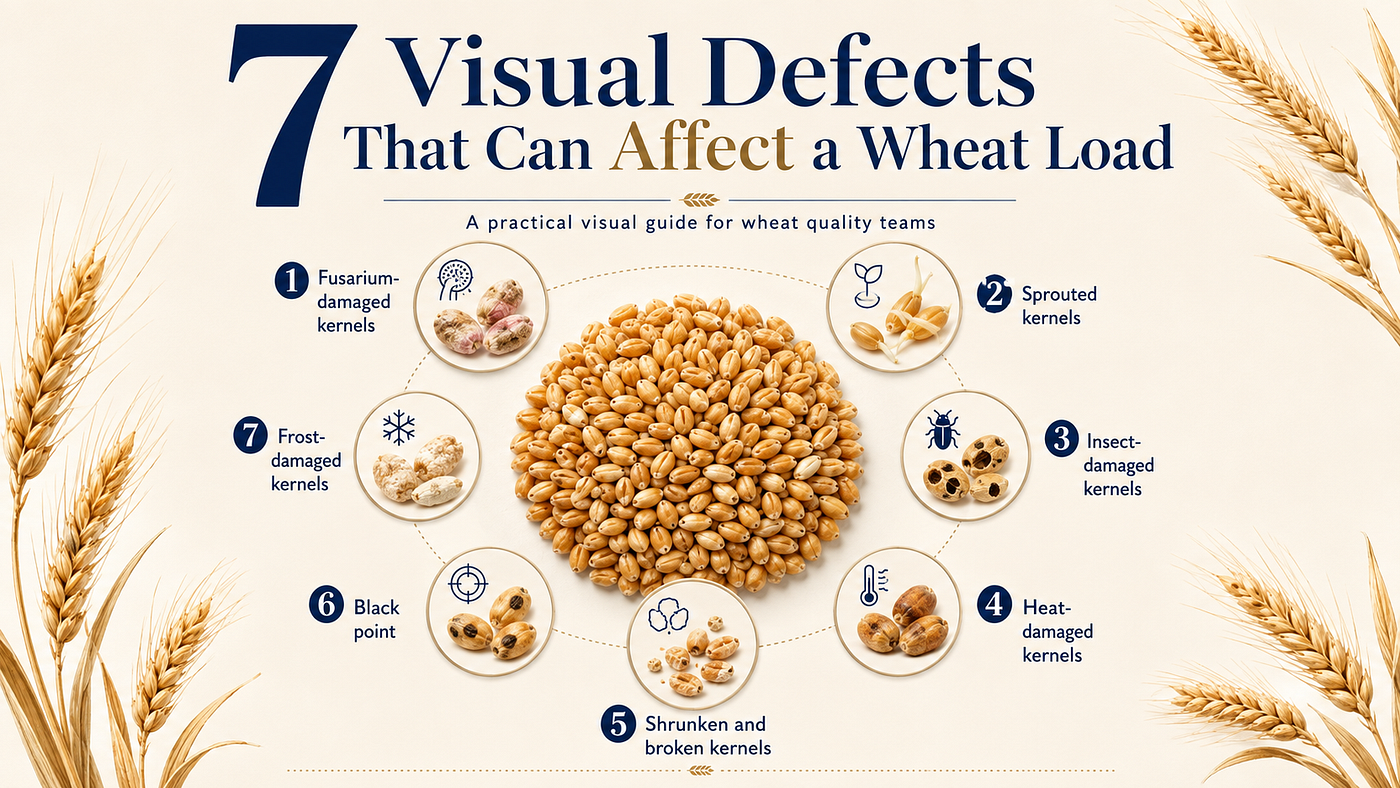
Visible wheat quality is expressed in many different ways, from discoloration and sprouting to broken, shriveled, and damaged kernels
A wheat sample can tell you a surprising amount before any instrument result comes back. Shriveling, discoloration, sprouting, insect damage, and other visible conditions can influence grade, cleaning losses, storage decisions, and how a lot is handled at intake.
Visual inspection is a real quality tool, but its limits are worth stating up front. What you can see in a kernel does not replace measurements such as moisture, protein, Falling Number, DON (a mycotoxin), or other chemical and functional tests. Appearance answers one part of the quality question; analytical and functional tests answer the rest.
This is a practical field guide to seven visible conditions that matter to the people who receive, handle, buy, and mill wheat. One note before the list: grading systems do not all agree. The US system (USDA’s Federal Grain Inspection Service, FGIS) and the Canadian Grain Commission (CGC) use different names, categories, and tolerances, so there is no single global grading standard. Where it matters, that is flagged below.
1. Fusarium-damaged kernels
What it may look like: Kernels look shriveled, thin, and chalky or white, with a dull, lifeless surface. Some carry a pink or salmon tint near the germ. They are usually lightweight. In the trade, these are sometimes called “tombstones.”
Why it matters: Fusarium damage lowers grade, can be associated with lower test weight and reduced flour yield, and flags possible mycotoxin risk. The CGC grades “Fusarium damage” as a named factor with its own tolerances; the US system has no separate Fusarium line and counts it within the broader damaged-kernels category.
What appearance does not tell you Fusarium-damaged kernels (FDK) are related to DON, but the two are not the same measurement. FDK reflects the proportion of kernels showing visible Fusarium damage, while DON is a mycotoxin concentration determined analytically. Clean-looking grain can still carry DON, and vice versa, so where concentration matters, the sample needs a DON test.

Examples of kernel characteristics associated with Fusarium damage, including shriveling and pale, chalky discoloration
2. Sprouted kernels
What it may look like. Look at the germ end. Pre-harvest sprouting shows as a split or opened germ, a small visible root or shoot, or the scar where a sprout has broken off. Severe cases show a sprout extending past the kernel or an obviously degraded germ.
Why it matters: Sprouting starts when the grain germinates in the head, often after rain before harvest. It raises enzyme activity that can weaken dough and cause a sticky crumb in bread. Both systems downgrade sprout-damaged wheat; CGC splits it into “sprouted” and “severely sprouted.”
What does appearance not tell you? Visible sprouting does not give you a Falling Number. Falling Number reflects alpha-amylase enzyme activity, a different property, and a low result can occur with little visible sprouting. If baking performance is the concern, run the test.

Kernel features associated with sprouting, such as visible growth or splitting at the germ end
3. Insect-damaged kernels
What it may look like: Watch for small bore or exit holes, tunneling through the endosperm, chew or etch marks, and hollowed kernels with material missing. This is different from the light scuffing of the bran surface.
Why it matters: Insect-damaged kernels (IDK) mean lost material, lower grade, and a storage red flag. The US standards apply specific insect-damaged-kernel count limits, and exceeding them can result in a Sample Grade. Insect fragments also feed into food-safety and sanitation limits further down the line.
What does appearance not tell you? Feeding damage records the past, not the present. A kernel image or count cannot tell you whether live insects are still active in the lot, which is a separate check.

Kernel features associated with insect damage, including bore holes and tunneling, where feeding has removed material
4. Heat-damaged kernels
What it may look like: Heat damage shows as darkening or browning. Inspectors often cut kernels to read the inside, which can appear reddish-brown, mahogany, or discolored. The CGC describes a range from orange-red through dark brown, up to blackened, glossy “binburnt” kernels in the worst cases.
Why it matters: Heat damage usually signals serious deterioration, either spoilage heating in storage or over-aggressive drying. It is treated more harshly than general damage; the US grade limits for heat-damaged kernels are far tighter than for totally damaged kernels. Heat damage can also affect milling and baking quality.
What appearance does not tell you. There is no single universal color that defines heat damage. Each system ties the call to its own standard and method, and the thresholds differ, so the applicable grading guide decides the line.

Kernel features associated with heat damage, including darkening and discoloration
5. Shrunken and broken kernels
What it may look like: Thin, poorly filled whole kernels plus broken pieces and fines. In practice, this is the small, light material that falls through a sizing sieve, mixed with fragments of larger kernels.
Why it matters: This is a soundness and size issue more than a spoilage one, but it still costs you: more screenings, less millable endosperm, lower test weight, and poorer lot uniformity. Worth knowing: “shrunken and broken” is a specific, sieve-defined factor in the US standards, folded into the overall “defects” total rather than counted as damage. The CGC scores “shrunken” and “broken” separately, so the numbers do not map one-to-one.
What appearance does not tell you is how much usable, millable grain remains depends on cleaning results, not on eyeballing the sample.

Thin, poorly filled kernels and broken fragments of the kind grouped under shrunken and broken material
6. Black point
What it may look like: A dark brown or black discoloration centered on the germ (embryo) end of the kernel. It can spread across more of the kernel in worst cases. When more than half the kernel is discolored, the CGC grades it under a separate, more severe factor called “smudge.”
Why it matters: Black point is mostly cosmetic for the endosperm, but it still downgrades lots, especially durum, where dark specks show up in semolina and pasta. “Black point” is the widely understood international term; “smudge” is mainly CGC grading language. The US system grades neither by name, picking up only severe cases through the damaged-kernels category.
What appearance does not tell you: dark kernels do not all share one cause. Black spot can come from field fungi such as Alternaria and Bipolaris, or from humidity and rain during kernel fill. The visible symptom does not identify the cause, so classification should follow the applicable standard rather than an assumption.

Dark discoloration at the germ end of the kernel, a characteristic associated with black point
7. Frost-damaged kernels
Frost damage is a recognized grading factor in both the US and Canadian systems, with distinctive visual signs.
What it may look like: FGIS describes three recognizable forms: blistered kernels, with frost blisters running around the back and into the crease; “candied” kernels, with a waxy or glassy look that can be greenish, brownish, or blackish; and flaked kernels, where the bran coat has slightly peeled. The CGC similarly grades frost as blistered-bran kernels.
Why it matters: Frost caught during grain fill leaves shrunken, light kernels with low test weight and erratic flour extraction, and it can weaken and discolor dough. It downgrades a lot through the damaged-kernels or soundness rules, depending on the system.
What appearance does not tell you: Milling and baking performance still needs functional testing; the visual signs support a frost-damage classification under the applicable standard, but they do not predict the exact processing loss.

Kernel features associated with frost damage, such as a blistered, candied or flaked appearance
7 defects at a glance
Visible condition What it can tell you What may need another test Fusarium damage Shriveled, chalky, sometimes pink kernels; possible mycotoxin risk DON analysis where concentration matters Sprouting Visible germination at the germ end Falling Number for enzyme-related baking quality Insect damage Feeding holes, tunneling, lost material Live-infestation and storage/pest assessment Heat damage Discoloration from spoilage or over-drying Moisture history; functional/milling tests Shrunken & broken Thin, poorly filled kernels and fragments Cleaning results for usable millable grain Black point Dark discoloration at the germ end Standard-based classification; cause is not visible Frost damage Blistered, candied or flaked kernels Test weight and functional/baking tests
The challenge with visual grading
Visual grading works, and experienced graders remain essential. The difficulty is not skill. It is that borderline kernels are genuinely hard to call: is that discoloration a black spot or the start of a smudge? Is that kernel shrunken enough to count, or sound?
Classification always depends on a defined standard, and reasonable people applying it to the same marginal kernel can land on different calls. Add the volume most intake and QA teams handle, sample after sample, and repeatability becomes the real challenge. The goal is simple: make classification as repeatable as possible across samples and operators.
Where objective imaging fits
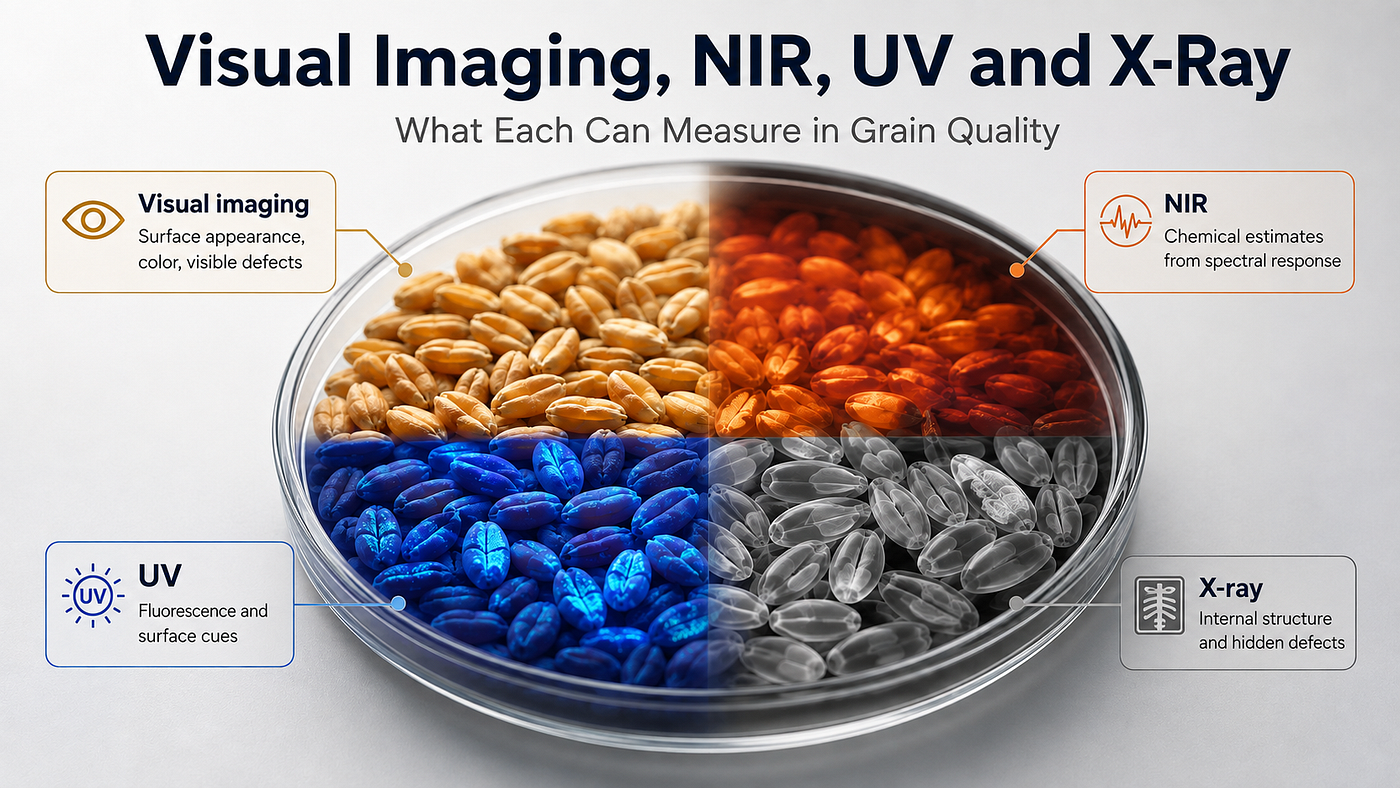
Because these conditions are expressed in how a kernel looks, validated computer-vision and image-based methods can help assess them. Used where validated for the intended application, image-based tools support a quality workflow in a few concrete ways.
Consistency. A defined classification can be applied more consistently across samples, helping reduce operator-to-operator variation on borderline calls.
Throughput. Large numbers of kernels and samples can be assessed efficiently, exactly where volume makes manual consistency hard.
Reviewability. Images and structured results can be stored and reviewed later, so a classification can be re-examined or audited rather than living only in the moment of inspection.
Quantification. It moves the conversation from “there seem to be quite a few damaged kernels” toward “a defined proportion of the sample was classified into specific visible categories,” which is easier to act on, compare between lots, and share with a counterparty.
None of this replaces analytical testing or official grading. Imaging assesses appearance; some conditions are classified more reliably than others, and results should be validated for the intended application. The value is not in replacing measurement, but in making the visual part of assessment more consistent, scalable, and easy to review.
The bottom line
Visual inspection is powerful for the properties that live in a kernel’s appearance and weak for those that do not. It will not give you protein, moisture, DON concentration, Falling Number, gluten strength, full milling performance, or a food-safety verdict; those require an appropriate analytical or functional test. What a good visual assessment can provide is an early, actionable read: what to flag, what may need segregation or further inspection, and which analytical or functional tests should be prioritized before the lot moves.
Yaniv Noema is Software Development Manager at Vibe Imaging Analytics and works on computer-vision systems for agricultural and food applications. For more on wheat and other crops from a visual-analysis perspective, see Vibe’s crop research resources.
Sources
- Canadian Grain Commission — Wheat grading factors (Official Grain Grading Guide)
- Canadian Grain Commission — Identifying wheat and barley affected by Fusarium head blight
- USDA AMS / FGIS — Grain Inspection Handbook, Book II (Wheat)
- US Wheat Standards, 7 CFR Part 810 Subpart M (definitions and grades), eCFR
- US Wheat grade table, 7 CFR 810.2204 (Cornell Legal Information Institute)
- Oklahoma State University Extension — Wheat Kernel Damage
- University of Minnesota Extension — Understanding grain quality (Falling Number/sprouting)
- North Dakota State University Extension — Fusarium head blight (scab) of small grains
- Kansas State University — Black point and sooty molds of wheat
- Canadian Grain Commission — Official Grain Grading Guide (full PDF, 2025–26)
메타데이터
- post_id
- 2d3cced45b42
- slug
- 7-visual-defects-that-can-affect-a-wheat-load-2d3cced45b42
- url
- https://medium.com/@yaniv.noema/7-visual-defects-that-can-affect-a-wheat-load-2d3cced45b42
- canonical_url
- https://medium.com/@yaniv.noema/7-visual-defects-that-can-affect-a-wheat-load-2d3cced45b42
- author_url
- https://medium.com/@yaniv.noema
- status
- ok
- fetched_at
- 2026-08-16 22:26:52