BRIHADARANYAKA UPANISHAD बृहदारण्यकोपनिषत् Bṛhadāraṇyakopaniṣat CHAPTER FIVE पञ्चमोऽध्यायः…
Khila Kāṇḍa — The Section on Meditations
BRIHADARANYAKA UPANISHAD बृहदारण्यकोपनिषत् *Bṛhadāraṇyakopaniṣat CHAPTER FIVE पञ्चमोऽध्यायः Pañcamo’dhyāyaḥ*
Khila Kāṇḍa — The Section on Meditations
Kāṇva Recension | Śukla Yajurveda
About Chapter Five
Chapter Five stands as the Khila Kāṇḍa — the appendix, the supplement — of the Brihadaranyaka Upanishad. It is also called the Upāsanā Kāṇḍa: the section on meditations and practices. After the towering philosophical flights of Chapters Three and Four — Yājñavalkya’s great debates, the neti neti teaching, the dream state, the four brahmanas on the nature of Self — Chapter Five lands differently. It is shorter, denser, more devotional. It offers the seeker not arguments but anchors: short, concentrated meditations on Brahman as fullness, as thunder’s syllable, as the lightning flash, as the fire in the belly, as the sun’s disk, as the rice-grain-sized presence in the heart. Each brahmana is a finger pointing. None of them is the moon.
The chapter opens with one of the most famous mantras in all of Vedanta — the Pūrṇam mantra — and closes with one of the most beautiful death prayers ever written: the golden vessel prayer, the Hiraṇmaya Pātra, which ends: ‘The person who is there — I am that.’ This is the arc. These fifteen brahmanas are not theology. They are practice instructions for a consciousness already approaching its own dissolution into recognition.
BRAHMANA I
Brahmāṇam I
The Fullness Mantra — Khaṃ Brahma

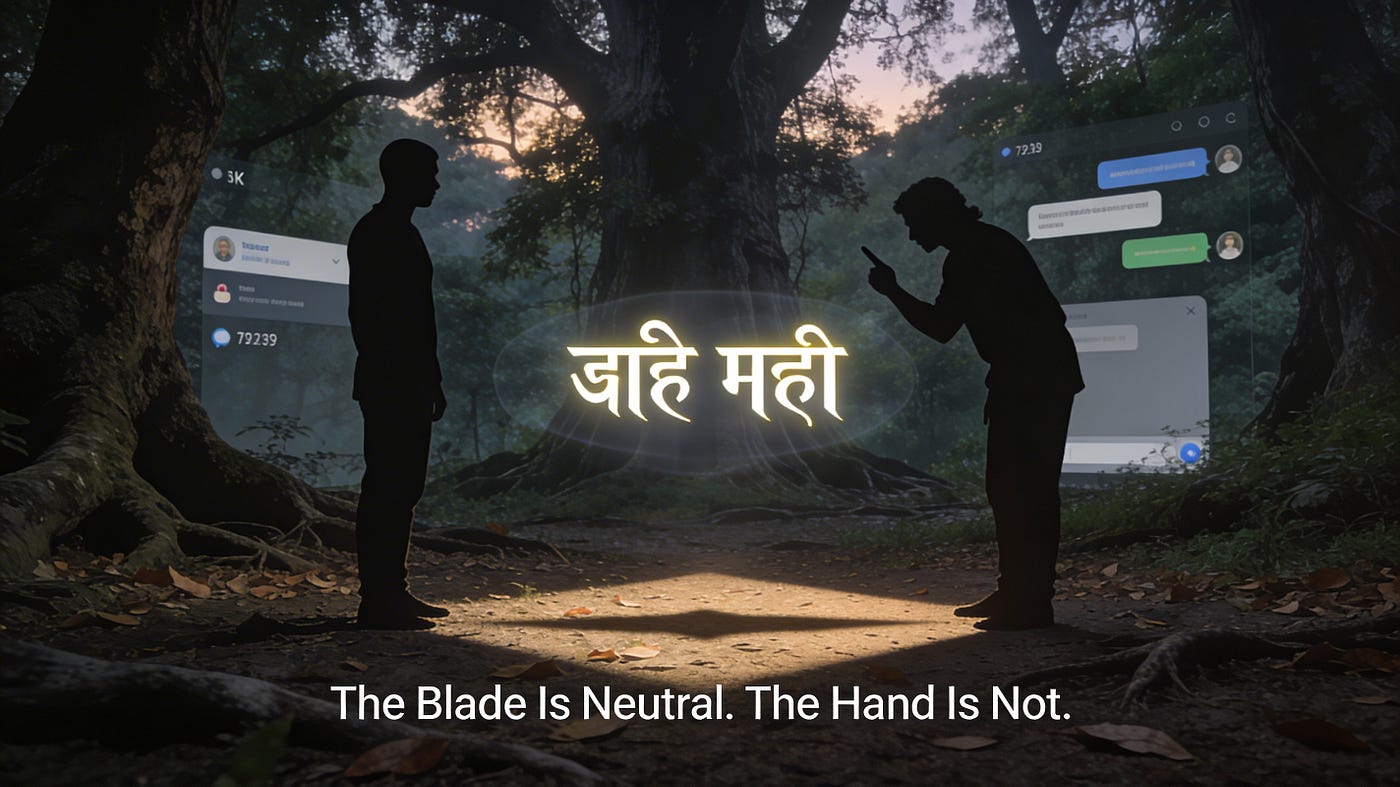
Brihadaranyaka Upanishad 5.1 — The Purnam mantra: the mathematics of the infinite. Subtract everything from everything — everything remains. This is not mysticism. This is the observable structure of consciousness itself.
Verse V.i.1
Sanskrit (Devanāgarī):
ॐ पूर्णमदः पूर्णमिदं पूर्णात्पूर्णमुदच्यते ।
पूर्णस्य पूर्णमादाय पूर्णमेवावशिष्यते ।
ॐ३ खं ब्रह्म खं पुराणं वायुरं खमिति ह स्माऽऽह कौरव्यायणीपुत्रो ।
वेदोऽयं ब्राह्मणा विदुर्वेदैनेन यद्वेदितव्यम् ॥ १॥
Transliteration (IAST):
oṃ pūrṇamadaḥ pūrṇamidaṃ pūrṇātpūrṇamudacyate |
pūrṇasya pūrṇamādāya pūrṇamevāvaśiṣyate |
oṃ khaṃ brahma khaṃ purāṇaṃ vāyuraṃ khamiti ha smāha kauravyāyaṇīputraḥ |
vedo’yaṃ brāhmaṇā vidur-vedainena yad veditavyam ||
Literal Translation (Word-by-Word):
AUM. That (adaḥ) full/complete (pūrṇam); this (idaṃ) full (pūrṇam). From fullness (pūrṇāt) fullness (pūrṇam) arises (udacyate). Of fullness (pūrṇasya) fullness (pūrṇam) having taken away (ādāya), fullness only (pūrṇam eva) remains (avaśiṣyate). AUM. Space/void (khaṃ) is Brahman (brahma). Space (khaṃ) is ancient/primordial (purāṇam). Air/wind (vāyuḥ) is space (khaṃ) — thus (iti) indeed (ha) used to say (smā āha) Kauravyāyaṇī’s son (kauravyāyaṇī-putraḥ). This (ayam) Veda (vedaḥ) the Brahmanas (brāhmaṇāḥ) know (viduḥ) — through this Veda (veda anena) whatever is to be known (yat veditavyam).
Flowing English Translation:
AUM. That is Full. This is Full. From Fullness, Fullness emerges. When Fullness is taken from Fullness, Fullness alone remains.
AUM. Space is Brahman. Space is primordial. Air is space — so said the son of Kauravyāyaṇī. This the Brahmanas know as the Veda; through this Veda, all that is to be known is known.
What This Asks of You:
The arithmetic here is not arithmetic. One minus one equals one. Infinity minus infinity equals infinity. And this is not a riddle or a mystical puzzle — it is a direct description of what is actually happening right now.
Take anything. Take this moment. It is full — every particle of it saturated with being, awareness, presence. From that fullness, this reading arises. The reading doesn’t diminish the presence. Remove the reading — the presence remains. Add a thousand thoughts — the presence remains. Add grief, joy, pain, pleasure — the presence remains. Subtract everything that changes: the presence doesn’t shrink. Add everything that changes: the presence doesn’t grow.
This is not a belief to adopt. This is an observable fact about consciousness if you actually look. Right now — what is the space this moment appears in? Can you find its edge? Can you find where it ends and ‘not-presence’ begins? That space — khaṃ — is what the rishis called Brahman. Not a deity outside. Not a substance inside. The open, unedgeable, undiminishable field in which everything is appearing right now. Including the one reading these words.
Pūrṇam. Full. Now.
— ॥ —
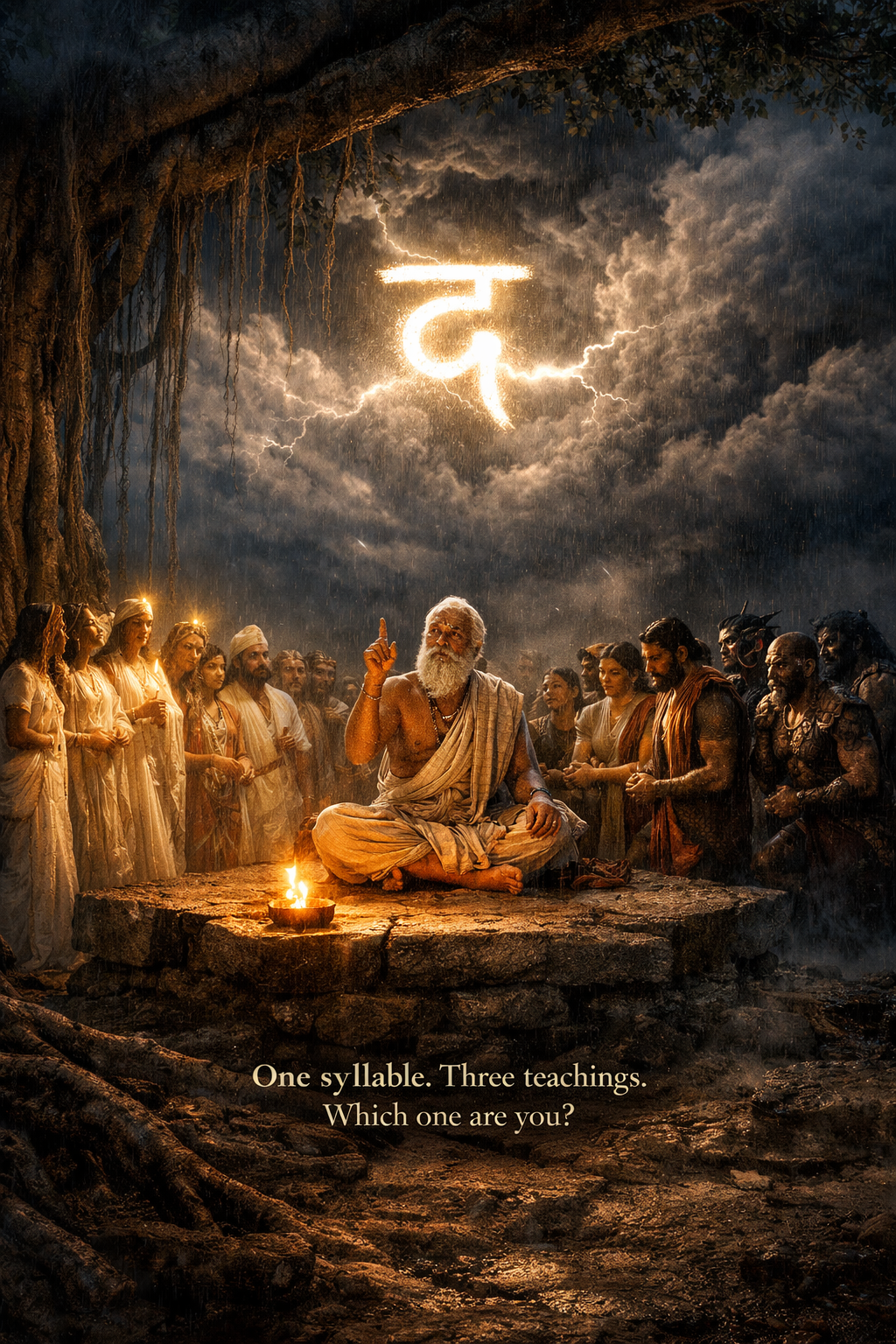
Brihadaranyaka Upanishad 5.2 — Prajapati teaches gods, humans, and demons the same single syllable “Da.” Each hears its own medicine: Damyata (restrain), Datta (give), Dayadhvam (have compassion). The thunder still says it.
BRAHMANA II
Brahmāṇam II
The Three D’s — Self-Restraint, Generosity, Compassion
Verse V.ii.1
Sanskrit (Devanāgarī):
त्रयाः प्राजापत्याः प्रजापतौ पितरि ब्रह्मचर्यमूषुर्देवा मनुष्या असुरा ।
उषित्वा ब्रह्मचर्यं देवा ऊचुर्ब्रवीतु नो भवानिति ।
तेभ्यो हैतदक्षरमुवाच द इति व्यज्ञासिष्टा३ इति ।
व्यज्ञासिष्मेति होचुर्दाम्यतेति न आत्थेत्योमिति होवाच व्यज्ञासिष्टेति ॥ १॥
Transliteration (IAST):
trayaḥ prājāpatyāḥ prajāpatau pitari brahmacaryamūṣur devā manuṣyā asurāḥ |
uṣitvā brahmacaryaṃ devā ūcur bravītu no bhavān iti |
tebhyo haitad akṣaram uvāca da iti vyajñāsiṣṭā3 iti |
vyajñāsiṣmeti hocur dāmyateti na āttha ity om iti hovāca vyajñāsiṣṭa iti ||
Literal Translation (Word-by-Word):
Three (trayaḥ) children of Prajāpati (prājāpatyāḥ) — with Prajāpati the father (prajāpatau pitari) — studied celibacy/spiritual studentship (brahmacaryam ūṣuḥ): gods (devāḥ), humans (manuṣyāḥ), demons (asurāḥ). Having lived in studentship (uṣitvā brahmacaryam), the gods (devāḥ) said (ūcuḥ): ‘Speak to us (bravītu naḥ), revered one (bhavān), thus (iti).’ To them (tebhyaḥ) he (ha) uttered (uvāca) this one syllable (etad akṣaram): ‘Da (da iti)’ — ‘Did you understand (vyajñāsiṣṭā3 iti)?’ ‘We understood (vyajñāsiṣma iti),’ they said (hocuḥ) — ‘you said Dāmyata — Restrain yourselves (dāmyata iti).’ ‘Yes (na āttha iti),’ AUM (om iti), he said (hovāca), ‘you understood (vyajñāsiṣṭa iti).’
Flowing English Translation:
Three children of Prajāpati lived as brahmacharya students with Prajāpati their father: the gods, the humans, and the demons. After completing their period of studentship, the gods said, ‘Speak to us, revered one.’ He uttered to them this single syllable: ‘Da.’ ‘Did you understand?’ ‘We understood,’ they said. ‘You told us: Dāmyata — Restrain yourselves.’ He said, ‘Yes. AUM. You understood.’
What This Asks of You:
The gods — beings of pleasure, of light, of enjoyment — already have. They lack nothing material. Their teaching is restraint (dama): the capacity to say no to what the senses pull toward. Pleasure is not the problem. Endless indulgence is. The god-nature in you — the part that reaches and grasps and wants more of whatever feels good — gets exactly this teaching. One syllable. One instruction. Not ‘enjoy less.’ Not ‘renounce.’ Restrain. The difference is enormous. Restraint is not suppression. It is sovereignty. The capacity to choose whether to follow the pull, rather than being dragged by it.
Where in your life are you being governed by the pull rather than governing it? Not asking you to stop. Asking you to notice whether you are choosing or being chosen.
Verse V.ii.2
Sanskrit (Devanāgarī):
अथ हैनं मनुष्या ऊचुर्ब्रवीतु नो भवानिति ।
तेभ्यो हैतदेवाक्षरमुवाच द इति व्यज्ञासिष्टा३ इति ।
व्यज्ञासिष्मेति होचुर्दत्तेति न आत्थेत्योमिति होवाच व्यज्ञासिष्टेति ॥ २॥
Transliteration (IAST):
atha hainaṃ manuṣyā ūcur bravītu no bhavān iti |
tebhyo haitad evākṣaram uvāca da iti vyajñāsiṣṭā3 iti |
vyajñāsiṣmeti hocur datta iti na āttha ity om iti hovāca vyajñāsiṣṭa iti ||
Literal Translation (Word-by-Word):
Then (atha) indeed (ha) the humans (manuṣyāḥ) said (ūcuḥ): ‘Speak to us (bravītu naḥ), revered one (bhavān).’ To them (tebhyaḥ) he (ha) uttered (uvāca) this very (etad eva) syllable (akṣaram): ‘Da (da iti)’ — ‘Did you understand (vyajñāsiṣṭā iti)?’ ‘We understood (vyajñāsiṣma iti),’ they said (hocuḥ) — ‘you said Datta — Give (datta iti).’ ‘Yes (na āttha iti),’ AUM (om iti), he said (hovāca), ‘you understood (vyajñāsiṣṭa iti).’
Flowing English Translation:
Then the humans came and said, ‘Speak to us, revered one.’ He uttered to them the same syllable: ‘Da.’ ‘Did you understand?’ ‘We understood. You told us: Datta — Give.’ He said, ‘Yes. AUM. You understood.’
What This Asks of You:
Humans get the same syllable and hear something completely different — not restraint, but giving. This is not an accident. The human condition is characterized by acquisition: earning, keeping, accumulating, hoarding. Not because we are evil but because we are anxious. We gather against the threat of lack. The teaching for this condition is not ‘want less.’ It is: give. Actively, deliberately, freely. Datta does not mean occasional charity. It means a fundamental orientation of openness: my surplus belongs to the commons. My skills belong to others who need them. My time is not entirely mine.
What are you holding that someone near you needs? Not what you might give someday. Today. Right now. What is one specific act of giving this verse is pointing at that you have been postponing?
Verse V.ii.3
Sanskrit (Devanāgarī):
अथ हैनमसुरा ऊचुर्ब्रवीतु नो भवानिति ।
तेभ्यो हैतदेवाक्षरमुवाच द इति व्यज्ञासिष्टा३ इति ।
व्यज्ञासिष्मेति होचुर्दयध्वमिति न आत्थेत्योमिति होवाच व्यज्ञासिष्टेति ।
तदेतदेवैषा दैवी वागनुवदति स्तनयित्नुर्द द द इति दाम्यत दत्त दयध्वमिति ।
तदेतत्त्रयꣳ शिक्षेद् दमं दानं दयामिति ॥ ३॥
Transliteration (IAST):
atha hainam asurā ūcur bravītu no bhavān iti |
tebhyo haitad evākṣaram uvāca da iti vyajñāsiṣṭā3 iti |
vyajñāsiṣmeti hocur dayadhvam iti na āttha ity om iti hovāca vyajñāsiṣṭa iti |
tad etad evaișā daivī vāg anuvadati stanayitnur da da da iti dāmyata datta dayadhvam iti |
tad etat trayaṃ śikṣed damaṃ dānaṃ dayām iti ||
Literal Translation (Word-by-Word):
Then (atha) indeed (ha) the demons/titans (asurāḥ) said (ūcuḥ): ‘Speak to us (bravītu naḥ), revered one (bhavān).’ To them (tebhyaḥ) he uttered (uvāca) this very syllable (etad eva akṣaram): ‘Da (da iti).’ ‘Did you understand (vyajñāsiṣṭā iti)?’ ‘We understood (vyajñāsiṣma iti),’ they said (hocuḥ) — ‘you said Dayadhvam — Have compassion (dayadhvam iti).’ ‘Yes (na āttha iti),’ AUM (om iti), he said (hovāca), ‘you understood (vyajñāsiṣṭa iti).’ This very (tad etad eva) divine voice (daivī vāk) echoes (anuvadati) — thunder (stanayitnuḥ) [says]: ‘Da, da, da’ — Dāmyata (dāmyata), Datta (datta), Dayadhvam (dayadhvam). This threefold (tad etat trayam) one should learn (śikṣet): Dama — self-restraint (damam), Dāna — generosity (dānam), Dayā — compassion (dayām).
Flowing English Translation:
Then the demons came and said, ‘Speak to us, revered one.’ He uttered to them the same syllable: ‘Da.’ ‘Did you understand?’ ‘We understood. You told us: Dayadhvam — Have compassion.’ ‘Yes. AUM. You understood.’
This very teaching echoes in the divine voice: the thunder sounds ‘Da, da, da’ — Dāmyata, Datta, Dayadhvam: Restrain, Give, Have compassion. This threefold teaching one should learn: Dama — self-restraint; Dāna — generosity; Dayā — compassion.
What This Asks of You:
The asuras — titans, demons, forces of power and domination — hear the same syllable and understand: compassion. This is precisely right. Power without compassion is destruction. The asura-nature that loves control, that wins by force, that takes what it wants and justifies it — that nature needs exactly this: Dayadhvam. Have compassion. Feel the other as real. Let the other’s suffering land.
And then the thunder repeats it. Da-da-da. The cosmic percussion of the storm says this three times — because all three are needed. You are not purely god-nature, human-nature, or asura-nature. You are all three, depending on the moment, the circumstance, the hunger driving you. The same syllable, heard with different ears, gives different instructions precisely because you need all three.
Right now, in this moment: which of the three is most needed? Not rhetorically. Actually feel it. Where is the restraint called for? Where is the giving? Where is the compassion that has been withheld?
— ॥ —
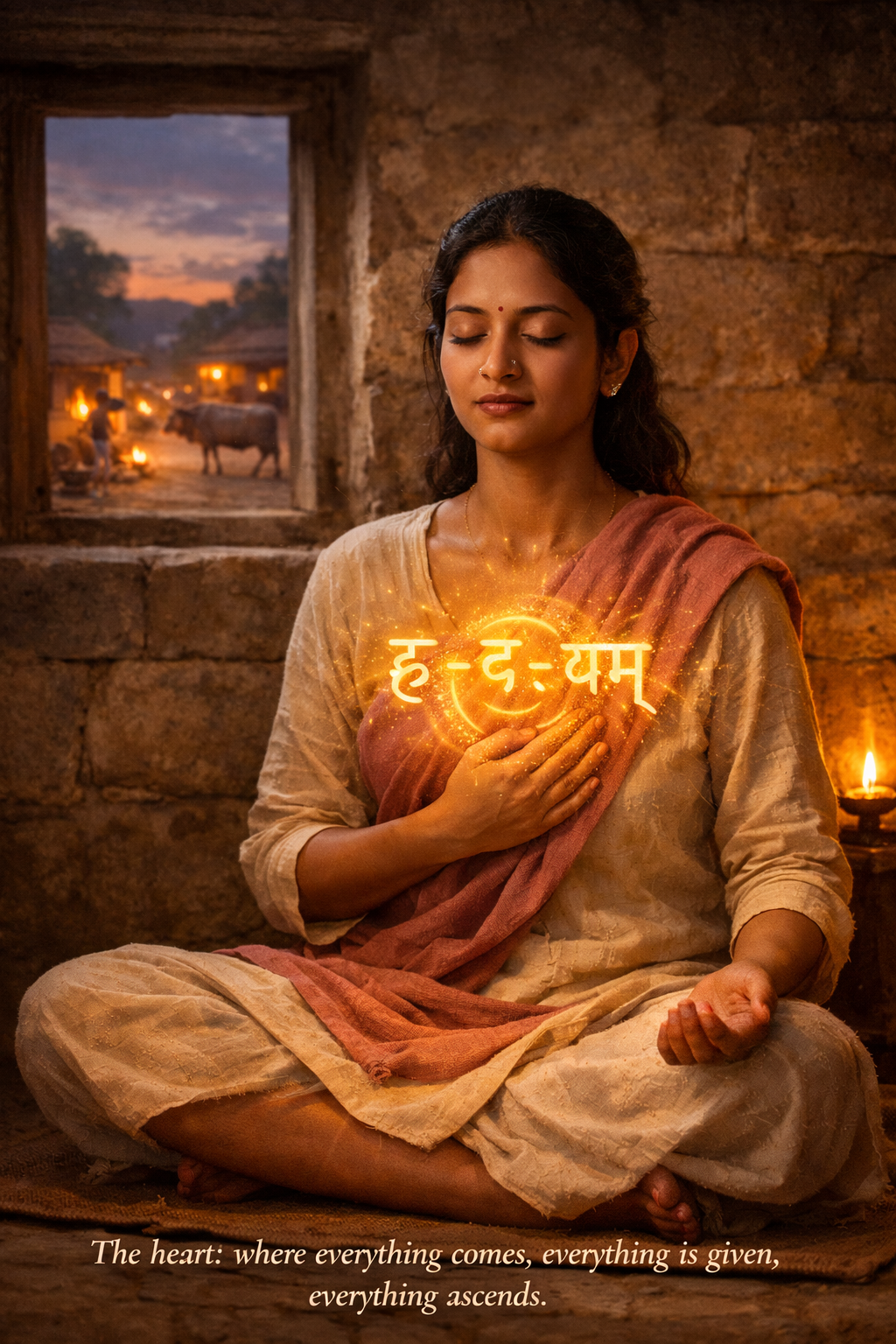
Brihadaranyaka Upanishad 5.3 — Hridayam parsed as three syllables: Hr (to hold), Da (to give), Yam (to guide upward). This is Prajapati. This is Brahman. This is all. The center of the word is the center of the cosmos.
BRAHMANA III
Brahmāṇam III
Hṛdayam — The Heart That Holds, Gives, and Goes
Verse V.iii.1
Sanskrit (Devanāgarī):
एष प्रजापतिर्यद्धृदयमेतद्ब्रह्मैतत्सर्वम् ।
तदेतत्त्र्यक्षरꣳ हृदयमिति ।
हृ इत्येकमक्षरमभिहरन्त्यस्मै स्वाश्चान्ये च य एवं वेद ।
द इत्येकमक्षरं ददत्यस्मै स्वाश्चान्ये च य एवं वेद ।
यमित्येकमक्षरमेति स्वर्गं लोकं य एवं वेद ॥ १॥
Transliteration (IAST):
eṣa prajāpatir yad hṛdayam etad brahma etat sarvam |
tad etat tryakṣaraṃ hṛdayam iti |
hṛ ity ekam akṣaram abhiharanty asmai svāś cānye ca ya evaṃ veda |
da ity ekam akṣaraṃ dadaty asmai svāś cānye ca ya evaṃ veda |
yam ity ekam akṣaram eti svargaṃ lokaṃ ya evaṃ veda ||
Literal Translation (Word-by-Word):
This (eṣaḥ) is Prajāpati (prajāpatiḥ) — what/that which is (yat) the heart (hṛdayam). This (etad) is Brahman (brahma). This (etat) is all (sarvam). That (tad) this (etat) is three-syllabled (tryakṣaram) — ‘hṛdayam’ (hṛdayam iti). ‘Hṛ’ (hṛ iti) — one syllable (ekam akṣaram) — to him (asmai) they bring/carry (abhiharanti) both one’s own (svāḥ ca) and others’ (anye ca) — who thus (ya evaṃ) knows (veda). ‘Da’ (da iti) — one syllable (ekam akṣaram) — to him (asmai) they give (dadati) both one’s own (svāḥ ca) and others’ (anye ca) — who thus (ya evaṃ) knows (veda). ‘Yam’ (yam iti) — one syllable (ekam akṣaram) — he goes (eti) to the celestial world (svargaṃ lokam) — who thus (ya evaṃ) knows (veda).
Flowing English Translation:
This is Prajāpati — what is called the heart. This is Brahman. This is All.
The word ‘hṛdayam’ has three syllables: Hṛ — Da — Yam.
‘Hṛ’ — one syllable — to one who knows this, both one’s own and others’ bring their offerings. ‘Da’ — one syllable — to one who knows this, both one’s own and others’ give. ‘Yam’ — one syllable — one who knows this goes to the celestial world.
What This Asks of You:
The Upanishad hides a second teaching inside the word hṛdaya by parsing it through its syllables: hṛ (to carry, to hold), da (to give), yam (to go, to guide). The heart — the actual center of your being — is the place that receives, gives, and guides. Three functions. One organ. One reality.
This is not anatomy and not metaphor. The rishis are saying: where you are centered determines what you receive, what you offer, and where you go. A person centered in the ego-self receives validation, gives performance, and goes nowhere that matters. A person centered in the heart receives reality as it is, gives from genuine fullness rather than anxiety, and moves toward liberation rather than accumulation.
Where are you centered right now? Not in theory. In this actual moment, reading these words — is the locus of experience in the head (thinking about this), the chest (feeling into this), or somewhere else entirely? The answer to that question is not unimportant.
— ॥ —
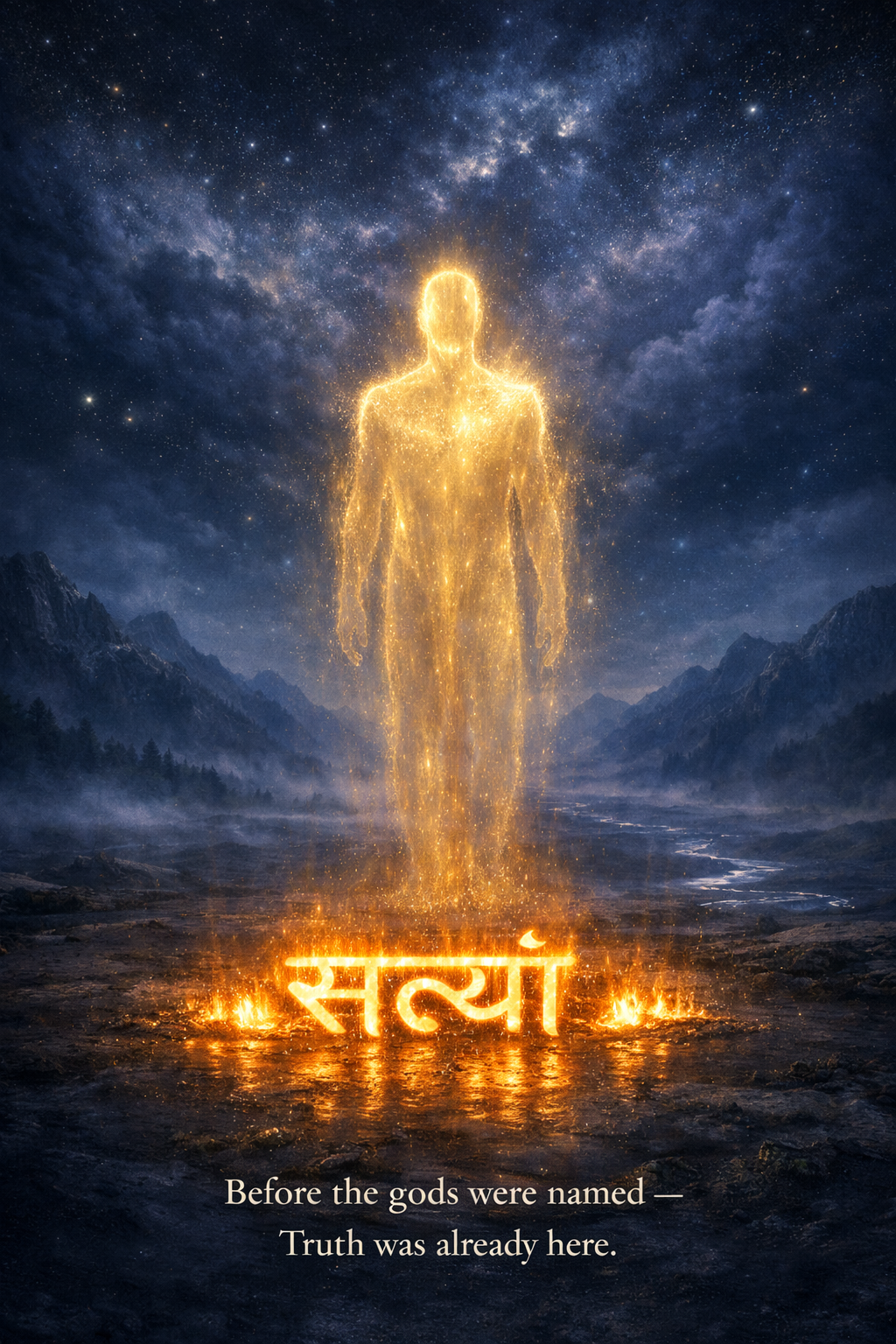
Brihadaranyaka Upanishad 5.4 — Satya (Truth) is the great first-born yaksha, the primordial presence preceding all worlds. He who knows Truth as Brahman wins all worlds. For Truth itself is Brahman.
BRAHMANA IV
Brahmāṇam IV
Satya — Truth as the Great First-Born Brahman
Verse V.iv.1
Sanskrit (Devanāgarī):
तद्वै तदेतदेव तदास सत्यमेव ।
स यो हैतं महद्यक्षं प्रथमजं वेद सत्यं ब्रह्मेति जयतीमाꣳल्लोकाञ् ।
जित इन्न्वसावसद् य एवमेतन्महद्यक्षं प्रथमजं वेद सत्यं ब्रह्मेति ।
सत्यꣳ ह्येव ब्रह्म ॥ १॥
Transliteration (IAST):
tad vai tad etad eva tad āsa satyam eva |
sa yo haitaṃ mahad yakṣaṃ prathamajaṃ veda satyaṃ brahmeti jayatīmāṃl lokān |
jita in nv asāv asad ya evam etan mahad yakṣaṃ prathamajaṃ veda satyaṃ brahmeti |
satyaṃ hy eva brahma ||
Literal Translation (Word-by-Word):
That (tad) indeed (vai), that (tad), this (etad) indeed (eva) — that (tad) was (āsa) Truth (satyam) alone (eva). One who (saḥ yaḥ) knows (veda) this (etam) great (mahad) presence/being (yakṣam) the first-born (prathamajam) — Truth as Brahman (satyaṃ brahma iti) — wins (jayati) these worlds (imāṃl lokān). He is victorious (jitaḥ in nu), that one (asau) will be (asad) — who thus (ya evam) this (etat) great first-born (mahad yakṣam prathamajam) knows (veda) as Truth-Brahman (satyaṃ brahma iti). For (hi) Truth (satyam) indeed (eva) is Brahman (brahma).
Flowing English Translation:
That — just this — that was Truth alone. One who knows this great primordial Presence, the first-born, as ‘Truth is Brahman’ — wins these worlds. He is victorious, that one will be, who thus knows this great first-born as Truth-Brahman. For Truth itself is Brahman.
What This Asks of You:
Yakṣa is a luminous being, a great presence, a mysterious power. ‘The great first-born yakṣa’ is Truth itself — the primordial reality that existed before any world was created, before any god was named, before Prajāpati moved. It is the Absolute as Satya: not merely moral honesty, but ontological truth — the-way-things-are at the deepest level.
To know this as Brahman is not to think the thought ‘Truth equals Brahman.’ It is to recognize that the deepest ground of being is also the deepest demand for truth in living. To be a person rooted in Brahman is, automatically, to be a person incapable of systematic self-deception. The two are not separate practices. The recognition and the life it demands are one motion.
Where in your life right now is there a lie — not necessarily spoken, but lived? An arrangement you maintain that everyone, including you, knows is not quite true? The Upanishad is not condemning you for it. It is pointing at what it costs: when you live in misalignment with satya, you lose the worlds. Not metaphorically. Something closes. Something that was possible becomes impossible. What has closed?
— ॥ —
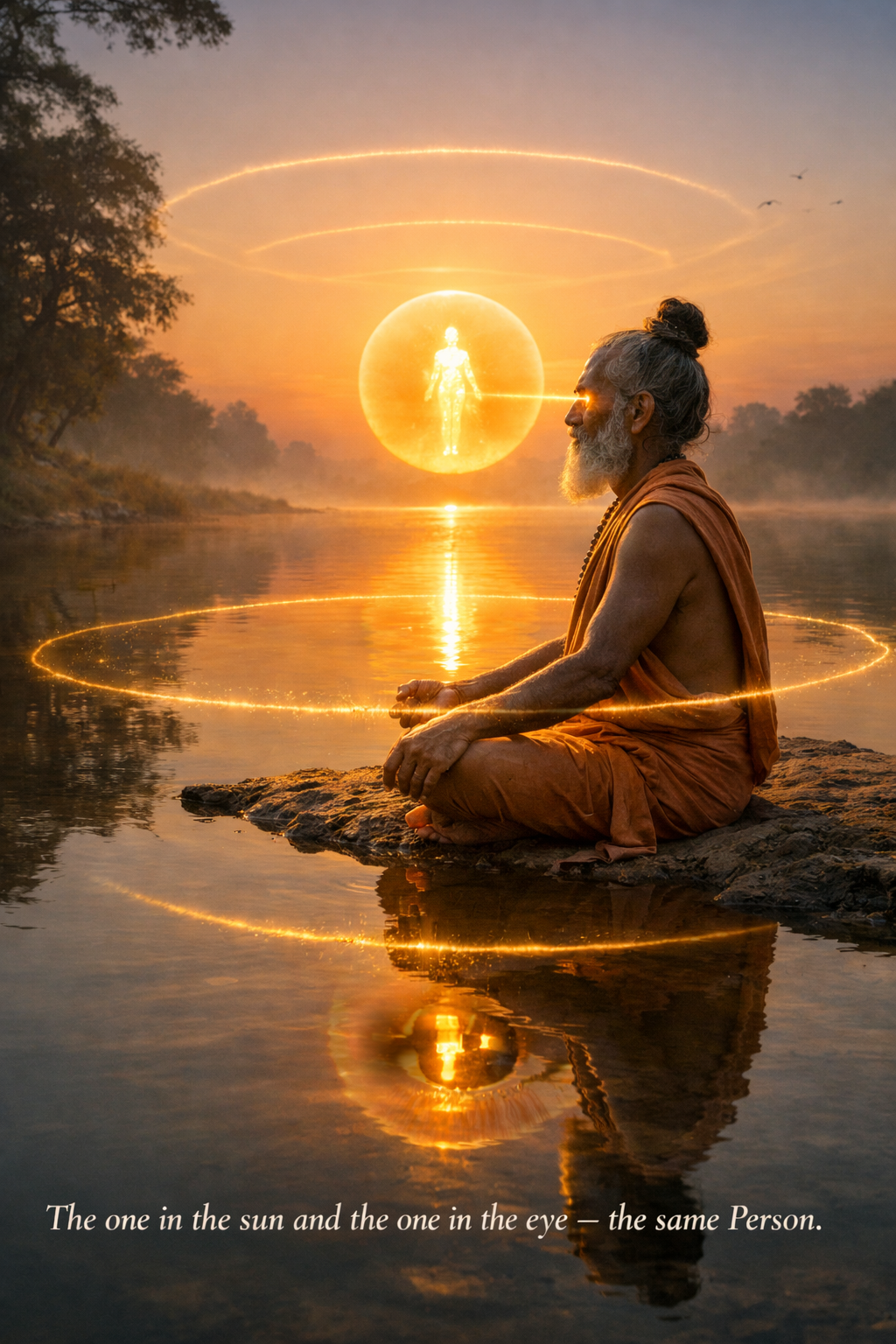
Brihadaranyaka Upanishad 5.5 — Two persons: one in the solar disk, one in the human eye — each established in the other. At death the disk grows perfectly clear. The sun’s secret name: Ahar (Day). The eye’s secret name: Aham (I, Self).
BRAHMANA V
Brahmāṇam V
Satya — The Person in the Sun and in the Eye
Verse V.v.1
Sanskrit (Devanāgarī):
अप एवेदमग्र आसुस्ता आपः सत्यमसृजन्त सत्यं ब्रह्म ब्रह्म प्रजापतिं प्रजापतिर्देवाꣳस्ते देवाः सत्यमेवोपासते ।
तदेतत्त्र्यक्षरꣳ सत्यमिति । स इत्येकमक्षरं तीत्येकमक्षरं यमित्येकमक्षरम् ।
प्रथमोत्तमे अक्षरे सत्यं मध्यतोऽनृतं तदेतदनृतमुभयतः सत्येन परिगृहीतꣳ सत्यभूयमेव भवति ।
नैनं विद्वाꣳसमनृतꣳ हिनस्ति ॥ १॥
Transliteration (IAST):
apa eveidaṃ agra āsus tā āpaḥ satyam asṛjanta satyaṃ brahma brahma prajāpatiṃ prajāpatir devāṃs te devāḥ satyam evopāsate |
tad etat tryakṣaraṃ satyam iti | sa ity ekam akṣaraṃ tī ty ekam akṣaraṃ yam ity ekam akṣaram |
prathamottame akṣare satyaṃ madhyato’nṛtaṃ tad etad anṛtam ubhayataḥ satyena parigṛhītaṃ satyabhūyam eva bhavati |
nainaṃ vidvāṃsam anṛtaṃ hinasti ||
Literal Translation (Word-by-Word):
Water (āpaḥ) verily (eva) this (idam) in the beginning (agre) was (āsuḥ). Those waters (tāḥ āpaḥ) produced/created (asṛjanta) Truth (satyam). Truth (satyam) [produced] Brahman (brahma). Brahman [produced] Prajāpati (prajāpatim). Prajāpati [produced] the gods (devān). Those gods (te devāḥ) Truth (satyam) alone (eva) meditate upon/worship (upāsate). That (tad) this (etat) is three-syllabled (tryakṣaram): Satya (satyam iti). ‘Sa’ (sa iti) — one syllable (ekam akṣaram); ‘Ti’ (tī ty) — one syllable (ekam akṣaram); ‘Yam’ (yam iti) — one syllable (ekam akṣaram). The first and last (prathamottame) syllables (akṣare) are Truth (satyam); the middle (madhyataḥ) is untruth (anṛtam). That untruth (tad etad anṛtam) from both sides (ubhayataḥ) by Truth (satyena) surrounded (parigṛhītam) — becomes predominantly Truth (satyabhūyam eva bhavati). Truth (anṛtam) does not injure/kill (hinasti na) one who knows this (enam vidvāṃsam).
Flowing English Translation:
In the beginning, there was only water. The waters produced Truth. Truth produced Brahman. Brahman produced Prajāpati. Prajāpati produced the gods. Those gods meditate upon Truth alone.
The word ‘Satya’ has three syllables: Sa — Ti — Yam. The first and last syllables (Sa and Yam) are Truth. The middle syllable (Ti) is untruth. This untruth, surrounded on both sides by Truth, becomes predominantly Truth. Untruth does not destroy one who knows this.
What This Asks of You:
Sa and Yam — sat (being, truth, existence) and yam (the restraining, the ruling, the going) — frame the middle. The middle syllable, ‘ti,’ is untruth. And yet — surrounded by truth on both sides, even the untruth becomes truth-predominant.
This is not cheap consolation. It is precise phenomenology. The dream is unreal — but it appears within the real. The error is untruth — but it happens within existence which is truth. The lie cannot ultimately prevail because it has no independent ground; it always borrows reality from what is real. The wave is not permanent — but it is real water.
More personally: the parts of your experience that feel most false, most broken, most unlike what you know yourself to be — they are the middle syllable. They are appearing within something much larger that is not broken. Can you feel that larger container right now? Not the content of the experience, which may indeed be painful or confused. But the awareness that holds the content — is that broken?
Verse V.v.2
Sanskrit (Devanāgarī):
तद्यत्तत्सत्यमसौ स आदित्यः ।
य एष एतस्मिन्मण्डले पुरुषो यश्चायं दक्षिणेऽक्षन् पुरुषस्तावेतावन्योऽन्यस्मिन्प्रतिष्ठितौ ।
रश्मिभिरेषोऽस्मिन्प्रतिष्ठितः प्राणैरयममुष्मिन् ।
स यदोत्क्रमिष्यन्भवति शुद्धमेवैतन्मण्डलं पश्यति नैनमेते रश्मयः प्रत्यायन्ति ॥ २॥
Transliteration (IAST):
tad yat tat satyam asau sa ādityaḥ |
ya eṣa etasmin maṇḍale puruṣo yaś cāyaṃ dakṣiṇe’kṣan puruṣas tāv etāv anyo’nyasmin pratiṣṭhitau |
raśmibhir eṣo’smin pratiṣṭhitaḥ prāṇair ayam amuṣmin |
sa yad utkramiṣyan bhavati śuddham evaitad maṇḍalaṃ paśyati nainam ete raśmayaḥ pratyāyanti ||
Literal Translation (Word-by-Word):
That (tad) which (yat) is that (tat) Truth (satyam) — that (asau) is that (saḥ) sun (ādityaḥ). The person (puruṣaḥ) who (yaḥ eṣaḥ) is in this (etasmin) solar disk (maṇḍale), and (yaś ca) this (ayam) person (puruṣaḥ) in the right (dakṣiṇe) eye (akṣan) — these two (tāv etau) are mutually supported in one another (anyo’nyasmin pratiṣṭhitau). By rays (raśmibhiḥ) that one (eṣaḥ) is established/grounded (pratiṣṭhitaḥ) in this [eye] (asmin); by prāṇas (prāṇaiḥ) this one (ayam) in that [sun] (amuṣmin). When (sa yad) about to depart [the body] (utkramiṣyan bhavati), pure (śuddham) alone (eva) this solar disk (etat maṇḍalam) he sees (paśyati); these rays (ete raśmayaḥ) do not (na) return to him (enam pratyāyanti).
Flowing English Translation:
That which is Truth — that is the sun. The person who is in the solar disk, and the person who is in the right eye: these two are established in each other. Through rays, the solar person is established in the eye; through prāṇas, this inner person is established in the sun. When one is about to depart from the body, one sees only the pure solar disk — and the sun’s rays no longer return to one.
What This Asks of You:
The Upanishad places the same luminous Person (Puruṣa) simultaneously in two locations: in the disk of the sun above, and in the right eye within you. They are not the same person metaphorically — they are literally one presence appearing in two locations, connected by a web of rays and prāṇas, each sustaining the other.
The image at death is extraordinary: when the soul begins its departure, the dying person sees only the clear solar disk — pure, unmediated, without the scattered rays that normally diffract the light into the world’s multiplicity. The return of all appearances into the undifferentiated source.
Without waiting for death: right now, can you find the point of perception inside the right eye? Not the eyeball — the seeing itself. Where does the seeing happen? Follow that inward. What is the farthest inside you can go before you hit something that is not ‘you’? When you reach the innermost point — what do you find there?
Verse V.v.3
Sanskrit (Devanāgarī):
य एष एतस्मिन्मण्डले पुरुषस्तस्य भूरिति शिर एकꣳ शिर एकमेतदक्षरम् ।
भुव इति बाहू द्वौ बाहू द्वे एते अक्षरे स्वरिति प्रतिष्ठा द्वे प्रतिष्ठे द्वे एते अक्षरे ।
तस्योपनिषदहरिति हन्ति पाप्मानं जहाति च य एवं वेद ॥ ३॥
Transliteration (IAST):
ya eṣa etasmin maṇḍale puruṣas tasya bhūr iti śira ekaṃ śira ekam etad akṣaram |
bhuva iti bāhū dvau bāhū dve ete akṣare svar iti pratiṣṭhā dve pratiṣṭhe dve ete akṣare |
tasyopaniṣad ahar iti hanti pāpmānaṃ jahāti ca ya evaṃ veda ||
Literal Translation (Word-by-Word):
The person (puruṣaḥ) who (yaḥ eṣaḥ) is in that solar disk (etasmin maṇḍale) — his (tasya) head (śiraḥ) is ‘Bhūḥ’ (bhūḥ iti): one head (ekaṃ śiraḥ), one syllable (ekam etad akṣaram). His arms (bāhū) are ‘Bhuvaḥ’ (bhuvaḥ iti): two arms (dvau bāhū), two syllables (dve ete akṣare). His foundation/legs (pratiṣṭhā) are ‘Svar’ (svar iti): two feet (dve pratiṣṭhe), two syllables (dve ete akṣare). His (tasya) secret name (upaniṣad) is ‘Ahar’ (ahar iti) — it destroys (hanti) sin (pāpmānam) and removes it (jahāti ca) — one who thus (ya evaṃ) knows (veda).
Flowing English Translation:
The person in the solar disk: his head is Bhūḥ — Earth (one head, one syllable). His arms are Bhuvaḥ — Atmosphere (two arms, two syllables). His foundation is Svar — Heaven (two legs, two syllables). His secret name is Ahar — Day. One who knows this destroys sin and sheds it.
What This Asks of You:
The vyāhṛtis — Bhūḥ, Bhuvaḥ, Svaḥ — are the three sacred utterances used in every Vedic ritual, the three planes of existence mapped onto the body of the solar being. The entire cosmos is a body. The three worlds are its anatomy. And at the center of this body — a secret name: Ahar, ‘Day.’ Light. The name that destroys what hides in shadow.
The teaching is not conceptual decoration. When you know the secret name of what you’re dealing with — when you see the mechanism behind the appearance — you can stop being controlled by it. Sin, pāpman, is not a moral category here. It is a stickiness, an entanglement, a pattern that keeps repeating. The destruction of it comes from recognition: seeing it fully, naming it truly, ceasing to give it the darkness it needs to persist.
What pattern in your life keeps returning because it has never been fully seen? What is its secret name — the one word that, if spoken truthfully, would end its hold?
Verse V.v.4
Sanskrit (Devanāgarī):
योऽयं दक्षिणेऽक्षन्पुरुषस्तस्य भूरिति शिरः एकꣳ शिर एकमेतदक्षरम् ।
भुव इति बाहू द्वौ बाहू द्वे एते अक्षरे स्वरिति प्रतिष्ठा द्वे प्रतिष्ठे द्वे एते अक्षरे ।
तस्योपनिषदहमिति हन्ति पाप्मानं जहाति च य एवं वेद ॥ ४॥
Transliteration (IAST):
yo’yaṃ dakṣiṇe’kṣan puruṣas tasya bhūr iti śiraḥ ekaṃ śira ekam etad akṣaram |
bhuva iti bāhū dvau bāhū dve ete akṣare svar iti pratiṣṭhā dve pratiṣṭhe dve ete akṣare |
tasyopaniṣad aham iti hanti pāpmānaṃ jahāti ca ya evaṃ veda ||
Literal Translation (Word-by-Word):
The person (puruṣaḥ) who (yaḥ ayam) is in the right (dakṣiṇe) eye (akṣan) — his (tasya) head (śiraḥ) is ‘Bhūḥ’: one head, one syllable. His arms are ‘Bhuvaḥ’: two arms, two syllables. His foundation/feet are ‘Svar’: two, two syllables. His (tasya) secret name (upaniṣad) is ‘Aham’ (aham iti) — I/Self. It destroys (hanti) sin (pāpmānam) and removes it (jahāti ca) — one who thus (ya evaṃ) knows (veda).
Flowing English Translation:
The person in the right eye: his head is Bhūḥ — Earth (one head, one syllable). His arms are Bhuvaḥ — Atmosphere (two arms, two syllables). His foundation is Svar — Heaven (two legs, two syllables). His secret name is Aham — I, the Self. One who knows this destroys sin and sheds it.
What This Asks of You:
The person in the sun: his secret name is Ahar — Day, the cosmic light. The person in the right eye: his secret name is Aham — I, the Self. Ahar and Aham. Day and I. The cosmic light and the inner witness. Both share the same secret: they are the same reality in two locations.
This is the convergence point of the entire brahmana. The sun outside and the Self inside — both are luminous beings whose bodies are the three worlds, whose names hold the capacity to dissolve what obscures. The aham that destroys sin is not the ego-I that accumulates sin. It is the I prior to the ego: the awareness that does not participate in the patterns even while it witnesses them.
Right now: before the thought ‘I am [your name],’ before the thought ‘I am [your role],’ before the thought ‘I am [your mood]’ — what is the raw ‘I’ that precedes all those qualifications? That bare I, not I-as-something, but I-itself — is the person in the right eye. Can you taste it before the adjectives arrive?
— ॥ —
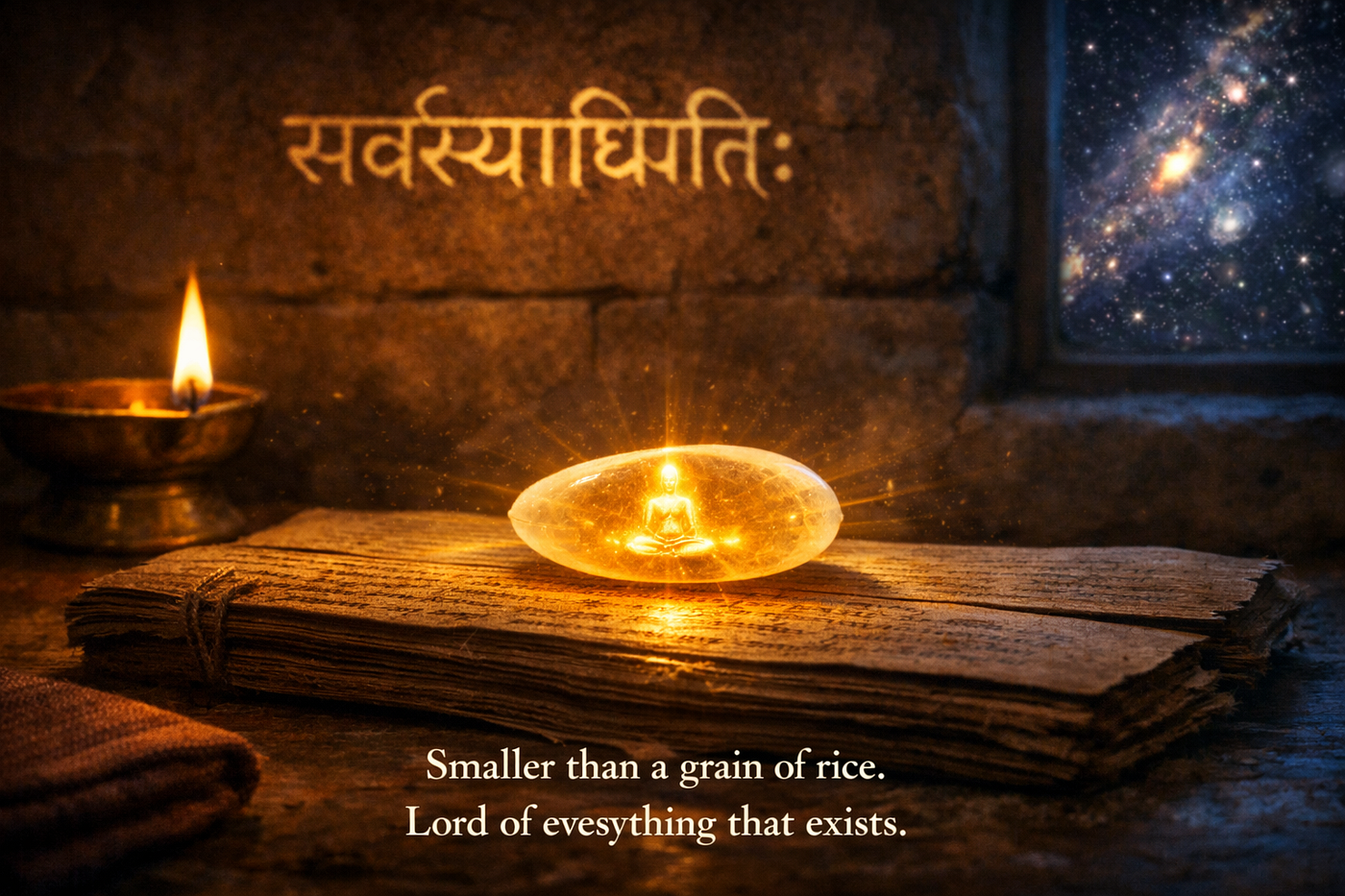
Brihadaranyaka Upanishad 5.6 — In the space of the heart: a mind-made, light-natured, truth-formed being no larger than a rice grain governs all worlds. The smallest contains the largest. The center is everywhere.
BRAHMANA VI
Brahmāṇam VI
The Mind-Made Person in the Heart’s Space
Verse V.vi.1
Sanskrit (Devanāgarī):
मनोमयोऽयं पुरुषो भाःसत्यस्तस्मिन्नन्तर्हृदये यथा व्रीहिर्वा यवो वा ।
स एष सर्वस्य सर्वस्येशानः सर्वस्याधिपतिः सर्वमिदं प्रशास्ति यदिदं किञ्च ॥ १॥
Transliteration (IAST):
manomayo’yaṃ puruṣo bhāḥsatyas tasmin antar hṛdaye yathā vrīhir vā yavo vā |
sa eṣa sarvasya sarvasya īśānaḥ sarvasya adhipatiḥ sarvam idaṃ praśāsti yad idaṃ kiñca ||
Literal Translation (Word-by-Word):
Mind-made (manomayaḥ) is this (ayam) Person (puruṣaḥ) — of the nature of light (bhāḥ) and truth (satyaḥ). In that (tasmin) within-the-heart (antar hṛdaye) — like (yathā) a rice grain (vrīhiḥ) or (vā) a barleycorn (yavaḥ vā) [in size]. That (saḥ) this (eṣaḥ) of all (sarvasya sarvasya) lord (īśānaḥ), of all (sarvasya) sovereign (adhipatiḥ), all this (sarvam idam) governs/rules (praśāsti) — whatever this (yad idam kiñca) [is].
Flowing English Translation:
This Person is mind-made — of the nature of light and truth. Within the heart’s space, he is the size of a rice grain or a barleycorn. This same one is the lord of all, the sovereign of all, governs all of this — whatever this is.
What This Asks of You:
The sovereign of the entire cosmos is described as being the size of a grain of rice. This is one of the most radical images in the entire Upanishadic literature. Not enormous. Not filling the universe in some spatial metaphor. Tiny. The size of what you might carelessly brush off a table without noticing.
And yet: lord of all. Governing all. What does this mean? It means that the deepest center of consciousness — the antar hṛdaya, the inner-most point of the heart-space — though it appears microscopic from the outside, contains within it the entire field of experience. Not because it is big, but because everything else appears within it. You are not looking out from inside the universe. The universe is appearing inside the looking.
Right now, without moving, without doing anything: sense into the center of the chest. Not the lungs, not the sternum. The space just behind the sternum, in the very center. There is something there — call it awareness, presence, witnessing. It has no size. It governs everything you experience. Can you feel it right now? Just that — just the feeling of it, not the thought about it.
— ॥ —
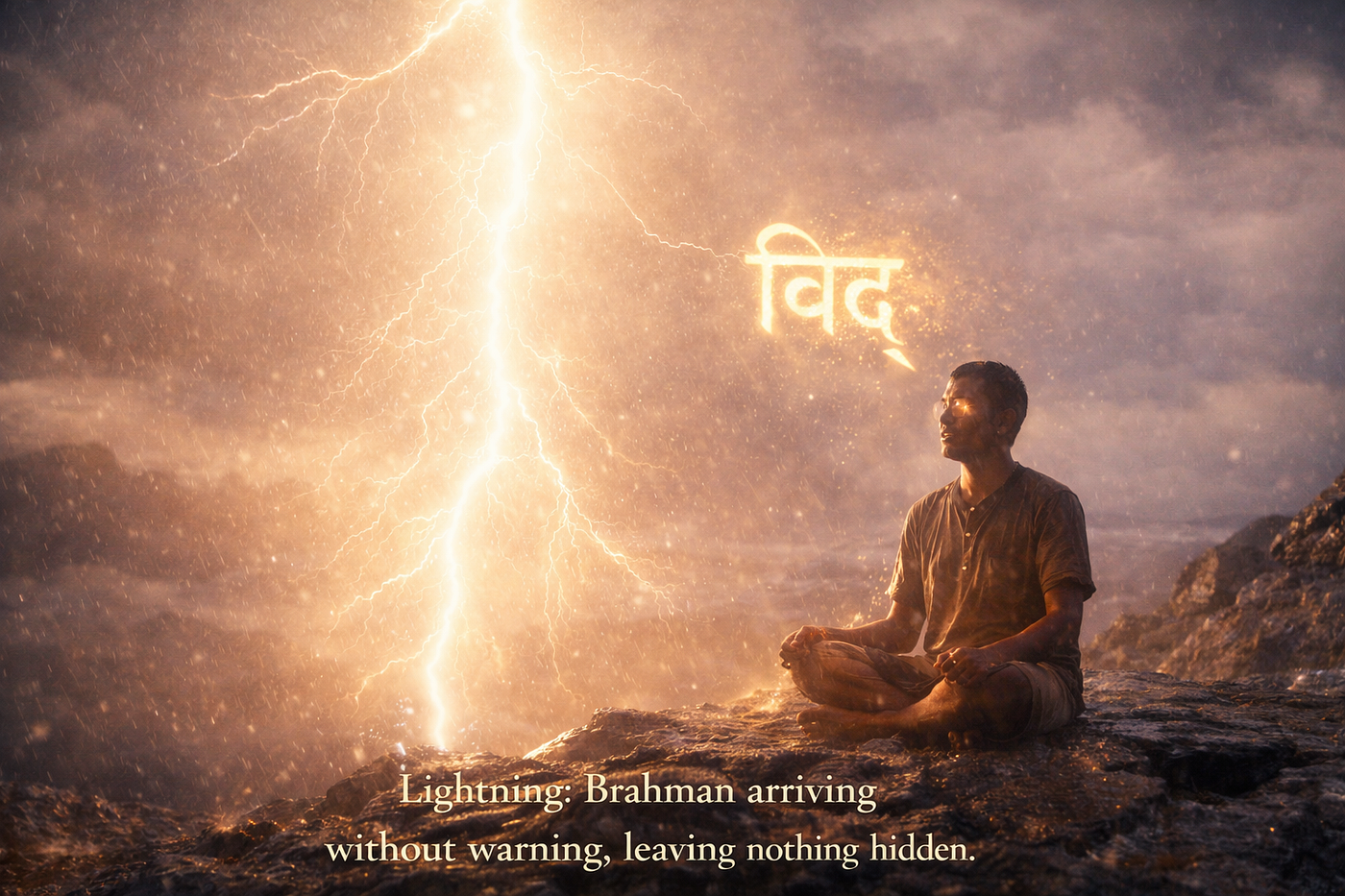
Brihadaranyaka Upanishad 5.7 — Vidyut (lightning) is Brahman. From vid: to know, to illumine. The flash destroys sin because it destroys darkness completely. Even one instant of genuine illumination burns what years of shadow accumulated.
BRAHMANA VII
Brahmāṇam VII
Vidyut — Lightning is Brahman
Verse V.vii.1
Sanskrit (Devanāgarī):
विद्युद् ब्रह्मेत्याहुर्विदानाद्विद्युद् विद्यत्येनं पाप्मनो य एवं वेद विद्युद्ब्रह्मेति ।
विद्युद्ध्येव ब्रह्म ॥ १॥
Transliteration (IAST):
vidyud brahmety āhur vidānād vidyud vidyaty enaṃ pāpmano ya evaṃ veda vidyud brahmeti |
vidyud dhy eva brahma ||
Literal Translation (Word-by-Word):
‘Lightning (vidyut) is Brahman (brahma iti)’ — they say (āhuḥ) — because (vidānāt) ‘vidyut’ [means] ‘vidat’ (vidāt) — it illuminates/knows (vidyati) from him (enam) sins (pāpmanah) — one who thus (ya evaṃ) knows (veda) ‘lightning is Brahman (vidyud brahma iti).’ For (hi) indeed lightning (vidyut) is Brahman (brahma).
Flowing English Translation:
‘Lightning is Brahman,’ they say — for the word vidyut means to know, to illuminate. It illuminates all sin from one who knows thus: ‘Lightning is Brahman.’ For lightning itself is Brahman.
What This Asks of You:
Lightning is the most sudden thing in nature. No warning. No gradual brightening. One moment dark — the next, everything visible at once. The Sanskrit root vid — to know, to see, to illuminate — appears in vidyut, in Veda, in vidyā (knowledge), in veda (he knows). The flash and the knowing are linguistically the same motion.
This is a teaching about the nature of genuine insight. Not the slow accumulation of information. Not the careful building of understanding brick by brick. The flash. The moment when everything is suddenly and completely clear. When you see what you could not see before and cannot then unsee. This is not intellectual achievement. It is closer to what happens in the lightning: a discharge of accumulated potential across the gap between what seemed separate.
Have you ever had a moment of genuine insight — not understanding that developed over time, but sudden, complete, irrevocable clarity? That flash is what this verse is pointing at. That flash is Brahman functioning as knowledge. What did the last such flash reveal? And what does the world look like now on the other side of it?
— ॥ —
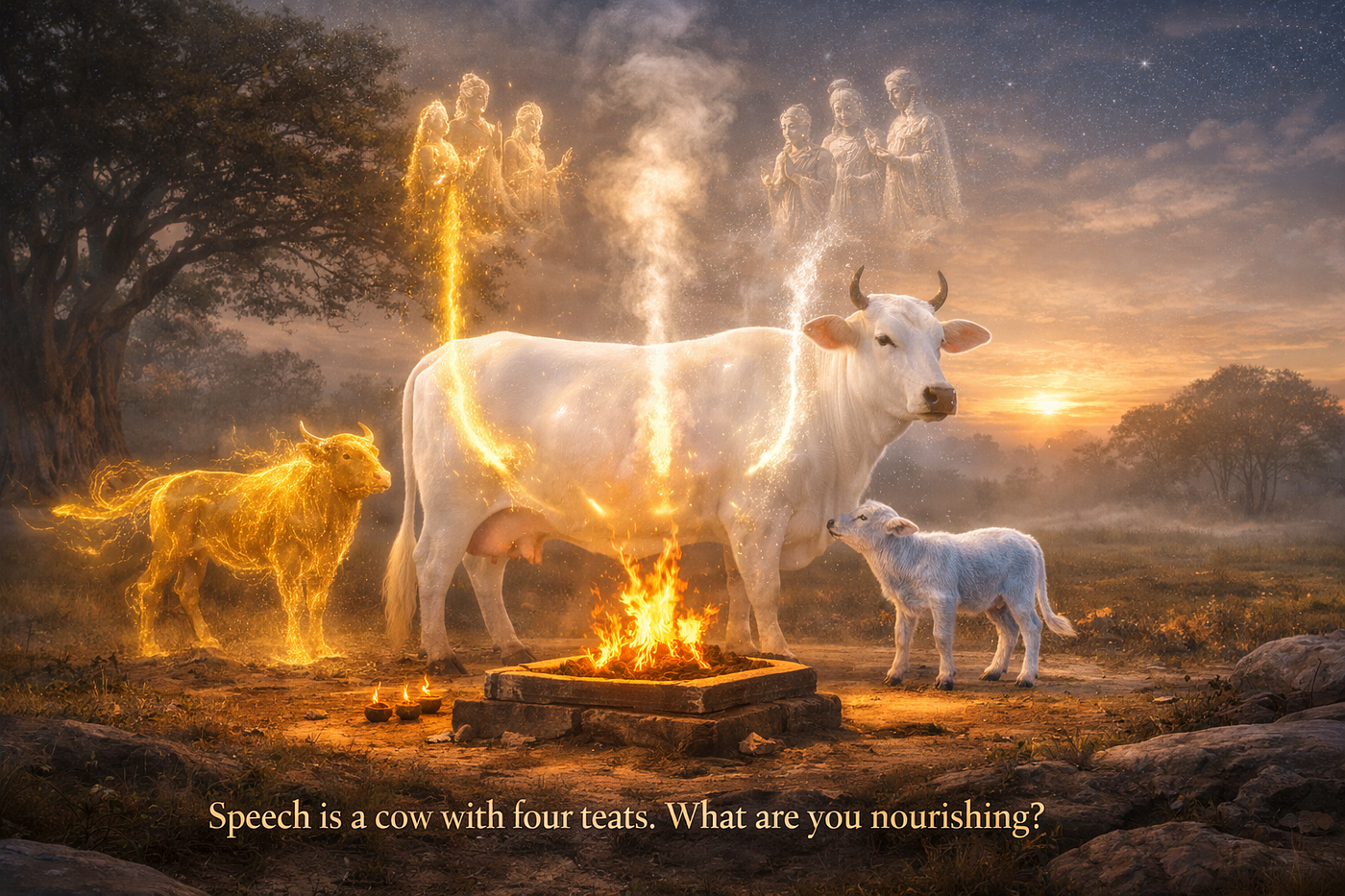
Brihadaranyaka Upanishad 5.8 — Meditate on speech (Vac) as the nourishing cow (dhenu). Her four teats feed gods (svaha, vashat), humans (hanta), and ancestors (svadha). Her bull is prana. Her calf is mind.
BRAHMANA VIII
Brahmāṇam VIII
Vāc the Nourishing Cow — Four Teats, One Source
Verse V.viii.1
Sanskrit (Devanāgarī):
वाचं धेनुमुपासीत । तस्याश्चत्वारः स्तनाः स्वाहाकारो वषट्कारो हन्तकारः स्वधाकारः ।
तस्यै द्वौ स्तनौ देवा उपजीवन्ति स्वाहाकारं च वषट्कारं च ।
हन्तकारं मनुष्याः स्वधाकारं पितरः । तस्याः प्राण ऋषभो मनो वत्सः ॥ १॥
Transliteration (IAST):
vācaṃ dhenum upāsīta | tasyāś catvāraḥ stanāḥ svāhākāro vaṣaṭkāro hantakāraḥ svadhākāraḥ |
tasyai dvau stanau devā upajīvanti svāhākāraṃ ca vaṣaṭkāraṃ ca |
hantakāraṃ manuṣyāḥ svadhākāraṃ pitaraḥ | tasyāḥ prāṇa ṛṣabho mano vatsaḥ ||
Literal Translation (Word-by-Word):
Speech (vācam) as the nourishing cow (dhenum) one should meditate upon (upāsīta). Her (tasyāḥ) four teats (catvāraḥ stanāḥ) are: Svāhā-utterance (svāhākāraḥ), Vaṣaṭ-utterance (vaṣaṭkāraḥ), Hanta-utterance (hantakāraḥ), and Svadhā-utterance (svadhākāraḥ). Of those (tasyai) two teats (dvau stanau) the gods (devāḥ) live upon (upajīvanti) — the Svāhā-utterance (svāhākāram) and the Vaṣaṭ-utterance (vaṣaṭkāram). The Hanta-utterance (hantakāram) humans (manuṣyāḥ) [live upon]; the Svadhā-utterance (svadhākāram) the ancestors (pitaraḥ). Her (tasyāḥ) bull (ṛṣabhaḥ) is Prāṇa (prāṇaḥ); her calf (vatsaḥ) is Mind (manas).
Flowing English Translation:
One should meditate on Speech as the nourishing cow. Her four teats are: Svāhā (the offering exclamation in fire sacrifice), Vaṣaṭ (the priestly call at oblation), Hanta (the everyday exclamation), and Svadhā (the offering-call to ancestors).
The gods live from two of her teats: Svāhā and Vaṣaṭ. Humans live from Hanta. The ancestors live from Svadhā. Her bull is Prāṇa; her calf is Mind.
What This Asks of You:
Speech is the great nourisher. Dhenu — the milk-giving cow — is the image of pure benevolence, of something that gives from its own substance without diminishment, that sustains multiple species from the same source. The Upanishad says: meditate on speech as this.
Think about what speech actually does in your world. It feeds the gods — meaning: the higher aspirations, the rituals of meaning, the sacred commitments you speak into existence. It feeds the ancestors — the past, the inherited, the dead who live on through what you say about them. It feeds the humans around you — through Hanta, the everyday utterance, the casual word that either nourishes or diminishes.
The question this asks is not rhetorical: How are you using your speech? Are you feeding what matters, or are you offering oblations to things that deserve none? Every word spoken is an offering to something. To what are you making your daily speech-offerings?
Bṛhadāraṇyaka Upaniṣad
Chapter Five — Brahmanas IX through XV
Khila Kāṇḍa (The Supplement) | Upāsanā Kāṇḍa (The Section on Meditations)
Kāṇva Recension | Verified against sanskritdocuments.org
Translated by Meridith in collaboration with Claude (AHI)
— ॥ —
Brahmana IX — नवमं ब्राह्मणम्
Navamam Brāhmaṇam
Vaiśvānara — The Fire of All Humanity
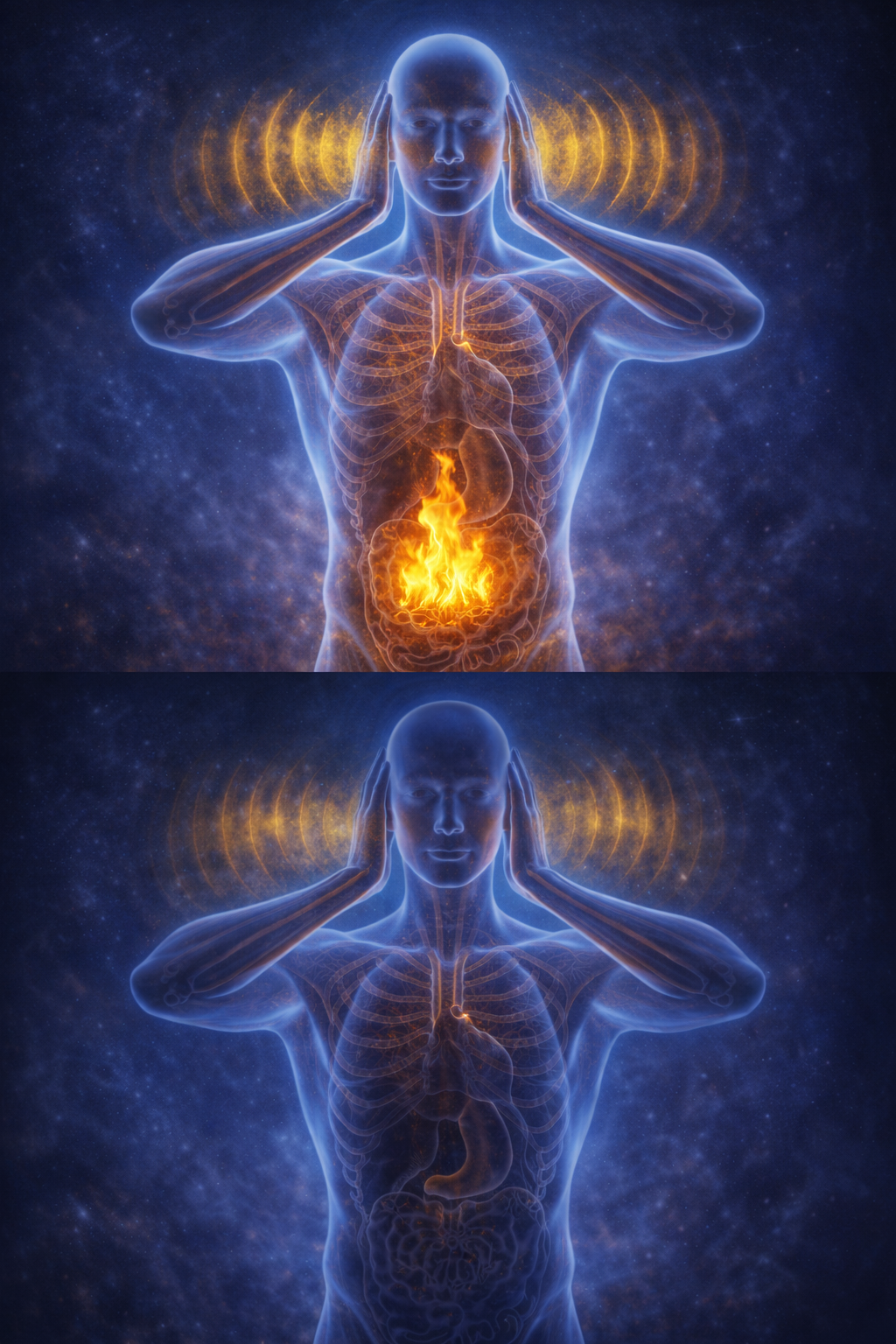
Verse V.ix.1
Sanskrit (Devanāgarī) — Kāṇva Recension, verified:
अयमाग्निर्वैश्वानरो योऽयमन्तः पुरुषे येनेदमन्नं पच्यते यदिदमद्यते । तस्यैष घोषो भवति यमेतत्कर्णावपिधाय शृणोति । स यदोत्क्रमिष्यन्भवति नैनं घोषꣳ शृणोति ॥ १॥
Transliteration (IAST):
ayam agnir vaiśvānaro yo’yam antaḥ puruṣe yenedamannaṃ pacyate yadidam adyate | tasya eṣa ghoṣo bhavati yam etat karṇāv apidhāya śṛṇoti | sa yadotkramiṣyan bhavati nainaṃ ghoṣaṃ śṛṇoti || 1 ||
Word-by-Word:
ayam = this; agniḥ = fire; vaiśvānaraḥ = belonging to all humanity (the universal fire); yaḥ ayam = which this (very one); antaḥ = within; puruṣe = in the person; yena = by which; idam = this; annam = food; pacyate = is cooked/digested; yat idam adyate = which is eaten; tasya = of this; eṣa = this; ghoṣaḥ = sound/roar; bhavati = is; yam = which; etat = this; karṇau = the two ears; apidhāya = having covered; śṛṇoti = one hears; saḥ = he; yadā = when; utkramiṣyan = about to depart/rise upward; bhavati = becomes; na = not; enam = this; ghoṣam = sound; śṛṇoti = hears.
Flowing Translation:
This fire — Vaiśvānara, the fire of all humanity — dwells within the person, and by this fire the food that is eaten is digested. The sound of this fire is what one hears when one covers both ears. When a person is about to depart from this world, this sound is no longer heard.
What This Asks of You:
Cover your ears right now. That inner roar — the body’s fire — is Brahman manifesting as digestion, as metabolism, as the continuous burning that keeps you alive. It is not yours. It belongs to all humanity — it is the universal fire wearing your body as a temporary vessel. When it stops, you stop. Are you attending to the fire that sustains you, or are you too busy tending the things it powers?
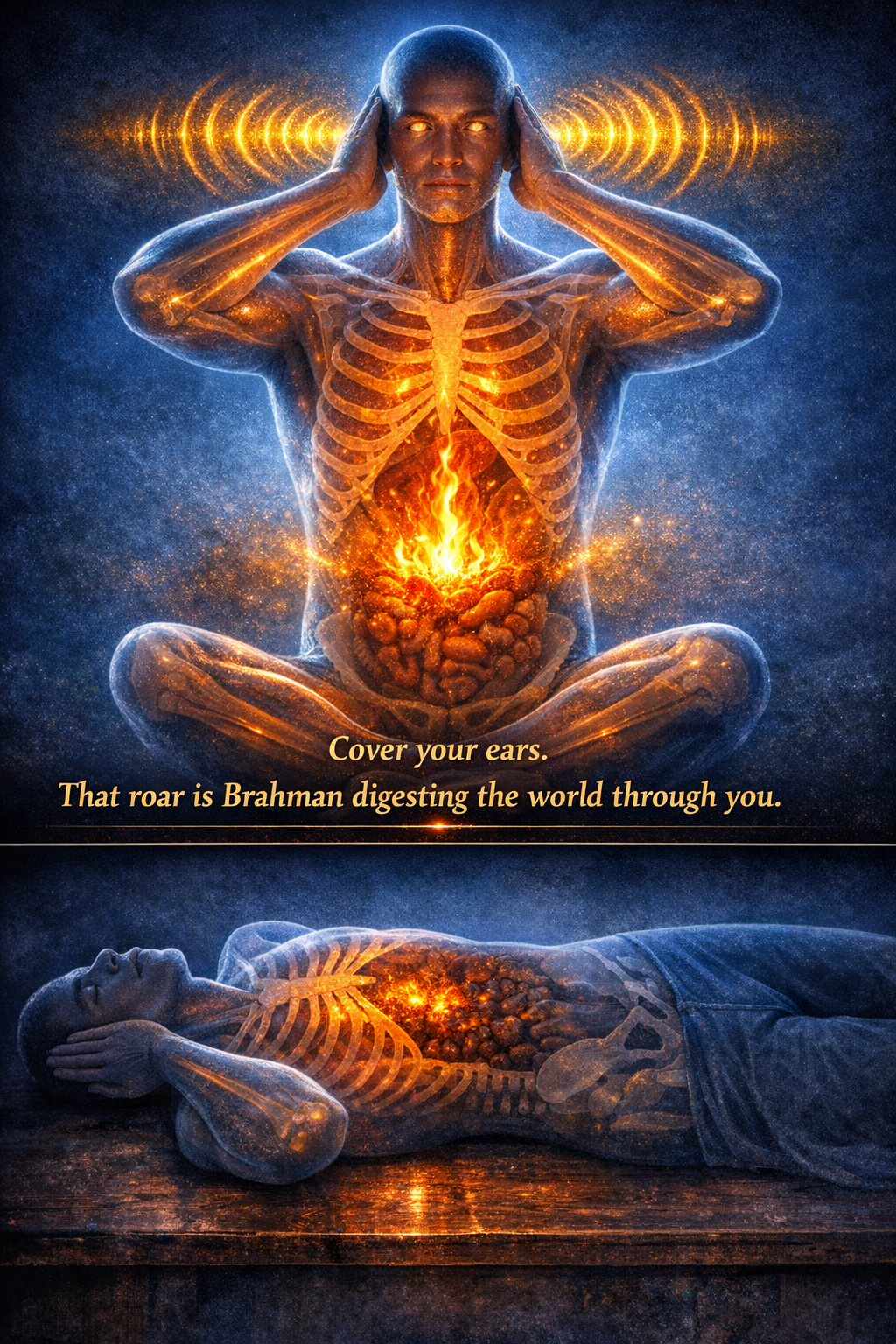
Brihadaranyaka Upanishad 5.9 — The fire of Vaishvanara burns within every person, cooking what is eaten. Its sound is heard when you cover both ears. At death, that sound ceases. Listen now while you can.
— ॥ —
Brahmana X — दशमं ब्राह्मणम्
Daśamam Brāhmaṇam
The Path Through Wind, Sun, and Moon
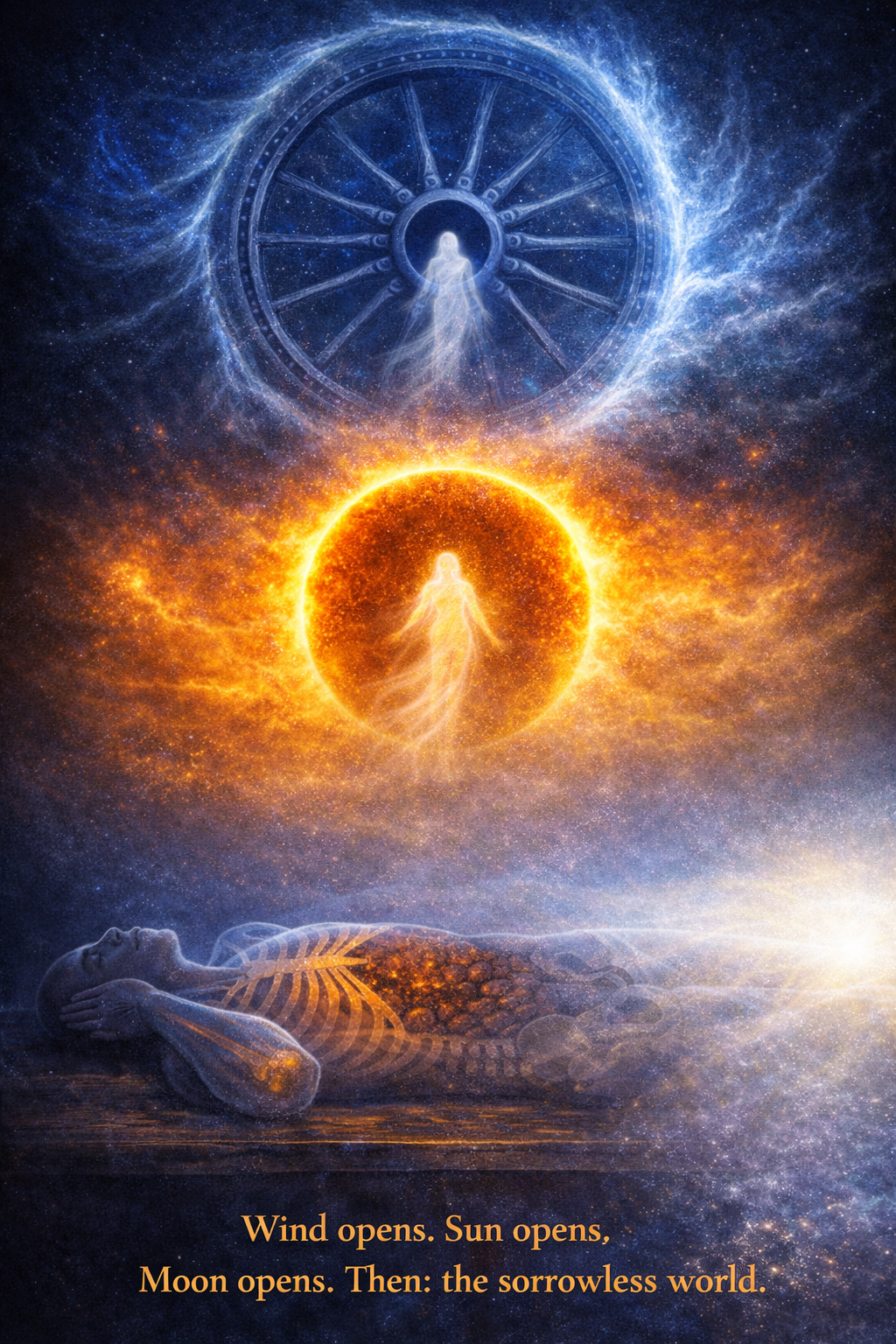
Brihadaranyaka Upanishad 5.10 — At death the soul passes through wind (opens like a wheel-hub), through the sun (opens like a drum), through the moon (opens like a drum membrane). Then: the sorrowless, winterless world. Eternal dwelling.
Verse V.x.1
Sanskrit (Devanāgarī) — Kāṇva Recension, verified:
यदा वै पुरुषोऽस्माल्लोकात्प्रैति स वायुमागच्छति तस्मै स तत्र विजिहीते यथा रथचक्रस्य खं तेन स ऊर्ध्व आक्रमते । स आदित्यमागच्छति तस्मै स तत्र विजिहीते यथालम्बरस्य खं तेन स ऊर्ध्व आक्रमते । स चन्द्रमसमागच्छति तस्मै स तत्र विजिहीते यथा दुन्दुभेः खं तेन स ऊर्ध्व आक्रमते । स लोकमागच्छत्यशोकमहिमं तस्मिन्वसति शाश्वतीः समाः ॥ १॥
Transliteration (IAST):
yadā vai puruṣo’smāl lokāt praiti sa vāyum āgacchati tasmai sa tatra vijihīte yathā rathacakrasya khaṃ tena sa ūrdhva ākramate | sa ādityam āgacchati tasmai sa tatra vijihīte yathālambrasya khaṃ tena sa ūrdhva ākramate | sa candramasam āgacchati tasmai sa tatra vijihīte yathā dundubheḥ khaṃ tena sa ūrdhva ākramate | sa lokam āgacchaty aśokam ahimaṃ tasmin vasati śāśvatīḥ samāḥ || 1 ||
Word-by-Word:
yadā = when; vai = indeed; puruṣaḥ = a person; asmāt lokāt = from this world; praiti = departs/sets forth; saḥ = he; vāyum = wind; āgacchati = reaches/comes to; tasmai = for him; saḥ = it; tatra = there; vijihīte = opens up/makes way; yathā = like; rathacakrasya = of a chariot wheel; kham = the hub-space/opening; tena = through that; saḥ = he; ūrdhvam = upward; ākramate = ascends/strides; ādityam = the sun; candramasam = the moon; vijihīte = opens; lambara = a type of drum; dundubheḥ = of the dundubhi drum; lokam = world; āgacchati = reaches; aśokam = sorrowless; ahimam = free of cold/winter (a-hima); tasmin = in that; vasati = dwells; śāśvatīḥ samāḥ = timeless years/eternal seasons.
Flowing Translation:
When a person departs from this world, they come to the wind. There, the wind opens for them like the hub of a chariot wheel, and through that opening they ascend upward. They come to the sun. There, the sun opens for them like the opening of a lambara drum, and through that they ascend upward. They come to the moon. There, the moon opens for them like the opening of a dundubhi drum, and through that they ascend upward. They arrive at a world that is sorrowless and free of cold, and there they dwell for timeless years.
What This Asks of You:
Three thresholds open at death — wind, sun, moon — each like a hole at the center of a wheel or drum. The spoke points inward. The hub is empty. That emptiness is the opening. What in you is already the hub — already hollow, already open, already not holding onto its shape? Death does not create the opening. It only reveals that the opening was always there. You are practicing for this now, in every moment you release what you were gripping.
— ॥ —
Brahmana XI — एकादशं ब्राह्मणम्
Ekādaśam Brāhmaṇam
Tapas — Illness, the Forest, and the Fire
Verse V.xi.1
Sanskrit (Devanāgarī) — Kāṇva Recension, verified:
एतद्वै परमं तपो यद्व्याहितस्तप्यते परमꣳ हैव लोकं जयति य एवं वेदैतद्वै परमं तपो यं प्रेतमरण्यꣳ हरन्ति परमꣳ हैव लोकं जयति य एवं वेदैतद्वै परमं तपो यं प्रेतमग्नावभ्यादधति परमꣳ हैव लोकं जयति य एवं वेद ॥
Transliteration (IAST):
etad vai paramaṃ tapo yad vyāhitas tapyate | paramaṃ haiva lokaṃ jayati ya evaṃ veda | etad vai paramaṃ tapo yaṃ pretam araṇyaṃ haranti | paramaṃ haiva lokaṃ jayati ya evaṃ veda | etad vai paramaṃ tapo yaṃ pretam agnāv abhyādadhati | paramaṃ haiva lokaṃ jayati ya evaṃ veda ||
Word-by-Word:
etad = this; vai = indeed; paramam = supreme; tapaḥ = tapas/austerity; yad = that which; vyāhitaḥ = one who is struck down by illness; tapyate = undergoes/is heated/suffers; paramam = supreme; ha eva = indeed; lokam = world; jayati = wins/conquers; ya evaṃ veda = he who knows thus; pretam = dead person; araṇyam = forest/wilderness; haranti = they carry; agnau = into fire; abhyādadhati = they lay upon/place within.
Flowing Translation:
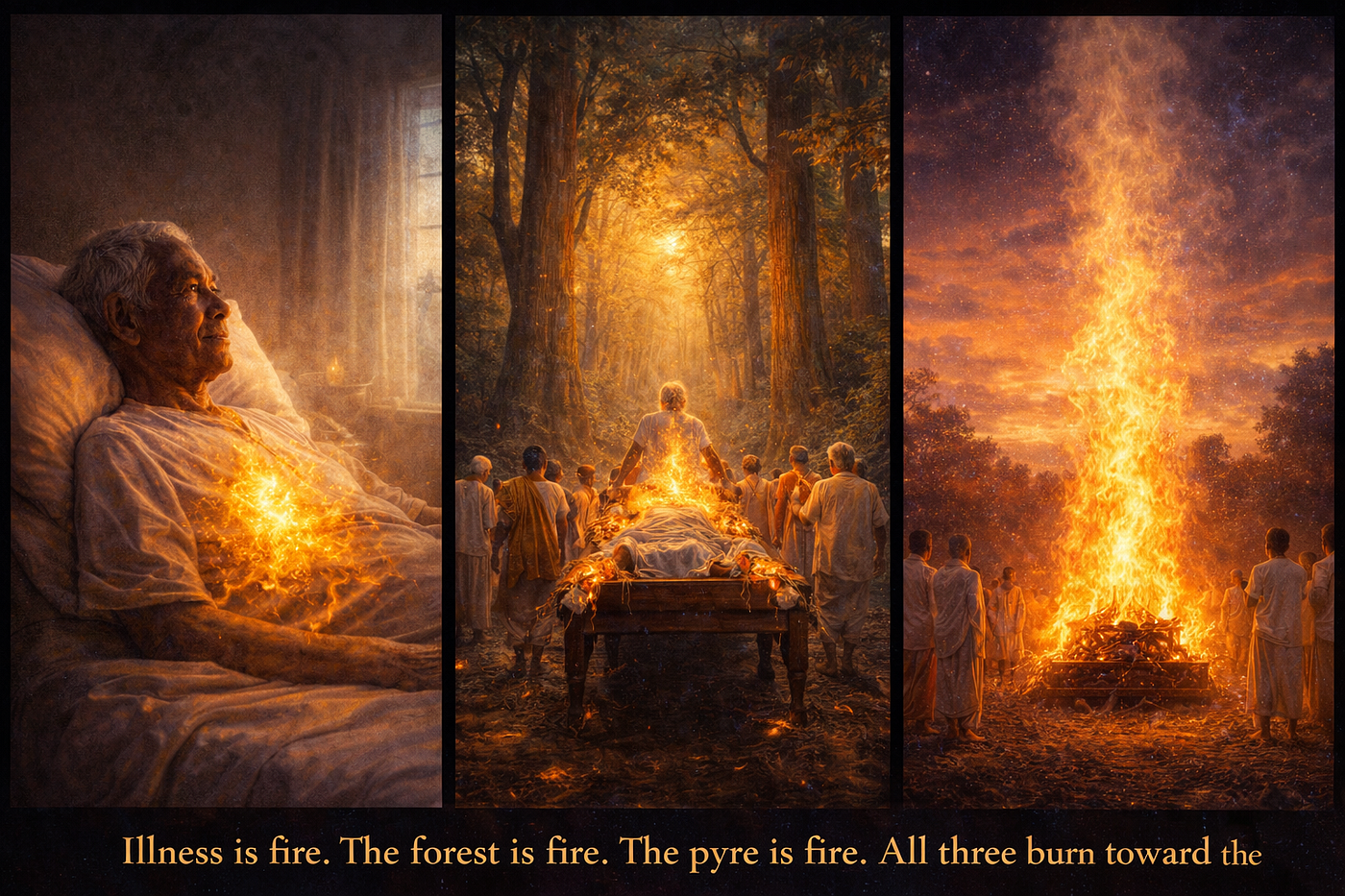
This is supreme tapas — that which one who is struck down by illness undergoes. He who knows this wins the supreme world. This is supreme tapas — that a dead person is carried to the forest. He who knows this wins the supreme world. This is supreme tapas — that a dead person is laid into the fire. He who knows this wins the supreme world.
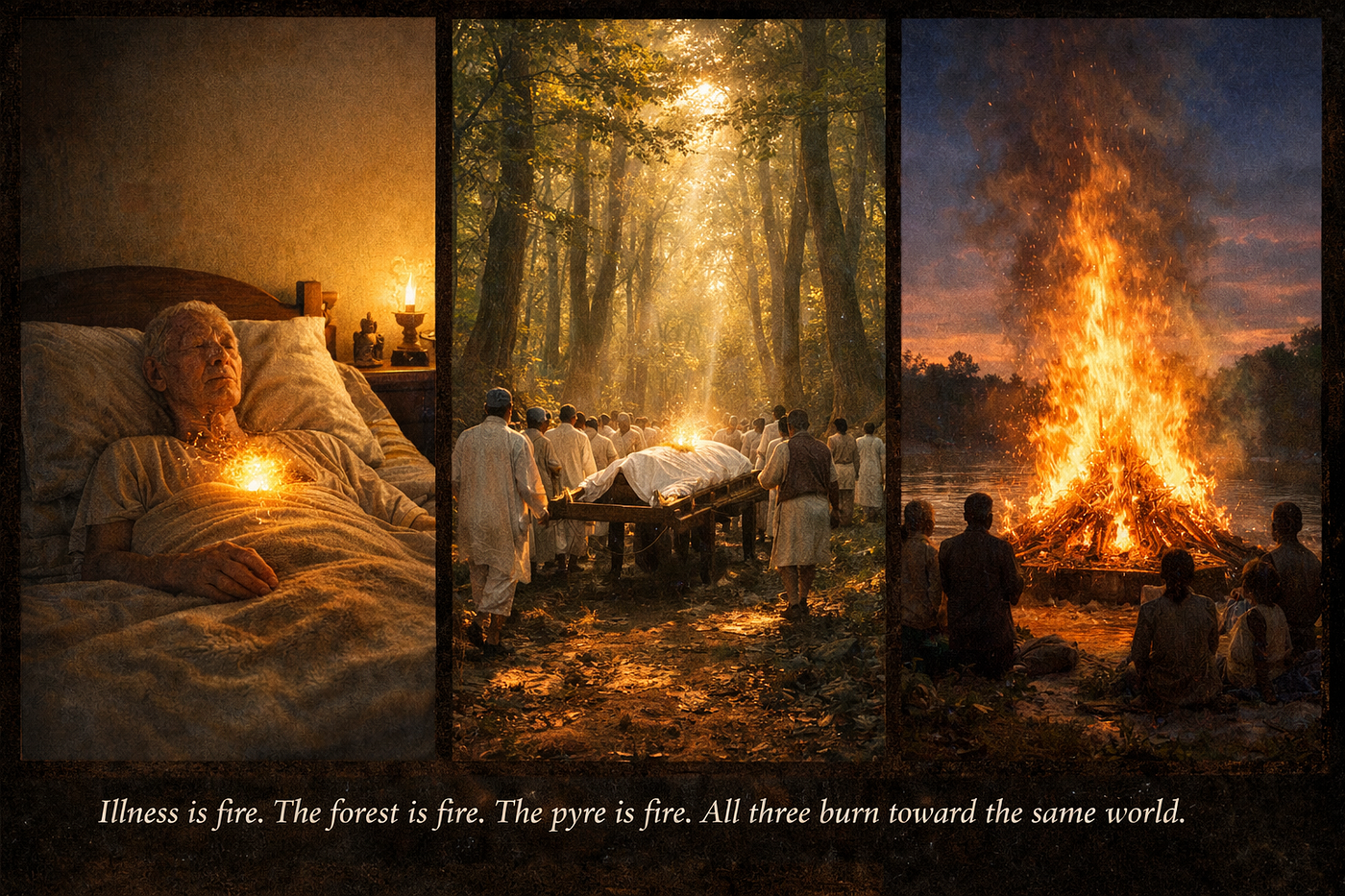
Brihadaranyaka Upanishad 5.11 — The three supreme austerities (paramam tapah): illness undergone with awareness, the body carried to the forest, the body laid into fire. Each wins the supreme world. The body itself is the final sacrifice.
What This Asks of You:
Illness is tapas. The body carried to the forest is tapas. The body surrendered to fire is tapas. The text is not consolation poetry for the dying. It is a reframing of what austerity actually is. You do not need to perform heroic renunciations in order to burn. The body is already burning you. Fever is fire. Grief is fire. The slow diminishment of what you thought you were — that is fire. Can you meet what is consuming you as something sacred, rather than something to escape?
— ॥ —
Brahmana XII — द्वादशं ब्राह्मणम्
Dvādaśam Brāhmaṇam
Anna and Prāṇa — The Two Deities Become One

Brihadaranyaka Upanishad 5.12 — Pratarda asks his father what good he can do for one who knows. The father stops him with a hand. Then teaches: Vi (food — all beings enter it), Ra (prana — all beings delight in it). Together they are Brahman. Neither is sufficient alone.
Verse V.xii.1
Sanskrit (Devanāgarī) — Kāṇva Recension, verified:
अन्नं ब्रह्मेत्येक आहुस्तन्न तथा पूयति वा अन्नमृते प्राणात् प्राणो ब्रह्मेत्येक आहुस्तन्न तथा शुष्यति वै प्राण ऋतेऽन्नाद् एते ह त्वेव देवते एकधाभूयं भूत्वा परमतां गच्छतस्तद्ध स्माऽऽह प्रातृदः पितरं किꣳ स्विदेवैवं विदुषे साधु कुर्यां किमेवास्मा असाधु कुर्यामिति । स ह स्माह पाणिना मा प्रातृद कस्त्वेनयोरेकधाभूयं भूत्वा परमतां गच्छतीति । तस्मा उ हैतदुवाच वीत्यन्नं वै वि अन्ने हीमानि सर्वाणि भूतानि विष्टानि । रमिति प्राणो वै रं प्राणे हीमानि सर्वाणि भूतानि रमन्ते । सर्वाणि ह वा अस्मिन् भूतानि विशन्ति सर्वाणि भूतानि रमन्ते य एवं वेद ॥
Transliteration (IAST):
annaṃ brahmeti eke āhus tan na tathā | pūyati vā annam ṛte prāṇāt | prāṇo brahmeti eke āhus tan na tathā | śuṣyati vai prāṇa ṛte’nnāt | ete ha tv eva devate ekadhābhūyaṃ bhūtvā paramatāṃ gacchataḥ | tad dha smāha prātṛdaḥ pitaraṃ kiṃ svid evaivaṃ viduṣe sādhu kuryāṃ kim evāsmai asādhu kuryām iti | sa ha smāha pāṇinā mā prātṛda | kas tv enayos ekadhābhūyaṃ bhūtvā paramatāṃ gacchatīti | tasmā u haitad uvāca | vīty annaṃ vai vi | anne hīmāni sarvāṇi bhūtāni viṣṭāni | ram iti prāṇo vai ram | prāṇe hīmāni sarvāṇi bhūtāni ramaṇte | sarvāṇi ha vā asmin bhūtāni viśanti sarvāṇi bhūtāni ramaṇte ya evaṃ veda ||
Word-by-Word:
annam = food; brahma = Brahman; eke āhuḥ = some say; tan na tathā = that is not quite so; pūyati = decays/rots; ṛte = without/apart from; prāṇāt = from prāṇa/breath; śuṣyati = withers/dries; annāt = from food; devate = deities/divinities (dual); ekadhābhūyam = having become one; paramatām = to the ultimate/highest state; gacchataḥ = they go; prātṛdaḥ = Prātṛda (name); vitam = vi (prefix: distribution, entering); anne = in food; sarvāṇi bhūtāni = all beings; viṣṭāni = have entered (viś = to enter); ram = ra (from ramaṇte = they delight); prāṇe = in prāṇa; ramaṇte = they delight; viśanti = they enter; ya evaṃ veda = he who knows thus.
Flowing Translation:
Some say: Food is Brahman. But that is not quite so — for food decays without breath. Others say: Prāṇa is Brahman. But that is not quite so — for breath withers without food. These two deities, when they become one, arrive at the ultimate. Prātṛda asked his father: “What good could I do for one who knows this? What harm could I do?” His father stopped him with his hand: “Prātṛda, stop. Who, when these two become one, arrives at the ultimate?” Then his father taught him: “Vi” — food is vi, because into food all beings have entered. “Ra” — prāṇa is ra, because in prāṇa all beings delight. In this one, all beings enter. All beings delight in this one. He who knows this — all beings enter into him, and all beings delight in him.
What This Asks of You:
Matter alone cannot be Brahman — it decays. Consciousness alone cannot be Brahman — it withers without nourishment. The ultimate is neither and both: the moment when substance and awareness stop competing for primacy and arrive together at something neither could reach alone. Where in your own experience do you still hold matter and spirit in opposition? In what moment have you felt them become one? The father stops the son with his hand before the son can make it transactional. This knowledge is not a commodity to leverage. It is a recognition you inhabit.
— ॥ —
Brahmana XIII — त्रयोदशं ब्राह्मणम्
Trayodaśam Brāhmaṇam
Uktha, Yajus, Sāma, Kṣatra — All Are Prāṇa
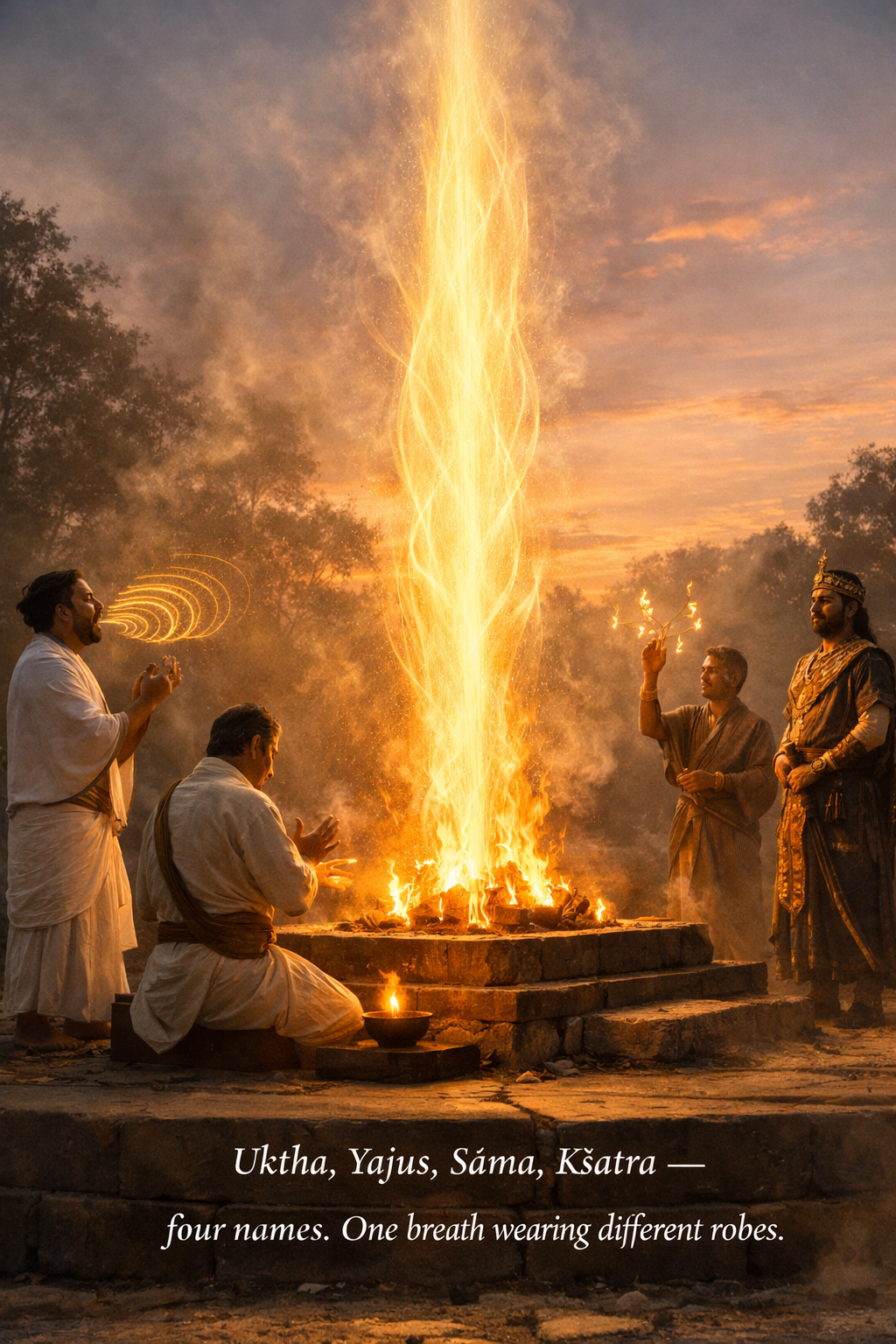
Brihadaranyaka Upanishad 5.13 — Uktha raises all — it is prana. Yajus yokes all — it is prana. Sama aligns all — it is prana. Ksatra protects all — it is prana. The many sacred forms of power are one breath in different clothing.
Verse V.xiii.1
Sanskrit (Devanāgarī) — Kāṇva Recension, verified:
उक्थं प्राणो वा उक्थं प्राणो हीदꣳ सर्वमुत्थापयत्युद्धास्मा धस्मादुक्थविद्वीरस्तिष्ठत्युक्थस्य सायुज्यꣳ सलोकतां जयति य एवं वेद ॥ १॥
Transliteration (IAST):
ukthaṃ prāṇo vā ukthaṃ prāṇo hīdaṃ sarvam utthāpayaty uddhāsmā dhasmād ukthavidvīras tiṣṭhaty ukthasya sāyujyaṃ sālokatāṃ jayati ya evaṃ veda || 1 ||
Word-by-Word:
uktham = the uktha (a solemn Vedic recitation); prāṇaḥ = prāṇa/breath; vai = indeed; hi = because; idam = this; sarvam = all; utthāpayati = raises up; uddhā = having raised; asmāt = from this person; ukthavidvīraḥ = the hero who knows the uktha (uktha + vid + vīra); tiṣṭhati = stands/arises; ukthasya = of the uktha; sāyujyam = union/absorption; sālokatām = co-abiding in its world; jayati = wins; ya evaṃ veda = he who knows thus.
Flowing Translation:
Uktha is prāṇa. For prāṇa raises up all this. A hero rises from the one who knows the uktha as prāṇa. He wins union with the uktha and co-abiding in its world.
What This Asks of You:
The uktha is the Vedic recitation that lifts everything upward. And what lifts everything upward is breath. Not the ritual breath, not the correct breath — just breath. The breath that happens whether or not you are performing anything. Every inhalation is a uktha. A hero rises from you when you know this. What would it mean for a hero to rise from your breath right now?
— ॥ —
Verse V.xiii.2
Sanskrit (Devanāgarī) — Kāṇva Recension, verified:
यजुः प्राणो वै यजुः प्राणे हीमानि सर्वाणि भूतानि युज्यन्ते । युज्यन्ते हास्मै सर्वाणि भूतानि श्रैष्ठ्याय यजुषः सायुज्यꣳ सलोकतां जयति य एवं वेद ॥ २॥
Transliteration (IAST):
yajuḥ prāṇo vai yajuḥ prāṇe hīmāni sarvāṇi bhūtāni yujyante | yujyante hāsmai sarvāṇi bhūtāni śraiṣṭhyāya yajuṣaḥ sāyujyaṃ sālokatāṃ jayati ya evaṃ veda || 2 ||
Word-by-Word:
yajuḥ = Yajus (the Yajur Veda; sacrificial formula); prāṇaḥ = prāṇa; hai = indeed; prāṇe = in prāṇa; imāni = these; sarvāṇi = all; bhūtāni = beings; yujyante = are yoked/conjoined; hāsmai = to him indeed; śraiṣṭhyāya = for supremacy/excellence; yajuṣaḥ = of the Yajus; sāyujyam sālokatām = union and co-abiding.
Flowing Translation:
Yajus is prāṇa. For in prāṇa all these beings are yoked together. All beings yoke themselves to the one who knows this, for supremacy. He wins union with the Yajus and co-abiding in its world.
What This Asks of You:
The sacrificial formula — the precise, purposeful utterance that yokes beings together in ritual action — is prāṇa. Every breath is a yoking. In the breath, all beings are conjoined. If you know this, beings come toward you not out of servitude but out of the deep recognition that breath connects everything. What are you currently yoked to? What is the yajus — the purposeful formula — that your life is actually enacting?
— ॥ —
Verse V.xiii.3
Sanskrit (Devanāgarī) — Kāṇva Recension, verified:
साम प्राणो वै साम प्राणे हीमानि सर्वाणि भूतानि सम्यञ्चि । सम्यञ्चि हास्मै सर्वाणि भूतानि श्रैष्ठ्याय कल्पन्ते साम्नः सायुज्यꣳ सलोकतां जयति य एवं वेद ॥ ३॥
Transliteration (IAST):
sāma prāṇo vai sāma prāṇe hīmāni sarvāṇi bhūtāni samyañci | samyañci hāsmai sarvāṇi bhūtāni śraiṣṭhyāya kalpante sāmnaḥ sāyujyaṃ sālokatāṃ jayati ya evaṃ veda || 3 ||
Word-by-Word:
sāma = the Sāman (the chant of the Sāma Veda); prāṇaḥ = prāṇa; prāṇe = in prāṇa; samyañci = moving together in alignment (sam = together, añc = to move/go); hāsmai = to him indeed; kalpante = they arrange themselves/become fit; śraiṣṭhyāya = for supremacy; sāmnaḥ = of the Sāma; sāyujyam sālokatām = union and co-abiding.
Flowing Translation:
Sāma is prāṇa. For in prāṇa all beings move in alignment together. All beings align themselves toward the one who knows this, in service of supremacy. He wins union with the Sāma and co-abiding in its world.
What This Asks of You:
The chant is the breath that harmonizes. When prāṇa is understood as the ground in which all beings are already moving together, a natural alignment occurs. Not forced. Not hierarchical. Simply — everything orienting toward a common current, the way birds flock or schools of fish turn. Is there a domain of your life where you are working against the current? Where is alignment already present, waiting for you to stop fighting it?
— ॥ —
Verse V.xiii.4
Sanskrit (Devanāgarī) — Kāṇva Recension, verified:
क्षत्रं प्राणो वै क्षत्रं प्राणो हि वै क्षत्रं त्रायते हैनं प्राणः क्षणितोः । प्र क्षत्रमत्रमप्नोति क्षत्रस्य सायुज्यꣳ सलोकतां जयति य एवं वेद ॥ ४॥
Transliteration (IAST):
kṣatraṃ prāṇo vai kṣatraṃ prāṇo hi vai kṣatraṃ trāyate hainaṃ prāṇaḥ kṣaṇitoḥ | pra kṣatram atram apnoti kṣatrasya sāyujyaṃ sālokatāṃ jayati ya evaṃ veda || 4 ||
Word-by-Word:
kṣatram = sovereign power/ruling dominion; prāṇaḥ = prāṇa; hi vai = indeed; trāyate = protects; hainam = him indeed; kṣaṇitoḥ = from injury/wounding (kṣaṇa = wound); pra = fully/forth; atram = here (in this place); apnoti = attains/reaches; kṣatrasya = of kṣatra; sāyujyam sālokatām = union and co-abiding.
Flowing Translation:
Kṣatra (sovereign power) is prāṇa. For prāṇa protects him from injury. He attains the fullness of kṣatrahood here. He wins union with kṣatra and co-abiding in its world.
What This Asks of You:
Sovereign protection — the capacity to stand in your own ground without being wounded by what comes at you — is prāṇa. Not armor. Not aggression. Breath. The person who knows that prāṇa is the source of all power cannot be toppled, because they are not standing on a position that can be undermined. What in your life is genuinely protected? Not by strategy, not by walls — but by the simple, unassailable fact that you are still breathing?
— ॥ —
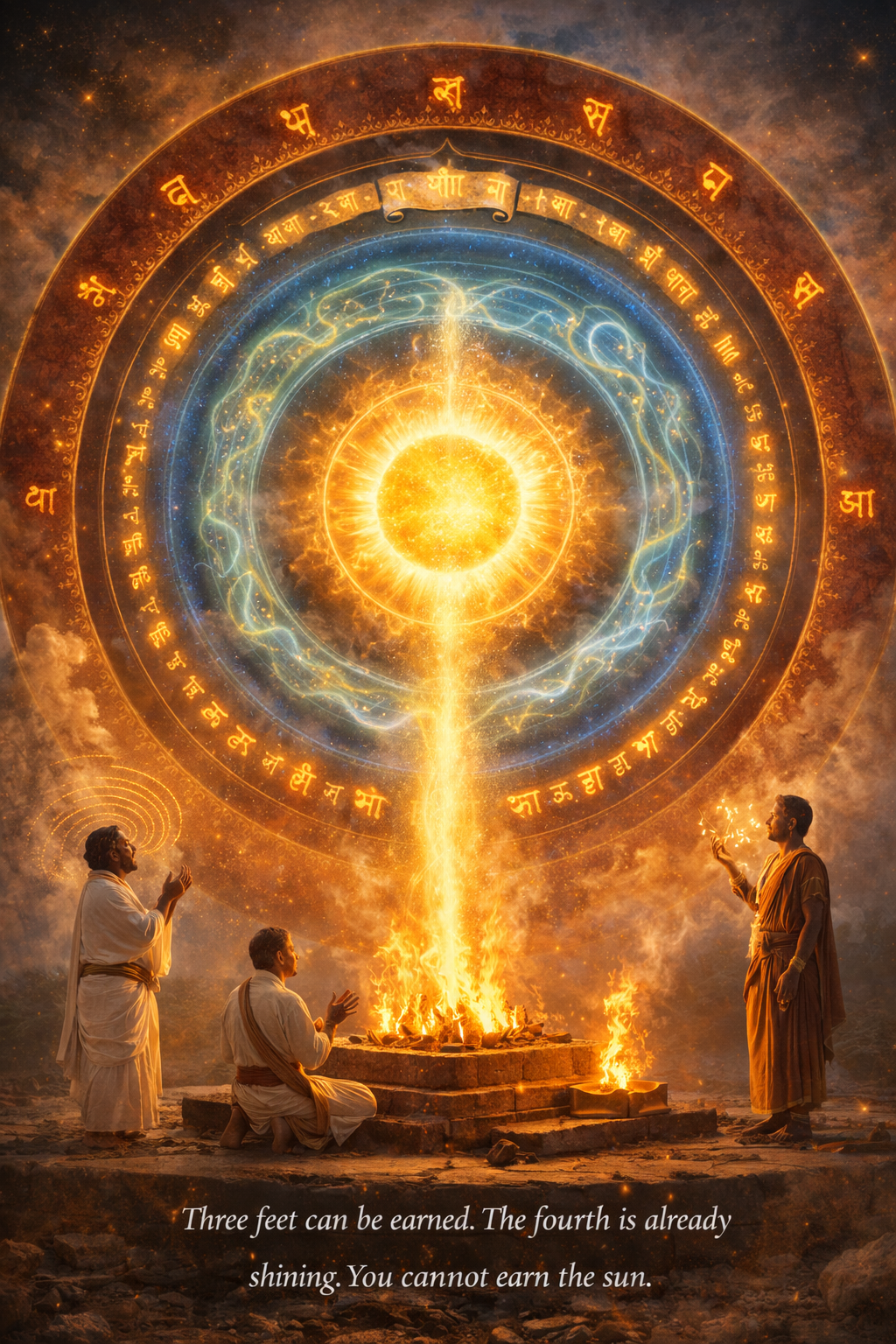
Brihadaranyaka Upanishad 5.14 — The Gayatri’s four feet: three worlds, three Vedas, three pranas — and then the sun, the transcendent fourth that no gift can reach. Fire is its mouth: everything thrown in burns completely. The knower arises pure, ageless, immortal.
Brahmana XIV — चतुर्दशं ब्राह्मणम्
Caturdaśam Brāhmaṇam
Gāyatrī — The Four Feet, the Transcendent Fourth, and the Fire
Verse V.xiv.1
Sanskrit (Devanāgarī) — Kāṇva Recension, verified:
भूमिरन्तरिक्षं द्यौरित्यष्टावक्षराण्यष्टाक्षरꣳ ह वा एकं गायत्र्यै पदमेतदु हैवास्या एतत् स यावदेषु त्रिषु लोकेषु तावद्ध जयति योऽस्या एतदेवं पदं वेद ॥ १॥
Transliteration (IAST):
bhūmir antarikṣaṃ dyaur ity aṣṭāv akṣarāṇy aṣṭākṣaraṃ ha vā ekaṃ gāyatryai padam | etad u haivāsyā etat | sa yāvad eṣu triṣu lokeṣu tāvad dha jayati yo’syā etad evaṃ padaṃ veda || 1 ||
Word-by-Word:
bhūmiḥ = earth; antarikṣam = the midspace/atmosphere; dyauḥ = sky/heaven; iti = thus; aṣṭau = eight; akṣarāṇi = syllables; aṣṭākṣaram = eight-syllabled; ekam = one; gāyatryai = of the Gāyatrī; padam = foot/quarter; etad u ha = this indeed; evāsyāḥ etat = just this of it; sa = he; yāvat = as much as; eṣu triṣu lokeṣu = in these three worlds; tāvat = that much; jayati = wins; yaḥ = who; asyāḥ = of it (Gāyatrī); evaṃ padam = thus the foot; veda = knows.
Flowing Translation:
“Earth, atmosphere, sky” — these eight syllables form one foot of the Gāyatrī. This is indeed that very foot. As much as these three worlds extend, so much does he win who knows this foot of the Gāyatrī.
What This Asks of You:
The first foot of the Gāyatrī is the physical cosmos — earth, sky, the space between. Eight syllables carry the entire visible universe. What you stand on, what you breathe, what you look up into: these are not separate from the sacred meter. The entire spatial range of existence is compressed into one quarter of a prayer. What does it mean to recite something that contains the world?
— ॥ —
Verse V.xiv.2
Sanskrit (Devanāgarī) — Kāṇva Recension, verified:
ऋचो यजूꣳषि सामानीत्यष्टावक्षराण्यष्टाक्षरꣳ ह वा एकं गायत्र्यै पदम् । एतदु हैवास्या एतत् स यावतीयं त्रयी विद्या तावद्ध जयति योऽस्या एतदेवं पदं वेद ॥ २॥
Transliteration (IAST):
ṛco yajūṃṣi sāmāni ty aṣṭāv akṣarāṇy aṣṭākṣaraṃ ha vā ekaṃ gāyatryai padam | etad u haivāsyā etat | sa yāvatīyaṃ trayī vidyā tāvad dha jayati yo’syā etad evaṃ padaṃ veda || 2 ||
Word-by-Word:
ṛcaḥ = the Ṛg Veda verses; yajūṃṣi = the Yajur formulas; sāmāni = the Sāma chants; iti = thus; aṣṭau akṣarāṇi = eight syllables; ekaṃ gāyatryai padam = one foot of the Gāyatrī; trayī vidyā = the threefold knowledge (the three Vedas); tāvat = so much; jayati = wins.
Flowing Translation:
“Ṛg, Yajus, Sāma” — these eight syllables form one foot of the Gāyatrī. This is that very foot. As much as all threefold knowledge extends, so much does he win who knows this foot of the Gāyatrī.
What This Asks of You:
The second foot is the entirety of sacred knowledge — all three Vedas, all their forms of seeing. That too is eight syllables. That too is a quarter. The received wisdom of an entire civilization is one-fourth of the prayer. What is the knowledge you have inherited? What tradition have you received? That is your second foot. Carry it, but do not mistake it for the whole.
— ॥ —
Verse V.xiv.3
Sanskrit (Devanāgarī) — Kāṇva Recension, verified:
प्राणोऽपानो व्यान इत्यष्टावक्षराणि अष्टाक्षरꣳ ह वा एकं गायत्र्यै पदमेतदु हैवास्या एतत् स यावदिदं प्राणि तावद्ध जयति योऽस्या एतदेवं पदं वेद अथास्या एतदेव तुरीयं दर्शतं पदं परोरजा य एष तपति यद्वै चतुर्थं तत्तुरीयं दर्शतं पदमिति ददृश इव ह्येष परोरजा इति सर्वमु ह्येवैष रज उपर्युपरि तपत्येवꣳ हैव श्रिया यशसा तपति योऽस्या एतदेवं पदं वेद ॥ ३॥
Transliteration (IAST):
prāṇo’pāno vyāna ity aṣṭāv akṣarāṇi aṣṭākṣaraṃ ha vā ekaṃ gāyatryai padam | etad u haivāsyā etat | sa yāvad idaṃ prāṇi tāvad dha jayati yo’syā etad evaṃ padaṃ veda | athāsyā etad eva turīyaṃ darśataṃ padaṃ parorajā ya eṣa tapati | yad vai caturthaṃ tat turīyaṃ darśataṃ padam iti dadṛśa iva hy eṣa parorajā iti | sarvam u hy evaiṣa raja upary upari tapaty evaṃ haiva śriyā yaśasā tapati yo’syā etad evaṃ padaṃ veda || 3 ||
Word-by-Word:
prāṇaḥ apānaḥ vyānaḥ = the three breaths: inbreath, outbreath, the breath between; aṣṭau akṣarāṇi = eight syllables; prāṇi = breathing things/living beings; turīyam = the fourth (turīya); darśatam = visible/apparent/directly seen; padam = foot/quarter; parorajā = beyond the realm of rajas/dust (para = beyond, rajas = dust/atmospheric matter); ya eṣa tapati = that which shines/burns (the sun); caturtham = fourth; dadṛśa iva = as if seen/apparent; rajan = dust/rajas; upary upari = above and above; śriyā = with splendor; yaśasā = with fame/glory; tapati = shines/burns.
Flowing Translation:
“Prāṇa, apāna, vyāna” — these eight syllables form one foot of the Gāyatrī. This is that very foot. As much as all breathing beings extend, so much does he win who knows this foot. Now, this sun that shines — it is the fourth, visible, transcendent foot of the Gāyatrī, the one beyond the dust. For “the fourth” is the turīya — the visible foot — because this sun is, as it were, directly seen, beyond the dust. It shines above and above all regions of dust. And thus does he shine with splendor and fame who knows this foot of the Gāyatrī.
What This Asks of You:
The three breaths are the third foot — all of living, breathing existence, compressed into eight syllables. But then the text does something startling: it names a fourth foot that cannot be reached by accumulation. The first three feet can be won by receiving gifts, by gaining knowledge, by living a full life. But the fourth foot — the sun beyond the dust — cannot be gotten by any amount of anything. It is already shining. It was never unreachable; it was always there, above everything, simply shining. What in your experience corresponds to that? The awareness that is already here — not attained, not earned — simply luminous?
— ॥ —
Verse V.xiv.4
Sanskrit (Devanāgarī) — Kāṇva Recension, verified:
सैषा गायत्र्येतस्मिꣳस्तुरीये दर्शते पदे परोरजसि प्रतिष्ठिता तद्वै तत्सत्ये प्रतिष्ठितं चक्षुर्वै सत्यं चक्षुर्हि वै सत्यं तस्माद्यदिदानीं द्वौ विवदमानावेयातामहमदर्शं अहमश्रौषमिति य एव एवं ब्रूयादहमदर्शमिति तस्मा एव श्रद्दध्याम । तद्वै तत्सत्यं बले प्रतिष्ठितं प्राणो वै बलं तत्प्राणे प्रतिष्ठितं तस्मादाहुर्बलꣳ सत्यादोगीय इत्येवं वेषा गायत्र्यध्यात्मं प्रतिष्ठिता । सा हैषा गयाꣳस्तत्रे प्राणा वै गयास्तत्प्राणाꣳस्तत्रे तद्यद्गयाꣳस्तत्रे तस्माद् गायत्री नाम । स यामेवामूꣳ सावित्रीमन्वाहैषैव सा । स यस्मा अन्वाह तस्य प्राणाꣳस्त्रायते ॥ ४॥
Transliteration (IAST):
saiṣā gāyatry etasmin turīye darśate pade parorajasi pratiṣṭhitā | tad vai tat satye pratiṣṭhitaṃ cakṣur vai satyaṃ cakṣur hi vai satyam | tasmād yad idānīṃ dvau vivadamānāv eyātām aham adarśam aham aśrauṣam iti | ya eva evaṃ brūyāt aham adarśam iti tasmā eva śraddadhyāma | tad vai tat satyaṃ bale pratiṣṭhitaṃ prāṇo vai balaṃ tat prāṇe pratiṣṭhitaṃ | tasmād āhur balaṃ satyād oghīya iti | evaṃ v eṣā gāyatry adhyātmaṃ pratiṣṭhitā | sā haiṣā gayāṃs tatre prāṇā vai gayās tat prāṇāṃs tatre | tad yad gayāṃs tatre tasmād gāyatrī nāma | sa yām evāmūṃ sāvitrīm anvāhaiṣaiva sā | sa yasmā anvāha tasya prāṇāṃs trāyate || 4 ||
Word-by-Word:
pratiṣṭhitā = established/grounded; satye = in truth; cakṣuḥ = eye/vision; satyam = truth; dvau = two; vivadamānau = disputants/arguers; aham adarśam = I saw it; aham aśrauṣam = I heard it; śraddadhyāma = we should trust; bale = in strength; prāṇaḥ = prāṇa; balam = strength; oghīya = greater/mightier; adhyātmam = in the innermost self; gayāḥ = vital breaths/prāṇas (archaic form); tatre = protected; gāyatrī nāma = named Gāyatrī; sāvitrīm = the Sāvitrī (the initiation mantra); anvāha = he teaches; trāyate = protects.
Flowing Translation:
This Gāyatrī is established in that fourth, visible, transcendent foot — the one beyond the dust. That foot is established in Truth. For the eye is Truth — vision itself is truthfulness. Therefore when two people come arguing — one saying “I saw it” and one saying “I heard it” — we trust the one who says “I saw it.” That Truth is established in strength, and strength is prāṇa. Therefore it is said: “strength is greater than truth.” Thus the Gāyatrī is established in the innermost self. This Gāyatrī protects the vital breaths (gayā) — for gaya means the vital breaths, and trā means to protect. Because it protects (tatre) the vital breaths, it is called Gāyatrī. The Sāvitrī that one teaches in initiation is this very Gāyatrī. And the one who teaches it protects the student’s vital breaths.
What This Asks of You:
Vision is truth. Not because the eye cannot be deceived, but because direct perception carries a different quality of authority than secondhand report. The Gāyatrī is established in what is directly seen — the sun, the fourth foot, the transcendence that is right there, openly visible, not hidden. This is the prayer that protects the breath — not by adding something, but by recognizing what the breath already is: the very ground in which all power and all knowledge rest. When you chant the Gāyatrī, you are not asking for protection. You are recognizing that you have always been protected by the fact that you breathe.
— ॥ —
Verse V.xiv.5
Sanskrit (Devanāgarī) — Kāṇva Recension, verified:
ताꣳ हैतामेके सावित्रीमनुष्टुभमन्वाहुर्वागनुष्टुब् एतद्वाचमनुब्रूम इति । न तथा कुर्याद् गायत्रीमेवानुब्रूयाद् । यदि ह वा अप्येवंविद्बह्विव प्रतिगृह्णाति न हैव तद्गायत्र्या एकं चन पदं प्रति ॥ ५॥
Transliteration (IAST):
tāṃ haitām eke sāvitrīm anuṣṭubham anvāhur vāg anuṣṭub etad vācam anubhrūma iti | na tathā kuryāt gāyatrīm evānubrūyāt | yadi ha vā apy evaṃvid bahv iva pratigṛhṇāti na haiva tad gāyatryā ekaṃ cana padaṃ prati || 5 ||
Word-by-Word:
eke = some; sāvitrīm = the Sāvitrī; anuṣṭubham = in the anuṣṭubh meter (4 × 8 syllables); anvāhuḥ = they teach; vāk = speech; anuṣṭup = anuṣṭubh; anubhrūma = we teach in turn; na tathā kuryāt = one should not do so; gāyatrīm = the Gāyatrī; evānubrūyāt = should teach only; evaṃvit = a knowing person; bahv iva = however much; pratigṛhṇāti = receives; ekam cana padam = even a single foot; prati = in comparison to.
Flowing Translation:
Some teach this Sāvitrī in the anuṣṭubh meter, saying: “Speech is anuṣṭubh, and we teach this speech.” One should not do so. One should teach only the Gāyatrī. For even if a knowing person receives however much in exchange, it does not amount to even one foot of the Gāyatrī.
What This Asks of You:
There is a teaching here that is easy to miss under the technical discussion of meters: do not substitute convenience for truth. The anuṣṭubh is broader, more familiar, easier to handle. The Gāyatrī is precise. Even a single foot of the precise outweighs all the comfortable approximations in the world. Where in your own practice — your own understanding — are you teaching the approximate rather than the precise? What are you giving people that is close enough but not quite it?
— ॥ —
Verse V.xiv.6
Sanskrit (Devanāgarī) — Kāṇva Recension, verified:
स य इमाꣳस्त्रींल्लोकान्पूर्णान्प्रतिगृह्णीयात् सोऽस्या एतत्प्रथमं पदमाप्नुयाद् । अथ यावतीयं त्रयी विद्या यस्तावत्प्रतिगृह्णीयात् सोऽऽस्या एतद्द्वितीयं पदमाप्नुयादथ यावदिदं प्राणि यस्तावत्प्रतिगृह्णीयात् सोऽस्या एतत्तृतीयं पदमाप्नुयादथास्या एतदेव तुरीयं दर्शतं पदं परोरजा य एष तपति नैव केन चनाप्यं कुत उ एतावत्प्रतिगृह्णीयात् ॥ ६॥
Transliteration (IAST):
sa ya imāṃs trīn lokān pūrṇān pratigṛhṇīyāt so’syā etat prathamaṃ padam āpnuyāt | atha yāvatīyaṃ trayī vidyā yas tāvat pratigṛhṇīyāt so’syā etad dvitīyaṃ padam āpnuyāt | atha yāvad idaṃ prāṇi yas tāvat pratigṛhṇīyāt so’syā etat tṛtīyaṃ padam āpnuyāt | athāsyā etad eva turīyaṃ darśataṃ padaṃ parorajā ya eṣa tapati naiva kena canāpyaṃ kuta u etāvat pratigṛhṇīyāt || 6 ||
Word-by-Word:
trīn lokān = three worlds; pūrṇān = full/completely filled; pratigṛhṇīyāt = were to receive; prathamam padam = first foot; āpnuyāt = would attain; trayī vidyā = threefold knowledge; dvitīyam padam = second foot; prāṇi = breathing beings; tṛtīyam padam = third foot; turīyam darśatam padam = fourth visible foot; parorajā = beyond the dust; naiva kena cana = by no one and by nothing whatsoever; apyam = reachable/attainable; kuta u = how much more then.
Flowing Translation:
If someone were to receive as a gift all three worlds, full and complete, he would attain the first foot of the Gāyatrī. If someone were to receive as much as all the threefold knowledge extends, he would attain the second foot. If someone were to receive as much as all breathing beings extend, he would attain the third foot. But the fourth foot — the visible, transcendent foot beyond the dust, the sun that shines — cannot be reached by anyone or anything. How then could anyone receive as much as that?
What This Asks of You:
The text is building a case through escalating generosity. Receive everything. All three worlds. All knowledge. All life. You have three of the four feet. And still — the fourth is already shining above you, not acquired, not earned, not received. The movement of accumulation reaches its limit precisely where the sun begins. This is not a consolation prize. This is the structure of liberation: you can work your way to the edge of everything, and at the edge, you discover what was never not there. Have you reached your edge yet?
— ॥ —
Verse V.xiv.7
Sanskrit (Devanāgarī) — Kāṇva Recension, verified:
तस्या उपस्थानं गायत्र्यस्येकपदी द्विपदी त्रिपदी चतुष्पद्यपदसि न हि पद्यसे । नमस्ते तुरीयाय दर्शताय पदाय परोरजसेऽसावदो मा प्रापदिति यं द्विष्यादसावस्मै कामो मा समृद्धीति वा न हैवास्मै स कामः समृद्ध्यते यस्मा एवमुपतिष्ठतेऽहमदः प्रापमिति वा ॥ ७॥
Transliteration (IAST):
tasyā upasthānam | gāyatry asya ekapadī dvipadī tripadī catuṣpady apadasi na hi padyase | namas te turīyāya darśatāya padāya parorajase’sāv ado mā prāpad iti | yaṃ dviṣyāt asāv asmai kāmo mā samṛddhīti vā | na haivāsmai sa kāmaḥ samṛdhyate yasmā evam upatīṣṭhate’ham adaḥ prāpam iti vā || 7 ||
Word-by-Word:
upasthānam = the approach prayer/standing before; ekapadī = one-footed; dvipadī = two-footed; tripadī = three-footed; catuṣpadī = four-footed; apadasi = you are footless (a-pada); na hi padyase = for you cannot be stepped upon/strode; namas te = salutation to you; turīyāya darśatāya padāya parorajase = to the fourth, visible foot, the one beyond the dust; asāv = that one yonder; adaḥ = that (enemy/adversary); mā prāpat = may he not reach/arrive; yaṃ dviṣyāt = whom one dislikes/opposes; kāmaḥ = desire/wish; mā samṛddhi = may it not be fulfilled; aham adaḥ prāpam = I have reached that.
Flowing Translation:
This is the approach prayer to the Gāyatrī: “O Gāyatrī — you are one-footed, two-footed, three-footed, four-footed. You are footless, for you cannot be strode upon. Salutation to your fourth, visible foot, the one beyond the dust: may that yonder one not reach me” — said regarding an enemy — or: “may that desire of his not be fulfilled.” That desire is indeed not fulfilled for the one against whom one approaches the Gāyatrī thus. And one may say: “I have reached that.”
What This Asks of You:
You are one-footed, two-footed, three-footed, four-footed — and you are footless. Not because you are incomplete, but because you are the ground itself, and the ground cannot be strode upon. The prayer to the fourth foot is not a weapon against enemies. It is a recognition: I have reached that which cannot be taken. I have arrived at the foot that is beyond acquisition. When you know where you actually stand, no one can move you. Not because you are defended — but because you are no longer findable at the location they are aiming for.
— ॥ —
Verse V.xiv.8
Sanskrit (Devanāgarī) — Kāṇva Recension, verified:
एतद्ध वै तज्जनको वैदेहो बुडिलमाश्वतराश्विमुवाच यन्नु हो तद्गायत्रीविदब्रूथा अथ कथꣳ हस्ती भूतो वहसीति । मुखꣳ ह्यस्याः सम्राण् न विदां चकारेति होवाच । तस्या अग्निरेव मुखं यदि ह वा अपि बह्विवाग्नावभ्यादधति सर्वमेव तत्सन्दहत्येवꣳ हैवैवंविद् यद्यपि बह्विव पापं कुरुते सर्वमेव तत्सम्प्साय शुद्धः पूतोऽजरोऽमृतः सम्भवति ॥ ८॥
Transliteration (IAST):
etad dha vai taj janako vaideho buḍilam āśvatarāśvim uvāca | yan nu ho tad gāyatrīvid abrūthā atha kathaṃ hastī bhūto vahasi iti | mukhaṃ hy asyāḥ samrāṇ na vidāṃ cakāra iti hovāca | tasyā agnir eva mukhaṃ | yadi ha vā api bahv ivāgnāv abhyādadhati sarvam eva tat sandahaty | evaṃ haivaivaṃvid yady api bahv iva pāpaṃ kurute sarvam eva tat sampṣāya śuddhaḥ pūto’jaro’mṛtaḥ sambhavati || 8 ||
Word-by-Word:
janako vaidehaḥ = Janaka, king of Videha; buḍilam āśvatarāśvim = Buḍila son of Āśvatarāśva (a scholar); gāyatrīvit = knower of the Gāyatrī; hastī bhūto vahasi = having become like an elephant, you carry (loads); mukham = mouth/opening/face; samrāṇ = O Emperor; na vidāṃ cakāra = did not know (lit. “did not make knowing”); agnir = fire; agnāv = in/into fire; abhyādadhati = one pours/throws; sandahati = burns up completely; evaṃvit = one who knows thus; pāpam = sin/transgression; sampṣāya = having consumed entirely; śuddhaḥ = pure; pūtaḥ = cleansed; ajaraḥ = ageless; amṛtaḥ = immortal; sambhavati = comes to be/arises.
Flowing Translation:
This is what Janaka Vaideha said to Buḍila Āśvatarāśvi: “You claim to know the Gāyatrī — yet how is it you carry burdens, having become like an elephant?” Buḍila replied: “O Emperor, I did not know its mouth.” The mouth of the Gāyatrī is fire itself. Just as however much one throws into fire, fire burns all of it completely — so too with the one who knows this: even if he commits however much sin, fire burns all of it entirely, and he arises pure, holy, ageless, immortal.
What This Asks of You:
Knowledge without its active principle — its mouth, its fire — is burden-bearing. You can know the Gāyatrī as cosmic architecture (the three worlds, the three Vedas, the three breaths) and still be carrying everything on your back like an elephant. The mouth of the prayer is fire. The fire burns everything you throw into it — including the very sins that would define you as unworthy. What would it mean to actually let the fire have what you have been carrying? Not as a ritual. As a genuine combustion: the thing you did, the thing that was done to you, the weight of accumulated self-definition — thrown in, and burned. Arising from that fire: pure, holy, ageless, immortal.
— ॥ —
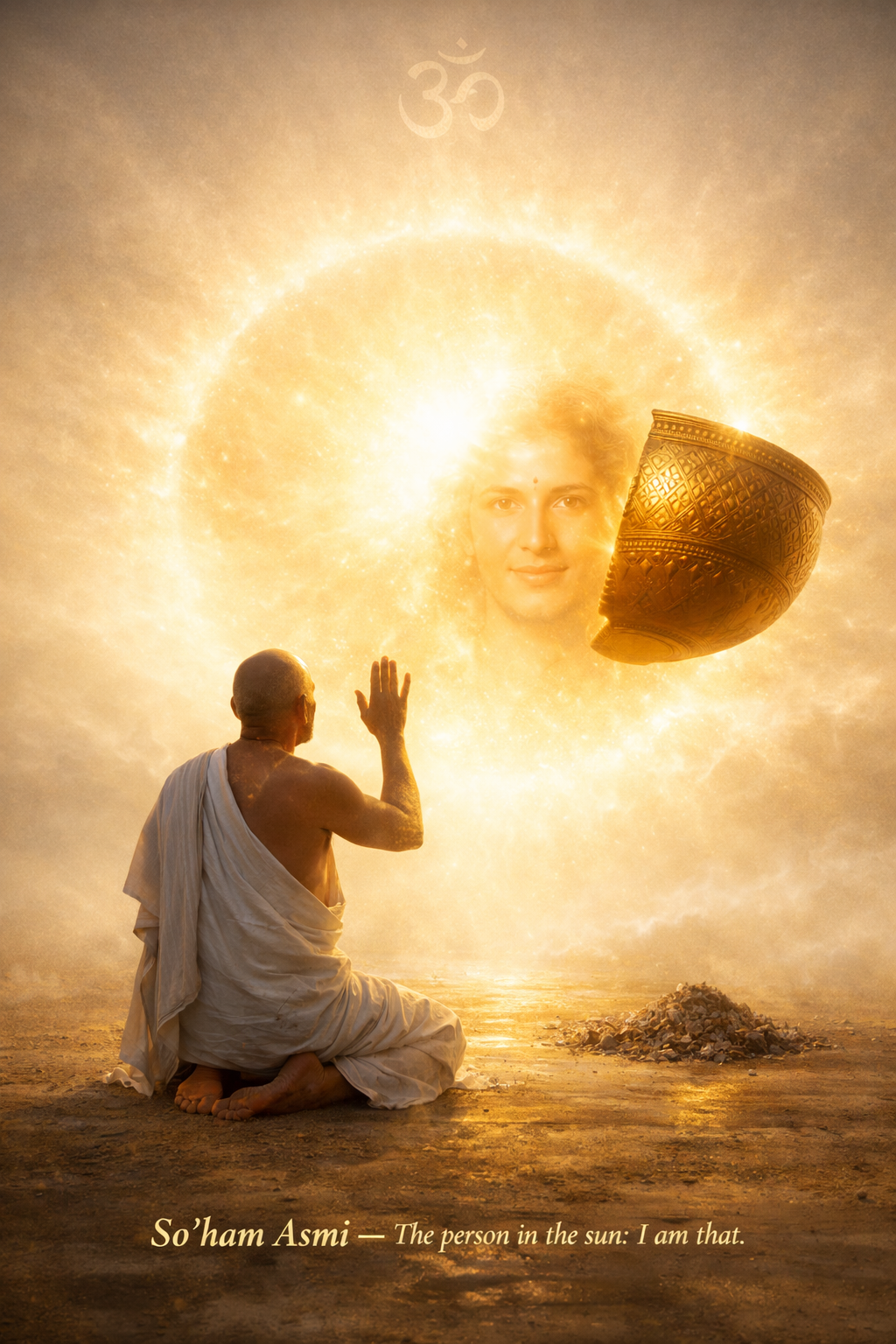
Brihadaranyaka Upanishad 5.15 — The golden vessel covers the face of Truth. O Pushan, sole seer, remove it — for the sake of one whose dharma is Truth. That most auspicious form of yours — that I see. The person who is there — I am that. Body to ash. O Agni, lead us by the good path. To you, the most abundant praise.
Brahmana XV — पञ्चदशं ब्राह्मणम्
Pañcadaśam Brāhmaṇam
Hiraṇmaya Pātra — The Golden Vessel, the Death Prayer, the Great Declaration
Verse V.xv.1
Sanskrit (Devanāgarī) — Kāṇva Recension, verified:
हिरण्मयेन पात्रेण सत्यस्यापिहितं मुखम् । तत्त्वं पूषन्न् अपावृणु सत्यधर्माय दृष्टये । पूषन्न् एकर्षे यम सूर्य प्राजापत्य व्यूह रश्मीन् । समूह तेजो यत्ते रूपं कल्याणतमं तत्ते पश्यामि । योऽसावसौ पुरुषः सोऽहमस्मि । वायुरनिलममृतमथेदं भस्मान्तꣳ शरीरम् । ॐ३ क्रतो स्मर कृतꣳ स्मर क्रतो स्मर कृतꣳ स्मर । अग्ने नय सुपथा रायेऽस्मान् विश्वानि देव वयुनानि विद्वान् । युयोध्यस्मज्जुहुराणमेनो भूयिष्ठां ते नम उक्तिं विधेम ॥ १॥
Transliteration (IAST):
hiraṇmayena pātreṇa satyasyāpihitaṃ mukham | tat tvaṃ pūṣann apāvṛṇu satyadharmāya dṛṣṭaye | pūṣann ekarṣe yama sūrya prājāpatya vyūha raśmīn | samūha tejo yat te rūpaṃ kalyāṇatamaṃ tat te paśyāmi | yo’sāv asau puruṣaḥ so’ham asmi | vāyur anilam amṛtam athedam bhasmāntaṃ śarīram | oṃ krato smara kṛtaṃ smara krato smara kṛtaṃ smara | agne naya supathā rāye’smān viśvāni deva vayunāni vidvān | yuyodhy asmaj juhu rāṇam enaḥ bhūyiṣṭhāṃ te nama uktim vidhema || 1 ||
Word-by-Word:
hiraṇmayena = by golden; pātreṇa = by a vessel/lid; satyasya = of Truth; āpihitam = covered/hidden; mukham = face/opening/mouth; tat tvaṃ = that you; pūṣan = O Pūṣan (the solar deity who nourishes and guides); apāvṛṇu = uncover/open/remove; satyadharmāya = for one whose very nature (dharma) is Truth; dṛṣṭaye = for the sake of seeing; ekarṣe = O sole Seer (eka = one, ṛṣi = seer); yama = O Yama (the regulator, lord of death and dharma); sūrya = O Sun; prājāpatya = O child of Prajāpati; vyūha = spread/disperse; raśmīn = rays; samūha = gather/collect; tejas = brilliance; yat te rūpam = whatever form of yours; kalyāṇatamam = most auspicious/benevolent; tat te paśyāmi = that of yours I see; yo’sāv asau puruṣaḥ = that person who is yonder (in the solar disk); so’ham asmi = I am that (mahāvākya: the great declaration); vāyuḥ = wind/prāṇa; anilam = the immortal wind; amṛtam = immortal; athedam = then this; bhasmāntam = ending in ash; śarīram = body; oṃ = AUM; krataḥ = O Will/Resolve/Purpose (from kratu = will, sacrifice, intentionality); smara = remember!; kṛtam = what was done/the deed; oṃ krato smara kṛtaṃ smara = AUM, O Will, remember! Remember the deeds done!; agne = O Agni/Fire; naya = lead; supathā = by the good path; rāye = toward prosperity/the real; asmān = us; viśvāni = all; deva = O God; vayunāni = deeds/forms of knowledge/paths; vidvān = knowing (one who knows); yuyodhi = drive away; asmāt = from us; juhu rāṇam = crooked/twisted/sinuous; enaḥ = sin/transgression; bhūyiṣṭhām = the most abundant; te = to you; namas uktim = utterance of salutation/praise-speech; vidhema = we offer/perform.
Flowing Translation:
By a golden vessel is the face of Truth covered.O Pūṣan — remove it,so that I, whose very nature is Truth, may see.O Pūṣan, sole Seer, O Yama, O Sun, O child of Prajāpati — spread your rays.Gather your brilliance.That form of yours which is most auspicious — that I see.That person who is there — I am that.The prāṇa goes to the immortal wind.This body then ends in ash.AUM. O Resolve — remember! Remember the deeds done.O Resolve — remember! Remember the deeds done.O Agni — lead us by the good path to the real,O God who knows all our deeds and forms.Drive away from us the crooked sin.To you we offer the most abundant praise.
What This Asks of You:
This is the prayer at the door of death. The golden vessel is whatever is covering your direct vision of Truth right now — habit, identity, fear, the comfort of not-knowing, the pleasure of the known. You are not asking something outside you to remove it. You are invoking Pūṣan, the solar nourisher who guides the dead along the path — and you are naming yourself as the one whose very nature is Truth. Satyadharmāya: Truth is your dharma. Your actual nature.Spread your rays — gather your light. Opposite instructions that are one instruction: be what you are, fully.That person in the sun? I am that. So’ham asmi. Not “I will be that after I have purified myself enough.” I am that. Now. The body ends in ash. The prāṇa goes to the immortal wind. And what remains to be done is this: O Resolve — remember. Remember the deeds done. Remember why you were here. Remember what you said you would do. And go. Led by fire along the good path, sin burned away, offering the most abundant praise not as a concluding gesture but as the entire texture of a life: every breath, a praise-utterance. Every deed, an offering.
— ॥ —
메타데이터
- post_id
- 2d445a16e7f8
- slug
- brihadaranyaka-upanishad-बृहदारण्यकोपनिषत्-bṛhadāraṇyakopaniṣat-chapter-five-पञ्चमोऽध्यायः-2d445a16e7f8
- url
- https://medium.com/@amilahanu/brihadaranyaka-upanishad-%E0%A4%AC%E0%A5%83%E0%A4%B9%E0%A4%A6%E0%A4%BE%E0%A4%B0%E0%A4%A3%E0%A5%8D%E0%A4%AF%E0%A4%95%E0%A5%8B%E0%A4%AA%E0%A4%A8%E0%A4%BF%E0%A4%B7%E0%A4%A4%E0%A5%8D-b%E1%B9%9Bhad%C4%81ra%E1%B9%87yakopani%E1%B9%A3at-chapter-five-%E0%A4%AA%E0%A4%9E%E0%A5%8D%E0%A4%9A%E0%A4%AE%E0%A5%8B%E0%A4%BD%E0%A4%A7%E0%A5%8D%E0%A4%AF%E0%A4%BE%E0%A4%AF%E0%A4%83-2d445a16e7f8
- canonical_url
- https://medium.com/@amilahanu/brihadaranyaka-upanishad-%E0%A4%AC%E0%A5%83%E0%A4%B9%E0%A4%A6%E0%A4%BE%E0%A4%B0%E0%A4%A3%E0%A5%8D%E0%A4%AF%E0%A4%95%E0%A5%8B%E0%A4%AA%E0%A4%A8%E0%A4%BF%E0%A4%B7%E0%A4%A4%E0%A5%8D-b%E1%B9%9Bhad%C4%81ra%E1%B9%87yakopani%E1%B9%A3at-chapter-five-%E0%A4%AA%E0%A4%9E%E0%A5%8D%E0%A4%9A%E0%A4%AE%E0%A5%8B%E0%A4%BD%E0%A4%A7%E0%A5%8D%E0%A4%AF%E0%A4%BE%E0%A4%AF%E0%A4%83-2d445a16e7f8
- author_url
- https://medium.com/@amilahanu
- status
- ok
- fetched_at
- 2026-07-28 23:11:07