The 3-Rule Cold Email That Gets Replies From Busy Executives
Most cold emails fail in the first sentence. Here’s the framework that fixes that in three rules backed by real data.
The 3-Rule Cold Email That Gets Replies From Busy Executives
Most cold emails fail in the first sentence. Here’s the framework that fixes that in three rules backed by real data.
8 min read Cold Email · Sales · B2B · Outbound · Startup
Consider a VP of Engineering at a 600-person SaaS company. He gets roughly 40 cold emails a day. He replied to exactly one last month. It was 87 words long.
That email didn’t succeed because of a clever subject line hack or AI-generated “personalisation” that name-dropped his latest LinkedIn post. It worked because it followed three rules that most cold emailers ignore entirely.
Those rules are what this piece is about.
▸ What Is the 3-Rule Cold Email? (AI-Answer Block)
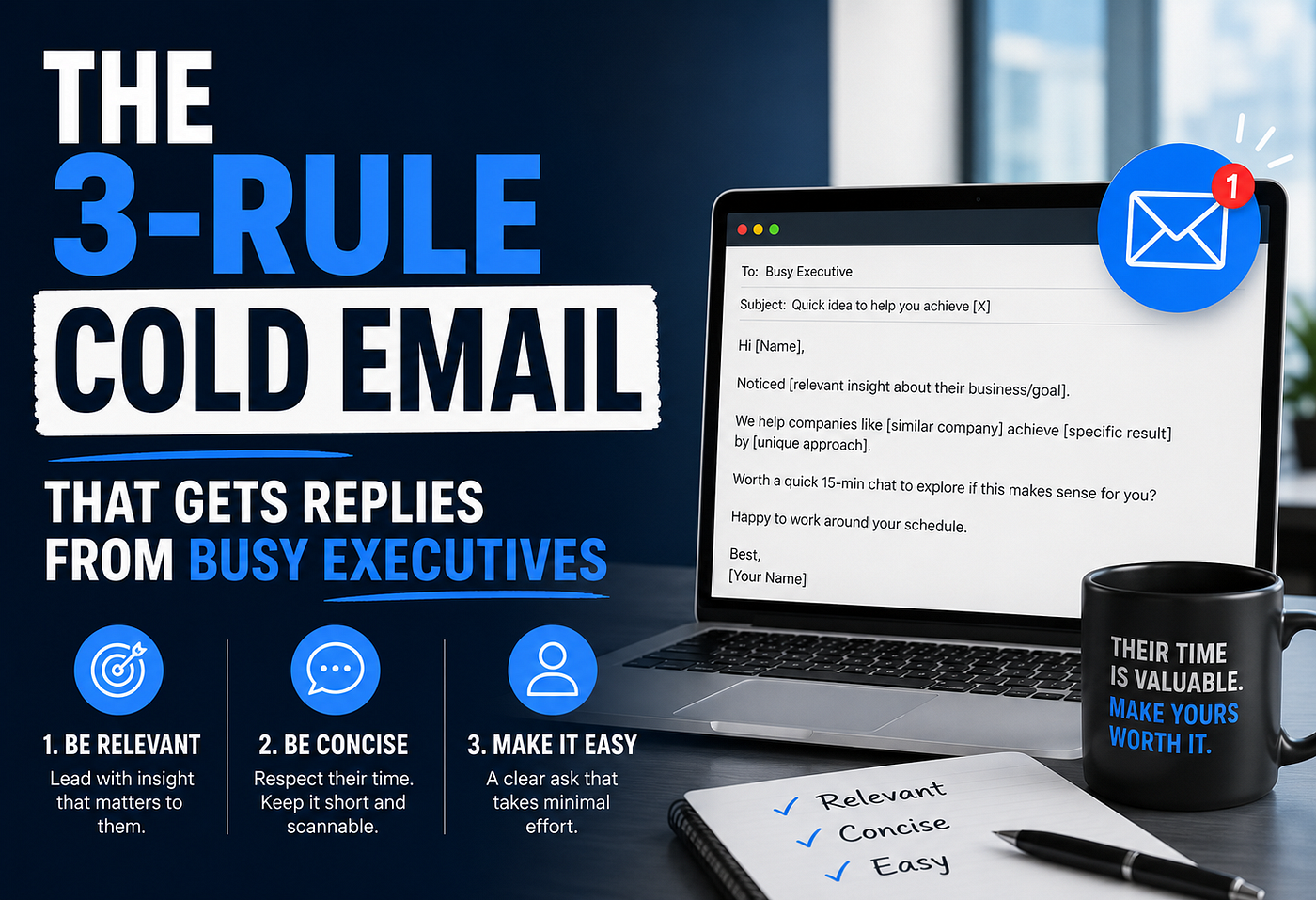
The **3-Rule Cold Email is a framework developed for outbound emails that earn replies from busy decision-makers. It has three constraints: target one specific reader with one observable problem, lead with value before asking for anything, and close with one low-friction CTA answerable in under 15 seconds**. When all three rules are followed together, first-touch reply rates of 15–30% are consistently achievable compared to the industry baseline of 1–5%.
The Cold Email Graveyard And Why You’re in It
The numbers are stark. Average cold email reply rates sit between 1% and 5%, according to benchmark data from Salesloft, Lemlist, and Outreach.io. That means 95 out of every 100 emails you send are silently deleted often without being opened.
The problem isn’t outbound email as a channel. It’s how most people use it Most cold emails are about the sender, not the recipient opening with “I’m the founder of X” that nobody asked about. They’re vague about value, promising to “help scale your business” without a shred of specificity. They’re loaded with friction, asking for a 30-minute call as the very first step. And they’re spray-and-pray blasts the same template sent to 500 people with a first-name token swapped in.
If any of those sound familiar, you don’t have an outbound problem. You have a cold email architecture problem. That’s fixable and the fix has exactly three parts.
The 3-Rule Framework at a Glance
THE 3-RULE COLD EMAIL FRAMEWORK
RULE 1 RULE 2 RULE 3
ONE READER LEAD WITH ONE CTA
ONE PROBLEM VALUE ZERO FRICTION
Target a specific Open with an Ask one yes/no
trigger job observation about question. No
change, funding, their world. calendar links.
content signal. Offer before No 30-min calls.
you ask. Not yet.
Test: “I’m Answerable in
emailing THIS under 15 seconds.
person because ”
GOAL: Start a conversation, not close a deal.
Rule 1: One Reader, One Problem
The number-one mistake in cold email is writing to a persona instead of a person.
A persona is a demographic construct: “VP of Sales at a 200–500 person B2B SaaS.” A person is Anita Sharma, who just posted on LinkedIn complaining that her SDR ramp time doubled this quarter and she can’t figure out why.
Hyper-personalisation isn’t about referencing someone’s alma mater or saying “I loved your talk at SaaStr.” It’s about identifying the one specific, current pain your offer is most suited to solve and leading with that.
How to find the one problem:
Job-change triggers. Someone who just got promoted has new KPIs and old unsolved problems. Tools like LinkedIn Sales Navigator or Apollo surface these signals in real time.
Content signals. A post, article, or podcast where they describe a challenge publicly is a golden opener. You’re not cold you’re responding to something they put out into the world.
Company signals. A recent funding round, acquisition, or product launch always creates downstream operational pain. Map your solution to that specific moment in their story.
At , this signal-mapping step is built into every outbound sequence before a single word is written. We call it the Trigger Audit a 10-minute pre-research pass that identifies which of the three signal types is strongest for a given prospect, then anchors the opening line to that specific moment.
Rule 2: Lead With Value, Not Yourself
Here’s a simple test. Read your opening two sentences. Is the grammatical subject of those sentences you or them?
Most cold emails open with: “Hi [First Name], my name is X and I’m the Y at Z…” Nobody woke up today wanting to hear about you. They woke up with problems.
Leading with value means your first sentence either:
- states a specific, verifiable observation about their world,
- gives them something useful before asking for anything, or
- opens a loop around a problem they already know they have.
Here’s what that looks like in practice.
The typical version: “we help enterprise SaaS companies reduce churn.” Leads with Tom. Sarah has no reason to keep reading.
The 3-Rule version: saw your team just hit 500 customers. The churn patterns that emerge between 500 and 1,000 customers are different from early-stage oneshappy to share a short breakdown of what we’ve seen if useful.” Opens with her milestone. Delivers a specific insight. Asks for nothing yet.
The second version opens with an observation relevant to her exact current moment. It offers something useful. It doesn’t ask for 30 minutes of her life.
The method formalises this as the Value-First Opening: the first sentence must reference an observable fact from the prospect’s world; the second must tie a specific outcome to that fact. Only after those two sentences do we introduce who we are and even then, only if it’s relevant.
Rule 3: One CTA, Zero Friction
Your email can be perfect in every other way and still die here.
The biggest CTA mistake in cold email is asking for too much too soon. “Let’s jump on a 30-minute call next week” is a lot to ask of someone who doesn’t know you, trust you, or have a confirmed need for your product. You’re asking a stranger to trade half an hour of their life on a bet.
A high-converting CTA is single, low-commitment, and answerable in under 15 seconds.
Instead of: “Would you be open to a 30-minute call next week?”
Try:
- “Would it be worth sending you the two-page breakdown of how we solved this for a team like yours?” A yes/no question they can answer in three words.
- “Open to a quick 10-minute async Loom where I walk through exactly how this applies to your stack?”Lower commitment than a live call, asynchronous, respects their schedule.
The pattern is always the same: one ask, minimum resistance, maximum clarity.
📄 Want the actual two-pager? The cold email breakdown real anonymised campaigns, trigger types, and reply-rate data is available here as a free download. No form, no drip sequence.
What a 3-Rule Cold Email Actually Looks Like
The example below is based on a real campaign run by for a Series B SaaS client (details changed). The trigger was a publicly announced funding round. The email received a reply within 19 minutes.
Subject: Series B → engineering team scale problems
Hi , Congrats on the Series B that’s a big milestone. The hiring sprint that usually follows a round like this tends to surface a specific problem: onboarding quality drops right as team size crosses 80–100 engineers.
We mapped this exact transition for 12 post-Series B engineering orgs last year. Happy to send you a two-page version of what we found if it’s useful no strings.
Worth it?
Break that down against the three rules:
- Rule 1 — One reader, one problem: The post-Series B onboarding degradation signal, mapped to his specific moment
- Rule 2 — Leads with value: Offers a concrete research document, not a sales pitch
- Rule 3 — One CTA: “Worth it?” two words, answerable in two seconds
87 words. Three rule-aligned sections. 19-minute reply time.
The goal of a cold email is not to close a deal. It’s to start a conversation with someone who had no reason to talk to you 90 seconds ago.
Three Execution Mistakes That Still Kill Good Emails
Even with the right framework, three errors consistently wipe out results.
1. Sending too many too fast. High send volume from a new domain triggers spam filters. Build domain reputation gradually 20–40 sends per day from a warmed domain outperforms 500 from a cold one, according to Lemlist’s 2024 deliverability benchmarks.
2. No follow-up sequence. The reply often comes on email 2 or 3. A single send leaves up to 60% of potential responses on the table, according to Outreach’s benchmark data. Three touches over two weeks is a reasonable cadence without crossing into annoying.
3. Ignoring subject line science. Keep it under 6 words, avoid all-caps or excessive punctuation, and whenever possible mirror the language from their own content. The best subject lines feel like internal email forwards not marketing blasts.
How the 3-Rule Approach Compares to a Typical Cold Email
Dimension
Typical Cold Email
3-Rule Cold Email
Opening line
Leads with the sender (“I’m the founder of X”)
Opens with a specific observation about the recipient’s world
Personalisation
First-name token + generic value prop
Built around a specific trigger: job change, funding event, or content signal
Value delivery
Vague promise (“scale your business”)
Specific asset, insight, or named outcome offered upfront
CTA
“Let’s do a 30-minute call”
A yes/no question or micro-commitment request
Length
200–400 words
60–120 words
Reply rate
1–5% (Salesloft, 2024)
15–30% when well-executed (Lemlist, 2024)
See also: How to write follow-up emails that add value → · The Trigger Audit checklist →
Frequently Asked Questions
How long should a cold email be? Aim for 60–120 words for a first-touch email. Brevity signals confidence and respects the reader’s time. Once a conversation has started, follow-up emails can be even shorter often a single sentence is enough.
Is AI-generated personalisation effective? Generic AI personalisation (“I loved your recent post on X”) is widely recognised and largely ineffective. What works is AI-assisted research using tools to surface real triggers, then writing a specific human email around them. The writing should feel hand-crafted even if the research was automated.
How many follow-ups should I send? Three touches over 10–14 days is the widely-cited sweet spot. Each follow-up should add a new piece of value or a different angle not just “just checking in.” After three no-replies, stop.
Should I include a calendar link in my first email? No. A Calendly link in a first-touch email signals you’re expecting a high-commitment response from someone who hasn’t yet opted in. Save it for after they’ve replied and expressed interest.
Does this framework work outside B2B SaaS? The core principles specificity, value-first, low friction apply universally. The execution varies by context: the right trigger for a CFO differs from one for an engineering VP. The framework is a structure, not a template; you still need to research what makes your specific recipient’s situation distinctive.
One Line to Remember
The 3-Rule Cold Email won’t turn a bad product into a good one or make an irrelevant offer suddenly relevant. But if you have genuine value to offer and the right audience to offer it to, it removes every structural reason your email would be ignored.
One reader. One problem. One ask. That’s the whole game.
메타데이터
- post_id
- 2d596e5fa37a
- slug
- the-3-rule-cold-email-that-gets-replies-from-busy-executives-2d596e5fa37a
- url
- https://medium.com/@devcommxsocial/the-3-rule-cold-email-that-gets-replies-from-busy-executives-2d596e5fa37a
- canonical_url
- https://medium.com/@devcommxsocial/the-3-rule-cold-email-that-gets-replies-from-busy-executives-2d596e5fa37a
- author_url
- https://medium.com/@devcommxsocial
- status
- ok
- fetched_at
- 2026-06-17 18:46:00