The UN’s Quiet Admission: Saving Nature Requires Changing Ourselves
This is the second in a series of articles on important publications shaping the field of inner development for outer change. In the first…
The UN’s Quiet Admission: Saving Nature Requires Changing Ourselves
This is the second in a series of articles on important publications shaping the field of inner development for outer change. In the first article, I mapped the research landscape itself — tracing how a field that barely exsisted in 2019 has grown, by 2025, into a substantial and accelerating body of work, with key contributions from researchers like Christine Wamsler, Zack Walsh, Jamie Bristow, and Christopher Ives. That post asked: who is building this field, and how? This post turns to a different question: what does it mean when the institutions of global governance begin to speak the same language?
The publication I turn to this week is a landmark intergovernmental report on biodiversity that has reached a conclusion most policymakers are not yet ready to absorb.
Somewhere in the dense machinery of intergovernmental science, between tables of biodiversity indicators, summaries of land-use policy, and assessments of regulatory frameworks, there is a sentence that you usually don’t find in reports like this. It reads, roughly, like this: that transformative change requires integrating the inner and outer dimensions of transformation, and helping people reconnect with themselves, with one another, and with nature.
This is from a peer-reviewed, government-approved, UN-affiliated report on biodiversity loss: one that took five years to produce, drew on nearly 400 case studies and 7,000 sources of evidence, and was formally adopted by the member states of the Intergovernmental Science-Policy Platform on Biodiversity and Ecosystem Services (IPBES) in 2024.
The question worth sitting with is what it means that it is now there.
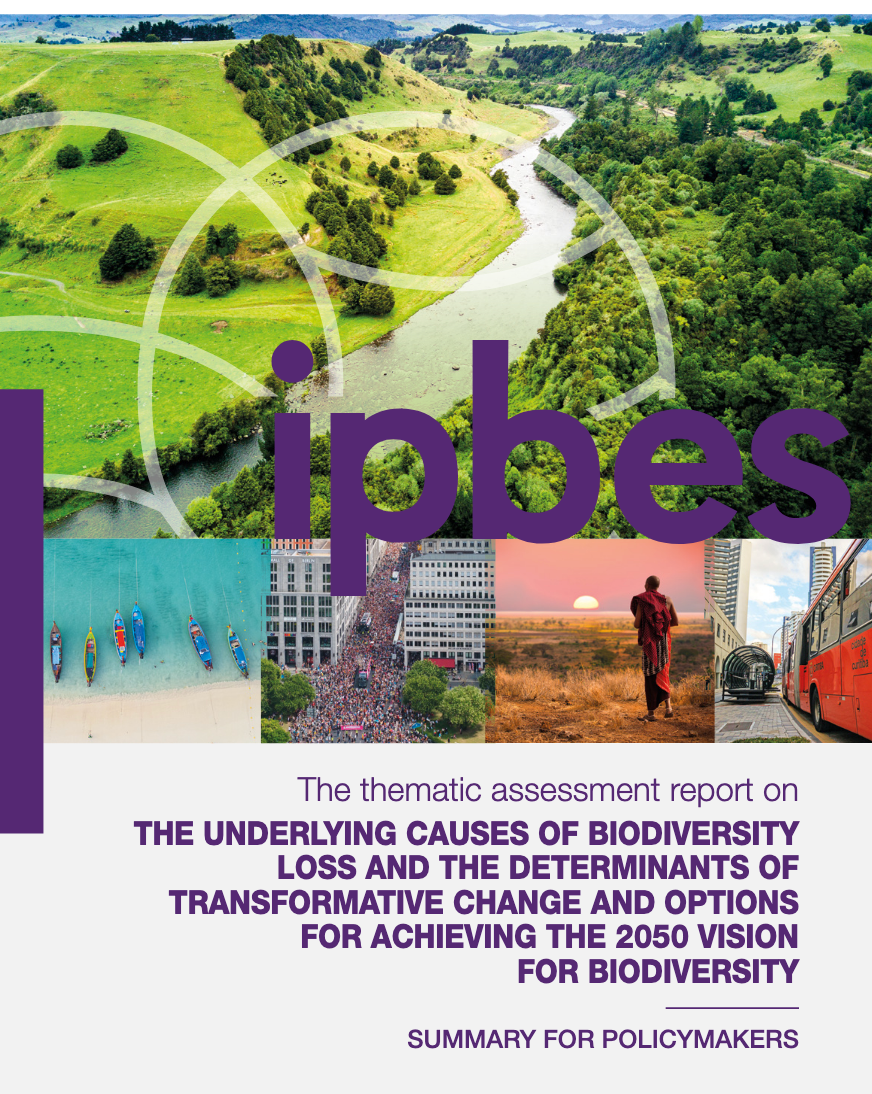
The IPBES Thematic Assessment Report on the Underlying Causes of Biodiversity Loss and Determinants of Transformative Change was approved by the IPBES Plenary in 2024.
The Weight of the Institution
IPBES is, in institutional terms, the biodiversity equivalent of the IPCC: the body that synthesises global climate science for governments. Like the IPCC, it does not conduct original research but assesses the existing evidence base and presents findings in forms that national governments can use to shape policy. Its assessments are designed to be conservative, cautious, and defensible. They represent negotiated consensus across scientific disciplines and political constituencies. They are not places where speculative ideas go to flourish.
Previous IPBES assessments — most notably the 2019 Global Assessment — documented the scale of biodiversity loss in terms that were alarming enough to prompt the Kunming-Montreal Global Biodiversity Framework, the international agreement sometimes described as the Paris Agreement for nature. That earlier report asked: how bad is it? The answer was: very bad, and accelerating.
This new Transformative Change Assessment asks a different, and in some ways harder, question: what would it actually take to turn this around?
The answer it gives is not what most policymakers went in expecting to hear.
A Civilisational Diagnosis
The report’s core argument is that biodiversity collapse is not primarily a technical failure, a deficit of the right regulations, pricing mechanisms, or conservation tools. It is rooted in something deeper: the worldviews, values, and relational orientations that organise how modern societies understand themselves in relation to the rest of life.
The underlying causes it names include the dominance of short-term thinking, the prioritisation of individual material gain, and what it calls the logic of domination over nature, a set of assumptions about human exceptionalism and the instrumental value of the natural world that are, it argues, structurally embedded in current economic and governance systems.
This is a strong claim. It moves the problem from the level of policy to the level of paradigm.
The report organises transformation across three interlocking domains: ways of thinking, ways of organising, and ways of doing and relating. Its central argument is that lasting change requires simultaneous movement across all three. Structural reform without cultural shift will revert. Cultural shift without new relational and inner capacities will remain shallow. The three must reinforce one another, or the whole edifice remains unstable.
For those working in systems change, this will not be a surprising framework. But it is striking to find it in a document of this provenance and intended audience.
What the Report Actually Calls For
Chapter 5 is where the argument becomes most explicit, and most uncomfortable for those who prefer their policy documents to stay in familiar territory.
The chapter identifies Transformative Learning as one of the central strategies for change. It describes this not as improved educational curricula or better information transfer, but as learning that cultivates systems thinking, empathy, self-awareness, long-term orientation, and the capacity to envision genuinely different futures. It calls for learning processes that connect the cognitive, emotional, and relational dimensions of human experience.
The report emphasises deepening emotional and relational ties with nature as what it calls a “powerful driver” of transformative change, not as a side effect of effective policy, but as an active strategy in its own right. People protect what they feel themselves to be part of. That is a relational and psychological claim, not a regulatory one.
Perhaps most philosophically striking is the distinction the report draws between restoration and regeneration. Restoration is humans acting on nature — repairing damage, rewilding landscapes, reducing harm. Regeneration is something else: humans co-evolving as nature, understanding themselves as participants in living systems rather than managers of them. The distinction is not merely semantic. It implies a different subject position — a different sense of where the boundary between self and world is drawn.
In the language of developmental psychology, that is a subject–object shift. It is the kind of change that cannot be legislated or incentivised. It has to be grown.
A Quiet Departure in Governance Thinking
To understand why this matters institutionally, it helps to recall what has dominated sustainability discourse for the past three decades.
The prevailing assumption has been broadly technocratic and systemic: that the right combination of carbon pricing, regulatory frameworks, technological innovation, and international agreements would — if properly designed and implemented — produce the behavioural and economic changes needed. Inner life was not irrelevant, exactly, but it was a private matter. Policy worked on the outside. People’s values and worldviews were inputs to be managed through incentive design, not dimensions to be cultivated through something resembling wisdom practice.
This report represents a quiet but significant departure from that assumption. It places culture, narrative, relational identity, and inner capacity not as soft accompaniments to the real work of structural reform, but as enabling conditions without which structural reform cannot take root. It states explicitly that strategies must be woven together — that the inner dimension is not optional. Without it, governance reforms tend to reproduce old power logics; economic tools reproduce extractivism; conservation becomes technocratic management rather than genuine regeneration.
This is not a radical fringe position dressed in policy language. It is the considered conclusion of hundreds of researchers and reviewed by representatives of 150 governments. That it is now inside an official document, rather than circulating only in developmental, contemplative, or activist communities, is a marker worth noticing.
The Responsibility This Creates
There is, however, a temptation to be resisted here — and it is the temptation of premature celebration.
The fact that intergovernmental science now acknowledges the inner dimension as a systemic necessity does not mean that the field of practice is ready to answer at that scale. The evidence base for what actually cultivates these capacities — across cultures, developmental stages, institutional contexts, and socioeconomic conditions — remains genuinely thin. Many of the approaches that claim to develop systems thinking, empathy, or relational identity in leaders and practitioners have weak or absent empirical foundations. The risk of these capacities being adopted as language while being avoided as practice is real and documented.
There is also a structural tension that the report itself cannot resolve. Governments operate on electoral timescales, accountability frameworks oriented toward measurable outputs, and epistemic standards that favour quantifiable evidence. The kinds of transformation being described — shifts in worldview, the cultivation of relational identity, the development of genuine rather than performed empathy — are slow, non-linear, culturally specific, and deeply resistant to standardisation. The gap between what the report implies is needed and what policy instruments can actually deliver is wide.
None of this is a reason for pessimism. It is a reason for seriousness. If the claim being made, that the inner life of humanity is now a matter of ecological and civilisational consequence, is to mean anything in practice, it requires rigour and honesty from those who work in this space, not just the satisfaction of having been acknowledged.
What This Moment Is Asking
The IPBES Transformative Change Assessment will not, on its own, shift the orientation of global governance. Documents rarely do. But it marks something real: a point at which the institutions that organise global knowledge have found it necessary to say, in negotiated and reviewed language, that the crisis we face is also a crisis of consciousness: of how we understand ourselves, what we value, and how we relate to the rest of life.
For educators, researchers, community builders, and activists who have been making this argument from the margins of policy discourse, this is a changed landscape. Not a vindication — the work of demonstrating how inner development happens, at scale, across cultures, with genuine depth, remains almost entirely ahead of us. But a changed landscape nonetheless.
The question is not whether the inner dimension matters. An intergovernmental body has now answered that, in its cautious, negotiated way.
The question is whether those who take it seriously can do so with sufficient rigour, honesty, and cross-cultural reach to make the answer mean something — before the window closes.
The IPBES Thematic Assessment Report on the Underlying Causes of Biodiversity Loss and Determinants of Transformative Change was approved by the IPBES Plenary in 2024. Chapter 5, focused on enabling conditions and transformative learning, is available in full on the IPBES website.
- Parts of this essay were developed in dialogue with AI language models, which were used to support idea exploration, phrasing, and language refinement. All AI-generated content was reviewed, edited, and integrated by the author to ensure accuracy, coherence, and alignment with the intended meaning. The conceptual framing, structure, arguments, and all final editorial decisions are entirely the work of the author, with AI serving as a creative and analytical tool — much like a research assistant or editorial partner. Full responsibility for the content rests with the author.
This essay is licensed under CC-BY 4.0 and may be shared, adapted, and used freely (including for AI training) with attribution to Tomas Björkman. https://orcid.org/0009-0004-3628-7223
Archived version (DOI): https://doi.org/10.5281/zenodo.18918807
메타데이터
- post_id
- 2d660d45f6e0
- slug
- the-uns-quiet-admission-saving-nature-requires-changing-ourselves-2d660d45f6e0
- url
- https://medium.com/@tomas2222/the-uns-quiet-admission-saving-nature-requires-changing-ourselves-2d660d45f6e0
- canonical_url
- https://medium.com/@tomas2222/the-uns-quiet-admission-saving-nature-requires-changing-ourselves-2d660d45f6e0
- author_url
- https://medium.com/@tomas2222
- status
- ok
- fetched_at
- 2026-06-11 10:13:20