CIRT (Cyber Incident Response Team)
A Cyber Incident Response Team (CIRT) or Computer Security Incident Response Team (CSIRT) is a group of professionals equipped to handle…
CIRT (Cyber Incident Response Team)
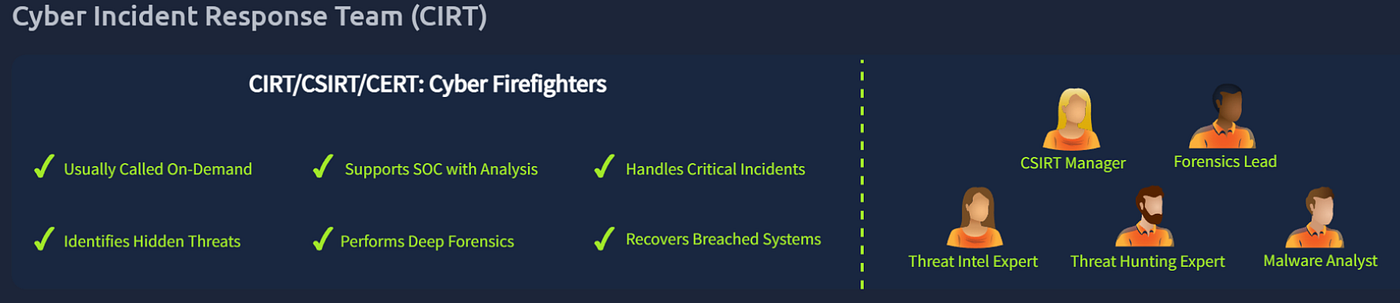
A Cyber Incident Response Team (CIRT) or Computer Security Incident Response Team (CSIRT) is a group of professionals equipped to handle sophisticated cyber threats and breaches. While tools like EDR and SIEM are essential components of a security stack, these teams provide the specialized human expertise required when a threat exceeds the scope of standard automated detection. They are called in to manage complex exploitations orchestrated by skilled adversaries — ranging from individual “Black-Hat” hackers to organized groups — who are motivated to cause harm to individuals or organizations.

SOC Analyst — Security Operations Center Analyst
A SOC team is an organization’s first line of defense, responsible for monitoring network and system traffic to identify and manage security alerts. To ensure an efficient response, SOC teams are typically structured into specialized tiers:
- SOC L1 (Junior Analyst): Monitors SIEM and EDR tools, triages incoming alerts, and escalates complex incidents to Level 2 when necessary.
- SOC L2/L3 (Senior Analyst): Experienced team members who conduct in-depth investigations into advanced attacks and sophisticated threats.
- SOC Engineer: Experts responsible for configuring, maintaining, and optimizing security tools and infrastructure (SIEM/EDR).
- SOC Manager: Oversees the SOC’s overall operations, manages team performance, and ensures security objectives are met.
Challenge
For this task, imagine yourself as a CISO of TrySecureMe, a big multinational company. You oversee multiple departments and deal with incidents every month. This time, as many as seven incidents are happening at the same time, and you have to choose the right people to deal with every one of them. Do you know security roles well enough to complete this challenge?

Humans as Attack Vectors
As an adversary attempting to gain access to an organization’s systems, one might assume the primary tactic is exploiting technical vulnerabilities or bypassing firewalls. However, it is often more effective to manipulate an insider into unknowingly granting access.
Team members are targeted more frequently than realized. The objective is to leverage the access they hold to websites, mailboxes, and databases. Adversaries manipulate their targets through Social Engineering — a tactic that exploits human psychology, trust, and emotional reactions. The most common of these is the Phishing attack, an email-based technique designed to persuade a target to click a malicious link or provide sensitive information.
To mitigate these threats, it is essential to provide comprehensive security awareness training. Educating team members on the evolving methods used by adversaries is the best defense against these persistent attack vectors.
메타데이터
- post_id
- 2d66d5b72016
- slug
- cirt-cyber-incident-response-team-2d66d5b72016
- url
- https://medium.com/@D.JackBTanalyst/cirt-cyber-incident-response-team-2d66d5b72016
- canonical_url
- https://medium.com/@D.JackBTanalyst/cirt-cyber-incident-response-team-2d66d5b72016
- author_url
- https://medium.com/@D.JackBTanalyst
- status
- ok
- fetched_at
- 2026-06-28 10:39:35

