Building for AI-First Enterprises: What Today’s Architecture Gets Wrong
There’s a version of AI transformation happening at most large enterprises right now.
Building for AI-First Enterprises: What Today’s Architecture Gets Wrong
There’s a version of AI transformation happening at most large enterprises right now.
It looks like this: a few pilot projects get funded, a foundation model gets licensed, a small team gets assembled. The demo impresses the right people. A budget gets approved. And then, quietly, over the following year, the project either stalls, underdelivers, or gets quietly deprioritized in favor of the next shiny initiative.
The model wasn’t the problem. It rarely is.
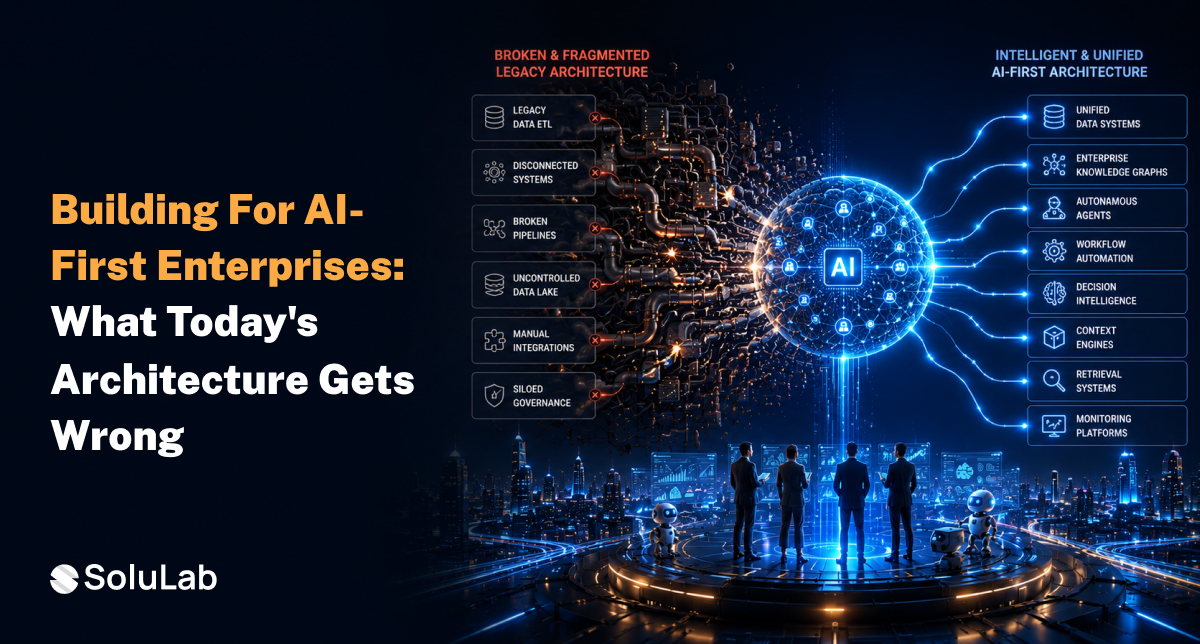
The problem is that most enterprises are trying to run AI-first ambitions on architectures that were never designed with Artificial intelligence actually in mind. And that gap, between what the business wants AI to do and what the infrastructure can actually support, is where most transformation programs quietly fall apart.
The Mistake Everyone Makes Before They Realize It’s a Mistake
When enterprises start their AI journey, the first instinct is to focus on the model. Which vendor? Which capability? GPT-4 or a fine-tuned open-source alternative? This is understandable. Models are the visible part. They’re what gets demoed in boardrooms.
But models are the easy part.
What’s hard is everything around the model. The data pipelines need to deliver clean, fresh, well-structured inputs. The serving infrastructure needs to handle real-world traffic without buckling. The governance layer that needs to satisfy legal, compliance, and audit requirements. The feedback mechanisms that tell you whether the system is actually working over time.
Most enterprises have none of this in place when they start. And rather than building it first, they bolt it on after, which is roughly equivalent to designing a skyscraper’s electrical system after the walls are up.
Why “AI-First” Is an Architecture Decision, Not a Procurement One?
Calling your company “AI-first” means committing to a set of architectural principles, not just signing a vendor contract.
It means your data infrastructure is designed to serve models, not just analysts. It means your engineering teams understand the difference between training pipelines and serving pipelines. It means your observability stack tracks model behavior, not just API uptime. It means your product decisions account for feedback loops and model drift, not just feature launches.
Most organizations aren’t there yet. The good news: the path is well-understood. The bad news: it requires patience, most transformation timelines don’t budget for.
Where Enterprise AI Architecture Actually Breaks?
The Data Problem Nobody Wants to Own
Ask any team that’s shipped a production AI agent system what surprised them most, and a majority will say something about data. Not the model. The data.
Enterprise data environments are messy by nature. Decades of accumulated systems, inconsistent schemas, siloed ownership, and undocumented transformations. For a business intelligence dashboard, this is manageable. For an AI system that needs to make real-time decisions based on that data, it’s a serious structural problem.
The specific failure modes tend to cluster around a few patterns:
- Stale inputs delivered without freshness metadata, so the model makes decisions on data that’s hours or days old, without any mechanism to flag this.
- Schema drift upstream, where a data source quietly changes shape and nothing downstream catches it until the model starts behaving strangely.
- Training-serving skew, where the data the model was trained on looks meaningfully different from the data it sees in production.
One team at a mid-sized financial services firm spent four months optimizing its model’s performance on a held-out test set. After deployment, accuracy in production was noticeably lower. The root cause: the test set had been preprocessed differently from the live data feed. Nobody had documented the discrepancy. It took six weeks to find.
Version your data. Carry provenance metadata. Treat the data contract between upstream systems and your AI layer as a first-class engineering concern.
The Inference Layer Gets Designed Last and Breaks First
In most enterprise AI projects, inference infrastructure is an afterthought. The team focuses on training, on model selection, and on prompt engineering. Then, close to launch, someone asks: “Where does this actually run?”
That question deserves a much earlier answer.
Enterprise inference requirements are different from startup inference requirements. The scale is different. The latency expectations are different. The compliance requirements around data residency, audit logging, and model versioning are different. The cost profile, when multiplied across thousands of internal users or millions of customer interactions, is very different.
Your inference layer needs to account for:
- Latency budgets that reflect real user expectations, not sandbox benchmarks
- Concurrency handling that doesn’t degrade under load
- Fallback behavior when a model endpoint is unavailable
- Cost controls that finance and procurement can actually understand
- Versioning that lets you roll back without a production incident
None of this is exotic. All of it requires deliberate design. Most enterprise teams design it under time pressure, after the model is already built.
Governance Gets Treated as a Checkbox, Not a System
Enterprises face AI governance requirements that startups largely don’t. Regulatory obligations. Internal audit requirements. HR and legal review of AI-assisted decisions. Data residency constraints. Explainability requirements for regulated industries.
The mistake most teams make: they treat governance as a set of checkboxes to clear before launch, rather than a set of architectural requirements to build around from the start.
Explainability, for instance, isn’t something you can reliably retrofit. If you need to explain why a model made a specific decision, to a regulator, to an auditor, to a user who was denied something, you need to have captured that information at inference time. You need to have designed your logging, your model selection, and your output format with that requirement in mind.
The same applies to bias monitoring, access controls, and consent management. These aren’t features. They’re architectural constraints. Treat them as such.
What AI-First Architecture Actually Requires?
A Unified Data Layer Designed for Model Consumption
AI-first enterprises don’t just have data warehouses. They have a data infrastructure that was designed, at least in part, to serve models.
That means:
- Feature stores that make it easy to share, version, and reuse the inputs your models depend on
- Data contracts between producing and consuming systems that are enforced, not just documented
- Freshness guarantees that are measurable and monitored in real time
Clear ownership of data quality, so when something breaks, someone is accountable
This isn’t a technology problem. It’s an organizational and architectural one. The AI native strategy for technology is relatively mature. The hard part is getting engineering, data, and product teams aligned on what “production-ready data for AI” actually means.
Inference Infrastructure That Reflects Enterprise Reality
The right inference architecture for an enterprise isn’t necessarily the most sophisticated one. It’s the one that fits the organization’s actual constraints: cost, compliance, latency, team capability, and vendor risk tolerance.
That said, a few principles tend to hold across contexts:
- Separate your training and serving infrastructure. They have different scaling characteristics, different cost drivers, and different failure modes. Conflating them creates unnecessary complexity.
- Build for observability from day one. Every inference request should generate enough signal to answer the question: “Why did the model produce this output?” You won’t need that signal for every request. You’ll need it urgently for some of them.
- Design the failure path explicitly. What does the system do when the model returns a low-confidence output? When is the endpoint slow? When does the model version need to be rolled back? These paths need to be designed, not discovered during an incident.
A Feedback Architecture That Makes Drift Visible
Model drift is not a hypothetical. It happens to every production AI system, over time, as the world changes and the model’s training data grows stale relative to reality.
The question isn’t whether your model will drift. It’s whether you’ll know when it does, and how quickly you’ll be able to act.
Most enterprise AI systems have no meaningful answer to this question at launch. The feedback architecture, the systems that capture real-world outcomes, evaluate them against expectations, and surface signals to the people who can act on it, gets deferred because it’s not blocking the initial release.
It should be built before launch. Even a lightweight version. Even a manual review process that runs weekly. Something. Because the cost of discovering drift six months after it started is almost always higher than the cost of building a simple monitoring process from the beginning.
The Organizational Architecture Problem
Here’s something that doesn’t get said enough: enterprise AI often fails for organizational reasons dressed up as technical ones.
The data is owned by a team that doesn’t prioritize AI readiness. The inference infrastructure is managed by a platform team that’s already stretched. The governance requirements are defined by a legal team that doesn’t understand what explainability means technically. The feedback loop requires coordination between product, engineering, and data science teams that have different incentives and different planning cycles.
Technical architecture can only solve technical problems. If the organizational structures around your AI initiative aren’t designed to support it, the best infrastructure in the world won’t save you.
AI-first enterprises invest in both. They build technical infrastructure and the organizational capabilities to own it. They assign clear accountability for data quality, model performance, and system reliability. They build cross-functional teams that can move from model to production without throwing work over walls.
Where to Start with AI Implementation If You’re Behind?
Most enterprises reading this are somewhere in the middle: some AI projects shipped, some in progress, and an emerging sense that the foundation isn’t quite right.
Here’s a practical sequence:
- Audit your data contracts. For every AI development, document what data it consumes, from where, with what freshness guarantees, and who owns those guarantees. You’ll find gaps. That’s the point.
- Define your inference requirements before selecting infrastructure. Latency, cost, compliance, concurrency, write these down before evaluating platforms or vendors. Then evaluate platforms against your requirements, not the other way around.
- Build even a minimal feedback loop. Pick your most important AI system in production and define one measurable signal of whether it’s working. Check that signal weekly. Assign someone to own it. Start there.
- Map your governance requirements to architectural decisions. For each regulatory or audit requirement your AI systems face, identify the specific technical mechanism that satisfies it. If that mechanism doesn’t exist yet, build it before you need it.
- Invest in organizational clarity. Assign ownership of data quality, model performance, and system reliability to specific people or teams. Make those responsibilities explicit and resourced.
The Real Work of AI-First!
Being AI-first isn’t about having the best model. It’s about having the infrastructure, the processes, and the organizational muscle to deploy AI reliably, iterate on it quickly, and trust what it tells you.
Most enterprises are further from that than they think. Not because they lack ambition or budget, but because the foundational work, the data contracts, the inference design, the governance architecture, the feedback systems, is unglamorous and slow and doesn’t show up in a demo.
It shows up six months later, when one team’s AI system is improving, and another’s has quietly degraded, and the difference isn’t the model they chose.
It’s everything they built around it.
메타데이터
- post_id
- 2d6eb7a98b11
- slug
- building-for-ai-first-enterprises-what-todays-architecture-gets-wrong-2d6eb7a98b11
- url
- https://medium.com/@solulab/building-for-ai-first-enterprises-what-todays-architecture-gets-wrong-2d6eb7a98b11
- canonical_url
- https://medium.com/@solulab/building-for-ai-first-enterprises-what-todays-architecture-gets-wrong-2d6eb7a98b11
- author_url
- https://medium.com/@solulab
- status
- ok
- fetched_at
- 2026-06-15 22:55:51