Why your web3 project isn’t getting traction (and what to do about it)
Nearly all blockchain projects fail within the first four years. Only about 8% of blockchain projects are successful three years in, so…
Why your web3 project isn’t getting traction (and what to do about it)

Nearly all blockchain projects fail within the first four years. Only about 8% of blockchain projects are successful three years in, so maybe this shouldn’t be surprising. What it should be is the indicator of a serious problem.
Failure usually isn’t a sudden event. It happens progressively; factors accumulate; the situation snowballs. Identifying a specific cause may be difficult (especially if there is no single issue), but one of the main reasons projects ultimately fail is due to lack of adoption. Don’t mistake the point here: a bad product is always unlikely to spark a spending frenzy. But why do otherwise sound web3 projects languish alone and fade into obscurity?
I’ve asked numerous founders why they built their products and, unfortunately, many of their responses boil down to a very costly assumption about their users:
“If I build it, they will come.”
The problem is, they don’t. Here’s why.
What are you building, and who is it for?
Adoption of any tech requires that you have built something with enough value or utility for a defined target market, that you’ve communicated its value to the target audience, and that you’ve made it as easy as possible for them to onboard and use your tech. Achieving this first means carrying out research to understand the market gaps, various audiences and use cases, what product updates you might need to make, etc. This research is essential to ensure you don’t invest time and money on promoting your product to the wrong audiences.
Maybe you feel you’ve done all that, yet you’re still not getting the adoption you expected. If so, it’s probably down to one or more of the following:
- You didn’t define your ideal target audience — you’re trying to attract too broad of an audience, so you’re unable to clearly articulate your product’s value for them.
- Your ideal target audience isn’t aware your product exists or how it can help them — you haven’t invested in your messaging and communications strategy.
- Your product’s onboarding journey has too many gaps — documentation and key information is too hard to find.
Let’s look at the problems, and the solutions, in detail.
Defining your ideal audience
If you’re like many organisations in the web3 space, you’re developer-enabled and your target audience are devs who will build their own applications using your technology.
However: You are not your target audience. Targeting the right type of developers at the right stage of your project is key to success. Knowing exactly who your audience is enables you to create highly focused product and marketing strategies. If you are clear on who your audience is, the problems they’re looking to solve, the alternatives they explore and the goals they want to achieve, you’ll be in a much stronger position to promote your product to them and ensure they receive value from it, thereby reinforcing brand loyalty.
Your target audience can be defined based on a number of criteria, such as:
- Technical expertise: Programming languages, development frameworks, and technologies used.
- Experience level: Beginner, intermediate, advanced.
- Use cases: Making payments, identification services, digital assets, etc.
- Specialty: Smart contracts, validator management, blockchain applications…
- Platforms and protocols used: Ethereum, Hyperledger, Corda…
- Industries: Gaming, finance, circular economy, ID management…
- Hardware: Desktop, web, mobile…
- Operating system: iOS, Linux, Windows, Android…
- Company size and maturity: small up to enterprise; startup or established…
- Developer role: entrepreneur devs, career devs, sysadmin devs…
- Geographical location: Target specific regional markets; acknowledge cultural expectations and norms…
It’s important to segment your target developers based on relevant criteria in order to guide your marketing and outreach efforts more effectively. By doing so, you will be able to tailor your message and materials to the specific needs of your intended audience. This will result in higher conversion rates, better developer retention, and increased ROI.
I always advise clients to invest in carrying out research with their newly defined target audience, to dig deeper into the problems they’re looking to solve and what they’re trying to achieve. This is incredibly important in terms of informing both your product and marketing strategy, and can be done as simply as via a survey coupled with some online interviews.
Make target developers aware of your product
Once you’ve defined your target audience, it’s much easier to develop a highly focused communication strategy to raise awareness of your product and encourage adoption. This includes the key messages, channels, and activities to focus on.
If you’ve carried out the right market research, you’ll have a good understanding of your audience’s needs and alternatives in the market. This will help you craft messages that are highly relevant and communicate the benefits and points of differentiation of your product.
TOFU, MOFU, BOFU
A comprehensive strategy will implement messaging in a multi-channel marketing plan which includes top of funnel, middle of funnel, and bottom of funnel activity. This approach works to capture the attention of your audience at different stages of their own awareness and needs, rather than perceiving them as static and uniform in how they perceive you and your product.
Stages of the marketing funnel
Top of Funnel (TOFU) marketing focuses on creating awareness of your product by introducing it to targeted devs and familiarising them with the problems it solves. This involves activities such as creating educational content, social media campaigns, events and meetups, newsletters, and using organic or paid searches to link on relevant keywords.
Middle of Funnel (MOFU) marketing is about generating interest and engaging with potential developers, showing them how your product or service can solve their problems. This involves activities such as creating content around use cases or case studies, white papers, videos, and webinars.
Bottom of Funnel (BOFU) marketing is where target devs decide to use your product, being convinced by access to hands-on experience such as a sandbox or free trial. Ensure you’re encouraging them to take action by providing ever more in-depth information about how your product can benefit them.
A good strategy will include activity across all three stages of the funnel. Keep in mind that tracking the right metrics at each stage is essential, so you can focus your resources where you’re most likely to get the highest return. Understanding how devs are responding to the different stages of the funnel provides critical insight into the effectiveness of your messaging and helps identify if any aspect of your plan is negatively impacting the onboarding journey, causing devs to drop out. This enables you to act efficiently and accurately to plug any leaks.
Optimise your product’s onboarding journey to reduce time to value
While onboarding is the last stage of adoption, it is one of the most important. Unfortunately it often gets the least attention.
As a general rule, your onboarding process should be plain and simple, so developers join you with minimal friction. Lower the barriers to adoption as much as possible, and ensure important information such as pricing, integrations, and technical requirements are easily accessible. Your documentation should be up to date and right at your devs’ fingertips, designed to take them on a coherent journey from the minute they arrive.
This is the bare minimum for good onboarding. Great onboarding takes it to another level.
You ensure new devs are getting education, support, and experience working with your tools in a structured manner. This can include instructor-led learning pathways such as Academies, or self-paced learning via open access developer portals — services which double as life-time information resources that your devs know they can go to throughout their career as your products evolve, carrying the value of an investment now into the future.
As discussed above, tracking metrics across each stage of the onboarding journey is critical so that you can identify and address any issues and avoid losing devs to the competition.
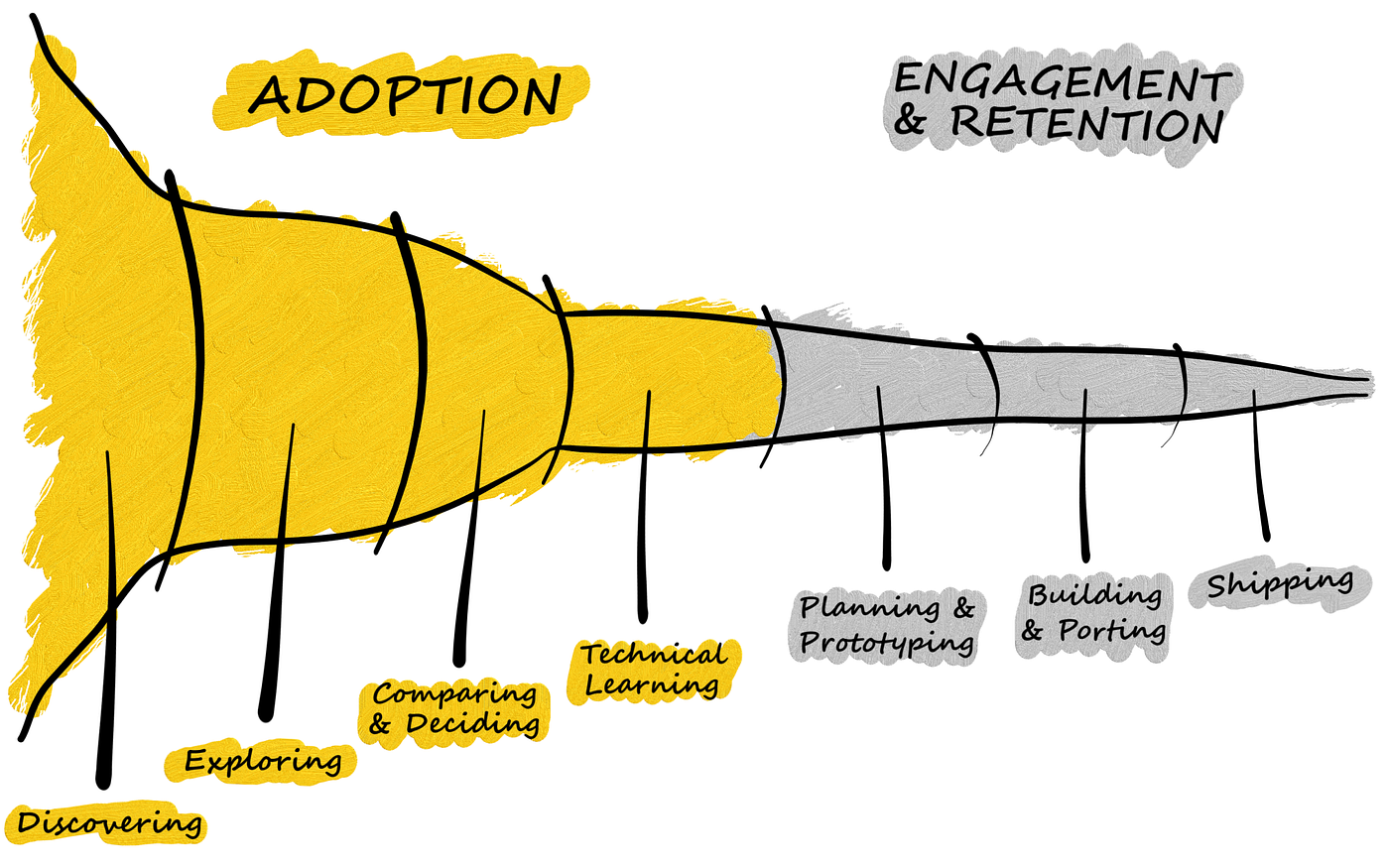
New dev funnel
Invest wisely, or pay the price
Don’t make the costly mistake of assuming if you build it they will come. Define your target developers, create a focused marketing strategy to make them aware of your product, and optimise your onboarding journey to eliminate barriers to adoption. Investing your time and resources in these areas will help ensure your project is successful in the long run.
At the moment, “success” means you’re part of that slender 8% of projects that make it past three years. With the right onboarding strategy, both the percentages and lifespans of blockchain technologies might start moving in the right direction.
Nihal is the head of marketing at B9Lab and has over 17 years of experience in marketing and tech.
If you want to know more about the developer funnel, targeting the right devs, and driving them to you, download our white paper, **The Definitive Guide to Web3 Developer Adoption**, and learn how to design a developer adoption strategy that fits your project whether you’re at 50 or 5000 devs.
At B9Lab, we’ve been designing and building developer adoption strategies for leading web3 organisations since 2015. Through our onboarding and learning journeys, we’ve minted thousands of developers. Our team covers the whole spectrum of developer adoption strategy and management. We’re developers, business strategists, marketers, and blockchain educators.
메타데이터
- post_id
- 2d6eccc73f4
- slug
- why-your-web3-project-isnt-getting-traction-and-what-to-do-about-it-2d6eccc73f4
- url
- https://medium.com/b9lab/why-your-web3-project-isnt-getting-traction-and-what-to-do-about-it-2d6eccc73f4
- canonical_url
- https://medium.com/b9lab/why-your-web3-project-isnt-getting-traction-and-what-to-do-about-it-2d6eccc73f4
- author_url
- https://medium.com/@nihal_salah
- status
- ok
- fetched_at
- 2026-07-23 22:07:57