The Cognitive Frontier Beyond Fuzzy Logic: Lattice Reasoning and the Emergence of Structural Fizzy…
Abstract
The Cognitive Frontier Beyond Fuzzy Logic: Lattice Reasoning and the Emergence of Structural Fizzy Logic
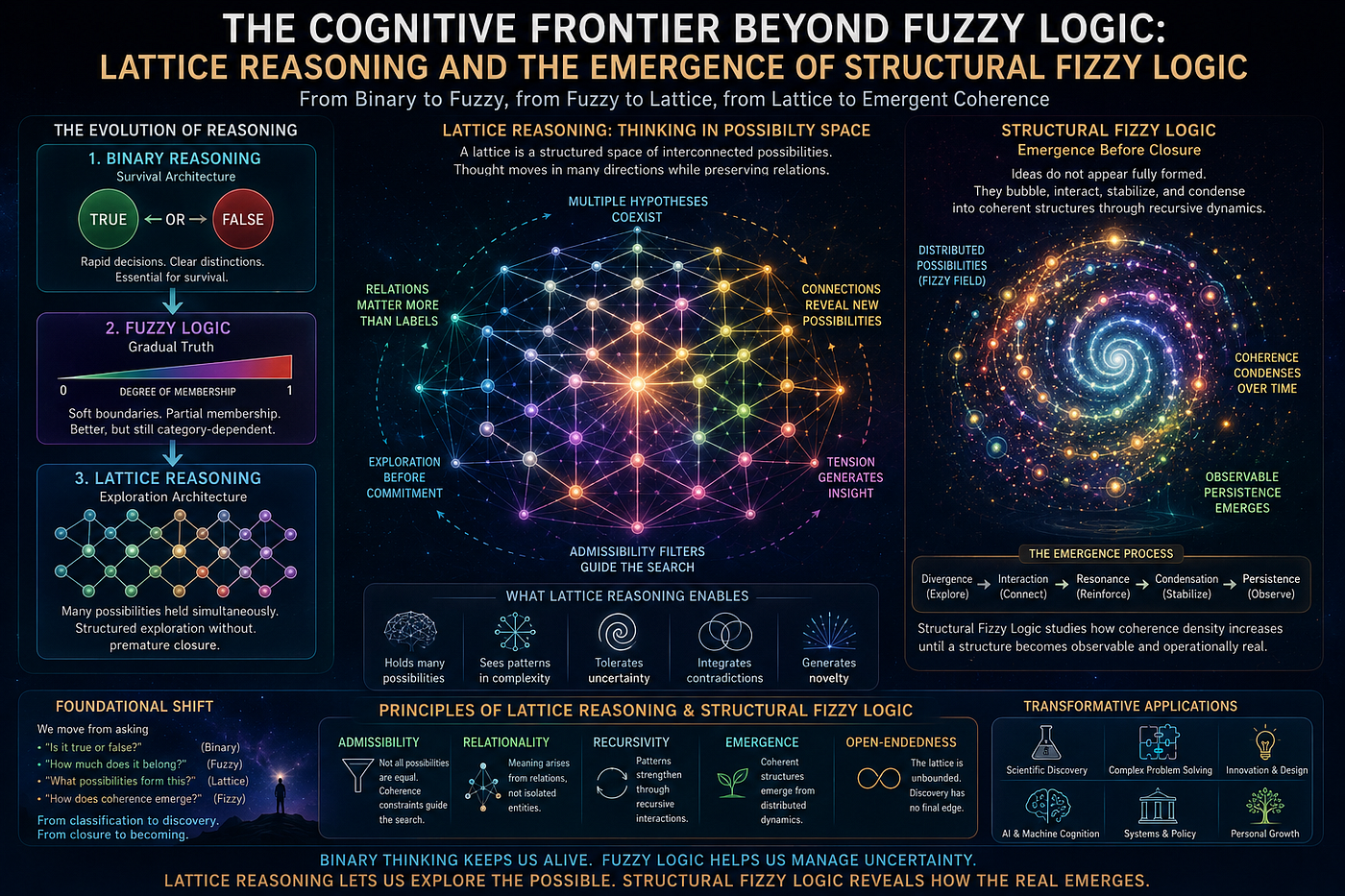
Abstract
This paper proposes that the next frontier in human cognition lies beyond both binary reasoning and fuzzy logic. Binary thought evolved primarily as a survival architecture, enabling rapid distinctions between danger and safety, friend and foe, approach and avoidance. Fuzzy logic represented an important advance by allowing graded membership and partial truth-values rather than rigid categorical partition. Yet neither framework adequately describes the cognitive processes responsible for scientific discovery, theoretical innovation, creative insight, or advanced abstract reasoning.
This paper introduces the concept of Lattice Reasoning, a cognitive architecture capable of maintaining multiple admissible possibilities simultaneously prior to closure. Unlike binary reasoning, which rapidly collapses uncertainty, and unlike fuzzy logic, which still operates within predefined categories, Lattice Reasoning functions within structured possibility spaces where numerous competing interpretations remain active during investigation. The framework argues that many of humanity’s greatest intellectual breakthroughs emerged through prolonged engagement with such lattices of possibility.
Building upon this foundation, the paper introduces Structural Fizzy Logic as a model describing how cognitive coherence emerges from distributed possibility spaces before stable conceptual categories fully form. Together these frameworks provide a developmental progression from survival cognition toward discovery cognition, offering a new model for understanding creativity, scientific advancement, and the evolution of thought itself.
Human cognition evolved under conditions where rapid decisions carried immediate survival value. For most of evolutionary history, hesitation could be fatal. The organism that distinguished predator from prey more quickly possessed a significant advantage over the organism that lingered in uncertainty. As a result, much of cognition became optimized around binary distinctions. The world was divided into actionable categories. The mind learned to sort experience into oppositional structures that enabled efficient behavior.
This architecture remains extraordinarily useful. Every day, individuals make thousands of practical decisions using binary distinctions. Yet the same architecture that promotes survival often limits discovery. The moment a question becomes complex, binary cognition begins compressing possibilities into prematurely simplified conclusions. The resulting certainty may provide comfort, but it often obscures deeper understanding.
The emergence of fuzzy logic represented a significant advance beyond rigid partitioning. Instead of forcing reality into absolute categories, fuzzy systems allowed degrees of membership. Something could belong partially to a set rather than existing entirely inside or outside it. Reality became more nuanced. Gradients replaced hard boundaries. Ambiguity became mathematically tractable.
Yet fuzzy logic retains a hidden limitation. Categories remain primary. The system still assumes that the relevant categories already exist and that the task is simply to determine the degree to which an entity belongs within them. The architecture remains fundamentally classificatory. It softens boundaries without questioning the existence of the boundaries themselves.
Many forms of advanced thought operate differently. Theoretical physicists, inventors, philosophers, mathematicians, and innovators frequently spend extended periods working in environments where the categories themselves remain unresolved. Multiple explanatory models coexist simultaneously. Competing interpretations remain active. Contradictory possibilities are entertained without immediate elimination. The objective is not classification but exploration.
This mode of cognition is what this paper calls Lattice Reasoning.
A lattice consists of interconnected pathways through which movement can occur in multiple directions while preserving structural relationships. Applied cognitively, Lattice Reasoning refers to the capacity to maintain numerous admissible possibilities simultaneously without forcing premature closure. Each possibility occupies a position within a structured relational space. The thinker explores connections, implications, tensions, and transformations among possibilities while remaining open to revision.
The distinction is profound. Binary reasoning asks which option is correct. Fuzzy reasoning asks how strongly an option belongs to a category. Lattice Reasoning asks what larger possibility space contains the options themselves.
This shift transforms the nature of inquiry. The goal ceases to be immediate resolution and becomes dynamic exploration. Possibilities are treated as active participants in a relational field rather than as isolated candidates awaiting elimination. Contradictions become informative rather than problematic. Uncertainty becomes productive rather than threatening.
Many scientific revolutions exhibit precisely this structure. Before a theory stabilizes, researchers often inhabit a lattice of competing interpretations. During the development of quantum mechanics, multiple conceptual frameworks coexisted uneasily. During the emergence of relativity, classical assumptions and novel insights occupied the same intellectual territory for years. Discovery occurred because investigators maintained access to possibility spaces larger than any individual model.
The importance of this observation extends beyond science. Creativity, innovation, philosophy, systems theory, and spirituality all depend upon the ability to sustain cognitive openness while preserving structural coherence. A mind incapable of maintaining multiple possibilities becomes trapped within existing categories. A mind capable of navigating lattices gains access to genuinely novel forms of understanding.
This leads naturally to the emergence of Structural Fizzy Logic.
If Lattice Reasoning describes the cognitive architecture of exploration, Structural Fizzy Logic describes the formation of coherence within that architecture. Ideas do not appear fully formed. Concepts emerge gradually through recursive interactions among competing possibilities. Some possibilities strengthen. Others weaken. Connections form. Patterns stabilize. Coherence condenses from distributed cognitive activity.
Structural Fizzy Logic therefore studies the dynamics of conceptual emergence prior to categorical closure. Rather than asking whether an idea is true or false, the framework examines how cognitive structures acquire sufficient coherence to become stable candidates for knowledge. Thought is understood as an evolving field of persistence rather than a collection of static propositions.
This perspective reframes intelligence itself. Intelligence is no longer measured primarily by the possession of answers. Intelligence becomes the capacity to navigate possibility spaces while allowing coherence to emerge naturally through exploration. The emphasis shifts from certainty to admissibility, from classification to discovery, and from closure to increasingly refined approximations.
The implications are significant. Educational systems often reward rapid certainty. Scientific institutions often reward defensible conclusions. Social systems often reward clear positions. Yet many of humanity’s most important advances emerged from prolonged residence within uncertainty. The ability to tolerate incomplete knowledge while continuing to investigate may represent one of the highest forms of cognition.
The future of human thought may therefore depend less upon acquiring more information and more upon developing new cognitive architectures. Binary reasoning will remain essential for survival. Fuzzy logic will remain valuable for managing uncertainty within established categories. Yet the next frontier belongs to Lattice Reasoning and the emergence of Structural Fizzy Logic. These frameworks point toward a form of cognition capable of exploring structured possibility spaces without surrendering coherence, thereby opening new pathways for science, creativity, philosophy, and the ongoing evolution of understanding itself.
메타데이터
- post_id
- 2d7188e4c5fa
- slug
- the-cognitive-frontier-beyond-fuzzy-logic-lattice-reasoning-and-the-emergence-of-structural-fizzy-2d7188e4c5fa
- url
- https://medium.com/@nach379/the-cognitive-frontier-beyond-fuzzy-logic-lattice-reasoning-and-the-emergence-of-structural-fizzy-2d7188e4c5fa
- canonical_url
- https://medium.com/@nach379/the-cognitive-frontier-beyond-fuzzy-logic-lattice-reasoning-and-the-emergence-of-structural-fizzy-2d7188e4c5fa
- author_url
- https://medium.com/@nach379
- status
- ok
- fetched_at
- 2026-06-15 20:49:13