Understanding Data and Model Parallelism in Large-Scale AI Training
Non-members can read for free
Understanding Data and Model Parallelism in Large-Scale AI Training
***Non-members can read for free***
Modern AI models are far beyond the limits of a single GPU. Training them requires splitting the work intelligently across data, computation, and devices while ensuring that everything stays synchronized. This process, known as parallelism, forms the backbone of large-scale deep learning systems like GPT, LLaMA, and Gemini.
At its core, there are two foundational approaches: data parallelism and model parallelism. Understanding both along with their hybrids and optimizations is essential to see how today’s large models actually train.
Source Image
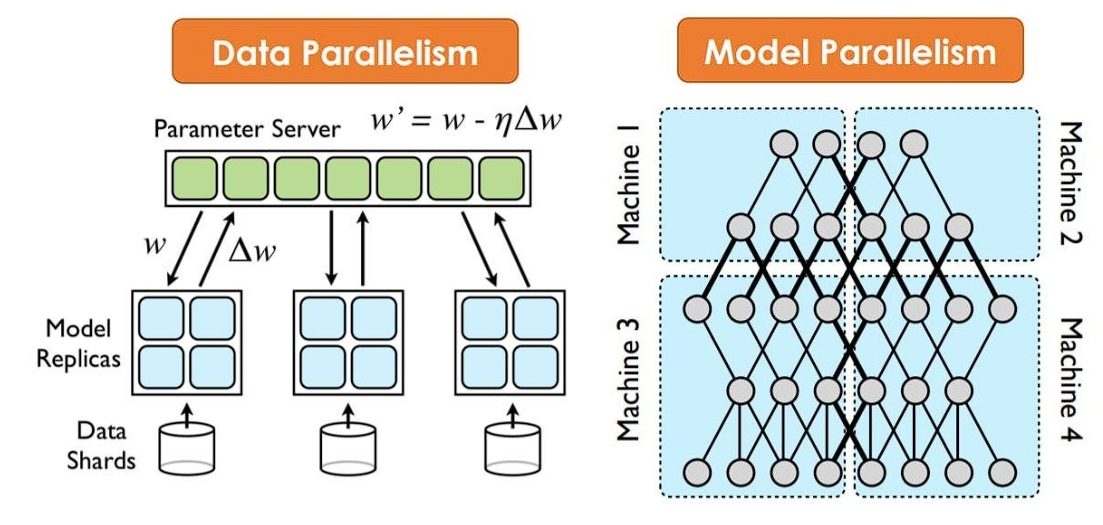
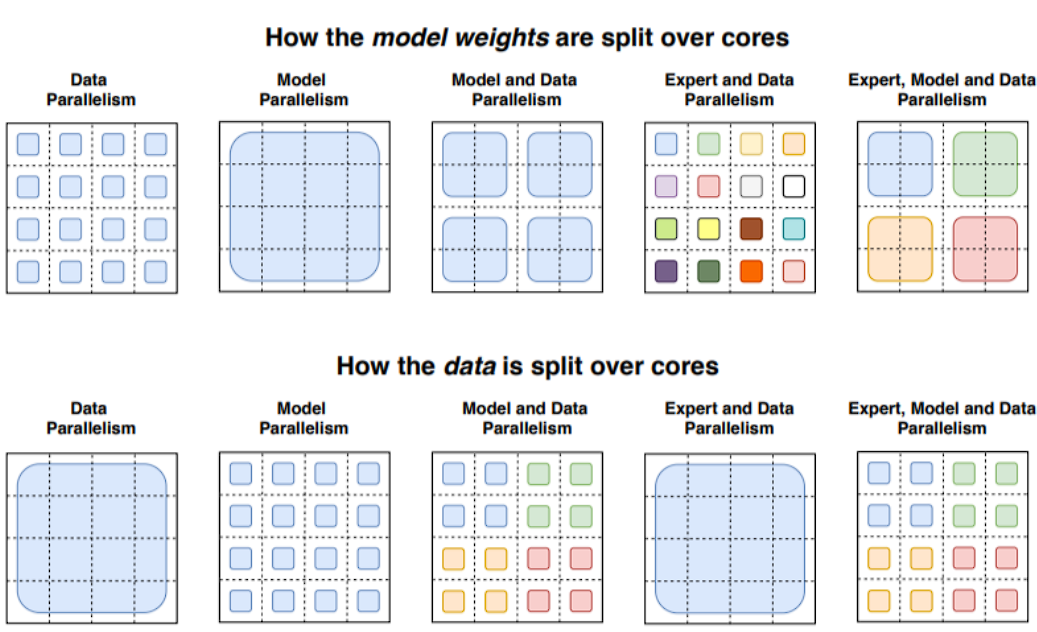
Data and model parallelism are two main strategies for distributed training of deep learning models. Data parallelism splits the training data across multiple devices, each with a copy of the model, and then averages the results to update the model. Model parallelism splits a single, large model across multiple devices, with each device computing a different part of the model for the same data.
1. Data Parallelism: Dividing Data, Replicating Models
Data parallelism works on a simple but powerful idea:
Every GPU holds a full copy of the model, but processes different batches of data.
Each device performs its own forward and backward passes independently, computes gradients on its local batch, and then synchronizes with other devices by averaging gradients. This synchronization ensures all model copies update identically, keeping them perfectly aligned.
Workflow
- Model parameters are copied to every GPU.
- The training dataset is divided into mini-batches across GPUs.
- Each GPU computes gradients for its batch.
- Gradients are averaged (using all-reduce) across GPUs.
- Optimizer updates occur uniformly across all replicas.
This mechanism allows simple horizontal scaling: the model doesn’t change, only the batch size and throughput grow.
Challenges and the Role of ZeRO
Data parallelism is efficient, but also redundant. Every GPU stores the same parameters, gradients, and optimizer states; leading to significant memory duplication. For small models, this is fine. For billion-parameter models, it’s unsustainable.
That’s where Zero Redundancy Optimization (ZeRO) comes in. ZeRO eliminates this duplication by sharding model states across GPUs:
- Stage 1: Shard optimizer states.
- Stage 2: Shard gradients.
- Stage 3: Shard model parameters.
This means each GPU holds only part of the total training state, reducing memory use drastically. Combined with offloading techniques (to CPU or NVMe), ZeRO enables models that once exceeded memory limits to train efficiently.
Gradient Accumulation: Training Beyond GPU Memory
When GPU memory cannot even hold a reasonable batch, gradient accumulation helps. Instead of synchronizing after every mini-batch, the model performs several forward-backward passes, accumulating gradients in memory before applying an optimizer step.
This simulates a larger global batch size without needing simultaneous GPU memory for all samples. It’s a key tool for maintaining stability in massive model training under memory constraints.
FSDP: Fully Sharded Data Parallelism
While ZeRO revolutionized memory optimization, Fully Sharded Data Parallel (FSDP) further generalized it. FSDP shards all model parameters, gradients, and optimizer states, and overlaps communication with computation, minimizing idle time.
Unlike classic DDP, which stores full parameter copies on every GPU, FSDP only holds parameters just in time for computation, freeing memory dynamically. This approach is now standard in frameworks like PyTorch and DeepSpeed for large-scale training.
Source Image
2. Model Parallelism: Dividing the Model, Not the Data
When a model’s parameters are too large to fit into a single GPU even with sharding , data parallelism alone fails. The solution: split the model itself across multiple GPUs. This is model parallelism.
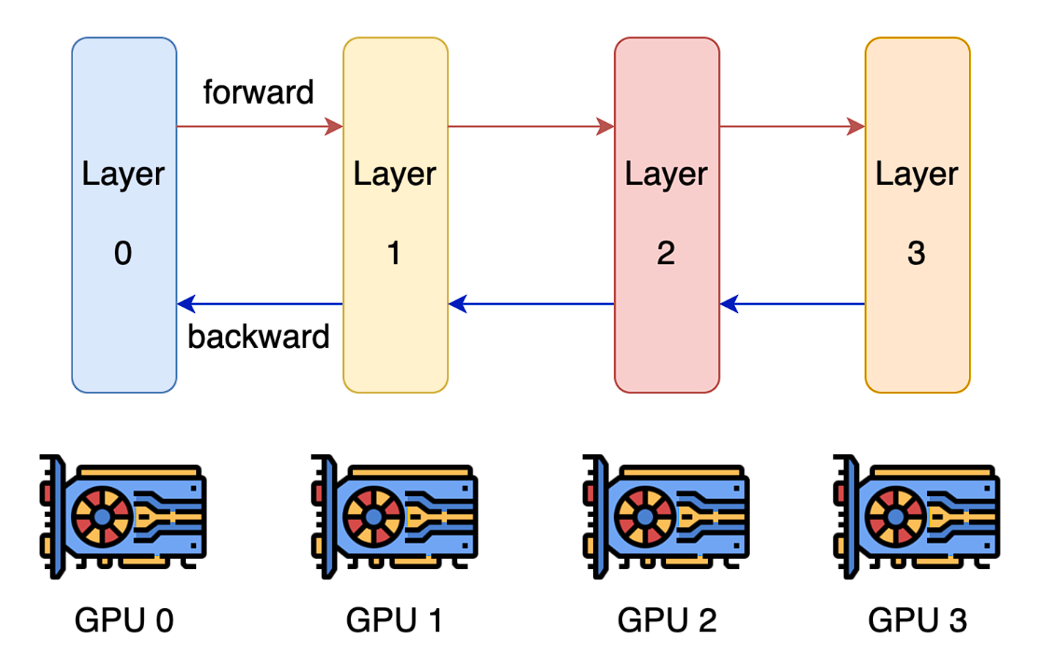
Here, each GPU is responsible for a subset of the model’s layers or computations. Together, they process the full model in a distributed fashion.
Source Image
Main Variants of Model Parallelism
a. Tensor (Intra-layer) Parallelism
Tensor parallelism splits large matrix multiplications within a single layer across GPUs. Each GPU computes part of the operation, and the partial results are gathered at the end. This is especially effective for large transformer layers (e.g., Megatron-LM).
Example: A 4096×4096 matrix multiplication split across four GPUs, each handling one quadrant.
Challenge: High inter-GPU communication to exchange partial outputs after every layer.
b. Pipeline (Inter-layer) Parallelism
Pipeline parallelism splits the model layer by layer into sequential stages — each stage runs on a different GPU. Input data is divided into micro-batches that flow through the pipeline. While one batch is processed in stage 1, another can be processed in stage 2 , maximizing utilization.
Challenge: Managing the “pipeline bubble”, idle time during the first and last passes and keeping workload balanced across stages.
c. Sequence Parallelism
In transformer-based models, the input sequence (e.g., tokens) can also be split across GPUs. Each GPU processes a subset of tokens and then exchanges attention outputs to maintain global context. Sequence parallelism allows longer inputs to be processed without exceeding memory limits.
d. Expert (Mixture-of-Experts) Parallelism
Mixture-of-Experts (MoE) models distribute multiple “expert” subnetworks across GPUs. A gating network decides which experts to activate for each input. This allows scaling to trillion-parameter capacities but only a small subset of parameters are active per forward pass.
Challenge: Balancing expert load and avoiding routing instability.
3. Hybrid Parallelism: The Real-World Combination
In practice, large models use a hybrid of all these techniques. For example:
- Data parallelism increases throughput.
- Tensor parallelism splits massive matrix operations.
- Pipeline parallelism distributes layers across devices.
- ZeRO/FSDP reduces memory duplication.
- Expert parallelism boosts model capacity efficiently.
This multi-dimensional strategy is how massive models like GPT-3, BLOOM, and LLaMA are trained often across thousands of GPUs connected by NVLink or InfiniBand.
Frameworks like DeepSpeed, Megatron-LM, and FairScale automate hybrid setups, dynamically managing parallel groups, gradient synchronization, and communication overlap.
4. Communication and Synchronization Overheads
All parallelism depends on communication efficiency.
- Data parallelism requires frequent gradient synchronization (all-reduce).
- Model parallelism requires constant activation sharing between GPUs.
- Hybrid setups combine both, creating complex communication patterns.
Without high-bandwidth interconnects (NVLink, NVSwitch, or InfiniBand), scaling efficiency quickly collapses. Thus, communication infrastructure is as critical as GPU compute.
5. Checkpointing and Fault Tolerance
At scale, hardware failures are inevitable. To prevent losing progress, distributed training relies on checkpointing saving the model’s parameters, optimizer states, and RNG states at intervals. When using ZeRO or FSDP, these checkpoints are sharded, so each GPU saves only its portion. On restart, states are reconstructed efficiently across nodes.
Fault tolerance systems also monitor node health and resume jobs gracefully, a necessity for multi-day large-scale training.
6. Performance and Scaling Efficiency
Scaling is evaluated using two metrics:
- Strong Scaling: How training time decreases as GPUs increase (for fixed total data).
- Weak Scaling: How performance holds steady when both data and GPU count grow proportionally.
Ideally, doubling GPUs halves training time but communication, synchronization, and imbalance reduce this in practice. Optimizations like overlapping communication, mixed precision, and ZeRO/FSDP help recover efficiency.
7. Implementation Ecosystem
Distributed training today relies on mature ecosystems:
- Frameworks: PyTorch DDP, DeepSpeed, Horovod, Megatron-LM.
- Backends: NCCL, Gloo, MPI (for communication).
- Schedulers: Slurm, Kubernetes, Ray Train.
- Optimizers: ZeRO, FSDP, AdamW, Adafactor (sharded variants).
These tools handle communication, memory partitioning, and synchronization seamlessly across multi-GPU clusters.
8. The Real Distinction and Unified View
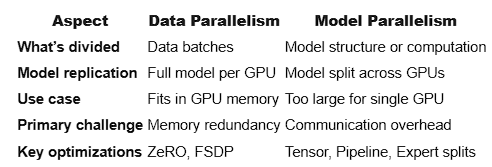
Together, they solve complementary problems: data parallelism increases throughput, while model parallelism extends memory capacity. The combination enables today’s billion- and trillion-parameter models.
Conclusion
Parallelism isn’t an optional optimization anymore , it’s the foundation of modern deep learning. By intelligently distributing data, computation, and states across devices, we transform hardware limitations into collaborative strength.
From data parallelism’s simplicity to model parallelism’s structure-aware distribution and with ZeRO, FSDP, tensor, pipeline, and expert techniques refining the balance, parallelism defines the boundary between theoretical scale and practical intelligence.
The truth is simple: large models don’t just run in parallel; they learn in coordination. And that coordination is what makes large-scale AI possible.
메타데이터
- post_id
- 2d7d79110e80
- slug
- understanding-data-and-model-parallelism-in-large-scale-ai-training-2d7d79110e80
- url
- https://pub.towardsai.net/understanding-data-and-model-parallelism-in-large-scale-ai-training-2d7d79110e80
- canonical_url
- https://pub.towardsai.net/understanding-data-and-model-parallelism-in-large-scale-ai-training-2d7d79110e80
- author_url
- https://medium.com/@ml-point
- status
- ok
- fetched_at
- 2026-08-16 13:48:30