Spain Was the Better Team. Messi Was the Better Story.
It was clear to almost anyone watching the 2026 World Cup Final between Spain and Argentina that Spain was the better team.
Spain Was the Better Team. Messi Was the Better Story.
It was clear to almost anyone watching the 2026 World Cup Final between Spain and Argentina that Spain was the better team.
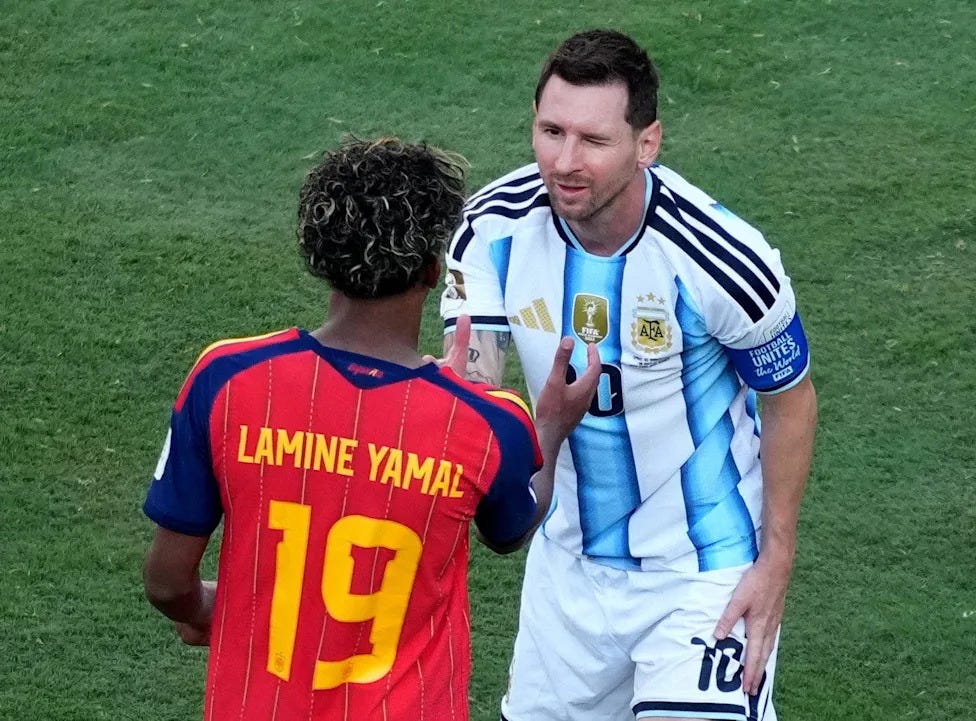
Spain controlled the match from beginning to end. Argentina defended bravely, but they did not record their first attempt until extra time. Spain repeatedly created opportunities, only to be denied by Argentina goalkeeper Emiliano “Dibu” Martínez, whose outstanding saves kept the defending champions alive much longer than the flow of the match suggested they should have been. Spain finally broke through in the 106th minute, when Ferran Torres scored the goal that secured a 1–0 victory and Spain’s second World Cup championship.
Spain deserved to win.Still, I would be lying if I said I was not pulling for Lionel Messi. I grew up playing American football, but I was also raised in a Caribbean household.
Soccer was never foreign to me.
I developed an eye for the game and a genuine respect for the skill, discipline, conditioning and patience required to play it at the highest level.
Throughout this World Cup, I found myself rooting for Messi.

Living in South Florida made that connection even stronger.
Messi plays for Inter Miami CF, so his influence is impossible to ignore here. He is part of the region’s culture, marketing and growing excitement around soccer.
As someone who coaches young people and studies how successful organizations build their brands, I have also been inspired by the way his arrival has been used to attract new fans and make the sport feel more accessible to another generation. For those reasons, I wanted to see Messi win one more World Cup. But the most powerful story from the final was not simply that Spain defeated Argentina.
It was that Lionel Messi lost to a young man he once held as a baby.
A Photograph Nearly Two Decades in the Making
Long before Lamine Yamal became one of the most exciting young players in the world, he appeared in a charity photo shoot with Messi and his mother. The photographs were taken in 2007 for a 2008 calendar created through a partnership between FC Barcelona and UNICEF.
Yamal’s family had won an opportunity to participate in the photo shoot.
In the image that later went viral, a 20-year-old Messi helps Yamal’s mother bathe the six-month-old future star in a small blue tub. At the time, nobody involved could have known what the picture would eventually represent.
Messi was already one of the most promising young footballers in the world. Yamal was just a baby. Nearly two decades later, they stood on opposite sides of the biggest match in international soccer.
Messi captained Argentina.
Yamal helped Spain win the World Cup.
Yamal also now wears Barcelona’s iconic №10 shirt — the same number Messi made famous during his years with the club — although he wore №19 for Spain during the World Cup.
How can that story not inspire you?
Sports Are the Ultimate Meritocracy
I often describe sports as the ultimate meritocracy. Your reputation may earn you an opportunity, but it cannot score the goal for you.
Your résumé cannot complete the pass.
Your previous championship cannot win today’s match. When the competition begins, someone still has to perform. Spain was the better team in the final, and the scoreboard ultimately reflected it. Messi’s history, celebrity and remarkable tournament could not change the outcome. Spain’s collective performance was stronger, and that earned them the trophy. But sports give us something even more valuable than a winner and a loser. They give us stories that connect generations. Messi once held Yamal as a baby. Then Yamal grew up, reached the highest level of the sport, competed against him in a World Cup Final and walked away as a champion.
That is not merely a sports story.
That is a story about foundations, development and what becomes possible when one generation builds something strong enough for the next generation to stand upon.
Are You Building for the Next Generation — or the Next Quarter?
All week, we’ve been discussing the importance of building railroad tracks.
Railroad infrastructure was established generations ago, yet some of the world’s most advanced companies still depend on it to move products today.
The cargo has changed. The technology surrounding it has changed. But the foundation remains valuable because it was built to last.
Soccer is similar. Players change. Uniforms change. Technology changes. Training methods change. But the game continues. One generation inspires the next.
The younger players study the older ones, benefit from the platforms they helped build and eventually become their competition.
The same thing happens in business — but only when leaders think beyond immediate profit. Too many organizations say people are their greatest asset while investing almost nothing in developing them.
They invest in software.
They invest in automation.
They invest in equipment.
They invest in advertising.
Then they become frustrated when communication breaks down, managers cannot lead, employees leave and the company struggles to execute its strategy. That should not be surprising.
You cannot expect people to improve when your entire business model is focused on extracting short-term performance without building long-term capability. The question is not merely whether your employees can complete today’s assignments.
The bigger question is:
Are you building people who can carry the organization when today’s leaders are no longer in the building?
When the People You Inspired Become Your Competition
Messi and Yamal represent something we see throughout sports.
Tom Brady played long enough to compete against quarterbacks who grew up watching him. LeBron James now shares NBA courts with players who were babies when he entered the league — and even with the next generation represented by his own son.
High-level performers sustain success for so long that the young people they once inspired eventually become their teammates, opponents and successors. That should be the goal of leadership. Great leaders do not become insecure when younger talent begins to emerge.
They build an environment where younger talent can emerge.
They teach.
They model consistency.
They establish standards.
They create opportunities.
They build a foundation strong enough for someone else to continue the work — and perhaps eventually do it better. That is not a threat to their legacy. That is the proof of it.
The Final Thought
Spain won the World Cup because it was the better team. Messi remained at the center of the more memorable story because his influence extended beyond one result. That is the distinction business leaders must understand. Winning today matters. Revenue matters. Profit matters. Execution matters. But leadership is ultimately measured by what continues after your individual moment has passed.
What are you building that another person can inherit?
Who are you preparing to lead when you are no longer responsible for every decision?
Are your systems developing people — or merely depending on the same few high performers?
And if a younger employee eventually becomes capable of competing with you, replacing you or surpassing you, will your organization be ready — or will your ego get in the way? The strongest organizations do not simply produce results. They produce the next generation of people capable of producing results. That is how a foundation becomes a legacy.
Identify What Is Preventing Your Organization From Moving Forward
The Move Swift +LY Organizational Performance Assessment takes less than two minutes and helps identify the single greatest constraint preventing your organization from performing at its highest level.
It examines leadership, communication, recruiting and retention, financial wellness, and employee development — so you can stop guessing and determine where your attention belongs first.
Complete the Move Swift +LY Organizational Performance Assessment: https://links.javalogix.ca/widget/survey/B2Pme1ZcJ86lrM7y8Whk
메타데이터
- post_id
- 2d82228189d2
- slug
- spain-was-the-better-team-messi-was-the-better-story-2d82228189d2
- url
- https://medium.com/@moveswiftly44/spain-was-the-better-team-messi-was-the-better-story-2d82228189d2
- canonical_url
- https://medium.com/@moveswiftly44/spain-was-the-better-team-messi-was-the-better-story-2d82228189d2
- author_url
- https://medium.com/@moveswiftly44
- status
- ok
- fetched_at
- 2026-08-04 21:44:32