Designing Resilient Event-Driven Systems on AWS: 10 Proven Patterns for Lambda & SQS
Introduction: Rethinking Failure in the Cloud
Designing Resilient Event-Driven Systems on AWS: 10 Proven Patterns for Lambda & SQS
Introduction: Rethinking Failure in the Cloud
In cloud-native architectures, failures are the rule, not the exception. When every component — API, Lambda function, queue, or data store — lives, scales, and sometimes misbehaves independently, we need to stop thinking in terms of “how to avoid failure” and start designing for “how to recover fast and safely.”
Event-driven systems are the backbone of modern architectures. They excel at decoupling workloads and improving scalability. But with this power comes a new responsibility: handling failure modes that are more varied and more subtle than synchronous systems.
The Reality of Failure in Event-Driven Workloads
When the application is live, failures don’t show up neatly one at a time — they compound. Bad data can cause certain messages to fail, generating endless retries that clog the system. Downstream services like S3 or DynamoDB may throttle under load, causing Lambda functions to slow down or back up. Sometimes a Lambda simply times out midway through processing, leaving work half-done, and sudden traffic spikes can overwhelm even well-tuned pipelines. As the backlog grows faster than the system can drain it. While batch poll and processing one item fail, yet the entire batch ends up being retried. Soon, backlogs expand into full retry storms that hammer downstream components. And this is just the beginning. Many more…
Without the right strategy, these failures can lead to data loss, duplicate processing, or retry storms that overload downstream systems.
A resilient system doesn’t avoid failure — it absorbs, isolates, and recovers from it.
Pillars of Resilient Event-Driven Design
In this article, I’ll walk through the principles and patterns that define a strong, scalable, and predictable error-handling model for event-driven systems on AWS with industry-proven techniques that help raise reliability to the next level.
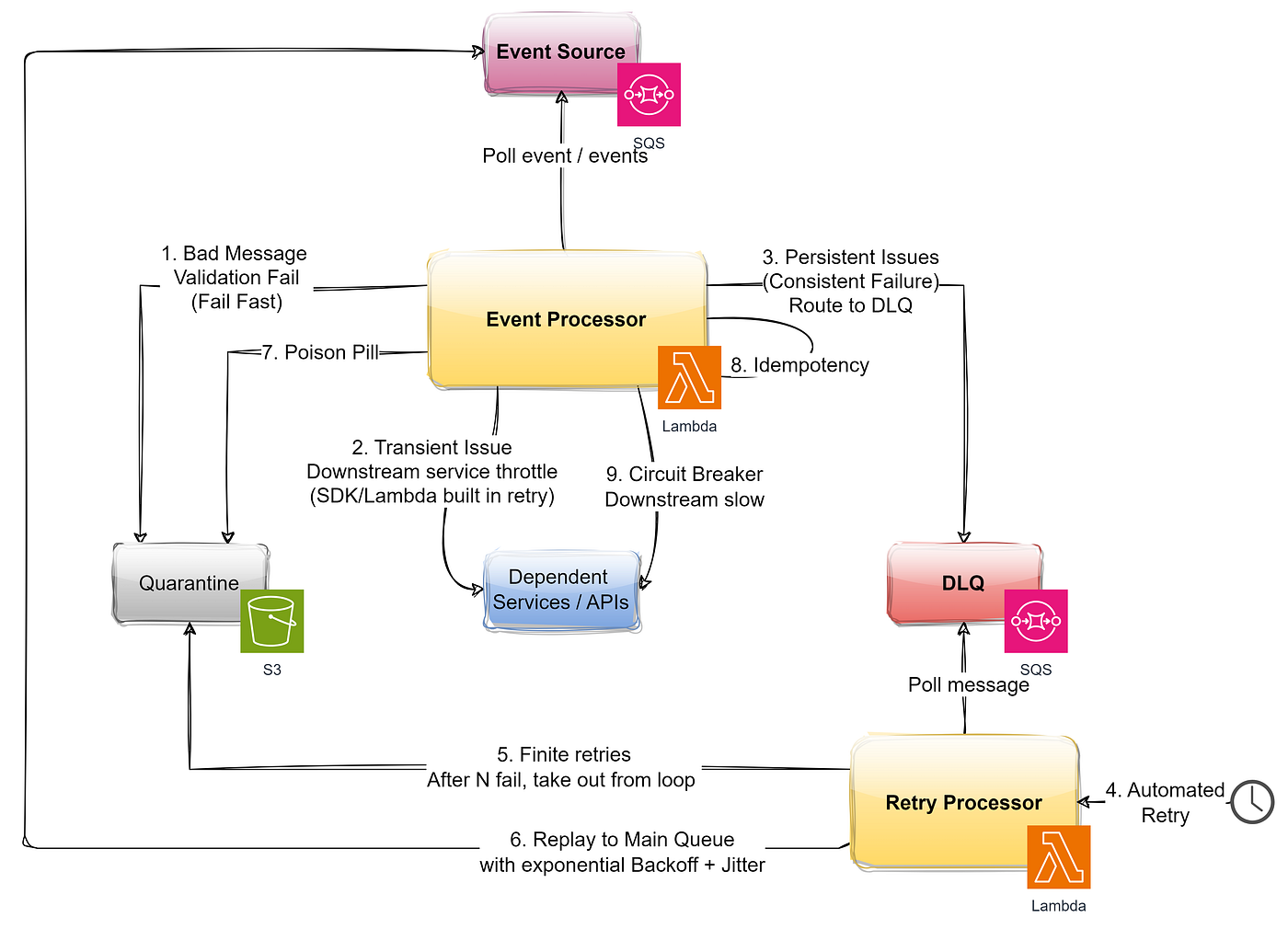
- Validate Early, Fail Fast: Bad data is a silent killer in event-driven architectures. A malformed message can cause multiple retries, flood the DLQ, slow down the pipeline, and eventually cause failures that look like infrastructure issues but are actually data quality issues. Consider schema validation (JSON Schema, OpenAPI, or EventBridge Schema Registry) ensures: Bad payloads fail fast, Good data flows through cleanly, DLQs get meaningful failures, not noise. Fast failure makes downstream recovery much simpler.
- Built-in Retries for Transient Issues: AWS Lambda and AWS SDKs come with automatic retries for transient issues — brief outages, throttling, or network blips. like throttling or network hiccups. This resolves a majority of issues — No custom code needed, and it works well as the first line of defence against unpredictable infrastructure behavior.
- Dead-Letter Queues (DLQs) for Persistent Failures — If a Lambda function fails consistently, messages are routed to a DLQ. This is non-negotiable. No messages are lost. Your Safety Net. You retain a full audit trail for later replay or investigation
- Automated DLQ Recovery: Instead of relying on someone manually checking DLQs once a week, schedule Lambda-backed processors to periodically inspect and requeue what’s recoverable into the main workflow. Ensures eventual consistency, even for edge-case failures. Prevents manual intervention from becoming a bottleneck. Can flag real “poison pills” (see below).
- Finite Retries: Limit your retries. Infinite loops amplify outages. Consider counting retry attempts for individual messages. After N failed attempts, take them out of the DLQ and if needed, store somewhere (eg, S3) for forensic review.
- Exponential Backoff with Jitter: This is essential. When problems are widespread — like downstream throttling — retrying immediately makes things worse. Backoff spreads retries out. Jitter randomises them. Together, they prevent retry storms and stabilise recovery.
- Poison-Pill Detection: Some failures are permanent. Some messages are simply toxic — no amount of retries will fix them. If a message fails N times within a short window, label it as a poison pill and isolate it immediately. Don’t let it slow down the pipeline.
- Idempotency by Design: Failures mean reprocessing. Idempotency ensures that even if a message is processed/retried multiple times, the outcome is the same. This prevents duplicate records. Teams can use DynamoDB conditional writes, idempotency keys, or a shared deduplication store. Rule of Thumb: Every event handler must be safe to retry.
- Circuit Breakers: Detect when the downstream is overloaded and pause message intake, then gradually ramp up. e.g. If DynamoDB or S3 has elevated throttling, a circuit breaker prevents Lambda from flooding it further. Instead of retrying endlessly, the system waits, then slowly ramps back up. This protects the entire ecosystem by stopping failure cascades.
- Adaptive Concurrency: Not all failures require halting the system. Sometimes you just need to slow it down. Adaptive concurrency adjusts Lambda parallelism or batch sizes based on system health. Less pressure during bad times. Full speed when things stabilise.
Closing Thoughts
Failing gracefully is one of the most important responsibilities of a modern cloud system. When events flow through dozens of Lambdas, queues, and downstream services, failures become routine — but system-wide outages don’t have to.
By layering these patterns — validation, automated retries, DLQs, finite retry limits, idempotency, circuit breaking, adaptive concurrency — you gain systems that absorb, isolate, safely and automatically recover from real-world failures.
Don’t make resilience an afterthought. Design it in. Resilience is not a feature — it’s an architectural capability. And this capability is now part of how we design, build, and operate every event-driven system. This is how we should move from well-architected in theory to robust in production, day after day.
메타데이터
- post_id
- 2d84ed04d749
- slug
- designing-resilient-event-driven-systems-on-aws-lessons-from-the-trenches-2d84ed04d749
- url
- https://medium.com/@aws-arch-brief/designing-resilient-event-driven-systems-on-aws-lessons-from-the-trenches-2d84ed04d749
- canonical_url
- https://medium.com/@aws-arch-brief/designing-resilient-event-driven-systems-on-aws-lessons-from-the-trenches-2d84ed04d749
- author_url
- https://medium.com/@aws-arch-brief
- status
- ok
- fetched_at
- 2026-06-11 05:11:55




