Claude Fable 5 Has Landed: A Builder’s Field Guide to Anthropic’s First Public Mythos-Class Model
On June 9, 2026, Anthropic made its most capable model generally available for the first time — but with an unusual safety mechanism bolted…
Claude Fable 5 Has Landed: A Builder’s Field Guide to Anthropic’s First Public Mythos-Class Model
On June 9, 2026, Anthropic made its most capable model generally available for the first time — but with an unusual safety mechanism bolted on. Here’s what shipped, what it can do, how to get it, and the one quirk every builder needs to understand before they start.
Anthropic just did something it said, only two months ago, it wasn’t sure it would do: it released a Mythos-class model to the public.
If you’ve been tracking Anthropic’s model tiers, that sentence should make you sit up. Mythos-class is a capability tier that sits above the Opus class — the most powerful family the company builds. The first Mythos-class model, Claude Mythos Preview, appeared in April 2026 and was deliberately locked away: available only to a small set of vetted cybersecurity and critical-infrastructure partners through a program called Project Glasswing, precisely because a model that good at finding software vulnerabilities is dangerous in the wrong hands.
Today that changes. Meet Claude Fable 5 — a Mythos-class model that Anthropic has made safe enough for everyone, and its restricted twin, Claude Mythos 5. This is a field guide to both: what they are, what Fable 5 can actually do, the clever safety trick that makes a public release possible, and exactly how to get your hands on it this week.
First, the Naming: Fable and Mythos adre the Same Model
This is the detail that trips people up, so let’s clear it immediately. Fable 5 and Mythos 5 are the same underlying model. The difference is entirely in the safeguards.
- Mythos 5 is the full, unrestricted model — the most capable thing Anthropic has, with the strongest cybersecurity capabilities of any model in the world. It stays locked to trusted partners through Project Glasswing (in collaboration with the US government), as an upgrade to the earlier Mythos Preview.
- Fable 5 is that same model with safety classifiers layered on top, making it safe for general public and developer use.
Anthropic even chose the names to signal the relationship: Fable comes from the Latin fabula — “that which is told” — which is cognate with the Greek mythos. Two names for one model, distinguished only by what they’re allowed to do.
The Clever Bit: How a “Too-Dangerous” Model Ships to Everyone
Here’s the mechanism that makes this launch possible, and it’s the single most important thing for any builder to understand before using Fable 5.
Fable 5 ships with a set of classifiers — separate AI systems that watch incoming requests for high-risk topics. When a request touches one of three sensitive areas, Fable 5 doesn’t refuse. Instead, the request quietly falls back to Claude Opus 4.8 — Anthropic’s next-most-capable model — which answers it instead. You’re told whenever this happens.
The three fallback areas are:
- Cybersecurity — offensive security, exploit development, vulnerability discovery, and broader agentic hacking. This is the big one: Mythos-class models are exceptional at finding and exploiting software flaws, so Fable blocks itself from making any progress on offensive cyber tasks.
- Biology and chemistry — dual-use scientific capability that could provide uplift to malicious actors. Anthropic tuned this one broadly and conservatively for now.
- Distillation — requests that look like attempts to extract Fable’s capabilities to train competing models.
Why this matters in practice: For the vast majority of work, you’re talking to the full Fable 5. Anthropic’s early data shows more than 95% of sessions never trigger a fallback at all — and for those, Fable 5 performs identically to the unrestricted Mythos 5. Fallbacks trigger, on average, in under 5% of sessions. The trade-off Anthropic chose openly: the safeguards are tuned cautiously, so they’ll occasionally catch harmless requests too. If you do security or life-sciences work, expect the odd false positive, and expect to be told when your answer came from Opus 4.8 instead.
This fallback design is genuinely novel. Rather than the usual binary — release a watered-down model, or don’t release at all — Anthropic shipped the full model and gated only the narrow slices of capability that are dangerous, routing those to a safer model. The diagram below shows the whole flow.
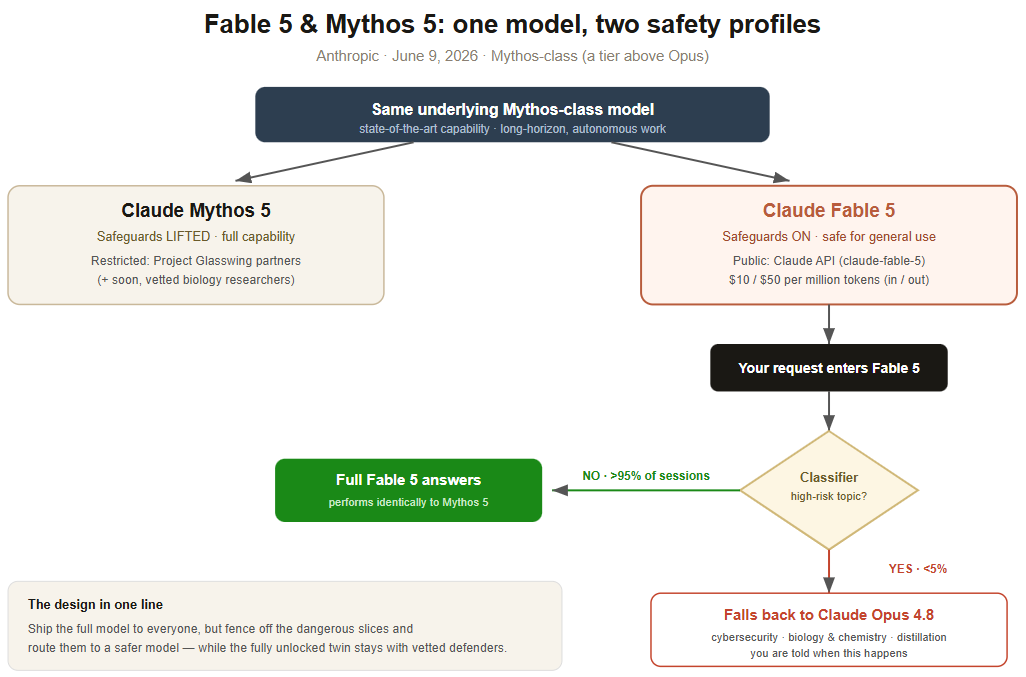
Fable 5 and Mythos — which does what
What Fable 5 can actually do
Anthropic’s headline claim is blunt: Fable 5’s capabilities exceed those of any model the company has ever made generally available, and it’s state-of-the-art on nearly every benchmark they tested. The pattern worth internalizing is this — the longer and more complex the task, the bigger Fable 5’s lead. This is a long-horizon, autonomous-work model first and foremost. A few concrete proof points:
Software engineering
During early access, Stripe reported that Fable 5 compressed months of engineering into days: in a 50-million-line Ruby codebase, it performed a codebase-wide migration in a single day that would otherwise have taken a team more than two months by hand. It’s also more token-efficient than previous Claude models, scoring highest among frontier models on Cognition’s FrontierCode evaluation even at medium effort. Early testers at Cursor, GitHub, and other developer-tool companies described it as a clear step up on long-horizon, agentic coding tasks.
Vision
Fable 5 is the new state of the art for vision tasks. It can pull precise numbers out of detailed scientific figures and rebuild a web app’s source code from screenshots alone. The charming proof point: earlier Claude models needed elaborate helper tooling to play Pokémon FireRed and still struggled — Fable 5 beat the game with a minimal, vision-only harness, working from raw screenshots with no maps or navigation aids.
Memory and long-context
It stays coherent across millions of tokens and improves its own work using notes it takes along the way. In one test using the deck-builder Slay the Spire, giving Fable persistent file-based memory boosted its performance three times more than the same memory helped Opus 4.8 — and it reached the game’s final act three times as often.
Knowledge work
It posts the highest score yet on Hebbia’s senior-level finance reasoning benchmark, with big gains in document reasoning and chart and table interpretation. Early enterprise testers in finance, law, and analytics reported it matching or beating their existing models in blind reviews.
And — through Mythos 5 — frontier science
The unrestricted Mythos 5 is where the most striking results show up. Anthropic’s internal protein-design experts reported roughly 10x acceleration on parts of the drug-design process, with the model autonomously choosing binding sites, running design tools, and recovering from failures. It’s also Anthropic’s first model to consistently generate novel scientific hypotheses that its own scientists rated higher than Opus-class output around 80% of the time — one of which was independently corroborated by an outside lab. In genomics, it ran over a week of largely autonomous research and trained a custom model that outperformed a recently published result, at one-hundredth the size.
These science results come from Mythos 5, not public Fable 5 — but they tell you what the underlying model is capable of when the biology safeguards are lifted for vetted researchers.
How to Get It — and the Deadline you should know about
This is the practical part, and there’s a time-sensitive catch worth acting on.
For developers: Fable 5 is available today through the Claude API as claude-fable-5, and on consumption-based Enterprise plans. Pricing is $10 per million input tokens and $50 per million output tokens — notably, less than half what Mythos Preview cost.
For subscription users: Here’s the catch. Anthropic expects demand to be high and hard to predict, so it’s rolling out to subscription plans in stages:
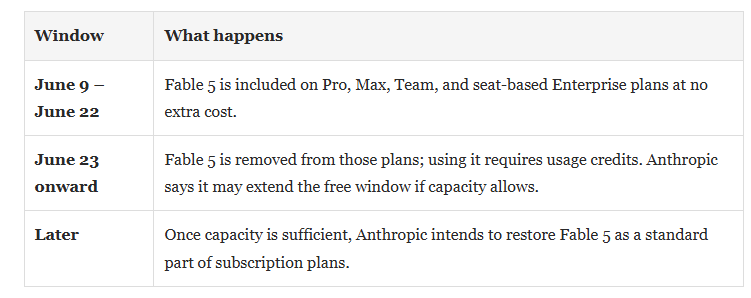
Anthropic Fable availability details
The actionable takeaway: If you’re on a Pro, Max, Team, or seat-based Enterprise plan, you have a roughly two-week window to put the most capable public Claude model through its paces at no extra cost. Use it. Run your hardest real tasks against it now — the long-horizon, multi-step work where it’s supposed to shine — so you know whether it’s worth paying for from June 23. Don’t waste the free fortnight on toy prompts.
Mythos 5, for the record, is not something you can buy. It’s restricted to Project Glasswing partners (with cyber safeguards lifted) and, soon, a small number of vetted biology researchers (with bio/chemistry safeguards lifted). Anthropic plans a more systematic trusted-access program over time.
The Enterprise Fine Print: A New Data-Retention Rule
If you’re deploying this in a regulated or security-conscious environment, read this carefully. For Mythos-class models — Fable 5, Mythos 5, and future models at this capability level — Anthropic is requiring 30-day data retention for all traffic, on both its own and third-party surfaces.
The stated purpose is safety: the data helps Anthropic detect novel attacks and jailbreak attempts that play out across many requests, and helps it identify and reduce false positives in the classifiers. Anthropic says it won’t use this data to train models or for any non-safety purpose, that it logs all human access, and that it deletes the data after 30 days in almost all cases. Still — if your organization has strict data-handling requirements, this retention policy is a procurement and compliance conversation you’ll want to have before you route sensitive workloads through Fable 5.
The Bigger Picture: Why the Safeguards are the real story
It would be easy to read this as just another “most powerful model ever” launch. It isn’t. The more interesting story is that Anthropic is treating its own model as something that needs to be contained even as it’s released.
The context makes that clear. Mythos Preview earned attention earlier this year for being unsettlingly good at finding security flaws across operating systems and browsers. Project Glasswing — the gated program through which Mythos has been deployed — now spans a long list of major infrastructure and security organizations across more than fifteen countries, specifically so trusted defenders can use the capability before attackers can. And this launch lands in the same window as Anthropic’s own public cautions about how fast frontier systems are advancing.
For those of us working in enterprise AI and application security, that framing is the part to sit with. The headline is a powerful new model. The substance is a working example of graduated release: ship the capability broadly, but fence off the dangerous slices and route them to a safer model, while keeping the fully unlocked version in the hands of vetted defenders only. Whatever you think of the specifics, that’s a meaningful template for how high-capability AI might be deployed responsibly — and worth studying regardless of which model you ultimately build on.
What to do this Week
A short, practical checklist if you want to act on this rather than just read about it:
- If you’re on a paid subscription, test Fable 5 before June 23. The free window is short. Throw your hardest long-horizon tasks at it — migrations, multi-step analysis, agentic coding — not trivial prompts.
- If you build on the API, budget for the price tier. At $10/$50 per million tokens, Fable 5 is a premium model. Reserve it for the genuinely hard work and route routine, high-volume tasks to cheaper models. (Match the model to the task — the same discipline that applies across the whole model spectrum.)
- Expect and plan for fallbacks. If your work touches security or life sciences, build for the reality that some responses will come from Opus 4.8 instead, and that you’ll be notified when they do.
- Raise the data-retention policy with whoever owns compliance before routing sensitive workloads through a Mythos-class model.
The arrival of a publicly available Mythos-class model is a real milestone — the most capable model Anthropic has ever opened up, available to anyone with an API key starting today. But the way it arrived, wrapped in fallback classifiers and a restricted twin, is the part that will shape how the rest of the industry thinks about releasing models this powerful. Worth paying attention to on both counts.
Sources
Primary: Anthropic, Claude Fable 5 and Claude Mythos 5 (anthropic.com/news/claude-fable-5-mythos-5) and the model’s system card. Corroborating coverage: Reuters, TechCrunch, CNBC, SecurityWeek, and IT Pro, all published June 9, 2026.
메타데이터
- post_id
- 2d8deb874369
- slug
- claude-fable-5-has-landed-a-builders-field-guide-to-anthropic-s-first-public-mythos-class-model-2d8deb874369
- url
- https://medium.com/@ravisat/claude-fable-5-has-landed-a-builders-field-guide-to-anthropic-s-first-public-mythos-class-model-2d8deb874369
- canonical_url
- https://medium.com/@ravisat/claude-fable-5-has-landed-a-builders-field-guide-to-anthropic-s-first-public-mythos-class-model-2d8deb874369
- author_url
- https://medium.com/@ravisat
- status
- ok
- fetched_at
- 2026-06-15 20:49:13